Fiscal policy · 财政政策
| English | 中文 | Pinyin · 拼音 |
|---|---|---|
| fiscal policy/ˈfɪskl ˈpɒlɪsi/ | 财政政策 | cái zhèng zhèng cè |
| budget deficit/ˈbʌdʒɪt ˈdefɪsɪt/ | 预算赤字 | yù suàn chì zì |
| budget surplus/ˈbʌdʒɪt ˈsɜːpləs/ | 预算盈余 | yù suàn yíng yú |
| expansionary/ekˈspænʃənəri/ | 扩张性 | kuò zhāng xìng |
| contractionary/kənˈtrækʃənəri/ | 紧缩性 | jǐn suō xìng |
| multiplier/ˌmʌltɪˈplaɪə/ | 乘数 | chéng shù |
| marginal propensity to consume/ˈmɑːdʒɪnl prəˈpensɪti tə kənˈsjuːm/ | 边际消费倾向 | biān jì xiāo fèi qīng xiàng |
| crowd out/kraʊd aʊt/ | 挤出 | jǐ chū |
Spending and taxing to steer the economy
- When a recession hits, governments can spend more and tax less to revive demand. That's fiscal policy 财政政策 — the budget as a lever.
- It works through government spending (G) and taxation (T), two big slices of aggregate demand.
通过支出和征税来引导经济
- 当衰退来袭时,政府能支出更多、征税更少以重振需求。那是财政政策(fiscal policy)——预算作为一根杠杆。
- 它通过**政府支出(G)和税收(T)**起作用,这是总需求的两大切片。
The government budget
- A budget deficit 预算赤字 = spending exceeds tax revenue (the government borrows).
- A budget surplus 预算盈余 = tax revenue exceeds spending.
- Expansionary 扩张性 fiscal policy (more G, lower T) boosts AD; contractionary 紧缩性 (less G, higher T) restrains it.
Expansionary fiscal policy (higher G or lower T) shifts AD right, raising real GDP — and, along an upward AS, the price level.
政府预算
- 一个预算赤字(budget deficit)= 支出超过税收收入(政府借款)。
- 一个预算盈余(budget surplus)= 税收收入超过支出。
- 扩张性(expansionary)财政政策(更多 G、更低 T)提振 AD;紧缩性(contractionary,更少 G、更高 T)抑制它。
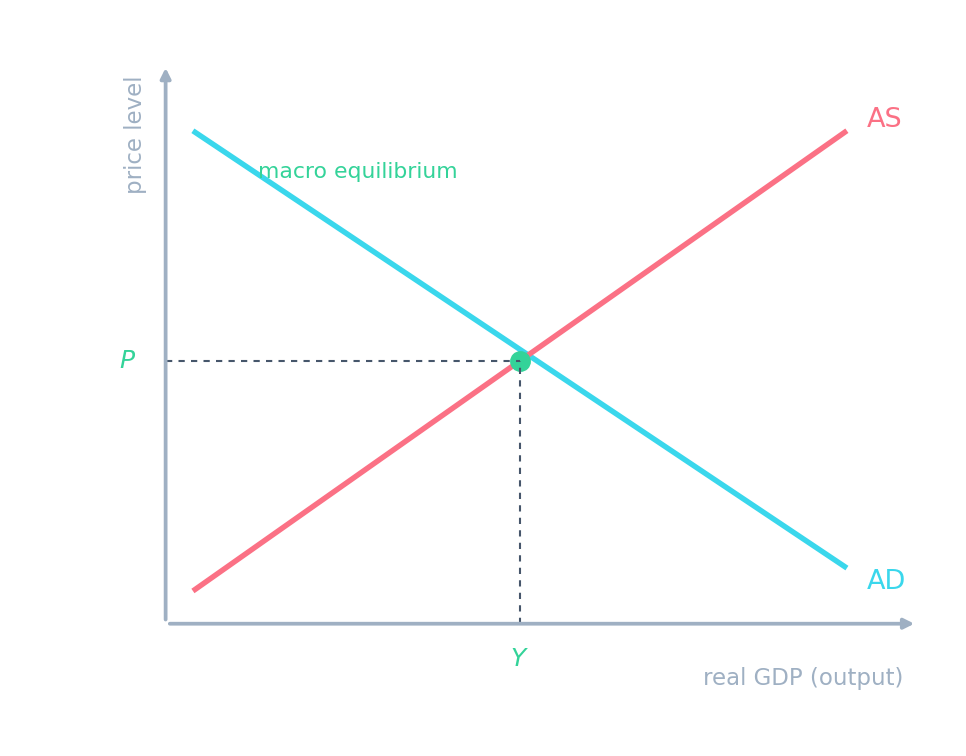
扩张性财政政策(更高的 G 或更低的 T)把 AD 右移,提高实际 GDP——并且,沿一条向上的 AS,提高价格水平。
Fiscal policy shifts AD · 财政政策移动 AD
Government spending and taxes move aggregate demand (AD). Drag AD to see real output and the price level change. · 政府支出和税收移动总需求(AD)。拖动 AD 看实际产出和价格水平变化。
A budget deficit occurs when: · 一个预算赤字发生在:
Spending > revenue → the government borrows → a deficit. · 支出 > 收入 → 政府借款 → 一个赤字。
Expansionary fiscal policy involves: · 扩张性财政政策涉及:
More G and/or lower T raises AD — that's expansionary fiscal policy. · 更多 G 和/或更低 T 提高 AD——那是扩张性财政政策。
The multiplier 乘数
- A change in spending has a multiplied effect: the initial spend becomes someone's income, which they re-spend, and so on.
- where MPC is the marginal propensity to consume 边际消费倾向.
Worked example. If MPC = 0.8, the multiplier $= \dfrac{1}{1 - 0.8} = \dfrac{1}{0.2} = 5$ — £1bn of spending raises GDP by £5bn.
Expansionary policy shifts AD right, raising output and prices
乘数
- 支出的一个变化有一个被乘大的效果:最初的支出变成某人的收入,他们再次花掉它,如此循环。
- 其中 MPC 是边际消费倾向。
例题。 如果 MPC = 0.8,乘数 $= \dfrac{1}{1 - 0.8} = \dfrac{1}{0.2} = 5$——10 亿英镑的支出把 GDP 提高 50 亿英镑。
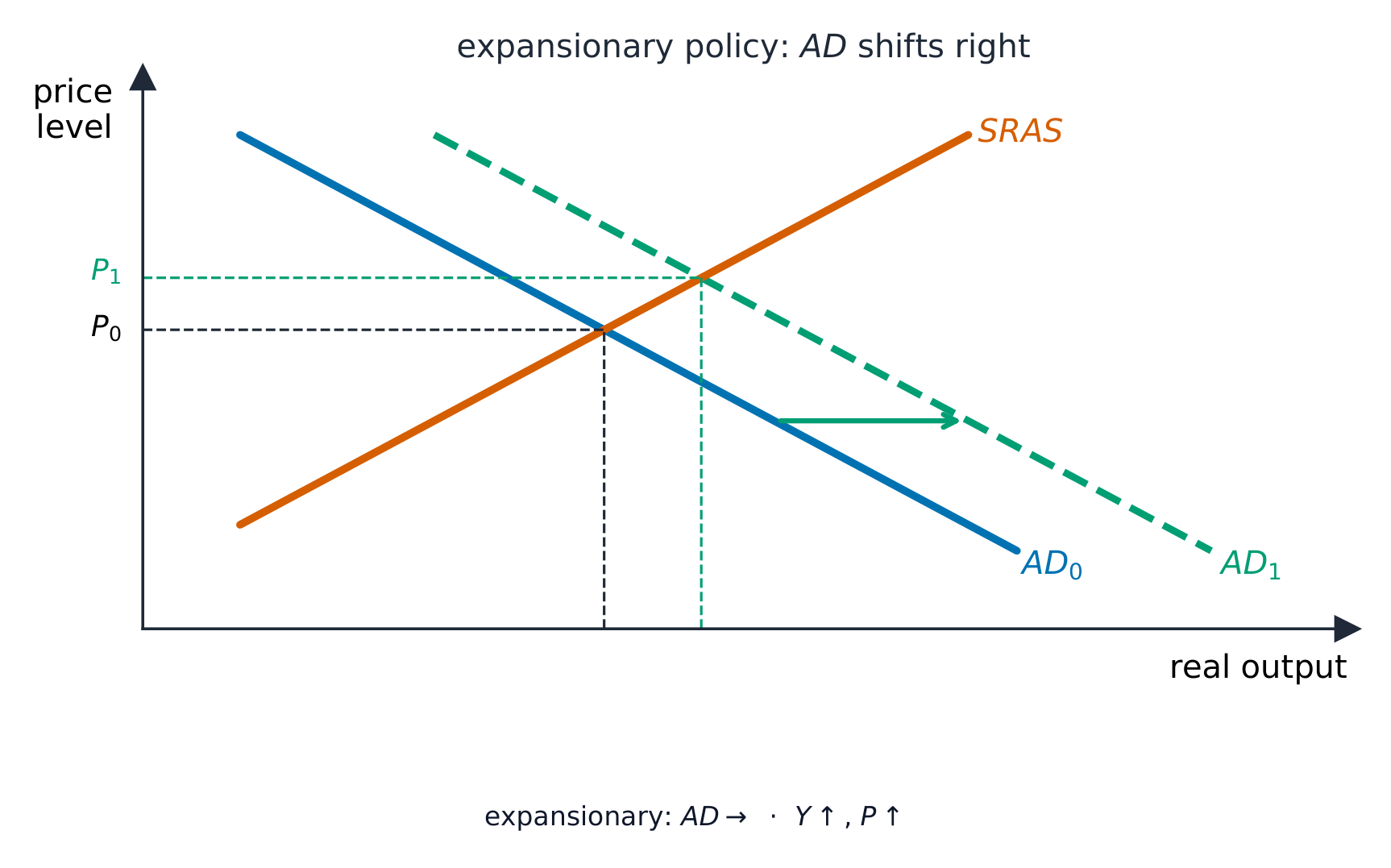
扩张性政策把 AD 右移,提高产出和价格
The fiscal multiplier, round by round · 一轮一轮看财政乘数
Set the MPC to 0.8 like the worked example — each spending round is MPC times the last, and the total settles at k × the injection. · 像例题一样把 MPC 设为 0.8 — 每一轮支出都是上一轮的 MPC 倍,总量收敛于 k × 注入额。
If the marginal propensity to consume (MPC) is 0.8, what is the multiplier = 1/(1 − MPC)? · 如果边际消费倾向(MPC)是 0.8,乘数 = 1/(1 − MPC) 是多少?
1 / (1 − 0.8) = 1 / 0.2 = 5. · 1 / (1 − 0.8) = 1 / 0.2 = 5。
The multiplier equals 1 divided by (1 − ______). · 乘数等于 1 除以 (1 − ______)。
Multiplier = 1/(1 − MPC). · 乘数 = 1/(1 − MPC)。
Drawbacks
- Deficits add to government debt; time lags delay the effect; and big spending can crowd out 挤出 private investment.
弊端
- 赤字增加政府债务;时间滞后延迟效果;大额支出能挤出私人投资。
Heavy government borrowing can crowd out private investment. · 沉重的政府借款能挤出私人投资。
Government borrowing can raise interest rates and reduce private investment — crowding out. · 政府借款能提高利率并减少私人投资——挤出。
You've got it
- fiscal policy = government spending and taxation; deficit = spend > tax
- expansionary (more G, less T) shifts AD right; contractionary restrains AD
- the multiplier $= \dfrac{1}{1 - MPC}$ magnifies a change in spending
你掌握了
- 财政政策 = 政府支出和税收;赤字 = 支出 > 税收
- 扩张性(更多 G、更少 T)把 AD 右移;紧缩性抑制 AD
- 乘数 $= \dfrac{1}{1 - MPC}$ 放大支出的一个变化