Economic growth · 经济增长
| English | 中文 | Pinyin · 拼音 |
|---|---|---|
| business cycle/ˈbɪznəs ˈsaɪkl/ | 经济周期 | jīng jì zhōu qī |
| potential growth/pəˈtenʃl ɡrəʊθ/ | 潜在增长 | qián zài zēng zhǎng |
| actual growth/ˈæktʃuːəl ɡrəʊθ/ | 实际增长 | shí jì zēng zhǎng |
| recession/rɪˈseʃn/ | 衰退 | shuāi tuì |
| recovery/rɪˈkʌvəri/ | 复苏 | fù sū |
| human capital/ˈhjuːmən ˈkæpɪtl/ | 人力资本 | rén lì zī běn |
Why economies boom and bust
- No economy grows in a smooth line — it surges, overheats, slumps, and recovers, again and again.
- Understanding the business cycle 经济周期 and what drives growth is the heart of macro policy.
为什么经济繁荣与萧条
- 没有经济沿一条平滑的线增长——它激增、过热、衰退、复苏,一次又一次。
- 理解商业周期(business cycle)和驱动增长的因素是宏观政策的核心。
Potential growth is best shown on a PPF as: · 潜在增长在一条 PPF 上最好显示为:
Potential (capacity) growth shifts the whole PPF out; actual growth can be a move toward/along it. · 潜在(产能)增长把整条 PPF 向外移动;实际增长能是一个朝向/沿着它的移动。
Actual vs potential growth 潜在增长
- Actual growth 实际增长 = the real rise in GDP this year (moving toward, or along, the PPF).
- Potential growth = the rise in the economy's capacity (the PPF shifting out) — from more or better resources and technology.
实际增长对潜在增长
- 实际增长(actual growth)= 今年 GDP 的真实上升(朝向 PPF,或沿着它移动)。
- 潜在增长(potential growth)= 经济产能的上升(PPF 向外移动)——来自更多或更好的资源和技术。
Economic growth shifts the frontier out · 经济增长把边界向外移动
Growth means the economy can produce more of BOTH goods — the whole frontier moves outward as resources or technology improve. · 增长意味着经济能生产更多的两种商品——随着资源或技术改善,整条边界向外移动。
A recession is conventionally two consecutive quarters of falling real GDP. · 一次衰退按惯例是实际 GDP 连续两个季度下降。
Two quarters of negative real GDP growth is the common definition. · 两个季度的负实际 GDP 增长是常见的定义。
Put the phases of the business cycle in order, starting from the peak. · 把商业周期的各阶段按顺序排列,从顶峰开始。
The cycle runs boom → slowdown → recession → recovery, then back to boom. · 周期运行繁荣 → 放缓 → 衰退 → 复苏,然后回到繁荣。
The business cycle
- Real GDP cycles around its long-run trend: boom → slowdown → recession 衰退 → recovery 复苏.
- A recession is conventionally two consecutive quarters of falling real GDP.
Real GDP swings above and below its long-run trend — booms and recessions.
Worked example. GDP rises from 500bn to 520bn in a year. Growth rate = (20 ÷ 500) × 100 = 4%.
商业周期
- 实际 GDP 围绕其长期趋势循环:繁荣(boom)→ 放缓 → 衰退(recession)→ 复苏。
- 一次衰退按惯例是实际 GDP 连续两个季度下降。
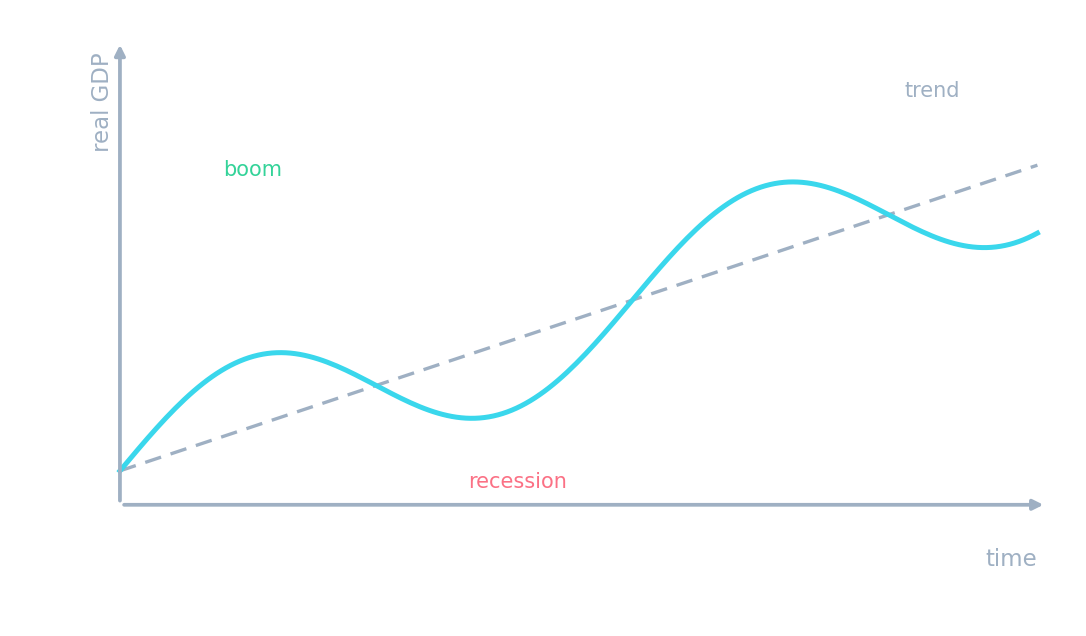
实际 GDP 在其长期趋势之上和之下摆动——繁荣和衰退。
例题。 GDP 在一年内从 5000 亿上升到 5200 亿。增长率 =(20 ÷ 500)× 100 = 4%。
GDP rises from 500bn to 520bn in a year. What is the growth rate (%)? · GDP 在一年内从 5000 亿上升到 5200 亿。增长率(%)是多少?
(20 / 500) × 100 = 4%. · (20 / 500) × 100 = 4%。
Causes and costs
- Causes of growth: investment, technology, education (human capital 人力资本), more labour.
- Benefits: higher incomes, more jobs, better public services. Costs: inflation risk, inequality, environmental damage, resource depletion.
原因与成本
- 增长的原因:投资、技术、教育(人力资本)、更多劳动。
- 利益:更高的收入、更多的工作、更好的公共服务。成本:通货膨胀风险、不平等、环境破坏、资源枯竭。
Spending by firms on capital goods, which raises future capacity, is called . · 企业在资本品上的支出,它提高未来产能,被称为。
Investment is a key driver of both actual and potential growth. · 投资是实际增长和潜在增长两者的一个关键驱动因素。
You've got it
- actual growth = real GDP rise; potential growth = capacity rise (PPF shifts out)
- the business cycle: boom → slowdown → recession → recovery, around a rising trend
- growth comes from investment, technology, human capital; it has benefits and costs
你掌握了
- 实际增长 = 实际 GDP 上升;潜在增长 = 产能上升(PPF 向外移动)
- 商业周期:繁荣 → 放缓 → 衰退 → 复苏,围绕一条上升的趋势
- 增长来自投资、技术、人力资本;它有利益也有成本