Aggregate Demand and Aggregate Supply · 总需求与总供给
| English | 中文 | Pinyin · 拼音 |
|---|---|---|
| price level/praɪs ˈlevl/ | 价格水平 | jià gé shuǐ píng |
| aggregate demand/ˈæɡrɪɡeɪt dɪˈmænd/ | 总需求 | zǒng xū qiú |
| aggregate supply/ˈæɡrɪɡeɪt səˈplaɪ/ | 总供给 | zǒng gōng jǐ |
| consumption/kənˈsʌmpʃn/ | 消费 | xiāo fèi |
| investment/ɪnˈvestmənt/ | 投资 | tóu zī |
| government spending/ˈɡʌvənmənt ˈspendɪŋ/ | 政府支出 | zhèng fǔ zhī chū |
| net exports/net ˈekspɔːts/ | 净出口 | jìng chū kǒu |
The supply and demand of a whole economy
- Zoom out from one market to the entire economy, and the same logic scales up: total demand and total supply set the overall price level 价格水平 and output.
- Aggregate demand 总需求 (AD) and aggregate supply 总供给 (AS) are the master diagram of macroeconomics.
整个经济的供给与需求
- 从一个市场放大到整个经济,同样的逻辑放大:总需求和总供给决定整体的价格水平和产出。
- 总需求(aggregate demand,AD)和总供给(aggregate supply,AS)是宏观经济学的主图。
Aggregate demand
- AD is total planned spending in the economy:
- C consumption 消费, I investment 投资, G government spending 政府支出, (X − M) net exports 净出口. The AD curve slopes down against the price level.
Real GDP swinging around its long-run trend
总需求
- AD 是经济中总的计划支出:
- C 消费,I 投资,G 政府支出,(X − M) 净出口。AD 曲线对价格水平向下倾斜。
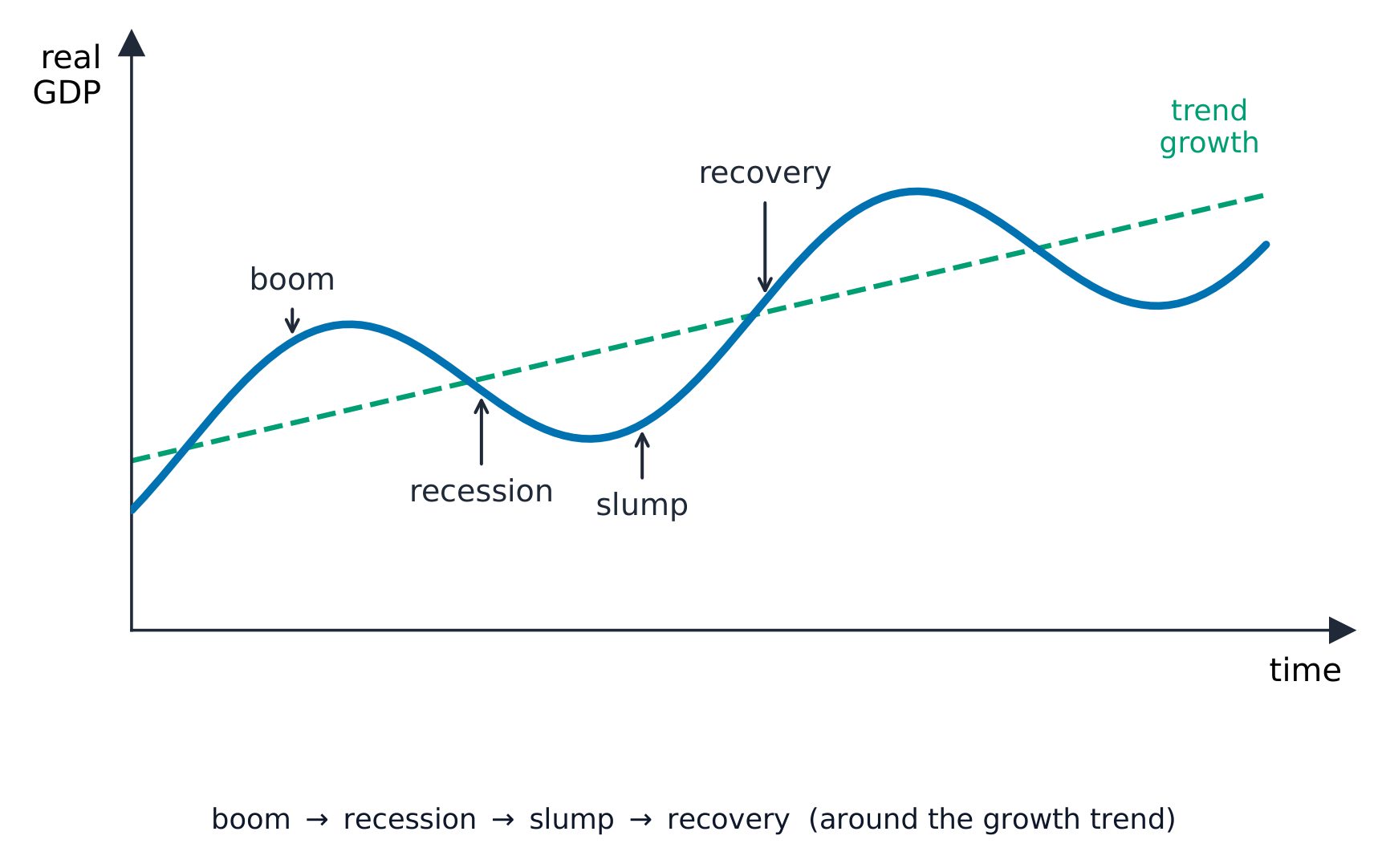
实际 GDP 围绕其长期趋势摆动
Aggregate demand & supply · 总需求与总供给
AD and AS cross at the price level and national output. · AD 和 AS 在价格水平和国民产出处相交。
If C = 600, I = 200, G = 300, X = 150, M = 100, what is AD = C + I + G + (X − M)? · 如果 C = 600,I = 200,G = 300,X = 150,M = 100,AD = C + I + G + (X − M) 是多少?
600 + 200 + 300 + (150 − 100) = 1100 + 50 = 1150. · 600 + 200 + 300 + (150 − 100) = 1100 + 50 = 1150。
Which is NOT a component of aggregate demand? · 哪个不是总需求的一个组成部分?
AD = C + I + G + (X − M); saving is a withdrawal, not a component of AD. · AD = C + I + G + (X − M);储蓄是一个抽出,不是 AD 的一个组成部分。
In AD = C + I + G + (X − M), the term (X − M) is called net . · 在 AD = C + I + G + (X − M) 中,项 (X − M) 被称为净。
Exports minus imports = net exports. · 出口减进口 = 净出口。
Aggregate supply and equilibrium
- AS is total planned output; it slopes up (higher prices reward more production).
- Where AD meets AS sets the equilibrium price level and real GDP.
AD and AS cross to set the economy's price level (P) and real output (Y).
Worked example. If C = 600, I = 200, G = 300, X = 150 and M = 100, then AD = 600 + 200 + 300 + (150 − 100) = 1150.
总供给与均衡
- AS 是总的计划产出;它向上倾斜(更高的价格奖励更多生产)。
- AD 与 AS 相遇之处决定均衡价格水平和实际 GDP。
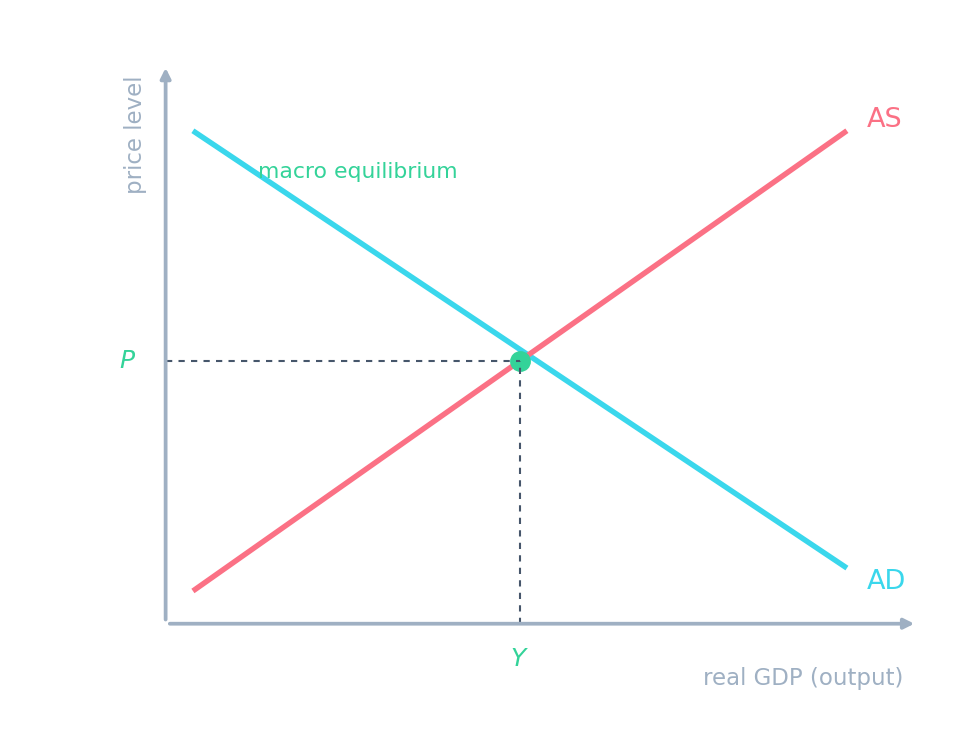
AD 和 AS 相交以决定经济的价格水平(P)和实际产出(Y)。
例题。 如果 C = 600,I = 200,G = 300,X = 150 且 M = 100,那么 AD = 600 + 200 + 300 + (150 − 100) = 1150。
The equilibrium price level and real output are set where AD meets AS. · 均衡价格水平和实际产出在 AD 与 AS 相遇处决定。
Their intersection determines the macro equilibrium. · 它们的交点决定宏观均衡。
Shifts
- AD shifts with confidence, interest rates, government policy, or the exchange rate.
- A rightward AD shift raises both output and the price level (if AS slopes up).
Demand-pull and cost-push inflation on the AD-AS diagram
移动
- AD 随信心、利率、政府政策或汇率而移动。
- 一个向右的 AD 移动同时提高产出和价格水平(如果 AS 向上倾斜)。

AD-AS 图上的需求拉动和成本推动通货膨胀
A rise in consumer confidence shifts AD right, which (with an upward AS) raises: · 消费者信心的上升把 AD 右移,这(在一条向上的 AS 下)提高:
A rightward AD shift along an upward AS raises real GDP and the price level. · 一个沿向上 AS 的向右 AD 移动提高实际 GDP 和价格水平。
You've got it
- AD $= C + I + G + (X - M)$, slopes down; AS slopes up
- they cross to set the equilibrium price level and real GDP
- a rightward AD shift raises output and the price level
你掌握了
- AD $= C + I + G + (X - M)$,向下倾斜;AS 向上倾斜
- 它们相交以决定均衡价格水平和实际 GDP
- 一个向右的 AD 移动提高产出和价格水平