The circular flow of income · 收入的循环流转
| English | 中文 | Pinyin · 拼音 |
|---|---|---|
| firms/fɜːmz/ | 企业 | qǐ yè |
| circular flow of income/ˈsɜːkjʊlə fləʊ ɒv ˈɪŋkʌm/ | 收入循环流 | shōu rù xún huán liú |
| households/ˈhaʊshəʊldz/ | 家庭 | jiā tíng |
| injections/ɪnˈdʒekʃnz/ | 注入 | zhù rù |
| withdrawals/wɪθˈdrɔːlz/ | 漏出 | lòu chū |
| savings/ˈseɪvɪŋz/ | 储蓄 | chǔ xù |
| investment/ɪnˈvestmənt/ | 投资 | tóu zī |
The economy as a loop
- Your wages come from a firm; you spend them at firms 企业; those firms pay wages again. Money goes round and round.
- The circular flow of income 收入循环流 captures this loop — and shows what makes an economy grow or shrink.
作为一个循环的经济
- 你的工资来自一家企业;你在企业花掉它们;那些企业再次支付工资。钱转来转去。
- 收入的循环流转(circular flow of income)抓住这个循环——并显示是什么让一个经济增长或收缩。
Households 家庭 and firms
- Households supply factors of production and receive income; they spend it on goods.
- Firms produce goods and pay households' incomes. Spending and income chase each other around the loop.
Spending flows from households to firms; income flows back — the basic two-sector circular flow.
家庭与企业
- 家庭(households)供给生产要素并收到收入;他们把它花在商品上。
- 企业(firms)生产商品并支付家庭的收入。支出和收入沿循环互相追逐。
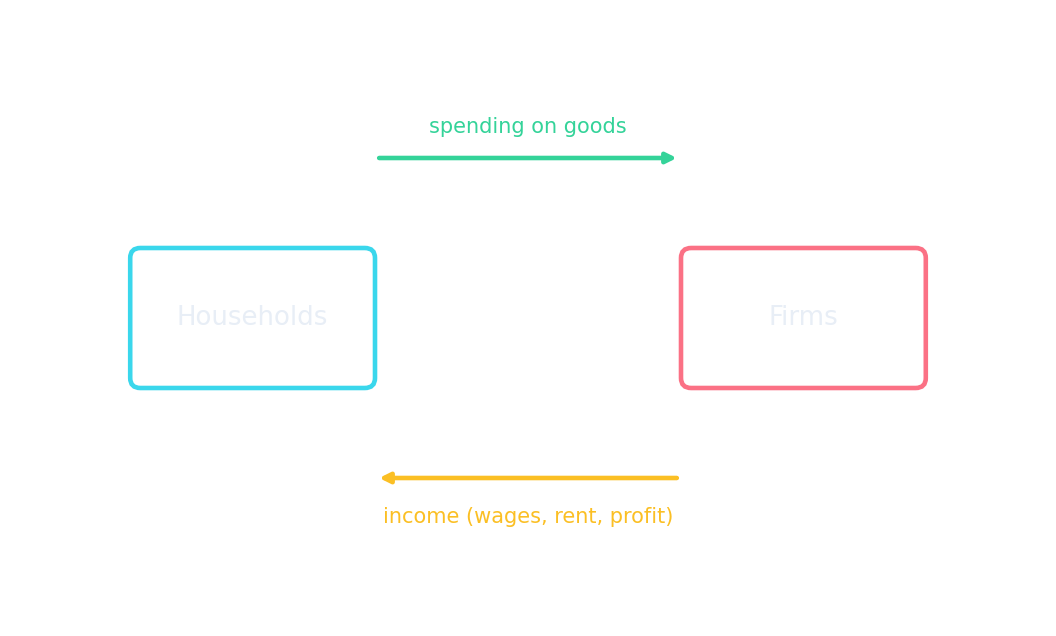
支出从家庭流向企业;收入流回——基本的两部门循环流转。
Injections & leakages · 注入与漏出
Money loops between households and firms. Injections grow national income, leakages shrink it; they are equal at equilibrium. · 钱在家庭和企业之间循环。注入使国民收入增长,漏出使其缩小;在均衡时两者相等。
The circular flow of income · 收入的循环流转
Money flows in a loop: households earn income from firms, then spend it back on the firms' goods. Step round the cycle. · 钱在一个循环中流动:家庭从企业赚得收入,然后把它花回到企业的商品上。绕这个循环走一步。
Injections 注入 and withdrawals 漏出
- Withdrawals (leakages) take money out of the loop: savings 储蓄 (S), taxes (T), imports (M).
- Injections add money in: investment 投资 (I), government spending (G), exports (X).
The circular flow of income with leakages and injections
注入与抽出
- 抽出(withdrawals,漏出)把钱带出循环:储蓄(S)、税收(T)、进口(M)。
- 注入(injections)把钱加入:投资(I)、政府支出(G)、出口(X)。

带漏出和注入的收入循环流转
Which is an injection into the circular flow? · 哪个是对循环流转的一个注入?
Injections are investment, government spending and exports; the others are withdrawals. · 注入是投资、政府支出和出口;其他的是抽出。
Classify each flow. · 给每个流动分类。
Withdrawals (S, T, M) leak out; injections (I, G, X) add in. · 抽出(S、T、M)漏出;注入(I、G、X)加入。
Savings, taxes and imports are the three ______ from the circular flow. · 储蓄、税收和进口是循环流转的三个______。
They leak money out of the flow. · 它们把钱从流动中漏出。
Equilibrium
- National income is in equilibrium when injections = withdrawals (S + T + M = I + G + X).
- If injections exceed withdrawals, income grows; if withdrawals exceed injections, it shrinks.
Saving is a withdrawal, not a boost. It may feel virtuous, but money saved leaves the circular flow — it only returns if it's borrowed and invested (an injection).
均衡
- 当注入 = 抽出(S + T + M = I + G + X)时,国民收入处于均衡。
- 如果注入超过抽出,收入增长;如果抽出超过注入,它收缩。
储蓄是一个抽出,不是一个提振。 它可能感觉有美德,但储蓄的钱离开循环流转——只有它被借出并投资(一个注入)时它才返回。
National income is in equilibrium when injections equal withdrawals. · 当注入等于抽出时,国民收入处于均衡。
When I + G + X = S + T + M, income is stable. · 当 I + G + X = S + T + M 时,收入稳定。
If injections exceed withdrawals, national income will: · 如果注入超过抽出,国民收入将:
More money enters the loop than leaves, so income rises. · 进入循环的钱比离开的多,所以收入上升。
You've got it
- the circular flow: households' spending → firms → income → households
- withdrawals (S, T, M) leak out; injections (I, G, X) add in
- equilibrium when injections = withdrawals; injections > withdrawals → income grows
你掌握了
- 循环流转:家庭的支出 → 企业 → 收入 → 家庭
- 抽出(S、T、M)漏出;注入(I、G、X)加入
- 当注入 = 抽出时均衡;注入 > 抽出 → 收入增长