Price controls, regulation and government failure · 价格管制、监管与政府失灵
| English | 中文 | Pinyin · 拼音 |
|---|---|---|
| shortage/ˈʃɔːtɪdʒ/ | 短缺 | duǎn quē |
| surplus/ˈsɜːpləs/ | 过剩 | guò shèng |
| price ceiling/praɪs ˈsiːlɪŋ/ | 价格上限 | jià gé shàng xiàn |
| price floor/praɪs flɔː/ | 价格下限 | jià gé xià xiàn |
| government failure/ˈɡʌvənmənt ˈfeɪlɪə/ | 政府失灵 | zhèng fǔ shī líng |
| unintended consequences/ˌʌnɪnˈtendɪd ˈkɒnsɪkwənsɪz/ | 意外后果 | yì wài hòu guǒ |
When the government sets the price
- Rent caps to help tenants, minimum wages to help workers — governments sometimes override the market price directly.
- But forcing price away from equilibrium always creates a shortage 短缺 or a surplus 过剩.
当政府定价时
- 为帮助租户的租金上限,为帮助工人的最低工资——政府有时直接覆盖市场价格。
- 但强迫价格偏离均衡总是造成一个短缺或一个过剩。
A maximum price (price ceiling) set below equilibrium causes a: · 一个定在均衡之下的最高价格(价格上限)造成一个:
Below equilibrium, demand exceeds supply → a persistent shortage. · 在均衡之下,需求超过供给 → 一个持续的短缺。
A price ceiling is a legal ______ price (it binds when set below equilibrium). · 一个价格上限是一个法定的______价格(当定在均衡之下时它生效)。
A ceiling is a maximum; a floor is a minimum. · 上限是一个最高值;下限是一个最低值。
Maximum price (price ceiling 价格上限)
- A price ceiling set below equilibrium (e.g. rent control) makes the good cheaper — but demand now exceeds supply.
- The result is a persistent shortage (and often queues or black markets).
A ceiling below equilibrium: quantity demanded exceeds quantity supplied — a shortage.
最高价格(价格上限)
- 一个定在均衡之下的价格上限(price ceiling,例如租金管制)使商品更便宜——但需求现在超过供给。
- 结果是一个持续的短缺(且常常有排队或黑市)。

一个均衡之下的上限:需求量超过供给量——一个短缺。
Price controls · 价格管制
A price set away from equilibrium causes a shortage or a surplus. · 一个定在偏离均衡的价格造成一个短缺或一个过剩。
A minimum wage (a price floor in the labour market) set above equilibrium can cause: · 一个定在均衡之上的最低工资(劳动市场中的价格下限)能造成:
Above equilibrium, supply exceeds demand → a surplus, i.e. unemployment. · 在均衡之上,供给超过需求 → 一个过剩,即失业。
Match each control to its result. · 把每项管制与它的结果配对。
A binding ceiling creates excess demand; a binding floor creates excess supply. · 一个生效的上限造成过度需求;一个生效的下限造成过度供给。
Minimum price (price floor 价格下限)
- A price floor set above equilibrium (e.g. a minimum wage, or farm price support) raises the price — but supply now exceeds demand.
- The result is a surplus (e.g. unemployment in a labour market, or unsold food).
A maximum price causes a shortage; a minimum price causes a surplus
最低价格(价格下限)
- 一个定在均衡之上的价格下限(price floor,例如最低工资,或农产品价格支持)提高价格——但供给现在超过需求。
- 结果是一个过剩(例如劳动市场中的失业,或卖不出的食品)。
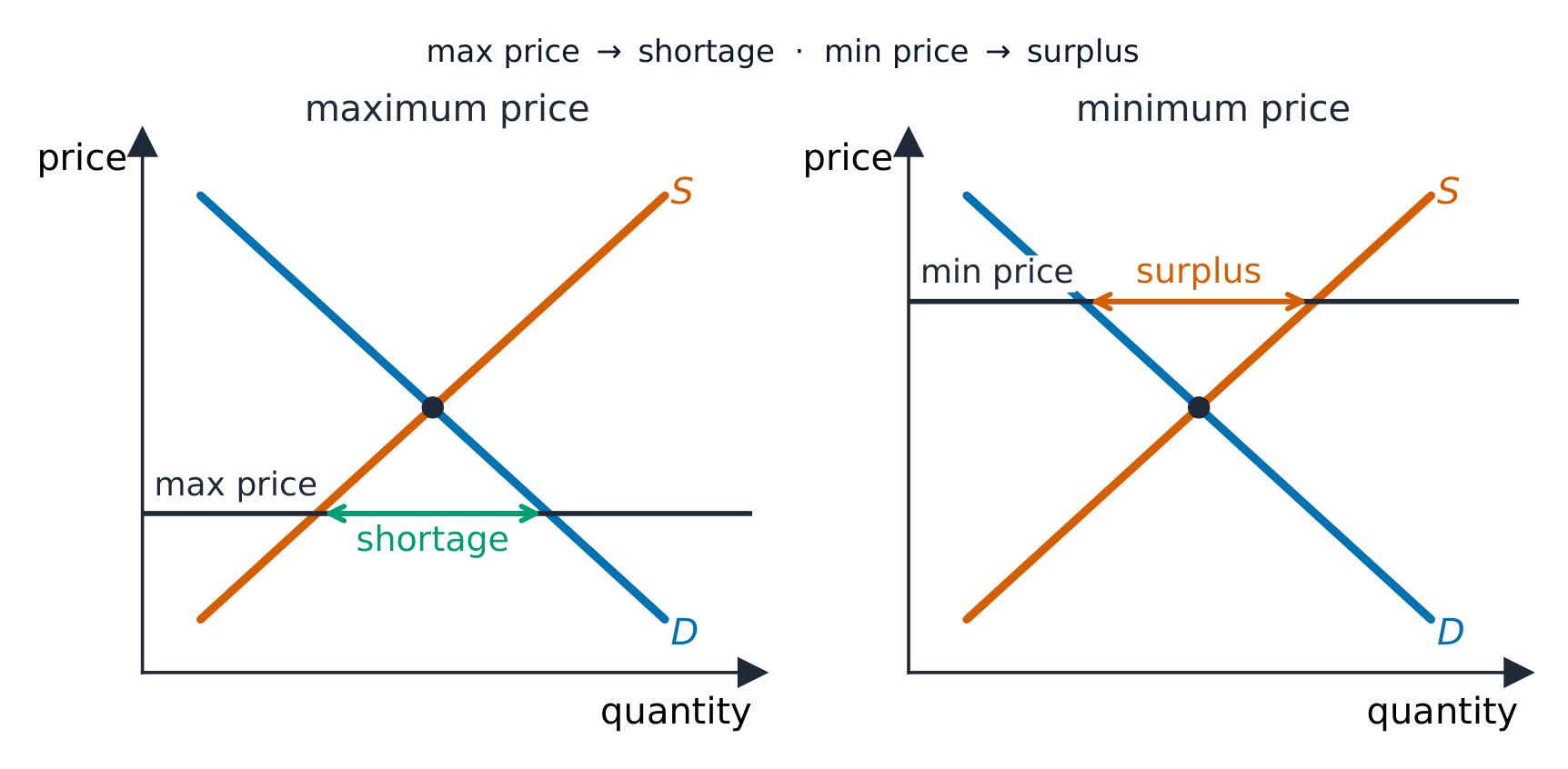
一个最高价格造成短缺;一个最低价格造成过剩
Government failure occurs when intervention creates unintended consequences that worsen welfare. · 当介入造成恶化福利的意外后果时,政府失灵发生。
E.g. rent caps can reduce the supply of housing over time. · 例如租金上限能随时间减少住房的供给。
Government failure 政府失灵
- Intervention can make things worse — government failure — through:
- unintended consequences 意外后果 (rent caps → fewer flats built), information gaps, and administrative costs.
Ceiling = shortage, floor = surplus. A ceiling is a maximum (binds below equilibrium → shortage); a floor is a minimum (binds above → surplus). Don't swap them.
政府失灵
- 介入能让事情更糟——政府失灵(government failure)——通过:
- 意外后果(unintended consequences,租金上限 → 建的公寓更少)、信息差距和行政成本。
上限 = 短缺,下限 = 过剩。 一个上限是一个最高值(在均衡之下生效 → 短缺);一个下限是一个最低值(在之上生效 → 过剩)。别把它们调换。
You've got it
- price ceiling (max, below equilibrium) → shortage; price floor (min, above) → surplus
- both move the market away from equilibrium, creating excess demand or supply
- government failure: intervention with unintended consequences can worsen welfare
你掌握了
- 价格上限(最高,均衡之下)→ 短缺;价格下限(最低,之上)→ 过剩
- 两者都把市场推离均衡,造成过度需求或过度供给
- 政府失灵:带意外后果的介入能恶化福利