Other reasons for intervention · 介入的其他理由
| English | 中文 | Pinyin · 拼音 |
|---|---|---|
| public good/ˈpʌblɪk ɡʊd/ | 公共物品 | gōng gòng wù pǐn |
| non-rival/nɒn ˈraɪvl/ | 非竞争性 | fēi jìng zhēng xìng |
| non-excludable/nɒn eksˈkluːdəbl/ | 非排他性 | fēi pái tā xìng |
| free-rider/friː ˈraɪdə/ | 搭便车 | dā biàn chē |
| demerit goods/ˈdemərɪt ɡʊdz/ | 有害品 | yǒu hài pǐn |
| merit goods/ˈmerɪt ɡʊdz/ | 有益品 | yǒu yì pǐn |
| asymmetric information/ˌeɪsɪˈmetrɪk ˌɪnfəˈmeɪʃn/ | 信息不对称 | xìn xī bú duì chēng |
| monopoly power/məˈnɒpəli ˈpaʊə/ | 垄断势力 | lǒng duàn shì lì |
When markets need a referee
- Even working markets leave gaps: no one builds a lighthouse for profit, firms hide product flaws, and monopolies overcharge.
- Beyond externalities, several failures give governments a reason to step in.
当市场需要一个裁判
- 即使运作的市场也留下缺口:没有人为利润建一座灯塔,企业隐藏产品缺陷,垄断者收费过高。
- 在外部性之外,几种失灵给政府一个介入的理由。
Public goods 公共物品
- A public good is non-rival 非竞争性 (my use doesn't reduce yours) and non-excludable 非排他性 (you can't stop free-riders 搭便车) — e.g. street lighting, national defence.
- Markets under-provide them because of the free-rider problem, so governments supply them.
A coal power station: producing electricity can impose a negative externality such as pollution on others
公共物品
- 一个公共物品(public good)是非竞争性(我的使用不减少你的)且非排他性(你不能阻止搭便车者)——例如路灯、国防。
- 市场供给不足它们,因为搭便车问题(free-rider problem),所以政府供给它们。

一个燃煤电厂:生产电力能给别人施加一个负外部性,例如污染
Reasons for intervention · 介入的理由
Governments step into markets when the free-market equilibrium isn't the best outcome for society. · 当自由市场均衡不是对社会最好的结果时,政府介入市场。
A public good is under-provided by markets because of: · 一个公共物品被市场供给不足,因为:
Non-excludability lets people free-ride, so private firms can't profit from supplying it. · 非排他性让人们搭便车,所以私人企业无法从供给它获利。
People enjoying a public good without paying for it are called ______ riders. · 享受一个公共物品而不为它付费的人被称为______者。
The free-rider problem is why markets under-provide public goods. · 搭便车问题是市场供给公共物品不足的原因。
Merit and demerit goods 有害品
- Merit goods 有益品 (healthcare, education) are under-consumed because people undervalue the benefit → governments encourage them.
- Demerit goods (tobacco, alcohol) are over-consumed because people underestimate the harm → governments discourage them.
An indirect tax shifts supply up; the burden splits between consumers and producers
优值物品与劣值物品
- 优值物品(merit goods,医疗、教育)被消费不足,因为人们低估利益 → 政府鼓励它们。
- 劣值物品(demerit goods,烟草、酒精)被过度消费,因为人们低估危害 → 政府不鼓励它们。
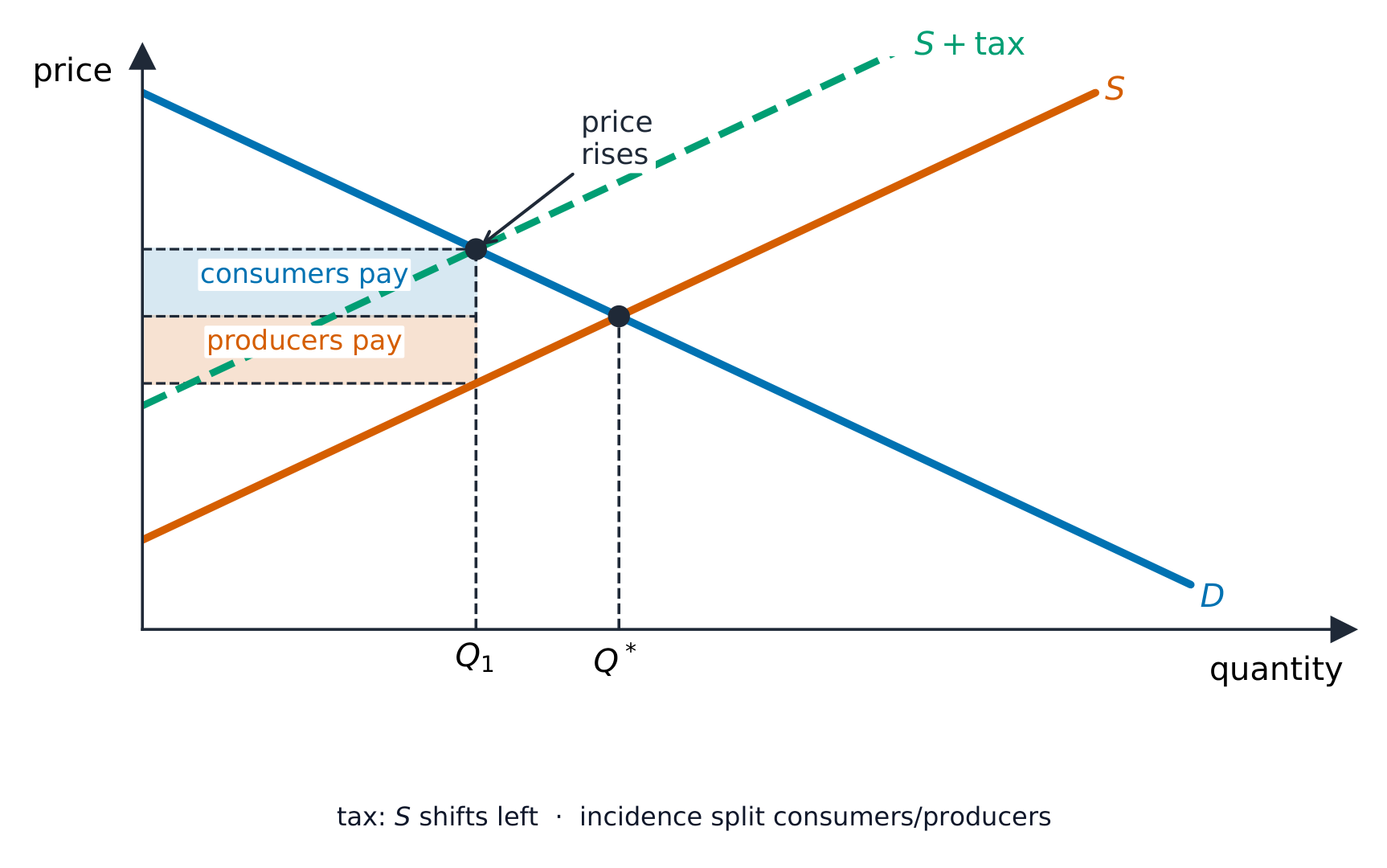
一项间接税把供给上移;负担在消费者和生产者之间分摊
A demerit good is one that is: · 一个劣值物品是一个:
Demerit goods (tobacco, alcohol) are over-consumed; governments discourage them. · 劣值物品(烟草、酒精)被过度消费;政府不鼓励它们。
Information and market power
- Information failure / asymmetric information 信息不对称: one side knows more (a used-car seller vs buyer) → bad decisions.
- Monopoly power 垄断势力: a dominant firm restricts output and raises price above the competitive level.
Asymmetric information — "the market for lemons": buyers can't tell good used cars from bad, so they offer a low price, good cars leave the market, and quality collapses.
信息与市场力量
- 信息失灵 / 不对称信息(information failure / asymmetric information):一方知道得更多(一个二手车卖家对买家)→ 糟糕的决策。
- 垄断力量(monopoly power):一个占主导的企业限制产出并把价格提高到竞争水平之上。
不对称信息——“柠檬市场”:买家分不清好的二手车和坏的,所以他们出一个低价,好车离开市场,质量崩溃。
Asymmetric information means one party in a transaction knows more than the other. · 不对称信息意味着一笔交易中的一方比另一方知道得更多。
E.g. a used-car seller knows the car's faults better than the buyer. · 例如一个二手车卖家比买家更了解车的缺陷。
Match each market failure to an example. · 把每个市场失灵与一个例子配对。
Each is a distinct reason markets under- or over-allocate resources. · 每一个都是市场配置资源不足或过度的一个不同理由。
You've got it
- public goods (non-rival, non-excludable) are under-provided → free-rider problem
- merit goods under-consumed (encourage); demerit over-consumed (discourage)
- information failure and monopoly power are further reasons to intervene
你掌握了
- 公共物品(非竞争性、非排他性)被供给不足 → 搭便车问题
- 优值物品消费不足(鼓励);劣值过度消费(不鼓励)
- 信息失灵和垄断力量是进一步的介入理由