| English | 释义 | 拼音 |
|---|---|---|
| equilibrium/ˌiːkwɪˈlɪbrɪəm/ | 均衡 | jūn héng |
| clears/klɪəz/ | 出清 | chū qīng |
| shortage/ˈʃɔːtɪdʒ/ | 短缺 | duǎn quē |
| surplus/ˈsɜːpləs/ | 过剩 | guò shèng |
Why pork doubled in price
- In 2018–19, African swine fever spread through China's pig farms, and millions of pigs died or were culled. By late 2019, pork prices were more than twice as high as a year earlier. Many families bought chicken and beef instead, and their prices rose too.
- No one ordered these price changes. They came from the interaction of demand and supply, which move the market to a new equilibrium 均衡.
Equilibrium
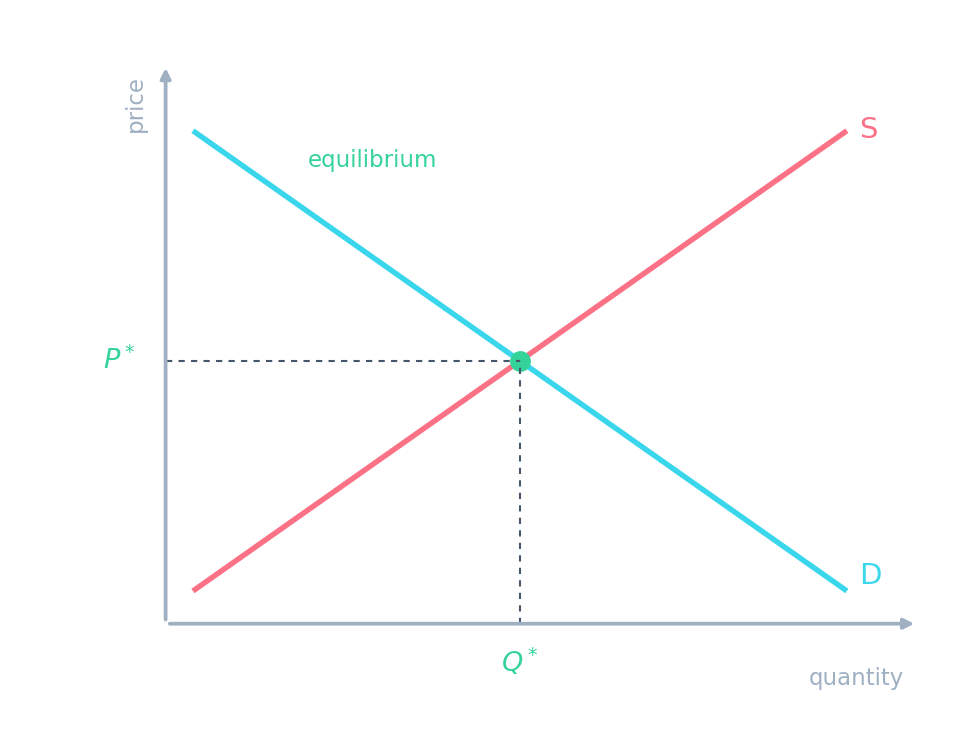
- Equilibrium is the price at which quantity demanded equals quantity supplied: the market clears 出清, with nothing left unsold and no buyer turned away at that price.
- Worked algebra: Qd = 100 − 5P and Qs = 10 + 5P. Set Qd = Qs: 100 − 5P = 10 + 5P, so 10P = 90, P = 9. Then Q = 100 − 45 = 55.
需求与供给
何地 需求 接触 供给 sets the equilibrium price and quantity.
Qd = 120 − 4P and Qs = 20 + 6P. What is the equilibrium price?
难度 2/5 · 今日首次完成可获 140 金币及少量额外奖励
120 − 4P = 20 + 6P, so 10P = 100 and P = 10.
Using Qd = 120 − 4P and Qs = 20 + 6P, what is the equilibrium quantity?
难度 2/5 · 今日首次完成可获 140 金币及少量额外奖励
At P = 10, Qd = 120 − 40 = 80 (and Qs = 20 + 60 = 80).
Disequilibrium: shortages and surpluses
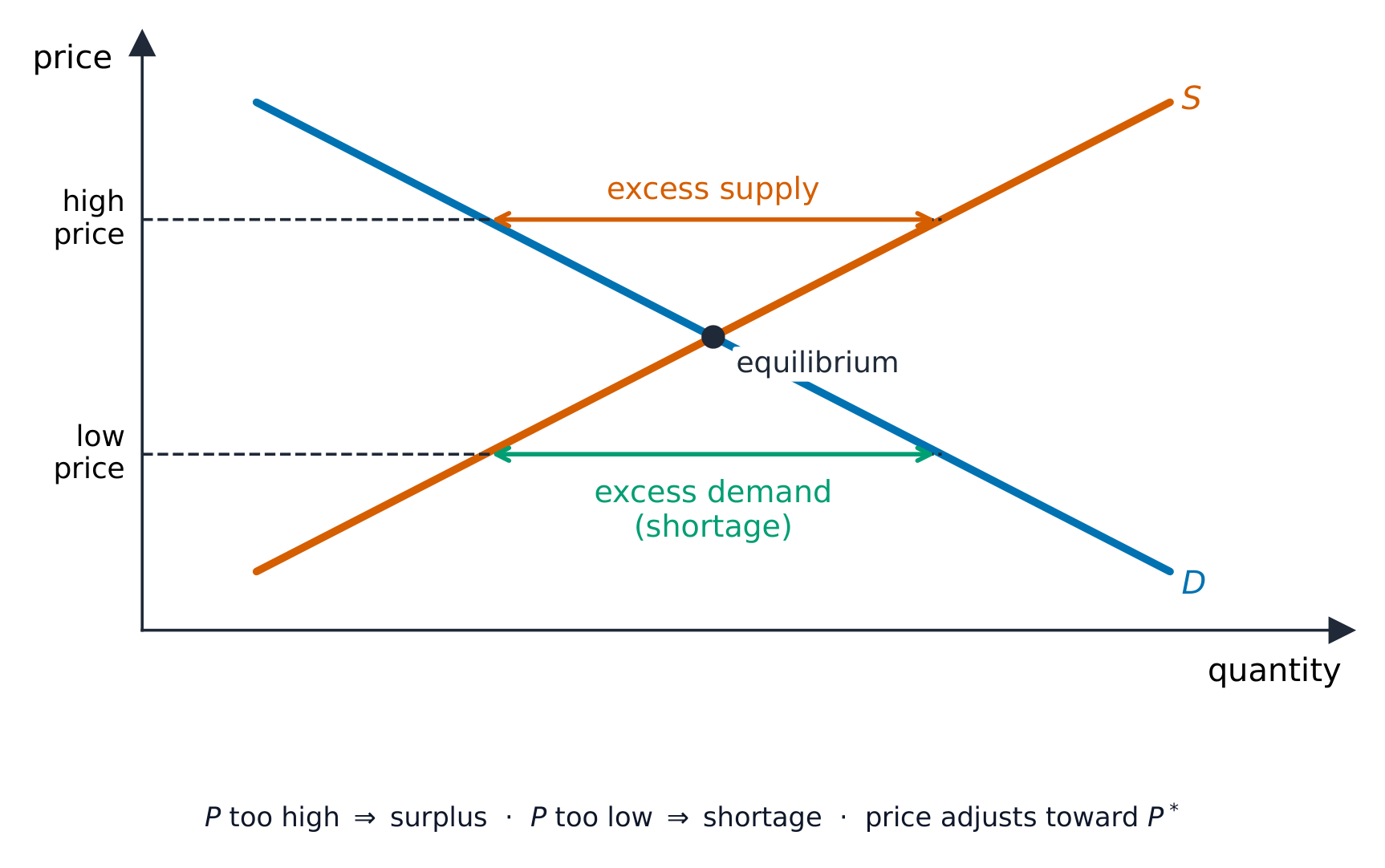
- Price below equilibrium → quantity demanded is greater than quantity supplied → a shortage 短缺 (excess demand) → buyers compete and sellers raise prices → price rises back to equilibrium.
- Price above equilibrium → quantity supplied is greater than quantity demanded → a surplus 过剩 (excess supply) → unsold stock builds up and sellers cut prices → price falls back to equilibrium.
At a price of 6, quantity demanded is 70 and quantity supplied is 40. How large is the shortage?
难度 2/5 · 今日首次完成可获 140 金币及少量额外奖励
70 − 40 = 30 units of excess demand, so the price will rise.
Shifts change the equilibrium
| Change | Curve shift | Price | Quantity |
|---|---|---|---|
| Incomes rise (normal good) | D right | rises | rises |
| A substitute becomes cheaper | D left | falls | falls |
| Disease or bad harvest | S left | rises | falls |
| New technology lowers costs | S right | falls | rises |
| D right and S right together | both | uncertain | rises |
| D right and S left together | both | rises | uncertain |
- When both curves shift, the result for one variable depends on which shift is larger.
Match each event to its effect on the market for coffee.
难度 2/5 · 今日首次完成可获 140 金币及少量额外奖励
Decide which curve shifts, and in which direction.
Demand and supply for phones both shift right. What happens?
难度 1/5 · 今日首次完成可获 100 金币及少量额外奖励
Both shifts raise quantity, but they push price in opposite directions.
Related markets
- Substitutes (competitive demand): pork and chicken. A pork shortage raises demand for chicken, so its price rises. Complements (joint demand): cars and petrol.
- Derived demand: demand for a factor comes from demand for what it makes (demand for builders depends on demand for houses). Joint supply: producing one good also produces another (beef and leather).
Match each pair to its relationship.
难度 2/5 · 今日首次完成可获 140 金币及少量额外奖励
Related markets move together in predictable ways.
Worked exam answer
With the help of a diagram, explain the effect of African swine fever on the market for pork and the market for chicken. [8]
Pork: the loss of pigs reduces supply, so the supply curve shifts left. At the old price there is a shortage, so the price rises; the new equilibrium has a higher price and lower quantity. Demand contracts along the curve as some buyers stop buying.
Chicken: chicken is a substitute, so the higher price of pork increases demand for chicken; the demand curve shifts right, raising both the price and quantity of chicken.
- Why it scores: correct curve and direction in each market, the movement from shortage to new equilibrium, and the substitute link between the markets (AO2). Label both diagrams with P, Q, D, S and the old and new equilibria.
A change in price does not shift its own curve. A higher pork price causes a contraction of demand for pork (a movement along the curve); only a change in another factor, such as income or the price of chicken, shifts the curve.
Equilibrium is where Qd = Qs and the market clears. Below it there is a shortage and price rises; above it there is a surplus and price falls. Demand shifts move P and Q in the same direction; supply shifts move them in opposite directions; two shifts together leave one result uncertain. Related markets are linked by substitutes, complements, derived demand and joint supply.
Exam practice. Explain, with a diagram, the effect on the market for electric cars of (i) a government subsidy to producers and (ii) a rise in the price of petrol. [8]
One shift at a time, then combine.