Price elasticity of supply · 供给价格弹性
| English | 中文 | Pinyin · 拼音 |
|---|---|---|
| price elasticity of supply/praɪs ɪlæˈstɪsɪti ɒv səˈplaɪ/ | 供给价格弹性 | gōng jǐ jià gé tán xìng |
| elastic/ɪˈlæstɪk/ | 富有弹性 | fù yǒu tán xìng |
| inelastic/ɪnɪˈlæstɪk/ | 缺乏弹性 | quē fá tán xìng |
| spare capacity/speə kəˈpæsɪti/ | 闲置产能 | xián zhì chǎn néng |
| mobility of factors/məʊˈbɪlɪti ɒv ˈfæktəz/ | 要素流动性 | yào sù liú dòng xìng |
Why farmers can't react overnight
- If strawberry prices jump, a factory can boost output in days — but a farmer must wait a whole growing season. Producers differ in how fast they respond.
- Price elasticity of supply 供给价格弹性 (PES) measures that responsiveness.
为什么农民不能一夜之间反应
- 如果草莓价格跳涨,一个工厂能在几天内增加产出——但一个农民必须等一整个生长季。生产者在反应有多快上不同。
- 供给价格弹性(price elasticity of supply,PES)测量那个反应性。
Measuring PES
- PES measures how quantity supplied responds to a price change:
- It is normally positive (price and quantity supplied move together).
Equilibrium price and quantity where demand meets supply
测量 PES
- PES 测量供给量如何对一个价格变化反应:
- 它通常是正的(价格和供给量一起移动)。
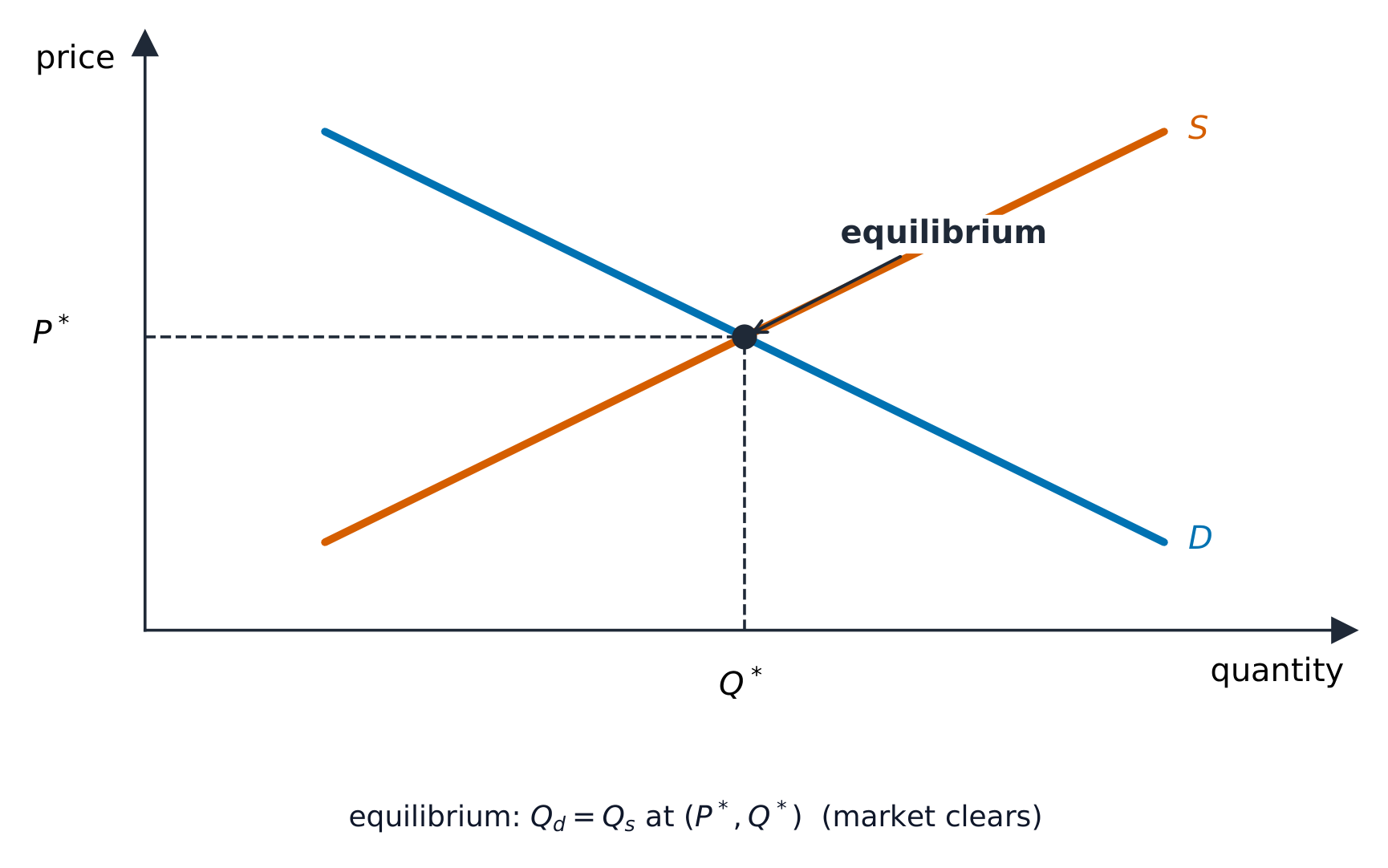
需求遇到供给的均衡价格和数量
Demand & supply · 需求与供给
Supply elasticity is how much quantity responds to price. · 供给弹性是数量对价格的反应程度。
Price rises 20% and quantity supplied rises 30%. What is the PES? · 价格上升 20% 而供给量上升 30%。PES 是多少?
PES = 30% / 20% = 1.5 — elastic. · PES = 30% / 20% = 1.5——弹性的。
PES = (% change in quantity supplied) ÷ (% change in ______). · PES =(供给量的 % 变化)÷(______的 % 变化)。
PES divides the % change in quantity supplied by the % change in price. · PES 把供给量的 % 变化除以价格的 % 变化。
Elastic 富有弹性 vs inelastic 缺乏弹性 supply
- $\text{PES} > 1$ → elastic (output responds easily — spare capacity 闲置产能, easy to store).
- $\text{PES} < 1$ → inelastic (output is hard to change quickly — farming, limited capacity).
A steep supply curve is inelastic; a flat one is elastic. Spare capacity and time make supply more elastic.
Worked example. Price rises 20% and quantity supplied rises 30%. PES $= \dfrac{30\%}{20\%} = 1.5$ — elastic.
弹性对非弹性供给
- $\text{PES} > 1$ → 弹性(产出容易反应——闲置产能、容易储存)。
- $\text{PES} < 1$ → 非弹性(产出难以快速改变——农业、有限的产能)。

一条陡的供给曲线是非弹性的;一条平的是弹性的。闲置产能和时间使供给更有弹性。
算例。 价格上升 20% 而供给量上升 30%。PES $= \dfrac{30\%}{20\%} = 1.5$——弹性。
Supply is elastic when PES is: · 当 PES 是以下时,供给是弹性的:
PES > 1 means quantity supplied responds strongly to price. · PES > 1 意味着供给量对价格反应强烈。
Why is the supply of a farm crop usually inelastic in the short run? · 为什么一种农作物的供给在短期内通常是非弹性的?
Production takes a season, so quantity supplied can't respond quickly to price — inelastic. · 生产需要一个季节,所以供给量无法对价格快速反应——非弹性。
Time is the key
- The longer the time period, the more elastic supply becomes — firms can build capacity, hire, and adjust.
- Other determinants: spare capacity, ease of storing stock, and mobility of factors 要素流动性.
时间是关键
- 时间期越长,供给变得越有弹性——企业能建产能、雇人和调整。
- 其他决定因素:闲置产能、储存库存的容易程度,以及要素的流动性。
Supply tends to be more elastic over a longer time period. · 在更长的时间段内,供给倾向于更有弹性。
Given time, firms can expand capacity, so supply responds more — more elastic. · 有了时间,企业能扩大产能,所以供给反应更多——更有弹性。
You've got it
- $\text{PES} = \dfrac{\%\Delta Q_s}{\%\Delta P}$, normally positive
- $\text{PES}>1$ elastic, $\text{PES}<1$ inelastic
- supply is more elastic with more time, spare capacity, and storable stock
你掌握了
- $\text{PES} = \dfrac{\%\Delta Q_s}{\%\Delta P}$,通常为正
- $\text{PES}>1$ 弹性,$\text{PES}<1$ 非弹性
- 供给随更多时间、闲置产能和可储存的库存而更有弹性