Income and cross elasticity of demand · 需求的收入弹性与交叉弹性
| English | 中文 | Pinyin · 拼音 |
|---|---|---|
| income elasticity/ˈɪŋkʌm ɪlæˈstɪsɪti/ | 收入弹性 | shōu rù tán xìng |
| cross elasticity/krɒs ɪlæˈstɪsɪti/ | 交叉弹性 | jiāo chā tán xìng |
| normal good/ˈnɔːml ɡʊd/ | 正常品 | zhèng cháng pǐn |
| luxury/ˈlʌkʃəri/ | 奢侈品 | shē chǐ pǐn |
| inferior good/ɪnˈfɪərɪə ɡʊd/ | 低档品 | dī dàng pǐn |
| substitutes/ˈsʌbstɪtjuːts/ | 替代品 | tì dài pǐn |
| complements/ˈkɒmplɪmənts/ | 互补品 | hù bǔ pǐn |
What a pay rise does to your shopping
- Get a raise and you buy more restaurant meals — but maybe fewer tins of cheap noodles. Income changes demand differently for different goods.
- Two more elasticities capture this: income elasticity 收入弹性 (YED) and cross elasticity 交叉弹性 (XED).
一次加薪对你购物的影响
- 得到加薪,你就买更多餐厅的饭——但也许更少罐便宜的面条。收入对不同的商品以不同的方式改变需求。
- 另外两个弹性捕捉这个:收入弹性(YED)和交叉弹性(XED)。
Income elasticity (YED)
- YED measures how demand responds to a change in income:
- Normal good 正常品: YED $> 0$ (demand rises with income); a luxury 奢侈品 has YED $> 1$.
- Inferior good 低档品: YED $< 0$ (demand falls as income rises — e.g. cheap noodles).
For a normal good, a rise in income shifts demand right; for an inferior good it would shift left.
Worked example. Income rises 10% and demand rises 20%. YED $= \dfrac{20\%}{10\%} = 2$ — a normal luxury good.
As income rises, demand for a normal good rises but an inferior good falls
收入弹性(YED)
- YED 测量需求如何对收入的一个变化反应:
- 正常商品(normal good):YED $> 0$(需求随收入上升);一个奢侈品有 YED $> 1$。
- 劣等商品(inferior good):YED $< 0$(需求随收入上升而下降——例如便宜的面条)。
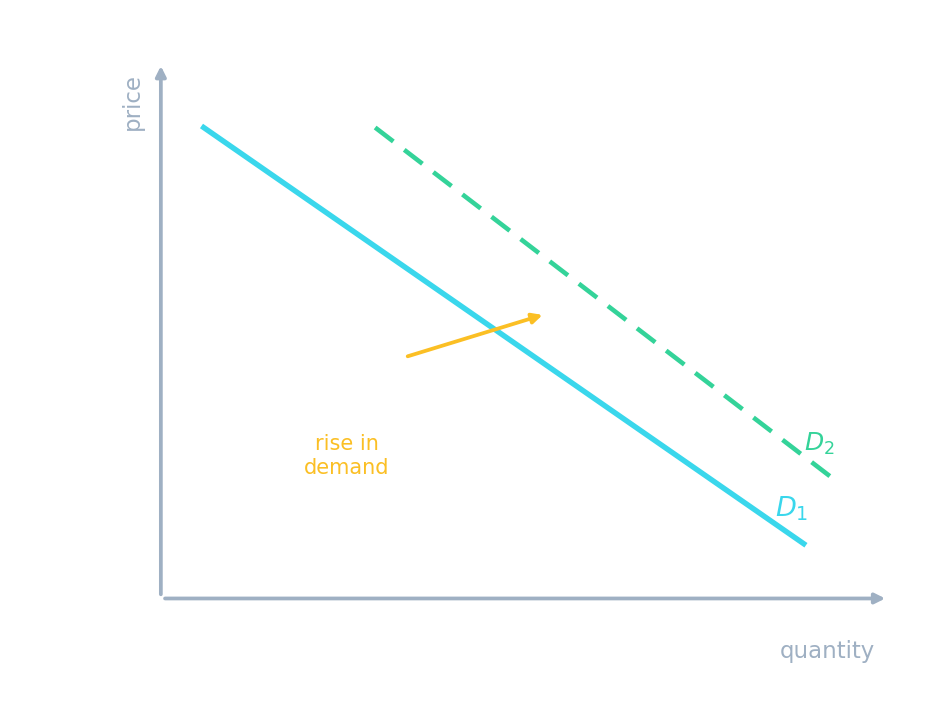
对一个正常商品,收入的上升把需求右移;对一个劣等商品它会左移。
算例。 收入上升 10% 而需求上升 20%。YED $= \dfrac{20\%}{10\%} = 2$——一个正常的奢侈品。
Elastic vs inelastic demand · 富有弹性与缺乏弹性的需求
A steep demand curve is inelastic (quantity barely responds to price); a shallow one is elastic · 弹性. Shift the curves to compare. · 陡峭的需求曲线是缺乏弹性的(数量对价格几乎不反应);平缓的是富有弹性的。移动曲线来比较。
Income rises 10% and quantity demanded rises 20%. What is the YED? · 收入上升 10% 而需求量上升 20%。YED 是多少?
YED = 20% / 10% = 2 — a normal luxury good. · YED = 20% / 10% = 2——一个正常的奢侈品。
An inferior good has an income elasticity (YED) that is: · 一个劣等商品有一个收入弹性(YED),它是:
For an inferior good, demand falls as income rises, so YED < 0. · 对一个劣等商品,需求随收入上升而下降,所以 YED < 0。
Cross elasticity (XED)
- XED measures how demand for good A responds to a change in the price of good B:
- Substitutes 替代品: XED $> 0$ (B dearer → buy more A). Complements 互补品: XED $< 0$ (B dearer → buy less A).
The demand curve slopes down; income, tastes and related prices shift it
交叉弹性(XED)
- XED 测量对商品 A 的需求如何对商品 B 的价格的一个变化反应:
- 替代品(substitutes):XED $> 0$(B 更贵 → 买更多 A)。互补品(complements):XED $< 0$(B 更贵 → 买更少 A)。

需求曲线向下倾斜;收入、口味和相关价格移位它
Two goods are substitutes if their cross elasticity (XED) is: · 如果两种商品的交叉弹性(XED)是以下,它们是替代品:
Substitutes: a rise in B's price raises demand for A, so XED > 0. · 替代品:B 的价格上升提高对 A 的需求,所以 XED > 0。
Complements (like printers and ink) have a negative cross elasticity of demand. · 互补品(像打印机和墨水)有一个负的需求交叉弹性。
A rise in the price of one reduces demand for the other → XED < 0. · 一个的价格上升减少对另一个的需求 → XED < 0。
Match each elasticity value to the type of good. · 把每个弹性值与商品的类型配对。
Sign and size of YED/XED classify the good and the relationship. · YED/XED 的符号和大小给商品和关系分类。
Why the signs matter
- The sign of YED/XED classifies the good; the size shows how strong the effect is.
- Firms use YED to forecast demand as incomes change, and XED to spot rivals (substitutes) and partners (complements).
Inelastic vs elastic demand: small vs large response to a price change
为什么符号重要
- YED/XED 的符号给商品分类;大小显示影响有多强。
- 企业用 YED 来在收入改变时预测需求,用 XED 来发现对手(替代品)和伙伴(互补品)。
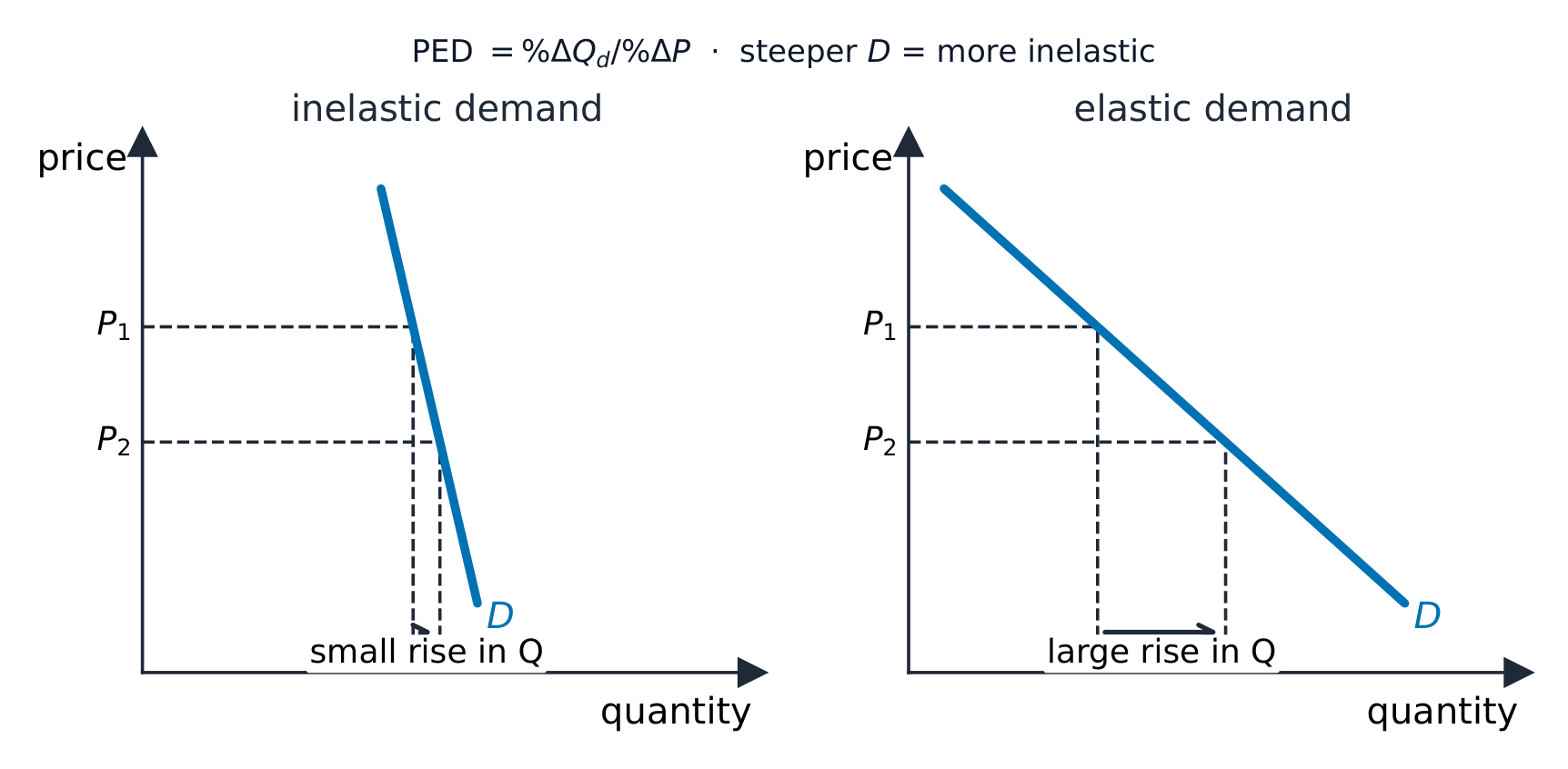
非弹性对弹性需求:对一个价格变化的小对大的反应
You've got it
- YED $= \dfrac{\%\Delta Q_d}{\%\Delta \text{income}}$: normal $>0$ (luxury $>1$), inferior $<0$
- XED $= \dfrac{\%\Delta Q_A}{\%\Delta P_B}$: substitutes $>0$, complements $<0$
- the sign tells you the type of good; the size tells you how strong the link is
你掌握了
- YED $= \dfrac{\%\Delta Q_d}{\%\Delta \text{income}}$:正常 $>0$(奢侈 $>1$),劣等 $<0$
- XED $= \dfrac{\%\Delta Q_A}{\%\Delta P_B}$:替代品 $>0$,互补品 $<0$
- 符号告诉你商品的类型;大小告诉你联系有多强