Classification of goods and services · 商品和服务的分类
| English | 中文 | Pinyin · 拼音 |
|---|---|---|
| economic good/ˌiːkəˈnɒmɪk ɡʊd/ | 经济物品 | jīng jì wù pǐn |
| free good/friː ɡʊd/ | 免费物品 | miǎn fèi wù pǐn |
| public good/ˈpʌblɪk ɡʊd/ | 公共物品 | gōng gòng wù pǐn |
| private good/ˈpraɪvət ɡʊd/ | 私人物品 | sī rén wù pǐn |
| rival/ˈraɪvl/ | 竞争性的 | jìng zhēng xìng de |
| excludable/eksˈkluːdəbl/ | 排他性的 | pái tā xìng de |
| free-rider/friː ˈraɪdə/ | 搭便车 | dā biàn chē |
| demerit good/ˈdemərɪt ɡʊd/ | 劣值品 | liè zhí pǐn |
| merit good/ˈmerɪt ɡʊd/ | 优值品 | yōu zhí pǐn |
Why no one sells fresh air
- Air is essential — yet free, because it isn't scarce. The moment something is scarce, it gets a price and becomes an economic good 经济物品.
- Not all goods behave the same way in a market; sorting them explains where markets work and where they fail.
为什么没人卖新鲜空气
- 空气是必需的——但免费,因为它不稀缺。一样东西一旦稀缺,它就有了一个价格并成为一个经济物品(economic good)。
- 不是所有物品在市场里都以同样的方式表现;给它们分类解释了市场在哪里有效、在哪里失灵。
Goods and services lab · 商品和服务实验室
Classify examples by rivalry, excludability or whether they are services. · 根据竞争性、排他性或是否为服务对示例进行分类。
Free vs economic goods
- A free good 免费物品 has no opportunity cost — unlimited relative to wants (e.g. air, sunlight).
- An economic good is scarce, so producing it has an opportunity cost and it commands a price.
The four types of good, classified by rivalry and excludability
自由物品对经济物品
- 一个自由物品(free good)没有机会成本——相对于欲望无限(例如空气、阳光)。
- 一个经济物品是稀缺的,所以生产它有一个机会成本,而它要一个价格。
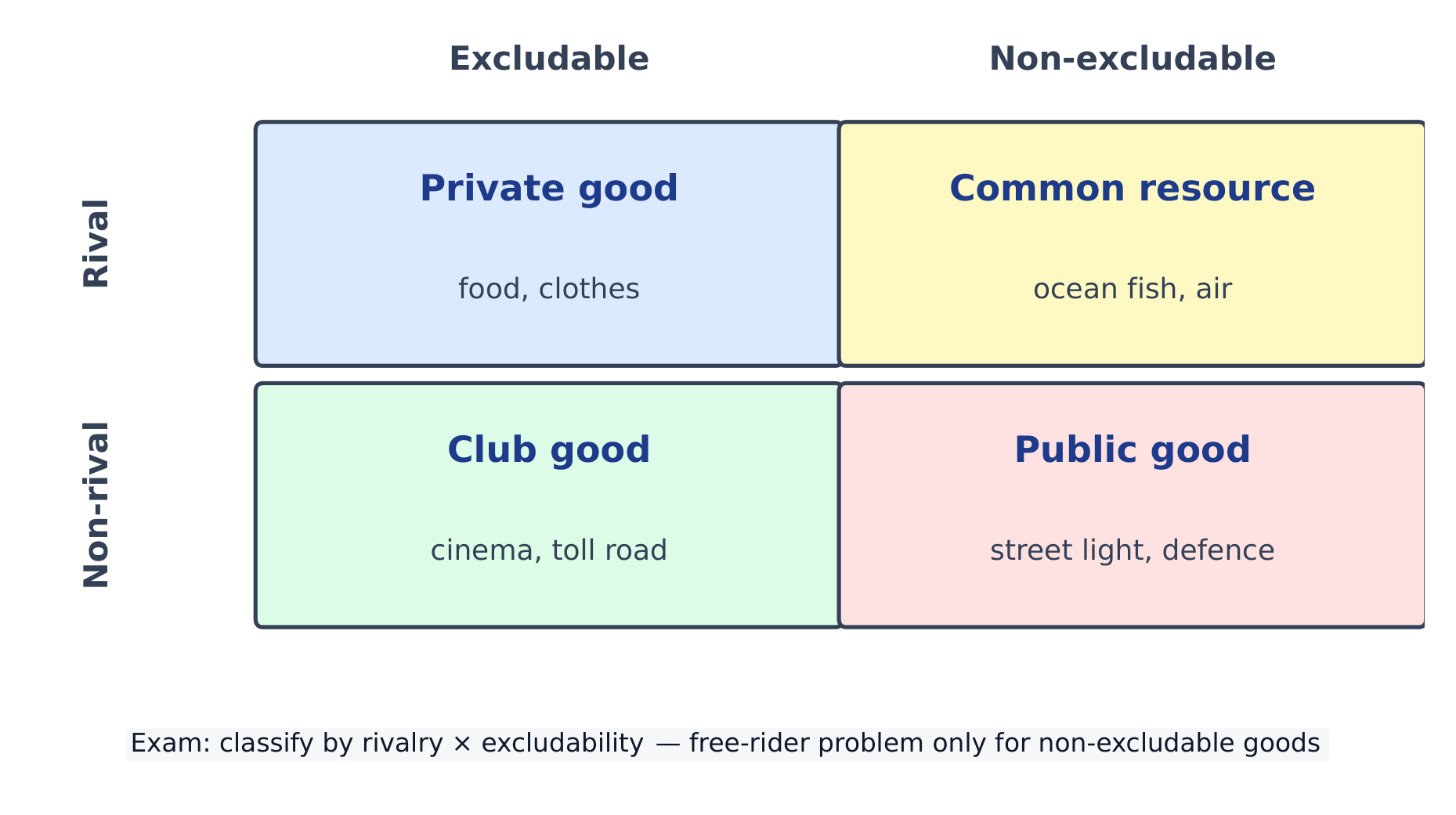
四种物品的类型,按竞争性和排他性分类
A free good is one that: · 自由物品是指:
A free good (like air) is unlimited relative to wants, so using it costs nothing. · 自由物品(如空气)相对于需求而言是无限的,因此使用它没有任何代价。
Private vs public goods 公共物品
- Rival: one person's use reduces another's. Excludable: you can stop non-payers. Public goods are neither — so markets under-provide them (the free-rider 搭便车 problem).
Making more capital goods today shifts the future PPC out further
私人物品对公共物品
- 竞争性(rival):一个人的使用减少另一个人的。排他性(excludable):你能阻止不付钱的人。公共物品两者都不是——所以市场供给不足它们(搭便车问题)。
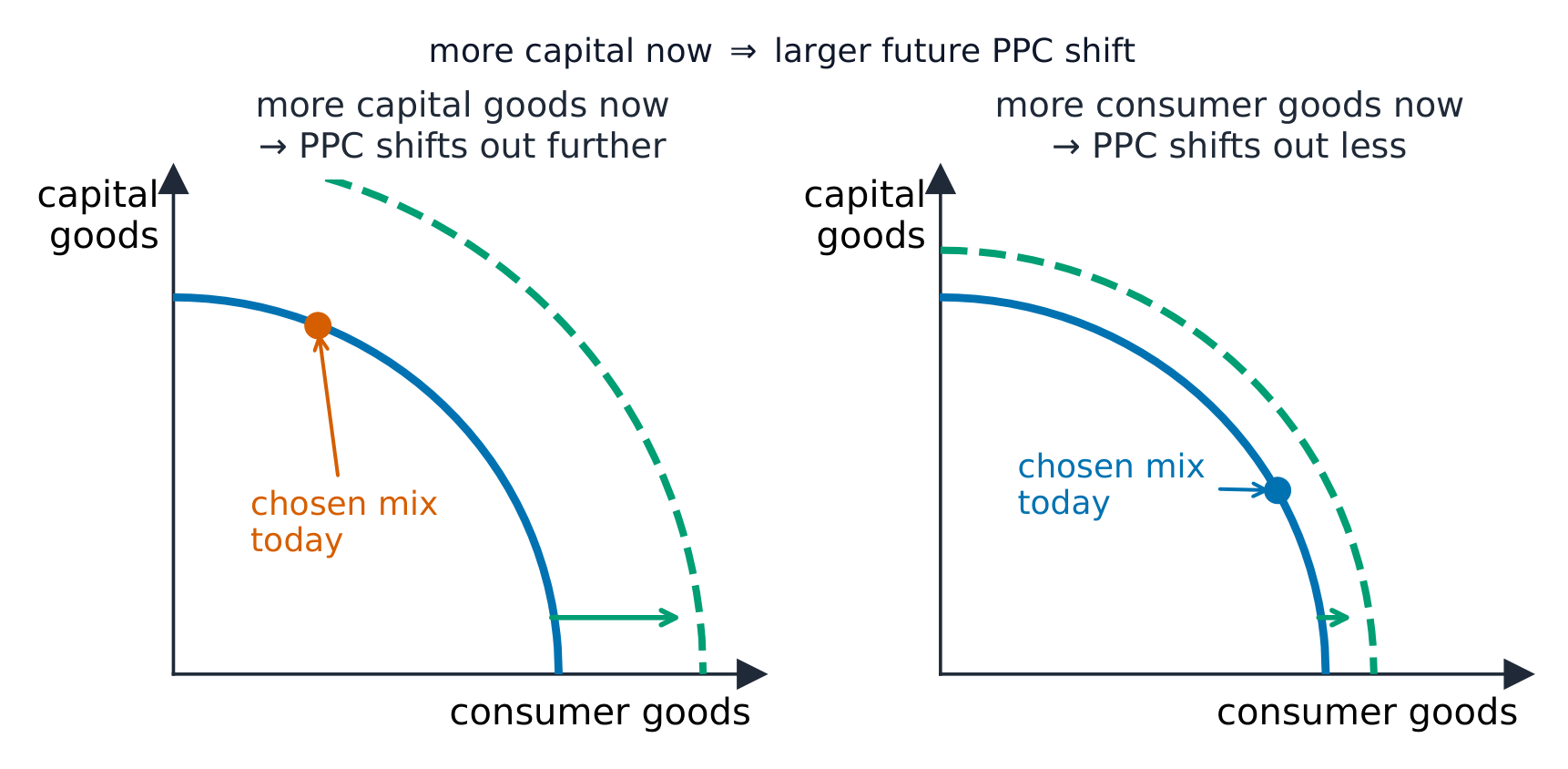
今天制造更多资本品把未来的 PPC 移得更远
A public good is: · 公共物品是:
Public goods (e.g. street lighting) are non-rival and non-excludable — hence the free-rider problem. · 公共物品(如路灯)是非竞争性和非排他性的 — 因此存在搭便车问题。
Because non-payers cannot be excluded from a public good, markets suffer the ______-rider problem. · 由于非付费者无法被排除在公共物品之外,市场会出现 ______-rider 问题。
People can enjoy a public good without paying — the free-rider problem — so markets under-provide it. · 人们可以不付费就享受公共物品 — 搭便车问题 — 因此市场供给不足。
Merit and demerit goods 劣值品
- A merit good 优值品 is better for you than you realise, so it's under-consumed (education, vaccines) — governments encourage it.
- A demerit good is worse than you realise, so it's over-consumed (tobacco, alcohol) — governments discourage it.
Public ≠ merit. A public good is defined by non-rivalry/non-excludability; a merit good is about mis-judged benefit. Education is a merit good but is excludable (so not a pure public good).
优值物品与劣值物品
- 一个优值物品(merit good)对你比你意识到的更好,所以它被消费不足(教育、疫苗)——政府鼓励它。
- 一个劣值物品(demerit good)比你意识到的更糟,所以它被过度消费(烟草、酒精)——政府不鼓励它。
公共 ≠ 优值。 一个公共物品由非竞争性/非排他性定义;一个优值物品是关于被误判的利益。教育是一个优值物品但是可排他的(所以不是一个纯公共物品)。
Match each good to its type. · 将每个商品与其类型匹配。
Street lighting is non-rival/non-excludable; an apple is rival/excludable; vaccines are under-consumed merit goods; tobacco is an over-consumed demerit good. · 路灯是非竞争/非排他的;苹果是竞争/排他的;疫苗是消费不足的优等品;烟草是消费过度的劣等品。
A merit good is under-consumed because people undervalue its benefits. · 优等品之所以消费不足,是因为人们低估了其益处。
Merit goods (education, vaccines) are under-consumed, so governments encourage them. · 优等品(教育、疫苗)消费不足,因此政府鼓励消费。
You've got it
- free good (no opportunity cost) vs economic good (scarce, has a price)
- public good = non-rival and non-excludable → markets under-provide (free-rider problem)
- merit goods under-consumed (encourage); demerit goods over-consumed (discourage)
你掌握了
- 自由物品(没有机会成本)对经济物品(稀缺,有价格)
- 公共物品 = 非竞争性且非排他性 → 市场供给不足(搭便车问题)
- 优值物品消费不足(鼓励);劣值物品过度消费(不鼓励)