| English | 释义 | 拼音 |
|---|---|---|
| solvent/ˈsɒlvənt/ | 溶剂 | róng jì |
| solute/ˈsɒljuːt/ | 溶质 | róng zhì |
| partition coefficient/pɑːˈtɪʃn ˌkəʊɪˈfɪʃənt/ | 分配系数 | fēn pèi xì shù |
| non-polar/nɒn ˈpəʊlə/ | 非极性 | fēi jí xìng |
| polar/ˈpəʊlə/ | 极性 | jí xìng |
Splitting between two solvents 溶剂
- Shake a solute 溶质 with two solvents that don't mix — it spreads between them.
- The ratio of its concentrations is the partition coefficient 分配系数.
- Polarity decides which solvent it prefers.
Partition coefficient lab
Kpc = concentration organic / concentration aqueous
Change organic-layer concentration and see the partition ratio.
A partition coefficient describes how a solute distributes between two immiscible solvents.
难度 1/5 · 今日首次完成可获 100 金币及少量额外奖励
It is the ratio of concentrations at equilibrium.
The partition coefficient
- It is constant at a fixed temperature.
- It only applies when the solute is in the same physical state in both solvents.
The partition coefficient is:
难度 1/5 · 今日首次完成可获 100 金币及少量额外奖励
Kpc = [solute in solvent 1] / [solute in solvent 2], constant at a fixed temperature.
The partition coefficient applies only when the solute is:
难度 1/5 · 今日首次完成可获 100 金币及少量额外奖励
Kpc is valid when the solute exists in the same physical state in each solvent.
Match each partition idea.
难度 2/5 · 今日首次完成可获 140 金币及少量额外奖励
Each item links the term to its correct meaning.
Polarity decides
- The value depends on the polarity of the solute and each solvent.
- A non-polar 非极性 solute dissolves more in the non-polar solvent; a polar 极性 solute prefers the polar solvent.
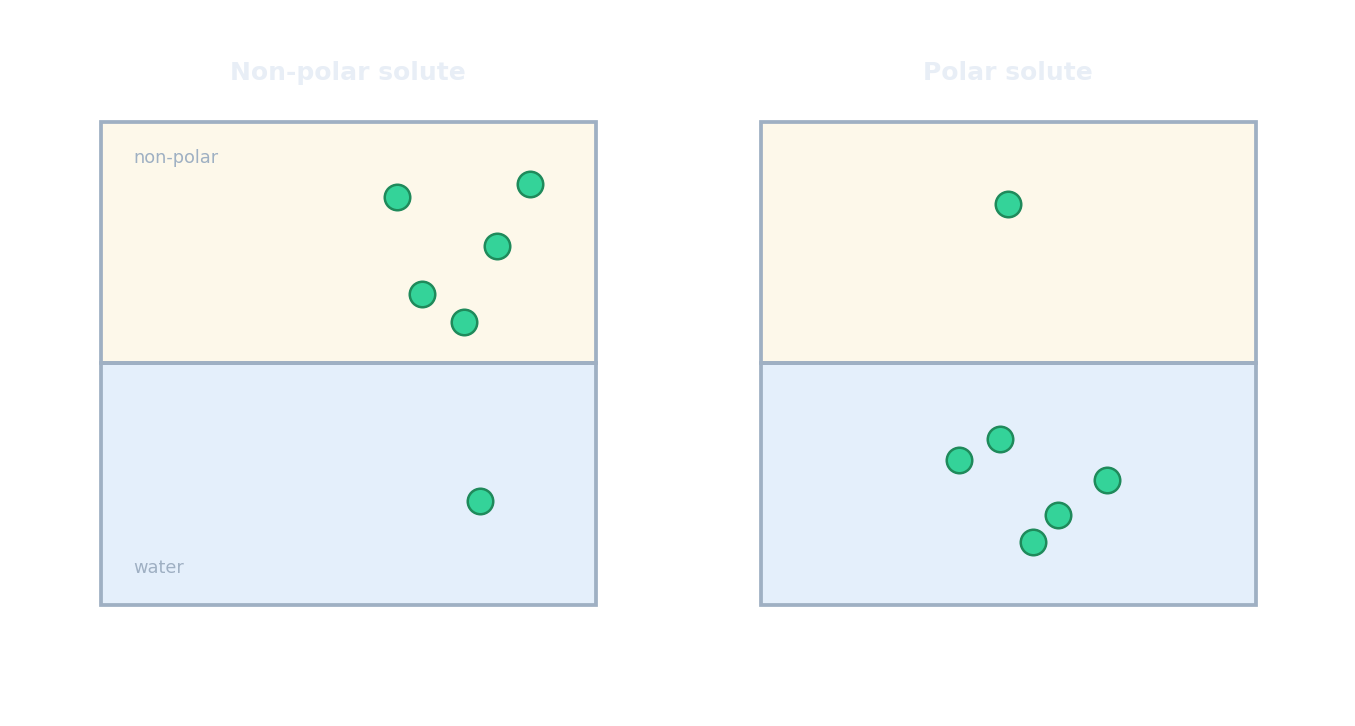
Polarity decides the split: a non-polar solute favours the non-polar layer, a polar solute the water layer.
A non-polar solute will dissolve more in:
难度 1/5 · 今日首次完成可获 100 金币及少量额外奖励
"Like dissolves like": a non-polar solute prefers the non-polar solvent; a polar solute the polar one.
The value of the partition coefficient depends on the polarity of the solute and solvents.
难度 1/5 · 今日首次完成可获 100 金币及少量额外奖励
Polarity governs how the solute distributes, so it sets the partition coefficient.
Worked example: one portion or two?
For Y, $K_{\text{pc}} = \dfrac{[\text{Y in hexane}]}{[\text{Y in water}]} = 5.0$. A sample of $50\ \text{cm}^3$ of water holds 1.20 g of Y. Let $x$ be the mass that moves into the hexane.
- One $50\ \text{cm}^3$ portion: $\dfrac{x/50}{(1.20 - x)/50} = 5.0$, so $x = 6.0 - 5.0x$ and $x = 1.00\ \text{g}$.
- Two $25\ \text{cm}^3$ portions: the first takes $0.857\ \text{g}$ (from $\dfrac{x/25}{(1.20-x)/50} = 5.0$), the second $0.245\ \text{g}$ of the $0.343\ \text{g}$ left, $1.10\ \text{g}$ in all. The same volume used in smaller portions extracts more.
$K_{\text{pc}} = \dfrac{[\text{X in hexane}]}{[\text{X in water}]} = 4.0$. $100\ \text{cm}^3$ of water containing 2.00 g of X is shaken with $100\ \text{cm}^3$ of hexane. What mass of X, in g, moves into the hexane?
难度 2/5 · 今日首次完成可获 140 金币及少量额外奖励
The volumes are equal, so $\dfrac{x}{2.00 - x} = 4.0$, giving $x = 8.0 - 4.0x$ and $x = 1.60\ \text{g}$.
A chemist has $50\ \text{cm}^3$ of organic solvent to extract a product from water. Which method extracts the most?
难度 1/5 · 今日首次完成可获 100 金币及少量额外奖励
Each extraction sets up a new equilibrium with fresh solvent, so several small portions remove more solute than one large portion.
You've got it
- $K_{\text{pc}} = \dfrac{[\text{solute in solvent 1}]}{[\text{solute in solvent 2}]}$ (constant at fixed temperature)
- it applies when the solute is in the same physical state in both solvents
- non-polar solute → non-polar solvent; polar solute → polar solvent