Catalysts · 催化剂
| English | 中文 | Pinyin · 拼音 |
|---|---|---|
| catalyst/ˈkætəlɪst/ | 催化剂 | cuī huà jì |
| reaction mechanism/rɪˈækʃn ˈmekənɪzəm/ | 反应机理 | fǎn yìng jī lǐ |
| homogeneous catalyst/həˈməʊdʒnɪəs ˈkætəlɪst/ | 均相催化剂 | jūn xiāng cuī huà jì |
| heterogeneous catalyst/ˌhetrəˈdʒiːnɪəs ˈkætəlɪst/ | 多相催化剂 | duō xiāng cuī huà jì |
A shortcut for reactions
- A catalyst 催化剂 speeds up a reaction but is not used up.
- It works by giving a new route with a lower activation energy.
- It does not change the enthalpy of the reaction.
反应的一条捷径
- 一个催化剂(catalyst)加速一个反应但不被用掉。
- 它通过给出一条有更低活化能的新路线来工作。
- 它不改变反应的焓。
A catalyst speeds up a reaction by: · 一个催化剂通过以下哪种加速一个反应:
A catalyst offers a new mechanism with a lower Eₐ, so more molecules can react; it is not used up. · 一个催化剂提供一个有更低 Eₐ 的新机理,所以更多分子能反应;它不被用掉。
A catalyst speeds up a reaction by providing a route with a lower activation energy. · 一个催化剂通过提供一条有更低活化能的路线加速一个反应。
It is not used up. · 它不被用掉。
How a catalyst works
- A catalyst provides a different reaction mechanism 反应机理 with a lower $E_A$.
- On the Boltzmann distribution, lowering $E_A$ moves the line left, so more molecules can react → more effective collisions → faster rate.
- The enthalpy change $\Delta H$ is unchanged — only the activation energy is lowered.
A catalyst gives a route with lower activation energy; the enthalpy change is unchanged
一个催化剂如何工作
- 一个催化剂提供一条有更低 $E_A$ 的不同反应机理(reaction mechanism)。
- 在玻尔兹曼分布上,降低 $E_A$ 把线向左移,所以更多分子能反应 → 更多有效碰撞 → 更快的速率。
- 焓变 $\Delta H$ 不变——只有活化能被降低。

一个催化剂给出一条有更低活化能的路线;焓变不变
Catalysts · 催化剂
a catalyst lowers Ea · 催化剂降低 Ea
A catalyst lowers Ea, so a bigger fraction of molecules can react — without heating. · 一个催化剂降低 Ea,所以更大比例的分子能反应——不用加热。
A catalyst does NOT change the: · 一个催化剂不改变:
A catalyst lowers Eₐ and speeds the rate, but the overall ΔH (reactants to products) is unchanged. · 一个催化剂降低 Eₐ 并加快速率,但总 ΔH(反应物到产物)不变。
Match each catalyst idea to its meaning. · 把每个催化剂概念匹配到它的含义。
Each item links the term to its correct meaning. · 每一项把术语链接到它正确的含义。
Two types
- a homogeneous catalyst 均相催化剂 is in the same physical state as the reactants (e.g. an acid dissolved among liquids).
- a heterogeneous catalyst 多相催化剂 is in a different state (e.g. solid iron speeding up the gases in the Haber process; a car's catalytic converter).
A homogeneous catalyst mixes in with the reactants; a heterogeneous one is a separate surface
两种类型
- 一个均相催化剂(homogeneous catalyst)与反应物处于相同的物理状态(例如溶在液体中的一种酸)。
- 一个多相催化剂(heterogeneous catalyst)处于一个不同的状态(例如哈伯法中加速气体的固体铁;一辆车的催化转化器)。
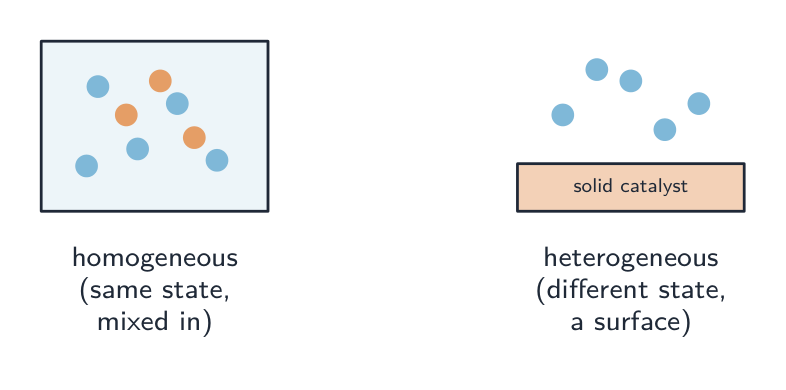
均相催化剂与反应物混在一起;多相催化剂是一个独立的表面
A heterogeneous catalyst is one that is: · 一个多相催化剂是这样一个,它:
Heterogeneous = different state (e.g. solid catalyst, gas reactants); homogeneous = same state. · 多相 = 不同的状态(例如固体催化剂、气体反应物);均相 = 相同的状态。
Solid iron speeding up the gas reaction in the Haber process is an example of a: · 固体铁加速哈伯法中的气体反应是以下哪种的一个例子:
The solid iron is in a different state from the gaseous reactants, so it is a heterogeneous catalyst. · 固体铁与气态反应物处于不同的状态,所以它是一个多相催化剂。
How a catalyst changes the picture
- A catalyst gives an alternative pathway with a lower activation energy.
- More molecules now have enough energy to react, so the rate rises — without being used up.
一个催化剂如何改变图景
- 一个催化剂给出一条有更低活化能的替代途径。
- 现在更多分子有足够的能量反应,所以速率上升——而不被用掉。
You've got it
- a catalyst speeds up a reaction, is not used up, and gives a route with lower $E_A$
- lower $E_A$ → more molecules can react → faster rate; $\Delta H$ is unchanged
- homogeneous = same state as reactants; heterogeneous = different state (e.g. solid iron, catalytic converter)
你掌握了
- 一个催化剂加速一个反应,不被用掉,并给出一条有更低 $E_A$ 的路线
- 更低的 $E_A$ → 更多分子能反应 → 更快的速率;$\Delta H$ 不变
- 均相 = 与反应物相同的状态;多相 = 不同的状态(例如固体铁、催化转化器)