| English | 释义 | 拼音 |
|---|---|---|
| rate of reaction/reɪt ɒv rɪˈækʃn/ | 反应速率 | fǎn yìng sù lǜ |
| concentration/ˌkɒnsənˈtreɪʃn/ | 浓度 | nóng dù |
| effective collision/ɪˈfektɪv kəˈlɪʒn/ | 有效碰撞 | yǒu xiào pèng zhuàng |
| orientation/ˌɔːrɪənˈteɪʃn/ | 取向 | qǔ xiàng |
How fast, and why
- Milk goes sour in days; iron rusts over years; a firework explodes in a fraction of a second. The rate of reaction 反应速率 is the change in concentration of a reactant or product per unit time, in mol dm⁻³ s⁻¹.
- For particles to react, they must collide, but not every collision works.
Rate of reaction is measured as the:
难度 1/5 · 今日首次完成可获 100 金币及少量额外奖励
Rate is how much the concentration (or amount) changes in each unit of time.
The rate of reaction can be found from the ______ of a concentration-time graph.
难度 1/5 · 今日首次完成可获 100 金币及少量额外奖励
A steeper gradient means a faster rate.
Effective collisions 有效碰撞
- An effective collision has enough energy (at least the activation energy) and the correct orientation 取向, so a reaction happens. Otherwise the particles just bounce apart.
- The rate depends on the frequency of effective collisions: how many happen per second.
反应速率
[A] = [A]₀·bᵗ
Reactant concentration falls over time as it's used up.
An effective collision is one that:
难度 1/5 · 今日首次完成可获 100 金币及少量额外奖励
A collision only reacts with sufficient energy and the right orientation.
The rate of reaction depends on the:
难度 1/5 · 今日首次完成可获 100 金币及少量额外奖励
More effective collisions per second means a faster rate.
Match each rate idea to its meaning.
难度 2/5 · 今日首次完成可获 140 金币及少量额外奖励
Each item links the term to its correct meaning.
Concentration 浓度 and pressure
- Increasing concentration (or gas pressure) packs particles closer together.
- They collide more often, so there are more effective collisions per second — the rate rises.

Increasing the concentration of a reactant speeds up the reaction because:
难度 1/5 · 今日首次完成可获 100 金币及少量额外奖励
More particles in the same volume collide more frequently, raising the rate.
Measuring rate in the lab
- Follow a reaction by measuring something that changes with time: gas volume (gas syringe), mass loss (as gas escapes), or a colour or conductivity change.
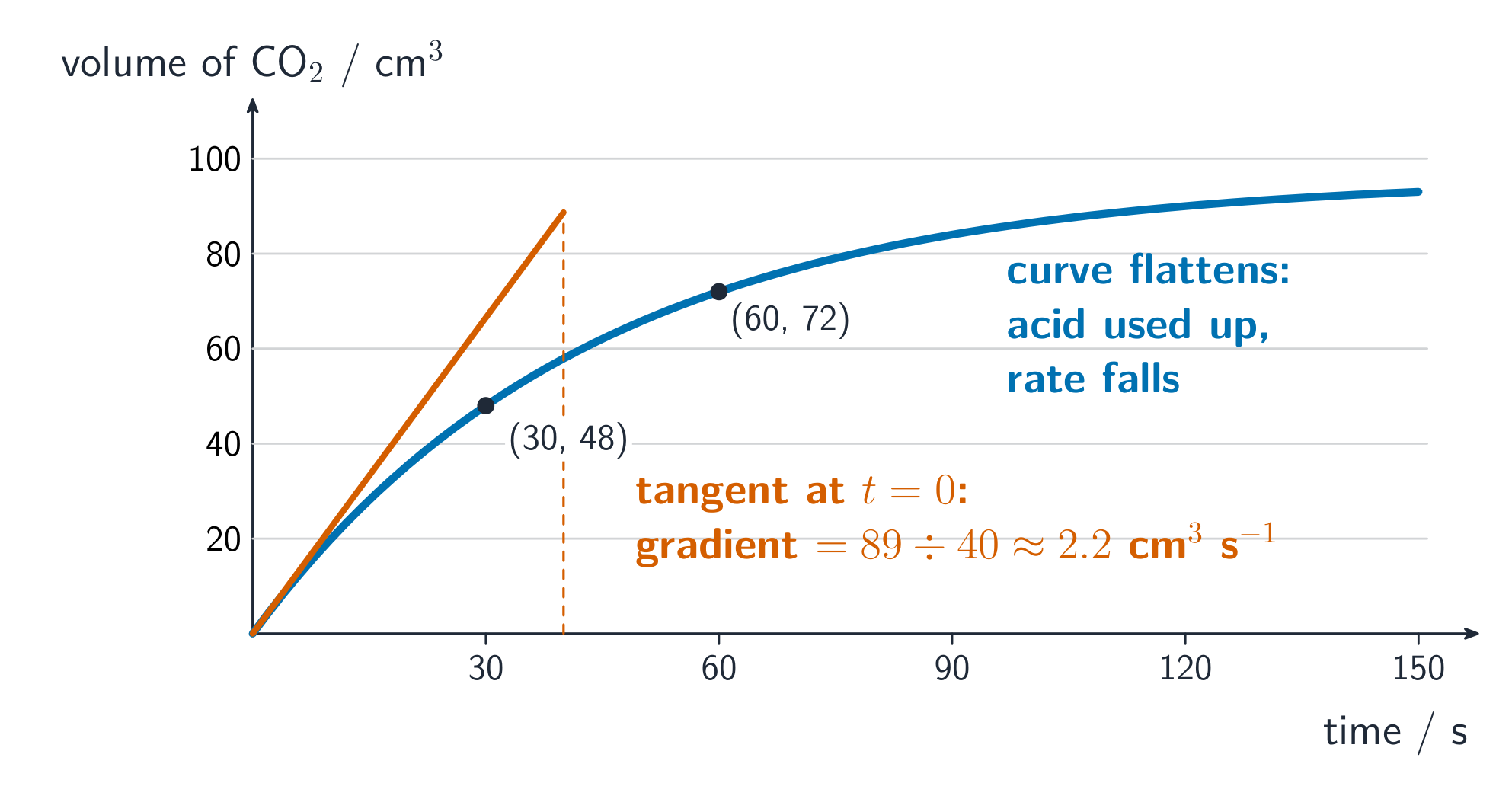
- Plot it against time. The rate at any moment is the gradient of the curve there; the initial rate is the gradient of the tangent at $t=0$.
Worked example: a rate from gas-volume data
Marble chips react with hydrochloric acid. The volume of $\text{CO}_2$ is 0 at the start, $48\ \text{cm}^3$ after 30 s and $72\ \text{cm}^3$ after 60 s.
- Mean rate over the first 30 s $= \dfrac{48}{30} = 1.6\ \dfrac{\text{cm}^3}{\text{s}}$; over the next 30 s it is $\dfrac{72 - 48}{30} = 0.8\ \dfrac{\text{cm}^3}{\text{s}}$.
- The rate falls because the acid is used up, so its concentration and the collision frequency drop.
- The initial rate is steeper than either mean rate. In the graph above, the tangent at $t=0$ passes through (40, 89), so the initial rate $=\dfrac{89}{40}\approx$ 2.2 cm³ s⁻¹.
A reaction loses 0.36 g of mass in its first 120 s. What is the mean rate of mass loss, in grams per second?
难度 2/5 · 今日首次完成可获 140 金币及少量额外奖励
$\dfrac{0.36}{120} = 0.0030$ g each second.
A tangent drawn at $t=0$ on a gas-volume graph passes through (0, 0) and (25 s, 60 cm³). What is the initial rate in cm³ s⁻¹?
难度 2/5 · 今日首次完成可获 140 金币及少量额外奖励
梯度 $=\dfrac{60}{25}=2.4$ cm³ s⁻¹.
Rate in mol dm⁻³ s⁻¹. In another reaction, [A] falls from 0.80 to 0.50 mol dm⁻³ in the first 40 s. Find the mean rate.
- Rate $=\dfrac{\text{change in concentration}}{\text{time}}=\dfrac{0.80-0.50}{40}=$ 0.0075 mol dm⁻³ s⁻¹ (7.5 × 10⁻³).
- Rate is always given as a positive number, even though [A] decreases.
The concentration of a product rises from 0 to 0.12 mol dm⁻³ in 60 s. Calculate the mean rate in mol dm⁻³ s⁻¹.
难度 2/5 · 今日首次完成可获 140 金币及少量额外奖励
$\dfrac{0.12}{60}=0.0020$ mol dm⁻³ s⁻¹.
- Higher concentration means more frequent collisions, not more energetic ones. The fraction of collisions that are effective stays the same.
- Draw a tangent so it touches the curve at one point; don't join two data points (that gives a mean rate).
- Gradient units come from the axes: cm³ s⁻¹ for gas volume, mol dm⁻³ s⁻¹ for concentration.
Increasing the concentration gives each collision more energy.
难度 1/5 · 今日首次完成可获 100 金币及少量额外奖励
Concentration changes how often particles collide, not how hard. Temperature changes energy.
You've got it
- rate = change in concentration (or amount) per unit time
- an effective collision needs enough energy + correct orientation
- rate depends on the frequency of effective collisions
- higher concentration/pressure → more frequent collisions → faster rate