| English | 释义 | 拼音 |
|---|---|---|
| enthalpy change/enˈθælpi tʃeɪndʒ/ | 焓变 | hán biàn |
| exothermic/eɡzəˈðɜːmɪk/ | 放热 | fàng rè |
| endothermic/ˌendəʊˈθɜːmɪk/ | 吸热 | xī rè |
| activation energy/ˌæktɪˈveɪʃn ˈenədʒi/ | 活化能 | huó huà néng |
| standard conditions/ˈstændəd kənˈdɪʃnz/ | 标准条件 | biāo zhǔn tiáo jiàn |
| formation | 生成 | shēng chéng |
| combustion/kəmˈbʌstʃn/ | 燃烧 | rán shāo |
| neutralisation/ˌnjuːtrəlaɪˈzeɪʃn/ | 中和 | zhōng hé |
Hot packs and cold packs
- Squeeze a hand warmer and it gets hot: its reaction gives energy to your hands. Crack a sports cold pack and it gets cold: its reaction takes energy from your skin.
- Chemists measure this energy as the enthalpy change 焓变, $\Delta H$, in kJ per mole of reaction.
The sign of $\Delta H$
- The reacting chemicals are the system; everything around them (water, the beaker, the air) is the surroundings. $\Delta H$ is the heat energy the system gains at constant pressure.
- Exothermic 放热: energy goes out to the surroundings, which warm up; $\Delta H$ is negative. Endothermic 吸热: energy comes in, the surroundings cool; $\Delta H$ is positive.
Ammonium nitrate dissolves in water and the temperature falls from 21 °C to 15 °C. Which statement is correct?
难度 1/5 · 今日首次完成可获 100 金币及少量额外奖励
The surroundings (the water) cool, so the system took energy in. Endothermic, ΔH > 0.
Reaction pathway diagrams
- The diagram plots enthalpy against the progress of the reaction. The drop or rise from reactants to products is $\Delta H$.
- The hill in between is the activation energy 活化能, $E_a$: the minimum energy colliding particles need to react. Even exothermic reactions need it, which is why a match is needed to light a fuel.
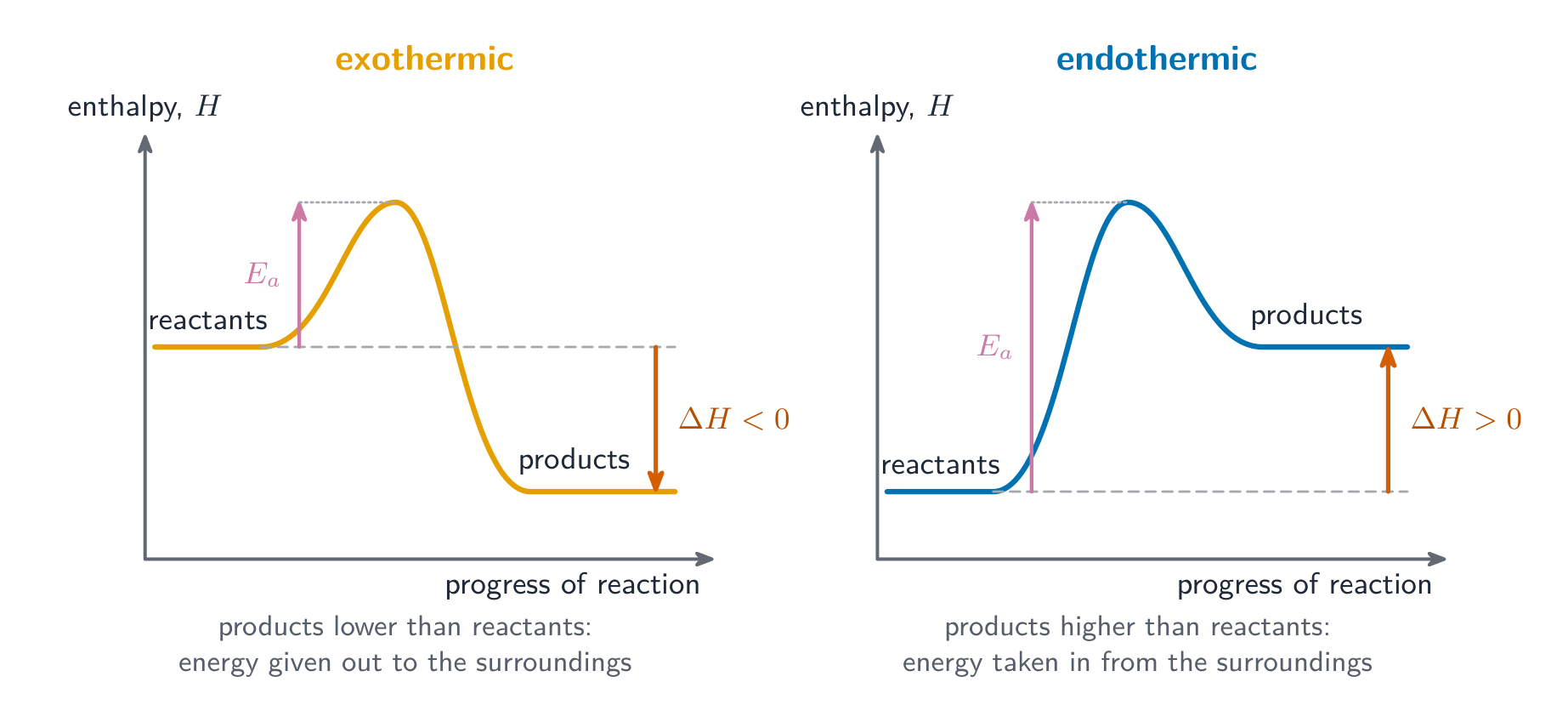
Reaction energy profiles
Ea = 能垒 · ΔH = 生成物 − 反应物
The hump is the activation energy; whether products sit below or above reactants sets ΔH.
The minimum energy that colliding particles need for a reaction to happen is the ______ energy.
难度 1/5 · 今日首次完成可获 100 金币及少量额外奖励
Activation energy, Ea, is the height of the hill on a reaction pathway diagram.
On the pathway diagram of an exothermic reaction, the products are higher than the reactants.
难度 1/5 · 今日首次完成可获 100 金币及少量额外奖励
False. In an exothermic reaction the products are lower; energy has been given out.
Standard conditions
- $\Delta H$ depends on temperature and pressure, so values are compared under standard conditions 标准条件: 298 K and 101 kPa, with each substance in its normal state at 298 K. The symbol is $\Delta H^{\ominus}$.
- Solutions in standard conditions have a concentration of $1.00\ \text{mol dm}^{-3}$.
What are standard conditions for enthalpy changes?
难度 1/5 · 今日首次完成可获 100 金币及少量额外奖励
298 K (25 °C) and 101 kPa, with solutions at 1.00 mol dm⁻³.
Four enthalpy changes to define
- $\Delta H_r^{\ominus}$, reaction: the enthalpy change for the amounts shown in the equation. $\Delta H_f^{\ominus}$, formation 生成: when 1 mol of a compound forms from its elements in their standard states.
- $\Delta H_c^{\ominus}$, combustion 燃烧: when 1 mol of a substance burns completely in oxygen. $\Delta H_{\text{neut}}^{\ominus}$, neutralisation 中和: when an acid and an alkali react to form 1 mol of water.
Match each enthalpy change to what is fixed at 1 mol.
难度 2/5 · 今日首次完成可获 140 金币及少量额外奖励
Each definition fixes a different amount, so read the name of the enthalpy change carefully.
Writing the equations. Write the equations that match $\Delta H_f^{\ominus}$ and $\Delta H_c^{\ominus}$ of ethanol, $\text{C}_2\text{H}_5\text{OH}(\text{l})$.
- Formation: 1 mol of ethanol from its elements, so fractions are allowed on the left: $2\text{C(s)}+3\text{H}_2(\text{g})+\tfrac12\text{O}_2(\text{g})\rightarrow\text{C}_2\text{H}_5\text{OH(l)}$.
- Combustion: 1 mol of ethanol burns completely: $\text{C}_2\text{H}_5\text{OH(l)}+3\text{O}_2(\text{g})\rightarrow2\text{CO}_2(\text{g})+3\text{H}_2\text{O(l)}$.
Which equation represents the standard enthalpy change of formation of water?
难度 1/5 · 今日首次完成可获 100 金币及少量额外奖励
1 mol of water from the elements in their standard states. Oxygen exists as O₂, and water is a liquid at 298 K.
Which equation represents the standard enthalpy change of combustion of methane?
难度 1/5 · 今日首次完成可获 100 金币及少量额外奖励
1 mol of methane burns completely to CO₂ and liquid water. The last option is formation, not combustion.
Does the equation fit the definition?
- $2\text{Na(s)}+\text{Cl}_2(\text{g})\rightarrow2\text{NaCl(s)}$: not $\Delta H_f$, because it makes 2 mol. Halve it: $\text{Na(s)}+\tfrac12\text{Cl}_2(\text{g})\rightarrow\text{NaCl(s)}$.
- $\text{CO(g)}+\tfrac12\text{O}_2(\text{g})\rightarrow\text{CO}_2(\text{g})$: this is $\Delta H_c$ of CO, but not $\Delta H_f$ of $\text{CO}_2$, because CO is not an element.
Why is C(s) + O₂(g) → CO₂(g) both ΔHf of CO₂ and ΔHc of carbon, but CO(g) + ½O₂(g) → CO₂(g) is not ΔHf of CO₂?
难度 1/5 · 今日首次完成可获 100 金币及少量额外奖励
Formation must start from elements only. CO is a compound, so the equation is ΔHc of CO.
- An exothermic $\Delta H$ must have a minus sign: "$-286$ kJ mol$^{-1}$", not "286 kJ released" in a $\Delta H$ box.
- Formation and combustion are both per mole of the named substance. Use fractions on the other side if needed, and give state symbols.
- The $\Delta H_f$ of an element in its standard state is zero by definition.
What is the standard enthalpy change of formation of O₂(g), in kJ mol⁻¹?
难度 2/5 · 今日首次完成可获 140 金币及少量额外奖励
Zero. An element in its standard state is not formed from anything else.
- Exothermic: $\Delta H<0$, surroundings warm. Endothermic: $\Delta H>0$, surroundings cool.
- $E_a$ is the hill from reactants to the top of the pathway diagram.
- Standard conditions: 298 K, 101 kPa, 1.00 mol dm$^{-3}$. $\Delta H_f$ and $\Delta H_c$ are per mole of the substance; $\Delta H_{\text{neut}}$ is per mole of water.