| English | 释义 | 拼音 |
|---|---|---|
| bond energy/bɒnd ˈenədʒi/ | 键能 | jiàn néng |
| average bond energies | 平均键能 | píng jūn jiàn néng |
| calorimetry/ˌkælɔːˈrɪmətri/ | 量热法 | liàng rè fǎ |
| specific heat capacity/spəˈsɪfɪk hiːt kəˈpæsɪti/ | 比热容 | bǐ rè róng |
Where the energy comes from
- In every reaction, bonds in the reactants break and new bonds in the products form. Breaking a bond always takes energy in; forming one always gives energy out.
- If the new bonds release more energy than the old ones needed, the reaction is exothermic. You can estimate $\Delta H$ from bond energies, or measure it in the lab.
Which statement about bonds is correct?
难度 1/5 · 今日首次完成可获 100 金币及少量额外奖励
Breaking a bond is always endothermic and making a bond is always exothermic.
Bond energy
- The bond energy 键能 is the energy needed to break 1 mol of a bond in gaseous molecules. It is always positive.
- Most values are average bond energies 平均键能: a C–H bond in methane is not exactly the same as one in ethanol, so tables give a mean over many compounds.
The C–H bond energy in a data table is exactly right for the C–H bonds in every organic molecule.
难度 1/5 · 今日首次完成可获 100 金币及少量额外奖励
False. It is an average over many compounds, so a bond-energy calculation only gives an estimate.
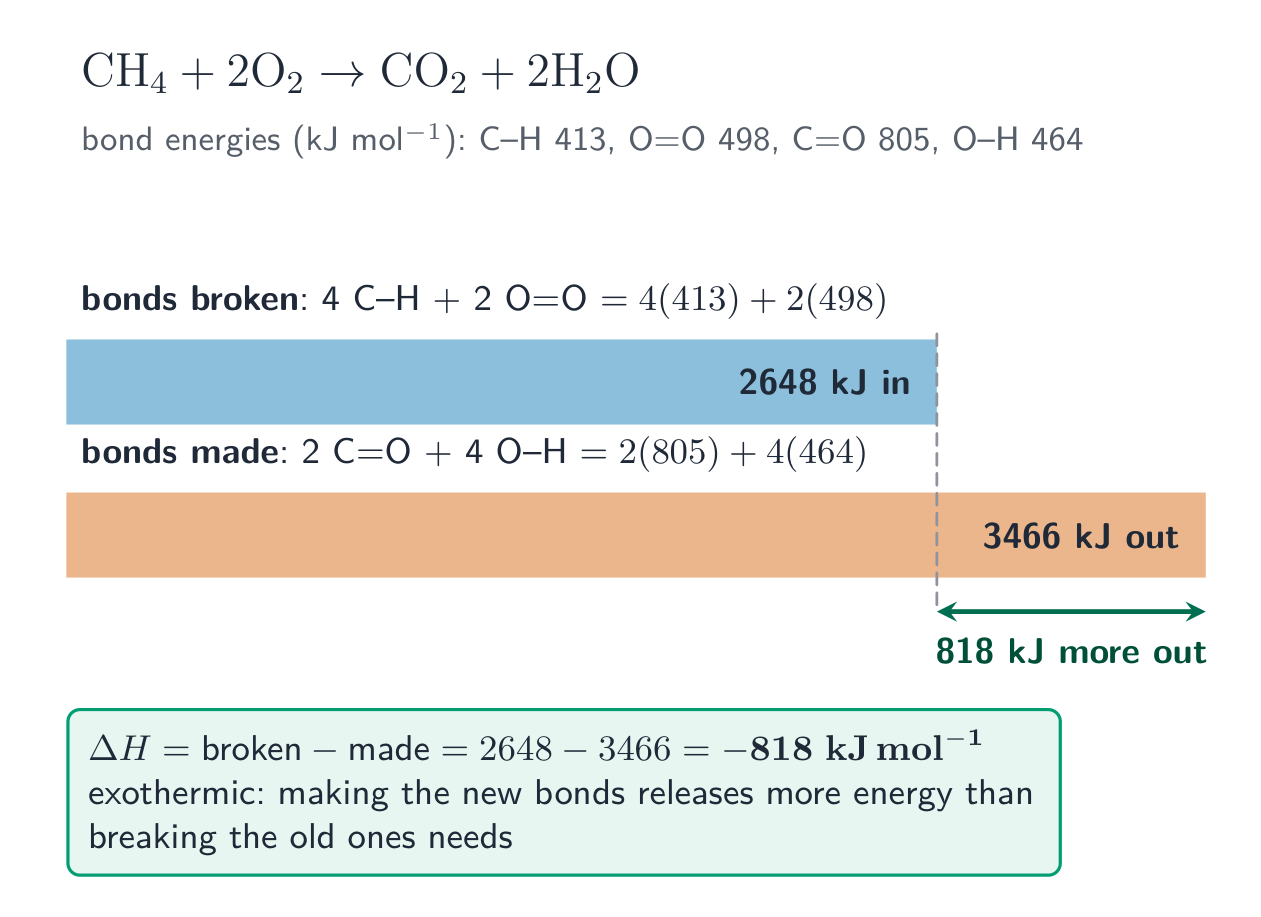
$\Delta H$ = broken − made
- $\Delta H=\sum(\text{bonds broken})-\sum(\text{bonds made})$. Use the positive bond energies on both sides; the subtraction gives the sign.
- Draw or picture the full structures first, so you count every bond, including double bonds such as O=O and C=O.
Energy in, energy out
ΔH = (energy to break bonds) − (energy released forming bonds). Adjust the activation energy and the overall change to compare exothermic and endothermic profiles.
Count only the bonds that change. Estimate $\Delta H$ for $\text{C}_2\text{H}_4+\text{H}_2\rightarrow\text{C}_2\text{H}_6$. (kJ mol$^{-1}$: C=C 612, C–C 347, H–H 436, C–H 413)
- The four C–H bonds of ethene are still there in ethane, so leave them out.
- Broken: C=C + H–H $=612+436=1048$. Made: C–C + 2 C–H $=347+2\times413=1173$.
- $\Delta H=1048-1173=-125\ \text{kJ mol}^{-1}$.
Estimate ΔH for H₂ + Cl₂ → 2HCl. (kJ mol⁻¹: H–H 436, Cl–Cl 242, H–Cl 431)
难度 2/5 · 今日首次完成可获 140 金币及少量额外奖励
Broken 436 + 242 = 678. Made 2 × 431 = 862. ΔH = 678 − 862 = −184 kJ mol⁻¹.
Estimate ΔH for N₂ + 3H₂ → 2NH₃. (kJ mol⁻¹: N≡N 945, H–H 436, N–H 391)
难度 2/5 · 今日首次完成可获 140 金币及少量额外奖励
Broken 945 + 3 × 436 = 2253. Made 6 N–H = 6 × 391 = 2346. ΔH = 2253 − 2346 = −93 kJ mol⁻¹.
Why bond-energy answers are only estimates
- Average bond energies are not exact for any one molecule. The data book value for the ethene reaction above is $-137\ \text{kJ mol}^{-1}$, not $-125$.
- Bond energies are for gases. If water forms as a liquid, extra energy is released as it condenses, so the real $\Delta H$ is more negative.
Why can a ΔH found from bond energies differ from the data book value? Select all that apply.
难度 2/5 · 今日首次完成可获 140 金币及少量额外奖励
Averages and changes of state cause the difference. Bond energies are positive, and Ea does not change ΔH.
Measuring $\Delta H$: calorimetry
- In calorimetry 量热法 the reaction heats or cools a known mass of water or solution. The energy transferred is $q=mc\Delta T$: $m$ in g, specific heat capacity 比热容 $c=4.18\ \text{J g}^{-1}\text{K}^{-1}$, $\Delta T$ in K.
- Then $\Delta H=-\dfrac{q}{n}$, with $q$ in kJ and $n$ the moles that reacted. The minus sign makes $\Delta H$ negative when the temperature rises.
A reaction raises the temperature of 25.0 g of solution by 12.0 K. How much energy, in J, was transferred? (c = 4.18 J g⁻¹ K⁻¹)
难度 2/5 · 今日首次完成可获 140 金币及少量额外奖励
q = 25.0 × 4.18 × 12.0 = 1254 J.
Neutralisation in a polystyrene cup. $50.0\ \text{cm}^3$ of $1.00\ \text{mol dm}^{-3}$ HCl is mixed with $50.0\ \text{cm}^3$ of $1.00\ \text{mol dm}^{-3}$ NaOH. The temperature rises by 6.8 K.
- Mass of solution $=100$ g (treat it as water, $1\ \text{g cm}^{-3}$). $q=100\times4.18\times6.8=2842$ J $=2.842$ kJ.
- Water formed: $n=1.00\times0.0500=0.0500$ mol.
- $\Delta H_{\text{neut}}=-\dfrac{2.842}{0.0500}=-56.8\ \text{kJ mol}^{-1}$.
Adding 0.0200 mol of zinc to excess copper(II) sulfate solution (50.0 g) raises the temperature by 20.4 K. Calculate ΔH in kJ mol⁻¹ (3 s.f.).
难度 2/5 · 今日首次完成可获 140 金币及少量额外奖励
q = 50.0 × 4.18 × 20.4 = 4264 J = 4.264 kJ. ΔH = −4.264 ÷ 0.0200 = −213 kJ mol⁻¹.
Burning a fuel under a can of water. 0.46 g of ethanol ($M=46.0$) heats 100 g of water by 20.0 K.
- $q=100\times4.18\times20.0=8360$ J $=8.36$ kJ. $n(\text{ethanol})=0.46/46.0=0.0100$ mol.
- $\Delta H_c=-\dfrac{8.36}{0.0100}=-836\ \text{kJ mol}^{-1}$. The data book value is $-1367$.
- The result is far too small because heat escapes to the air and the can, and some ethanol burns incompletely.
A student's value for ΔHc of propanol is −1100 kJ mol⁻¹, but the data book gives −2021. What is the main reason?
难度 1/5 · 今日首次完成可获 100 金币及少量额外奖励
Much of the heat warms the air and the can, so q is too small and ΔH comes out less negative.
- In $q=mc\Delta T$, $m$ is the mass of the water or solution being heated, not the mass of the fuel or solid.
- Convert J to kJ before dividing by $n$, and remember the minus sign for a temperature rise.
- In bond-energy sums, do not put a minus sign on the bonds made and subtract them; that flips the answer.
1.20 g of a solid is added to 50.0 cm³ of water. In q = mc∆T, which value is m?
难度 1/5 · 今日首次完成可获 100 金币及少量额外奖励
m is the mass of the liquid whose temperature changes. The small mass of solid is usually ignored.
- Bond energy: energy to break 1 mol of a bond in the gas state; most are averages.
- $\Delta H=\sum\text{broken}-\sum\text{made}$; only an estimate.
- Calorimetry: $q=mc\Delta T$ (mass of water), then $\Delta H=-q/n$. Heat loss makes measured values too small.