| English | 释义 | 拼音 |
|---|---|---|
| dot-and-cross diagram/dɒt ænd krɒs ˈdaɪəɡræm/ | 点叉图 | diǎn chā tú |
| expanded octet/ekˈspændɪd ɒkˈtet/ | 扩展八隅 | kuò zhǎn bā yú |
| bonding pair/ˈbɒndɪŋ peə/ | 成键电子对 | chéng jiàn diàn zi duì |
| lone pair/ləʊn peə/ | 孤对电子 | gū duì diàn zi |
| triple bond/ˈtrɪpl bɒnd/ | 三键 | sān jiàn |
Drawing the electrons
- A dot-and-cross diagram 点叉图 shows the outer electrons of each atom.
- Dots for one atom, crosses for the other.
- This makes it clear where each bonding electron came from.
A dot-and-cross diagram uses dots and crosses to:
难度 1/5 · 今日首次完成可获 100 金币及少量额外奖励
Different symbols (dots/crosses) track which atom each outer electron came from.
A dot-and-cross diagram shows the outer electrons of each atom in a bond.
难度 1/5 · 今日首次完成可获 100 金币及少量额外奖励
Dots and crosses distinguish the atoms' electrons.
What they can show
- You can draw them for ionic, covalent and coordinate bonding.
- They also handle molecules with an expanded octet 扩展八隅 or an odd number of electrons.
Dot-and-cross diagrams can be drawn for:
难度 1/5 · 今日首次完成可获 100 金币及少量额外奖励
They work for all three, including expanded-octet and odd-electron species.
Match each dot-and-cross term to its meaning.
难度 2/5 · 今日首次完成可获 140 金币及少量额外奖励
Dots and crosses track which atom each electron came from; lone pairs shape the molecule.
Worked examples
- Water: oxygen has two bonding pairs 成键电子对 and two lone pairs 孤对电子.
- Nitrogen ($\text{N}_2$): the atoms share three pairs (a triple bond 三键), with a lone pair on each.
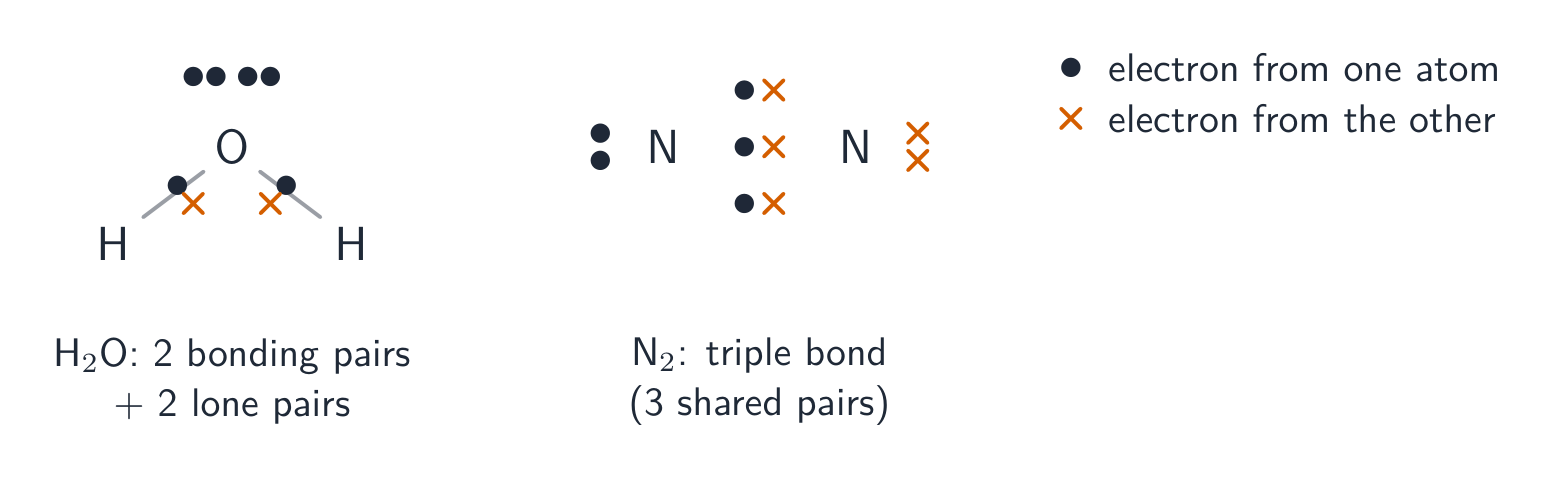
Water (two bonding + two lone pairs on O) and nitrogen (a triple bond) drawn with dots and crosses.
Shape from bonding and lone pairs
Count the bonding pairs and lone pairs around the central atom; they repel into the shape with least strain. Three bonds and one lone pair give a pyramid, like ammonia (NH3).
In the dot-and-cross diagram of water, the oxygen atom has:
难度 1/5 · 今日首次完成可获 100 金币及少量额外奖励
Oxygen forms two O–H bonds (two bonding pairs) and keeps two lone pairs.
The dot-and-cross diagram of N₂ shows:
难度 1/5 · 今日首次完成可获 100 金币及少量额外奖励
Nitrogen molecules share three pairs of electrons (a triple bond) plus a lone pair on each atom.
Worked example: carbon dioxide, step by step
Draw a dot-and-cross diagram for $\text{CO}_2$ (outer electrons only).
- Count: C has 4 outer electrons (crosses), each O has 6 (dots), 16 in all. C needs 4 more and each O needs 2 more, so C shares two pairs with each O: two C=O double bonds.
- Check: C now has 8 around it; each O has 2 shared pairs + 2 lone pairs = 8. So 16 electrons = 4 bonding pairs + 4 lone pairs. Common slips: drawing inner-shell electrons, or forgetting the lone pairs on O.
In a dot-and-cross diagram of HCN, how are the electrons arranged?
难度 1/5 · 今日首次完成可获 100 金币及少量额外奖励
C (4) shares 1 pair with H and 3 with N; N (5) uses 3 in the triple bond and keeps 1 lone pair.
Nitrogen monoxide, NO, has 11 outer electrons in total, so one electron must be unpaired.
难度 1/5 · 今日首次完成可获 100 金币及少量额外奖励
N has 5 and O has 6; an odd total cannot all be in pairs, so NO is a radical.
You've got it
- dot-and-cross = outer electrons, dots for one atom and crosses for the other
- shows where each bonding electron came from; works for ionic, covalent and coordinate bonds
- water = 2 bonding + 2 lone pairs on O; $\text{N}_2$ = 3 shared pairs (triple bond)