Ionisation energy · 电离能
| English | 中文 | Pinyin · 拼音 |
|---|---|---|
| ionisation energy/ˌaɪənaɪˈzeɪʃn ˈenədʒi/ | 电离能 | diàn lí néng |
| gaseous/ˈɡeɪsɪəs/ | 气态 | qì tài |
| nuclear charge/ˈnjuːklɪə tʃɑːdʒ/ | 核电荷 | hé diàn hè |
| atomic radius/əˈtɒmɪk ˈreɪdɪəs/ | 原子半径 | yuán zi bàn jìng |
| shielding/ˈʃiːldɪŋ/ | 屏蔽 | píng bì |
| spin-pair repulsion/spɪn peə rɪˈpʌlʃn/ | 自旋成对排斥 | zì xuán chéng duì pái chì |
How tightly are electrons held?
- Ionisation energy 电离能 is the energy to pull electrons off gaseous 气态 atoms.
- Its trends and dips are powerful evidence for shells and sub-shells.
- It is a favourite exam topic.
电子被抓得有多紧?
- 电离能(ionisation energy) 是把电子从气态原子上拉走所需的能量。
- 它的趋势和凹陷是 壳层和亚层 的有力证据。
- 它是一个热门的考试主题。
First and successive ionisation energies
- The first ionisation energy removes one electron from each atom in a mole of gaseous atoms (unit $\text{kJ}/\text{mol}$):
$$\text{X}(\text{g}) \rightarrow \text{X}^{+}(\text{g}) + \text{e}^{-}$$
- Successive ionisation energies remove the next electron each time, e.g. $\text{X}^{+}(\text{g}) \rightarrow \text{X}^{2+}(\text{g}) + \text{e}^{-}$.
- Each successive value is larger — the electron leaves a more positive ion.
第一电离能和逐级电离能
- 第一电离能(first ionisation energy) 从一摩尔 气态 原子中的每个原子移走一个电子(单位 $\text{kJ}/\text{mol}$):
$$\text{X}(\text{g}) \rightarrow \text{X}^{+}(\text{g}) + \text{e}^{-}$$
- 逐级(successive) 电离能每次移走下一个电子,例如 $\text{X}^{+}(\text{g}) \rightarrow \text{X}^{2+}(\text{g}) + \text{e}^{-}$。
- 每个逐级数值都 更大——电子离开的是一个更正的离子。
Why are gaseous atoms specified in the definition of ionisation energy? · 为什么电离能的定义中指明是气态原子?
Using gaseous atoms means there are no interactions between particles, so the value measures only the atom's own attraction. · 使用气态原子意味着粒子之间没有相互作用,所以这个值只衡量原子自身的吸引力。
The energy to remove one mole of electrons from one mole of gaseous atoms is the first ______ energy. · 从一摩尔气态原子中移走一摩尔电子所需的能量是第一 ______ 能。
It measures how tightly the outer electron is held. · 它衡量外层电子被抓得有多紧。
Each successive ionisation energy is larger than the last because: · 每个逐级电离能都比上一个大,因为:
After each removal the ion is more positive, so the next electron is held more tightly. · 每移走一个之后离子更正,所以下一个电子被抓得更紧。
What it depends on
- nuclear charge 核电荷 — more protons → stronger pull → higher IE.
- atomic radius 原子半径 — outer electron further out → weaker pull → lower IE.
- shielding 屏蔽 — more inner shells → more shielding → lower IE.
Successive ionisation energies of sodium: big jumps reveal the 2,8,1 shells
它取决于什么
- 核电荷——更多质子 → 更强的拉力 → 更高的电离能。
- 原子半径——外层电子更靠外 → 更弱的拉力 → 更低的电离能。
- 屏蔽——更多内壳层 → 更多屏蔽 → 更低的电离能。
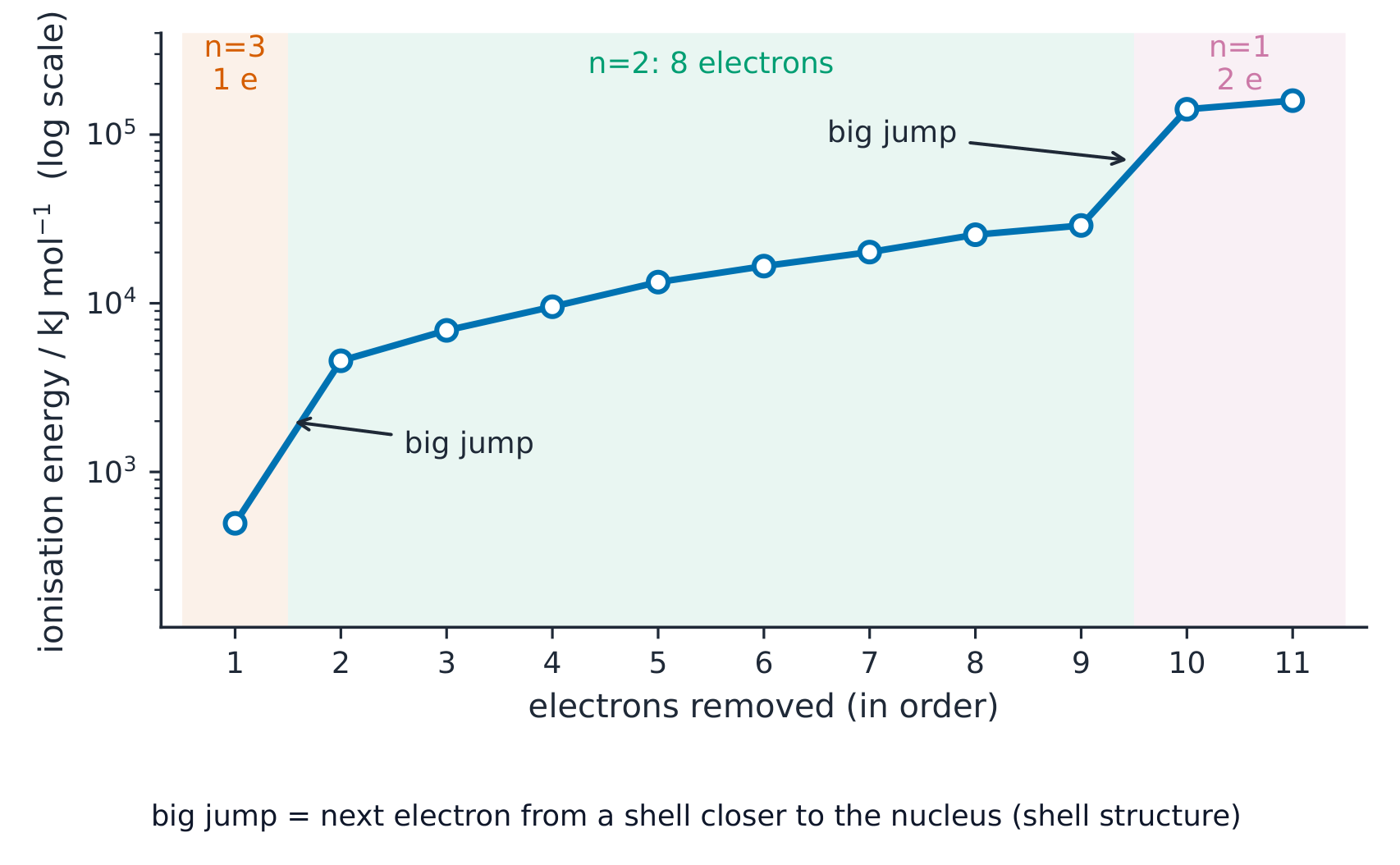
钠的逐级电离能:大跳跃揭示出 2,8,1 的壳层
Which change would LOWER the first ionisation energy? · 哪个变化会降低第一电离能?
More shielding weakens the pull on the outer electron, lowering the ionisation energy. · 更多的屏蔽减弱了对外层电子的拉力,降低电离能。
Match each change to its effect on first ionisation energy. · 把每个变化与它对第一电离能的影响配对。
IE rises with nuclear pull and falls with distance/shielding; successive ionisations always rise. · 电离能随核的拉力上升,随距离/屏蔽下降;逐级电离总是上升。
Trends and the tell-tale dips
- Across a period IE generally rises; down a group it falls.
- But two dips appear in Period 3 — evidence for sub-shells:
- Al dip: its electron comes from a higher-energy 3p sub-shell.
- S dip: a paired 3p electron is easier to remove (spin-pair repulsion 自旋成对排斥).
趋势和那两处暴露真相的凹陷
- 沿一个周期电离能总体 上升;沿一个族向下它 下降。
- 但第 3 周期出现两处凹陷——亚层 的证据:
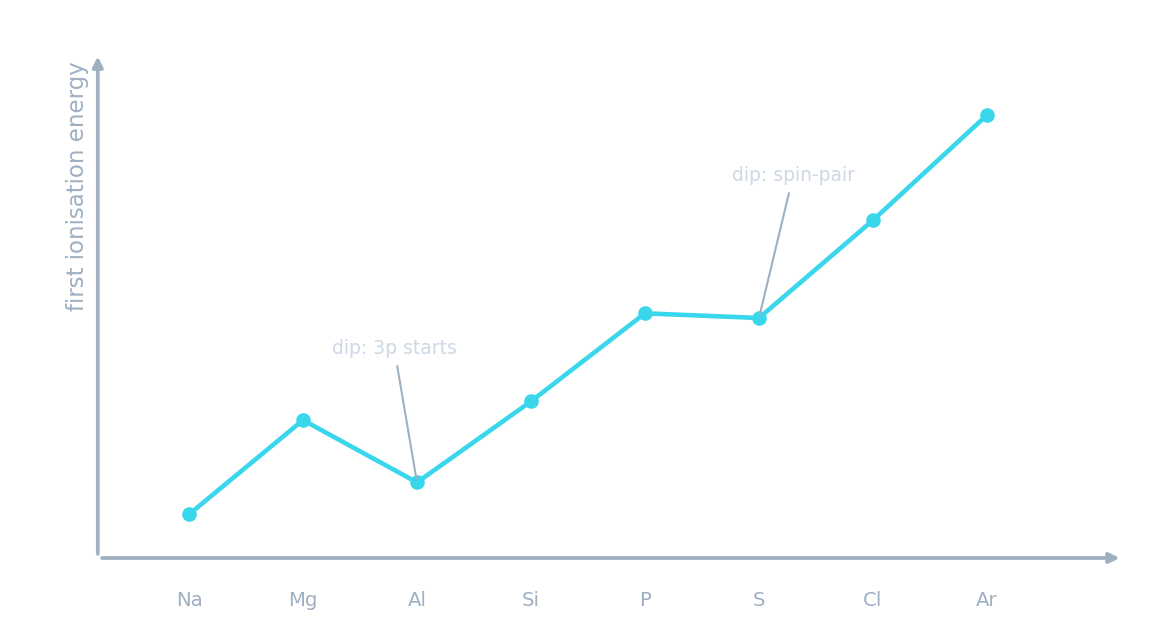
- Al 凹陷:它的电子来自一个更高能量的 3p 亚层。
- S 凹陷:一个成对的 3p 电子更容易移走(自旋配对排斥(spin-pair repulsion))。
The ionisation-energy trend — and its dips · 电离能的趋势——以及它的凹陷
First ionisation energy generally rises across a period, but DIPS where a new p sub-shell starts and where a p-orbital pair first forms. Step across to find the two tell-tale dips. · 第一电离能沿一个周期总体上升,但在一个新 p 亚层开始处、以及一个 p 轨道首次配对处会出现凹陷。一步步走过去,找出那两处暴露真相的凹陷。
The dip in first ionisation energy at aluminium (vs magnesium) is because: · 铝处第一电离能的凹陷(相对镁)是因为:
Al's outer electron is in 3p (higher energy than Mg's full 3s), so it is easier to remove — a dip. · 铝的外层电子在 3p(能量高于镁充满的 3s),所以更容易移走——一处凹陷。
Successive IE → shells
- Big jumps appear when the next electron must come from a shell closer in.
- Counting the electrons removed before the first big jump gives the element's group.
逐级电离能 → 壳层
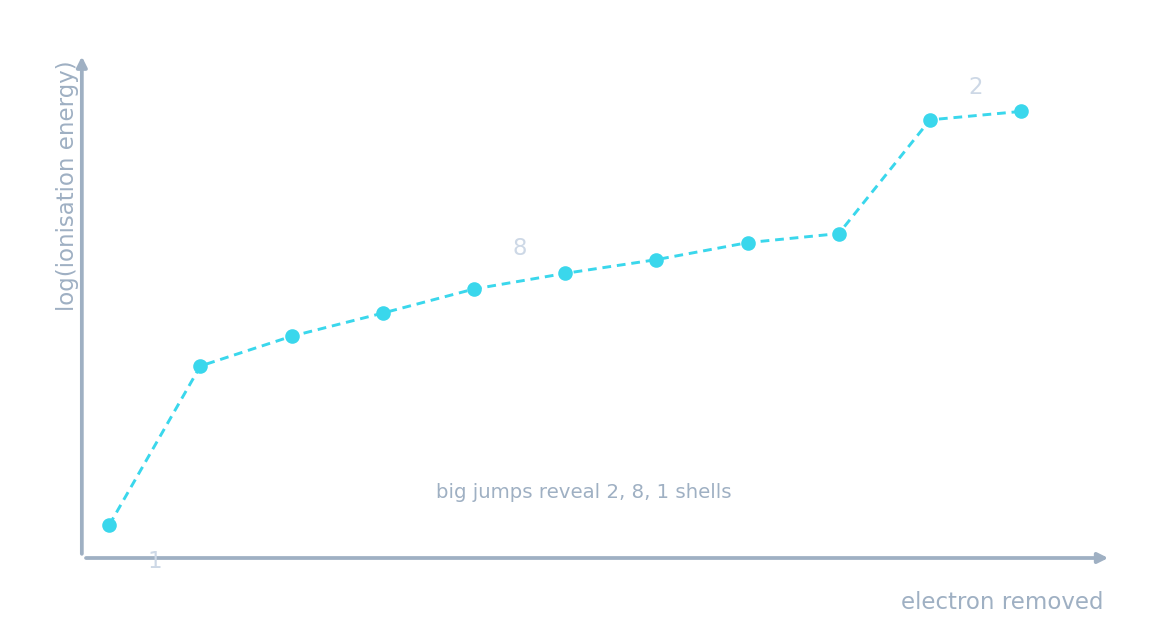
- 当下一个电子必须来自 更靠内的壳层 时,出现大 跳跃。
- 数一数第一个大跳跃前移走的电子数,给出元素的 族。
A big jump in successive ionisation energies happens when: · 逐级电离能中的大跳跃发生在:
The big jump marks moving to an inner shell; counting electrons before the first jump gives the outer-shell number (the group). · 大跳跃标志着移到一个内壳层;数一数第一个跳跃前的电子数,给出外壳层的数目(族)。
A big jump in successive ionisation energies marks the move to a new, inner shell. · 逐级电离能中的大跳跃标志着移到一个新的、更靠内的壳层。
The jumps reveal the shell structure — e.g. sodium's successive IEs split into 1, then 8, then 2. · 这些跳跃揭示出壳层结构——例如钠的逐级电离能分成 1,然后 8,然后 2。
You've got it
- 1st IE: $\text{X}(\text{g}) \rightarrow \text{X}^{+}(\text{g}) + \text{e}^{-}$ (gaseous, $\text{kJ}/\text{mol}$); successive values keep rising
- IE depends on nuclear charge, radius, shielding
- across a period IE rises (dips at Al = 3p starts, S = spin-pair); down a group it falls
- big jumps in successive IE reveal the shell structure (and the group)
你掌握了
- 第一电离能:$\text{X}(\text{g}) \rightarrow \text{X}^{+}(\text{g}) + \text{e}^{-}$(气态,$\text{kJ}/\text{mol}$);逐级数值持续 上升
- 电离能取决于 核电荷、半径、屏蔽
- 沿一个周期电离能 上升(在 Al = 3p 开始、S = 自旋配对 处凹陷);沿一个族向下它 下降
- 逐级电离能 中的大跳跃揭示出 壳层 结构(以及族)