Electron configuration · 电子排布
| English | 中文 | Pinyin · 拼音 |
|---|---|---|
| shell/ʃel/ | 壳层 | ké céng |
| sub-shell/sʌb ʃel/ | 亚层 | yà céng |
| orbital/ˈɔːbɪtl/ | 轨道 | guǐ dào |
| principal quantum number/ˈprɪnsɪpl ˈkwɒntəm ˈnʌmbə/ | 主量子数 | zhǔ liàng zǐ shù |
| configuration/kənˌfɪɡjəˈreɪʃn/ | 电子排布 | diàn zi pái bù |
| transition metal/trænˈsɪʃn ˈmetl/ | 过渡金属 | guò dù jīn shǔ |
Where the electrons live
- Electrons sit in shells 壳层, split into sub-shells 亚层, built from orbitals 轨道.
- They fill from lowest energy up.
- One surprise: 4s fills before 3d.
电子住在哪里
- 电子坐在 壳层(shells) 里,分成 亚层(sub-shells),由 轨道(orbitals) 构成。
- 它们从 最低能量 往上填。
- 一个意外:4s 在 3d 之前填。
The electron configuration of sodium (11 electrons) is 1s² 2s² 2p⁶ ______. · 钠(11 个电子)的电子排布是 1s² 2s² 2p⁶ ______。
Sodium has one electron in the 3s sub-shell. · 钠在 3s 亚层有一个电子。
Shells, sub-shells and orbitals
- Each shell has a principal quantum number 主量子数 $n = 1, 2, 3, \dots$ (bigger $n$ = further out, higher energy).
- Sub-shells are s, p, d; each is made of orbitals holding 2 electrons each.
| Sub-shell | Orbitals | Max electrons |
|---|---|---|
| s | 1 | 2 |
| p | 3 | 6 |
| d | 5 | 10 |
壳层、亚层和轨道
- 每个壳层有一个 主量子数 $n = 1, 2, 3, \dots$(更大的 $n$ = 更靠外、能量更高)。
- 亚层是 s、p、d;每个由 轨道 构成,每个轨道容纳 2 个电子。
| 亚层 | 轨道 | 最多电子 |
|---|---|---|
| s | 1 | 2 |
| p | 3 | 6 |
| d | 5 | 10 |
Filling the shells · 填充壳层
Drag the proton number. Electrons fill the shells from the inside out (2, then 8, then 8) — the basis of the periodic table. · 拖动质子数。电子从里到外填充壳层(2,然后 8,然后 8)——周期表的基础。
How many electrons can a p sub-shell hold? · 一个 p 亚层能容纳多少个电子?
A p sub-shell has 3 orbitals, each holding 2 electrons, so 6 in total (s = 2, d = 10). · 一个 p 亚层有 3 个轨道,每个容纳 2 个电子,所以共 6 个(s = 2,d = 10)。
Match each sub-shell to how many electrons it holds. · 把每个亚层与它容纳的电子数配对。
Each orbital holds 2; s has 1 orbital, p has 3, d has 5 — so 2, 6 and 10 electrons. · 每个轨道容纳 2 个;s 有 1 个轨道,p 有 3 个,d 有 5 个——所以是 2、6 和 10 个电子。
Order of filling
- 4s is lower than 3d, so 4s fills first.
填充顺序
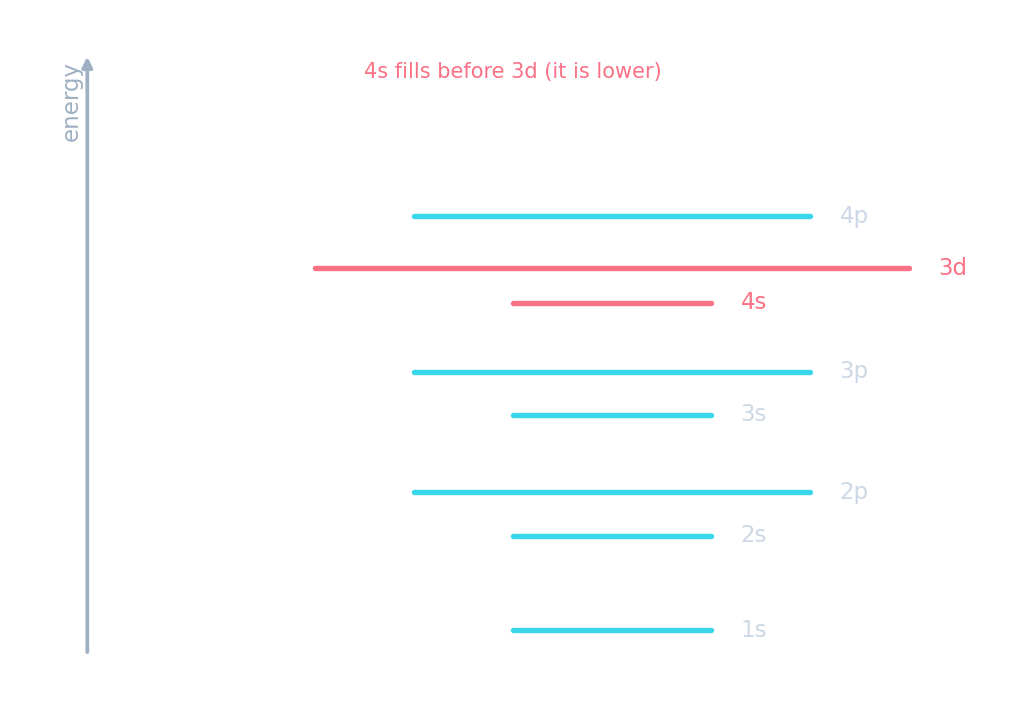
- 4s 比 3d 低,所以 4s 先填。
Which sub-shell fills first? · 哪个亚层先填?
4s lies just below 3d in energy, so 4s fills before 3d. · 4s 在能量上正好低于 3d,所以 4s 在 3d 之前填。
Put these sub-shells in the order they fill. · 把这些亚层按它们填充的顺序排列。
Fill by energy, not by number: 4s comes before 3d. · 按能量填,而不是按数字:4s 在 3d 之前。
Writing configurations 电子排布
- Iron (Fe, $Z=26$): $1\text{s}^2\,2\text{s}^2\,2\text{p}^6\,3\text{s}^2\,3\text{p}^6\,3\text{d}^6\,4\text{s}^2$, or shorthand $[\text{Ar}]\,3\text{d}^6\,4\text{s}^2$.
- For positive ions, a transition metal 过渡金属 loses its 4s electrons first: $\text{Fe}^{3+}$ is $[\text{Ar}]\,3\text{d}^5$.
写电子排布
- 铁(Fe,$Z=26$):$1\text{s}^2\,2\text{s}^2\,2\text{p}^6\,3\text{s}^2\,3\text{p}^6\,3\text{d}^6\,4\text{s}^2$,或简写 $[\text{Ar}]\,3\text{d}^6\,4\text{s}^2$。
- 对于正离子,过渡金属 先失去它的 4s 电子:$\text{Fe}^{3+}$ 是 $[\text{Ar}]\,3\text{d}^5$。
The ground-state configuration of iron (Z = 26) is: · 铁(Z = 26)的基态电子排布是:
After argon (18), iron adds 4s² then 3d⁶: [Ar] 3d⁶ 4s². · 在氩(18)之后,铁加上 4s² 然后 3d⁶:[Ar] 3d⁶ 4s²。
When iron forms Fe³⁺, which electrons are lost first? · 当铁形成 Fe³⁺ 时,先失去哪些电子?
Transition metals lose 4s before 3d, so Fe³⁺ is [Ar] 3d⁵. · 过渡金属先失去 4s 再失去 3d,所以 Fe³⁺ 是 [Ar] 3d⁵。
You've got it
- shells ($n$) → sub-shells (s/p/d) → orbitals (2 electrons each); s=2, p=6, d=10
- fill lowest energy first; 4s fills before 3d
- Fe: $[\text{Ar}]\,3\text{d}^6\,4\text{s}^2$
- ions lose 4s before 3d: $\text{Fe}^{3+} = [\text{Ar}]\,3\text{d}^5$
你掌握了
- 壳层($n$)→ 亚层(s/p/d)→ 轨道(每个 2 个电子);s=2,p=6,d=10
- 先填最低能量;4s 在 3d 之前填
- Fe:$[\text{Ar}]\,3\text{d}^6\,4\text{s}^2$
- 离子 先失去 4s 再失去 3d:$\text{Fe}^{3+} = [\text{Ar}]\,3\text{d}^5$