| English | 释义 | 拼音 |
|---|---|---|
| profitability/ˌprɒfɪtəˈbɪlɪti/ | 盈利能力 | yíng lì néng lì |
| liquidity/lɪˈkwɪdɪti/ | 流动性 | liú dòng xìng |
| capital employed/ˈkæpɪtl emˈplɔɪd/ | 所用资本 | suǒ yòng zī běn |
| gross profit margin/ɡrəʊs ˈprɒfɪt ˈmɑːdʒɪn/ | 毛利率 | máo lì lǜ |
| operating profit margin/ˈɒpəreɪtɪŋ ˈprɒfɪt ˈmɑːdʒɪn/ | 营业利润率 | yíng yè lì rùn lǜ |
| return on capital employed/rɪˈtɜːn ɒn ˈkæpɪtl emˈplɔɪd/ | 已动用资本回报率 | yǐ dòng yòng zī běn huí bào lǜ |
| current ratio/ˈkʌrənt ˈreɪʃɪəʊ/ | 流动比率 | liú dòng bǐ lǜ |
| acid-test ratio/ˈæsɪd test ˈreɪʃɪəʊ/ | 速动比率 | sù dòng bǐ lǜ |
Sales are up 25%. Is the business doing better?
- Thread & Co, a clothing retailer, opened a second shop. Its revenue rose from 800,000 to 1,000,000 dollars in one year, and the owners were pleased.
- Revenue alone does not show how well a firm is doing. Ratios compare one figure with another, so firms of different sizes, or the same firm in different years, can be compared. This lesson covers two groups: profitability 盈利能力 and liquidity 流动性.
The accounts we will use
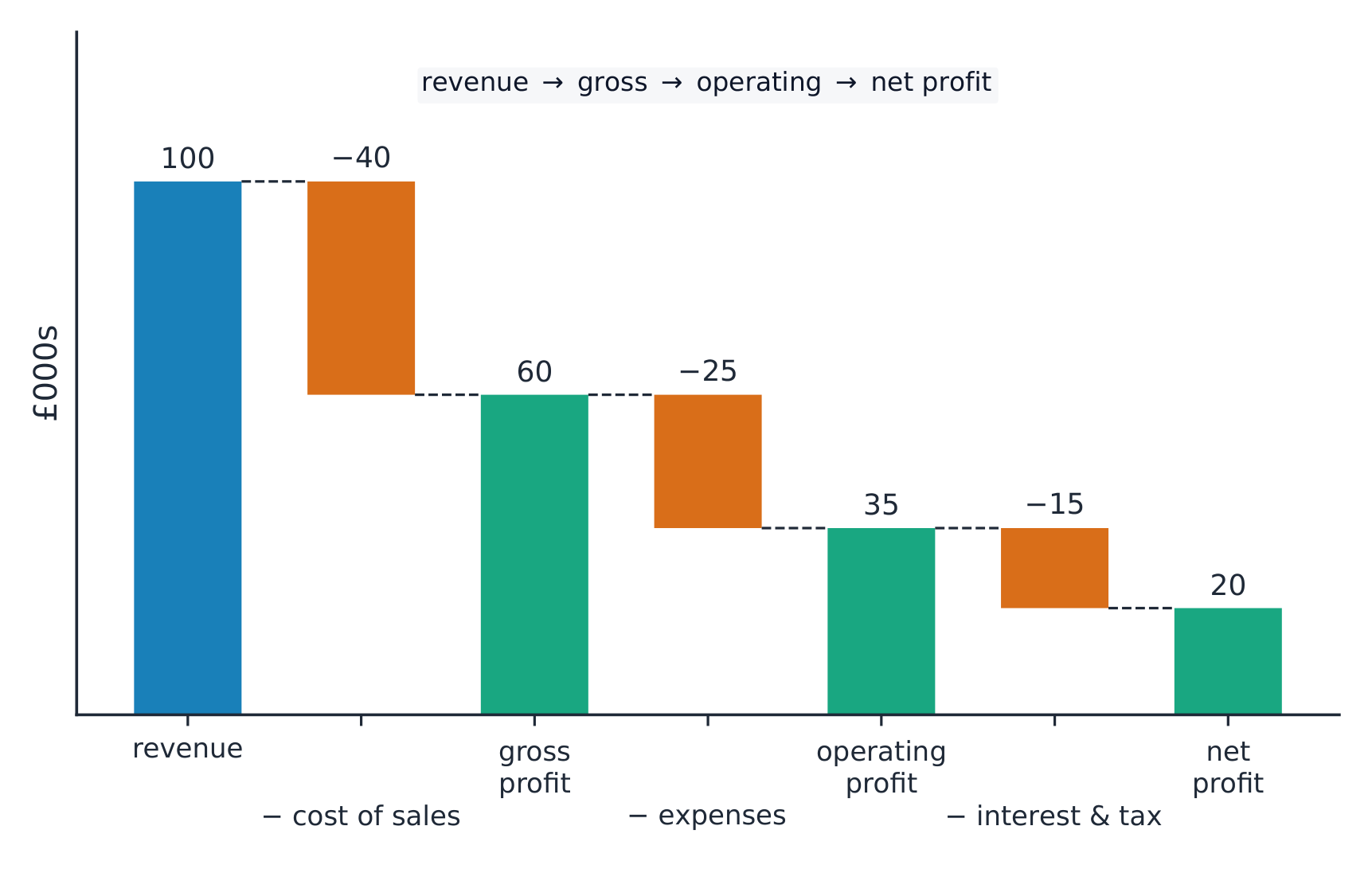
- Figures in $000, from the income statement and the statement of financial position.
| $000 | 2025 | 2026 |
|---|---|---|
| Revenue | 800 | 1,000 |
| Cost of sales | 480 | 650 |
| Gross profit | 320 | 350 |
| Expenses | 200 | 250 |
| Operating profit | 120 | 100 |
| Capital employed | 600 | 800 |
| Inventory | 90 | 160 |
| Current assets | 150 | 210 |
| Current liabilities | 100 | 150 |
- Capital employed 所用资本 = equity + non-current liabilities: all the long-term money put into the business.
Profitability ratios
- Gross profit margin 毛利率 = gross profit ÷ revenue × 100
- Operating profit margin 营业利润率 = operating profit ÷ revenue × 100
- ROCE 已动用资本回报率 (return on capital employed) = operating profit ÷ capital employed × 100
Thread & Co
| Ratio | 2025 | 2026 |
|---|---|---|
| Gross margin | 320 ÷ 800 = 40% | 350 ÷ 1,000 = 35% |
| Operating margin | 120 ÷ 800 = 15% | 100 ÷ 1,000 = 10% |
| ROCE | 120 ÷ 600 = 20% | 100 ÷ 800 = 12.5% |
- All three fell. Each dollar of sales now earns less profit, and the extra 200,000 of capital (the new shop) earns less than the old capital did.
- ROCE is the best single measure: compare it with the interest rate a bank pays. A ROCE below that rate means the money would earn more in the bank.
Gross profit is 90 and revenue is 300. What is the gross profit margin (%)?
难度 2/5 · 今日首次完成可获 140 金币及少量额外奖励
90 ÷ 300 × 100 = 30%.
Operating profit is 40 and capital employed is 200. What is ROCE (%)?
难度 2/5 · 今日首次完成可获 140 金币及少量额外奖励
40 ÷ 200 × 100 = 20%.
Revenue is 450,000 and operating profit is 54,000. What is the operating profit margin (%)?
难度 2/5 · 今日首次完成可获 140 金币及少量额外奖励
54,000 ÷ 450,000 × 100 = 12%.
Why margins change, and how to raise them
| Ratio fell because… | Ways to improve it |
|---|---|
| Gross margin: cost of sales rose faster than revenue (higher supplier prices, or price cuts to win sales) | find cheaper suppliers; buy in bulk; raise prices on popular lines |
| Operating margin: expenses rose (rent and wages of the new shop) | cut overheads; use staff and space better |
| ROCE: new capital not yet earning much | raise operating profit; sell assets that are not used |
- Each way has a cost: a higher price may cut sales, and a cheaper supplier may lower quality.
A firm's gross profit margin falls from 45% to 38%, but its expenses stay the same. What is the most likely cause?
难度 1/5 · 今日首次完成可获 100 金币及少量额外奖励
Gross margin only uses revenue and cost of sales. Rent, interest and buying assets do not affect it.
Liquidity ratios
- Current ratio 流动比率 = current assets ÷ current liabilities. Around 1.5 to 2 is often seen as comfortable.
- Acid-test ratio 速动比率 = (current assets − inventory) ÷ current liabilities. It leaves out stock, which may be slow to sell. Around 1 is often seen as safe.
Thread & Co
| Ratio | 2025 | 2026 |
|---|---|---|
| Current | 150 ÷ 100 = 1.5 | 210 ÷ 150 = 1.4 |
| Acid test | (150 − 90) ÷ 100 = 0.6 | (210 − 160) ÷ 150 = 0.33 |
- The current ratio looks fine, but the acid test shows the real problem: for every dollar due soon, Thread & Co has only 33 cents that is not stock. Inventory almost doubled (90 → 160).
Current assets are 120 and current liabilities are 60. What is the current ratio?
难度 2/5 · 今日首次完成可获 140 金币及少量额外奖励
120 ÷ 60 = 2 (i.e. 2:1).
The liquidity ratio that excludes inventory is the ______-test ratio.
难度 1/5 · 今日首次完成可获 100 金币及少量额外奖励
Acid-test = (current assets − inventory) ÷ current liabilities.
Current assets are 240,000, of which inventory is 120,000. Current liabilities are 160,000. What is the acid-test ratio?
难度 2/5 · 今日首次完成可获 140 金币及少量额外奖励
(240,000 − 120,000) ÷ 160,000 = 120,000 ÷ 160,000 = 0.75.
Too low or too high?
- Too low: the firm may not pay suppliers, staff or the bank on time. Retailers often run lower ratios because stock sells quickly for cash, so compare with similar firms.
- Too high: cash and stock are sitting idle instead of earning a return.
- To raise liquidity: sell off slow stock (even at a discount), chase customers who owe money, use a sale and leaseback, or turn a short-term loan into a long-term one.
账户比率诊断
Classify ratios by the question they answer about a business.
A firm has a current ratio of 4.5. What is the main concern?
难度 1/5 · 今日首次完成可获 100 金币及少量额外奖励
A very high current ratio means assets sit idle. Some of that cash or stock could be used to earn a return.
Worked exam answer
Using the ratios, evaluate whether opening the second shop has improved Thread & Co's performance. [10]
Profitability: revenue rose by 25%, but the gross margin fell from 40% to 35%, so cost of sales grew faster than sales, perhaps because of price cuts to attract customers to the new shop. The operating margin fell from 15% to 10% as the new shop's rent and wages added 50,000 of expenses. ROCE fell from 20% to 12.5%, so the 200,000 invested earns much less than the old business.
Liquidity: the acid test fell from 0.6 to 0.33, because inventory rose from 90,000 to 160,000. The firm may struggle to pay its suppliers.
Evaluation: a new shop often needs time to build sales, so one year of data may be too early to judge. The ratios also do not show non-financial gains, such as a stronger brand. However, the firm must act on the stock problem now: if the high stock is unsold fashion, it may need to be sold at a discount, which would cut margins again.
Judgement: so far the second shop has made performance worse: bigger, but less profitable and less liquid. It could still succeed if the firm cuts stock and its new shop's sales grow next year.
- Why it scores: it calculates and explains each change with a cause from the case, links profitability to liquidity, questions the data (one year only, non-financial factors) and gives a clear, conditional judgement.
Profit is not liquidity. A firm can be profitable and still be unable to pay its bills if its cash is tied up in stock or unpaid invoices. Always check both groups of ratios.
A profitable business can still have poor liquidity if its cash is tied up in stock and debtors.
难度 1/5 · 今日首次完成可获 100 金币及少量额外奖励
Profit and cash are different — check liquidity separately.
You've got it
- gross margin = gross profit ÷ revenue × 100; operating margin = operating profit ÷ revenue × 100
- ROCE = operating profit ÷ capital employed × 100: compare it with interest rates and past years
- current ratio = current assets ÷ current liabilities; acid test = (current assets − inventory) ÷ current liabilities
- always say why a ratio changed and what the firm could do about it; compare years or similar firms, never a ratio on its own
Write from the data: find the gross margin
- Gross profit is 64 and revenue is 200. Operating profit is 18 and capital employed is 120. Current assets are 90 and current liabilities are 30.
- Find the gross margin, ROCE and the current ratio.
Gross profit is 64 and revenue is 200. Operating profit is 18 and capital employed is 120. Current assets are 90 and current liabilities are 30. What are the gross profit margin, ROCE and the current ratio?
64 over 200 is 32 percent. 18 over 120 is 15 percent. 90 over 30 is 3.
What is the current ratio?
难度 1/5 · 今日首次完成可获 100 金币及少量额外奖励
Current assets divided by current liabilities is 3. Other options — 2 (the lesson current ratio); 32 (the gross margin used as the ratio).