The taxonomic hierarchy and kingdoms · 分类阶元与界
| English | 中文 | Pinyin · 拼音 |
|---|---|---|
| taxonomic hierarchy/ˌtæksəˈnɒmɪk ˈhaɪərɑːki/ | 分类层级 | fēn lèi céng jí |
| kingdom/ˈkɪŋdəm/ | 界 | jiè |
| phylum/ˈfaɪləm/ | 门 | mén |
| genus/ˈdʒenəs/ | 属 | shǔ |
| Protoctista/ˈprəʊtəʊktɪstə/ | 原生生物界 | yuán shēng shēng wù jiè |
| Fungi/ˈfʌŋɡi/ | 真菌界 | zhēn jùn jiè |
| photosynthesis/ˌfəʊtəʊˈsɪnθəsɪs/ | 光合作用 | guāng hé zuò yòng |
Sorting all of life
- Inside the Eukarya, organisms are sorted into smaller and smaller groups.
- This is the taxonomic hierarchy 分类层级.
- The Eukarya split into four kingdoms 界.
给所有生命分类
- 在真核生物内部,生物被分成越来越小的组。
- 这是 分类阶元(taxonomic hierarchy)。
- 真核生物分成 四个界(kingdoms)。
The smallest, most specific group in the taxonomic hierarchy is the ______. · 分类阶元中最小、最具体的组是 ______。
Domain → kingdom → phylum → class → order → family → genus → species. · 域 → 界 → 门 → 纲 → 目 → 科 → 属 → 种。
Kingdom to species
- The levels: Kingdom → Phylum 门 → Class → Order → Family → Genus 属 → Species.
- Each level is a smaller, more closely related group, ending at a single species.
从界到种
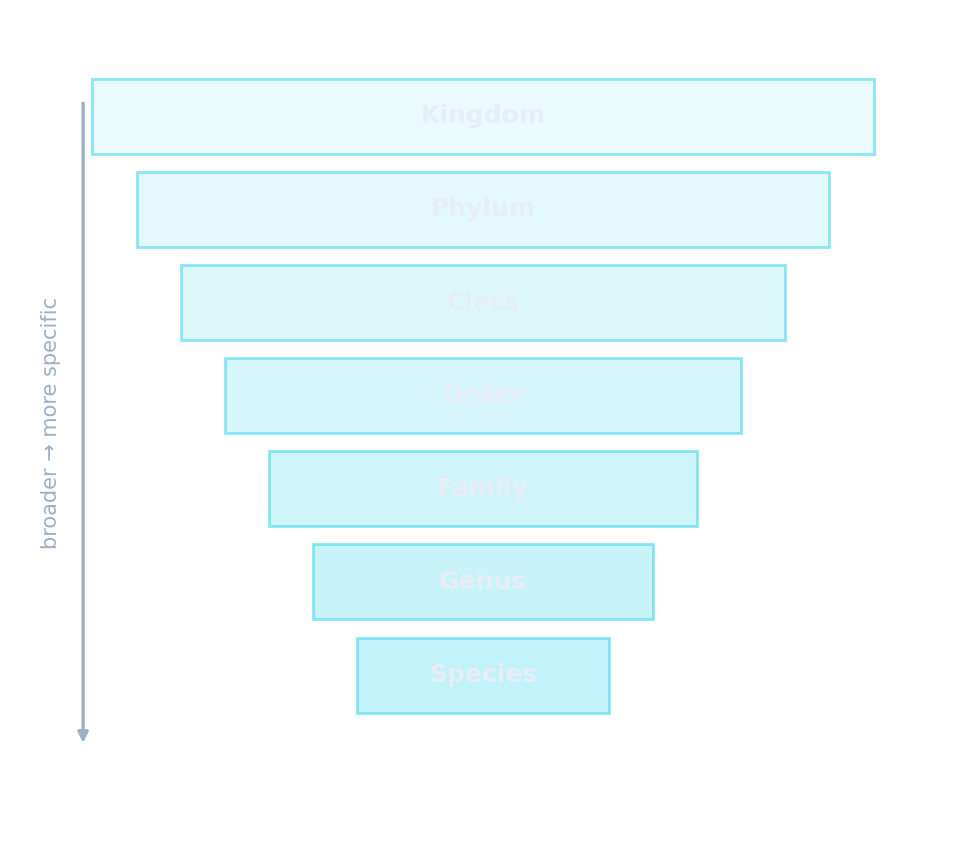
- 这些层级:界 → 门 → 纲 → 目 → 科 → 属 → 种。
- 每个层级是一个 更小、关系更近 的组,以单一物种结束。
The taxonomic hierarchy · 分类阶元
Step down the levels for one species — humans — from the broadest domain to the most specific species. · 对一个物种——人类——沿着这些层级向下,从最广的域到最具体的种。
Put the taxonomic levels in order, from broadest to most specific. · 把分类层级按顺序排列,从最广到最具体。
Kingdom → Phylum → Class → Order → Family → Genus → Species (broad to specific). · 界 → 门 → 纲 → 目 → 科 → 属 → 种(广到具体)。
Which level is the smallest, most closely related group? · 哪个层级是最小、关系最近的组?
Species is the most specific level; kingdom is the broadest. · 种是最具体的层级;界是最广的。
Two organisms in the same genus are more closely related than two that only share the same class. · 同一个属的两个生物比只共享同一个纲的两个关系更近。
The further down the hierarchy two organisms still match, the more closely related they are. · 两个生物在阶元中匹配得越往下,它们关系越近。
The four eukaryote kingdoms
- Protoctista 原生生物界 — mostly single-celled (e.g. Amoeba).
- Fungi 真菌界 — feed by absorbing food; cell walls of chitin.
- Plantae — make their own food by photosynthesis 光合作用.
- Animalia — feed on other organisms.
A museum insect collection: classification groups organisms by shared features.
四个真核生物界
- 原生生物界(Protoctista)——大多单细胞(例如 Amoeba)。
- 真菌界(Fungi)——通过 吸收 食物来取食;几丁质的细胞壁。
- 植物界(Plantae)——通过 光合作用 制造自己的食物。
- 动物界(Animalia)——取食 其他生物。

一个博物馆的昆虫收藏:分类按共有的特征把生物分组。
Which kingdom makes its own food by photosynthesis? · 哪个界通过光合作用制造自己的食物?
Plantae photosynthesise; Animalia feed on others; Fungi absorb food; Protoctista are mostly single-celled. · 植物界光合作用;动物界取食其他;真菌界吸收食物;原生生物界大多单细胞。
Match each kingdom to how it feeds. · 把每个界与它如何取食配对。
Plantae photosynthesise; Fungi absorb; Animalia feed on other organisms; Protoctista are a mixed group. · 植物界光合作用;真菌界吸收;动物界取食其他生物;原生生物界是一个混合的组。
Why classification changes
- New evidence — especially DNA and protein comparisons — can reveal true relationships.
- Organisms are reclassified when the evidence shows the old grouping was wrong.
为什么分类会改变
- 新证据——尤其是 DNA 和蛋白质的比较——能揭示真实的亲缘关系。
- 当证据显示旧的分组是错的时,生物被重新分类。
You've got it
- hierarchy: Kingdom → Phylum → Class → Order → Family → Genus → Species (broad → specific)
- four eukaryote kingdoms: Protoctista, Fungi (absorb), Plantae (photosynthesise), Animalia (feed on others)
你掌握了
- 阶元:界 → 门 → 纲 → 目 → 科 → 属 → 种(广 → 具体)
- 四个真核生物界:原生生物界、真菌界(吸收)、植物界(光合作用)、动物界(取食其他)