| English | 释义 | 拼音 |
|---|---|---|
| carbonic anhydrase/kɑːˈbɒnɪk ˈænhaɪdreɪz/ | 碳酸酐酶 | tàn suān gān méi |
| carbonic acid/kɑːˈbɒnɪk ˈæsɪd/ | 碳酸 | tàn suān |
| hydrogencarbonate/ˈhaɪdrəʊdʒeŋkɑːbɒneɪt/ | 碳酸氢根 | tàn suān qīng gēn |
| chloride shift/ˈklɔːraɪd ʃɪft/ | 氯转移 | lǜ zhuǎn yí |
| carbaminohaemoglobin/ˌkɑːbəˌmɪnəʊˌhiːməˈɡləʊbɪn/ | 氨甲酰血红蛋白 | ān jiǎ xiān xuè hóng dàn bái |
| buffer/ˈbʌfə/ | 缓冲 | huǎn chōng |
Carrying carbon dioxide
- A muscle working hard makes a lot of carbon dioxide. If it built up in the blood, the blood would become acidic and enzymes would stop working.
- The blood carries CO₂ to the lungs in three ways. Most of the chemistry happens inside red blood cells, using an enzyme and haemoglobin.
Three ways to carry CO₂
| Form | Where | % |
|---|---|---|
| hydrogencarbonate ions (HCO₃⁻) | plasma | 85 |
| carbaminohaemoglobin 氨甲酰血红蛋白 | red cells | 10 |
| dissolved CO₂ | plasma | 5 |
- The percentages are approximate. Carbaminohaemoglobin forms when CO₂ binds to the amine groups of haemoglobin, not to the haem groups where oxygen binds.
Most carbon dioxide is carried in the blood as ______ ions in the plasma.
难度 1/5 · 今日首次完成可获 100 金币及少量额外奖励
Formed from CO₂ and water in the red blood cells, then carried in the plasma.
Most carbon dioxide is carried in the blood as:
难度 1/5 · 今日首次完成可获 100 金币及少量额外奖励
The largest share is carried as hydrogencarbonate ions in the plasma.
Where does CO₂ bind to haemoglobin to form carbaminohaemoglobin?
难度 1/5 · 今日首次完成可获 100 金币及少量额外奖励
CO₂ binds to amine groups, not haem, so it does not simply compete with oxygen for the same site.
The reaction in red blood cells
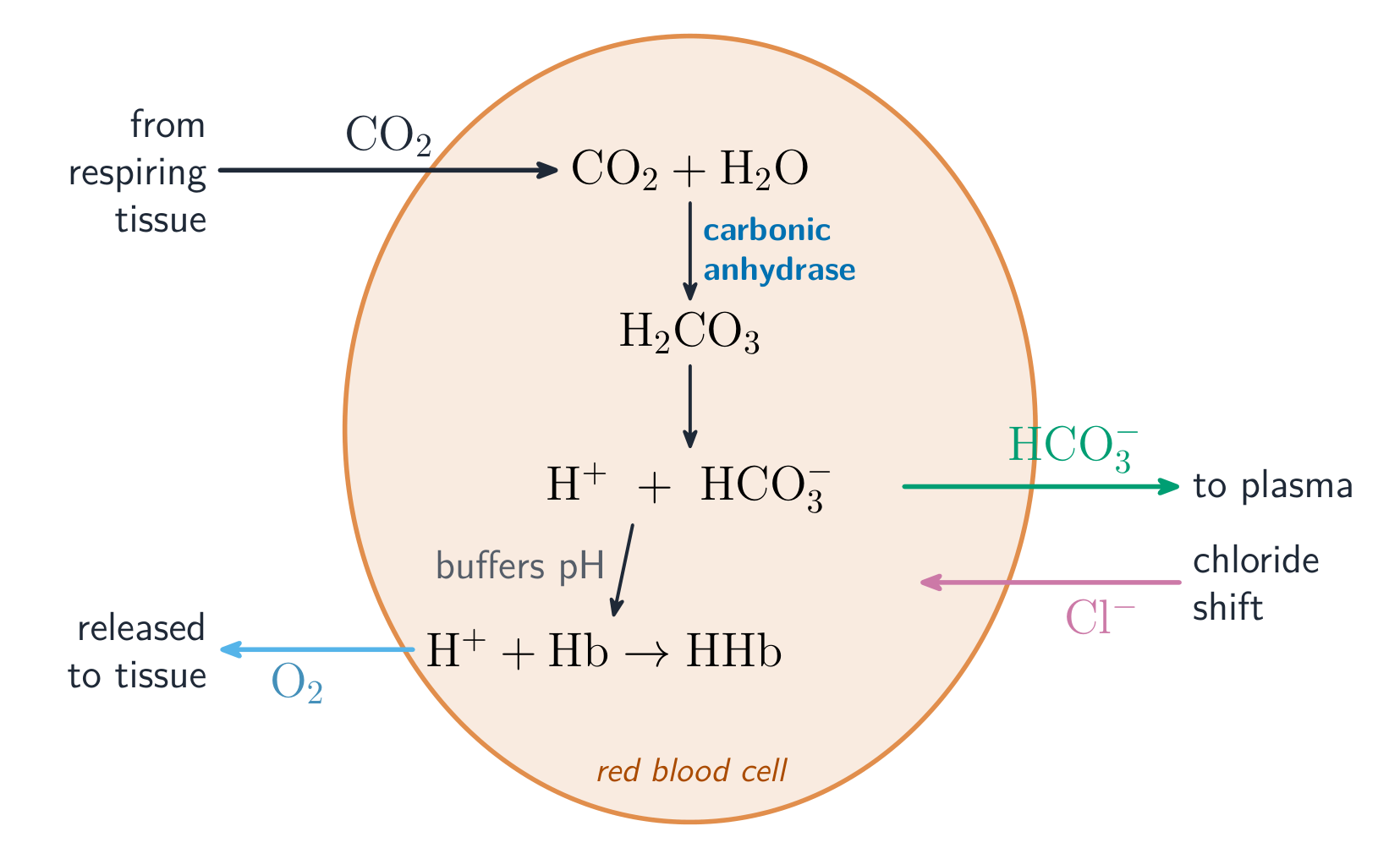
- CO₂ diffuses from the tissues into a red blood cell. The enzyme carbonic anhydrase 碳酸酐酶 makes it react quickly with water to form carbonic acid 碳酸, which splits into ions:
- The hydrogencarbonate 碳酸氢根 ions diffuse out into the plasma, which carries them to the lungs. Plasma has very little carbonic anhydrase, so this reaction happens mainly inside red blood cells.
The enzyme carbonic anhydrase speeds up the reaction of:
难度 1/5 · 今日首次完成可获 100 金币及少量额外奖励
Carbonic anhydrase catalyses CO₂ + water → carbonic acid, inside the red blood cell.
Match each term to its role in carrying CO₂.
难度 2/5 · 今日首次完成可获 140 金币及少量额外奖励
The enzyme makes carbonic acid; it splits into H⁺ and HCO₃⁻; chloride balances the charge; haemoglobin buffers the H⁺.
The chloride shift 氯转移 and the H⁺ ions
- As negative HCO₃⁻ ions leave the cell, negative chloride ions move in from the plasma to keep the charge balanced. This is the chloride shift.
- The H⁺ ions left behind bind to haemoglobin, forming haemoglobinic acid (HHb). This buffers 缓冲 the H⁺ so blood pH stays steady. It also makes haemoglobin release its oxygen: this is the Bohr effect from lesson 8.3.
Carrying carbon dioxide
Step through what happens to CO₂ in a red blood cell — most of it ends up as hydrogencarbonate in the plasma.
In the chloride shift, chloride ions move OUT of the red blood cell as hydrogencarbonate ions leave.
难度 1/5 · 今日首次完成可获 100 金币及少量额外奖励
False. As negative HCO₃⁻ ions leave the red blood cell, negative chloride ions move in to balance the charge.
The hydrogen ions produced are dealt with by:
难度 1/5 · 今日首次完成可获 100 金币及少量额外奖励
H⁺ binds haemoglobin (haemoglobinic acid), buffering the blood so the pH does not fall sharply.
Put the journey of CO₂ in a red blood cell in order.
难度 3/5 · 今日首次完成可获 200 金币及少量额外奖励
CO₂ in → carbonic acid → splits → HCO₃⁻ out (chloride in) → H⁺ buffered.
Hydrogencarbonate ions leave a red blood cell. What enters to balance the charge, and what is this called?
Chloride replaces the negative ions that leave.
At the lungs: everything runs backwards
- In the alveoli the CO₂ concentration is low, so CO₂ diffuses out of the blood. Carbonic anhydrase now speeds up the reverse reaction: H⁺ + HCO₃⁻ → H₂CO₃ → CO₂ + H₂O.
- HCO₃⁻ ions move back into the red blood cell, and chloride ions move out. Haemoglobin releases its H⁺ and is free to load oxygen again.
Put the events at the lungs in order, starting with blood arriving at an alveolus.
难度 3/5 · 今日首次完成可获 200 金币及少量额外奖励
Every step of the tissue reaction runs in reverse because CO₂ concentration is low in the alveolus.
Worked example: the chain of events in a red blood cell
A red blood cell passes a muscle that is respiring fast. Put these in order and explain each: CO₂ enters; Cl⁻ enters; HCO₃⁻ leaves; H⁺ binds to haemoglobin; oxygen is released.
- CO₂ diffuses in and carbonic anhydrase converts it with water to carbonic acid, which splits into H⁺ and HCO₃⁻. HCO₃⁻ diffuses out into the plasma, and Cl⁻ moves in to balance the charge (the chloride shift).
- H⁺ binds to haemoglobin, forming haemoglobinic acid; this buffers the pH and lowers haemoglobin's affinity, so oxygen is released to the muscle. This links CO₂ transport to the Bohr shift.
Which enzyme in red blood cells speeds up the reaction of CO₂ with water?
难度 1/5 · 今日首次完成可获 100 金币及少量额外奖励
Carbonic anhydrase makes carbonic acid rapidly.
In the chloride shift, chloride ions move into the red blood cell as hydrogencarbonate ions move out.
难度 1/5 · 今日首次完成可获 100 金币及少量额外奖励
This keeps the charge inside the cell balanced.
Worked exam question: an enzyme inhibitor
Question (4 marks). Acetazolamide is a drug that inhibits carbonic anhydrase. Suggest how it would affect the transport of carbon dioxide and of oxygen.
- Less CO₂ is converted to H⁺ and HCO₃⁻ in red blood cells, so less CO₂ is carried as hydrogencarbonate in the plasma (1 mark).
- More CO₂ stays dissolved in the plasma, or binds as carbaminohaemoglobin, so CO₂ removal from the tissues is slower (1 mark).
- Fewer H⁺ ions are made in the red blood cells, so fewer bind to haemoglobin (1 mark).
- Haemoglobin's affinity for oxygen stays higher, so less oxygen is released to respiring tissues: a smaller Bohr shift (1 mark).
Why answers lose marks: saying "no CO₂ is carried". An inhibited enzyme only slows the reaction, and the other two forms of transport still work.
Without looking back: a drug inhibits carbonic anhydrase. Explain its effect on oxygen release in respiring muscle (3 marks).
The enzyme links CO₂ transport to oxygen unloading through H⁺.
You've got it
- CO₂ travels as HCO₃⁻ in plasma (~85%), carbaminohaemoglobin (~10%) and dissolved (~5%)
- in red blood cells carbonic anhydrase speeds CO₂ + H₂O ⇌ H₂CO₃ ⇌ H⁺ + HCO₃⁻
- chloride shift: Cl⁻ moves in as HCO₃⁻ moves out (balances charge)
- H⁺ binds haemoglobin (haemoglobinic acid): buffers pH and releases O₂ (Bohr effect)
- at the lungs every step reverses: CO₂ diffuses out, HCO₃⁻ back in, Cl⁻ out
What enters the red blood cell in the chloride shift?
难度 1/5 · 今日首次完成可获 100 金币及少量额外奖励
Chloride balances the hydrogencarbonate that leaves.