| English | 释义 | 拼音 |
|---|---|---|
| transpiration/trænspəˈreɪʃn/ | 蒸腾作用 | zhēng téng zuò yòng |
| water vapour/ˈwɔːtə ˈveɪpə/ | 水蒸气 | shuǐ zhēng qì |
| stomata/ˈstəʊmətə/ | 气孔 | qì kǒng |
| cohesion/kəʊˈhiːʒn/ | 内聚力 | nèi jù lì |
| tension/ˈtenʃn/ | 张力 | zhāng lì |
| adhesion/ədˈhiːʒn/ | 附着力 | fù zhuó lì |
| xerophyte/ˈzɪərəfaɪt/ | 旱生植物 | hàn shēng zhí wù |
| cuticle/ˈkjuːtɪkl/ | 角质层 | jiǎo zhì céng |
Pulling water up a tree
- A tall tree lifts water tens of metres — with no pump.
- The "engine" is water leaving the leaves: transpiration 蒸腾作用.
- Sticky water molecules let the whole column be pulled up.
Transpiration
- Transpiration is the loss of water vapour 水蒸气 from a plant.
- Water evaporates from the wet cell surfaces inside the leaf.
- The water vapour then diffuses out through the stomata 气孔 into the air.
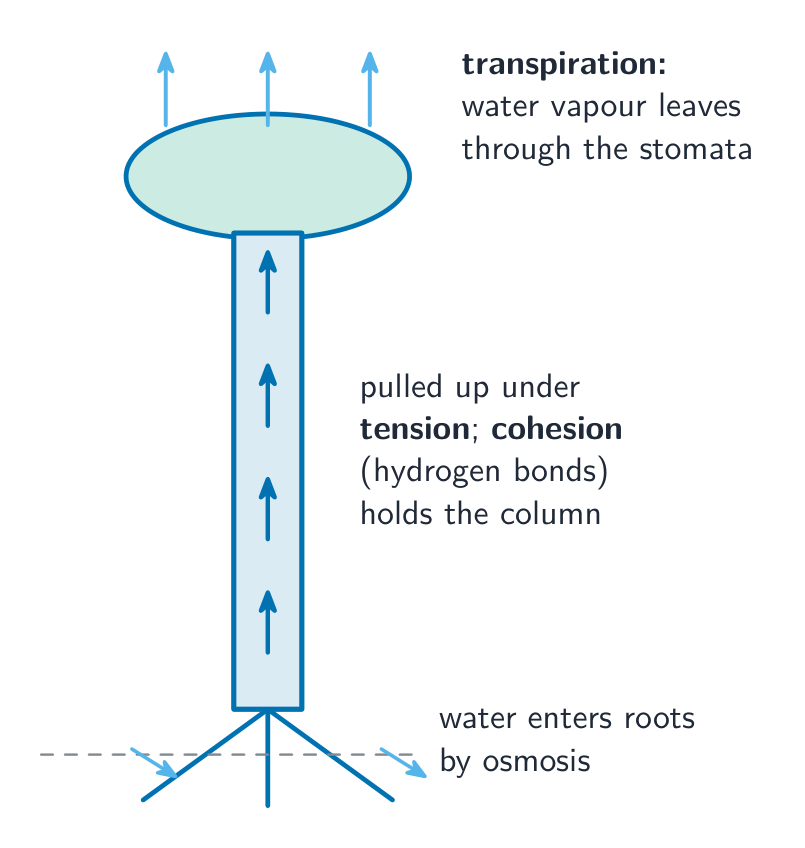
Transpiration pulls water up the xylem by cohesion 内聚力 and tension 张力
Transpiration is:
难度 1/5 · 今日首次完成可获 100 金币及少量额外奖励
Transpiration is water evaporating inside the leaf and the vapour diffusing out through the stomata.
Water vapour leaves the leaf mainly by diffusing out through pores called ______.
难度 1/5 · 今日首次完成可获 100 金币及少量额外奖励
After evaporating from leaf cell surfaces, the vapour diffuses out through the stomata.
Cohesion and tension
- Water molecules attract each other by hydrogen bonds, so they stick together — this is cohesion.
- Loss at the top puts the column under tension (a pull), and cohesion lets the whole column be drawn up — the cohesion–tension idea.
- Water also sticks to the cellulose walls — adhesion 附着力 — which helps hold the column in place.
The transpiration stream
Step through how water is pulled up a tree — evaporation at the top creates a tension that drags the whole cohesive column upward.
Cohesion in the cohesion–tension theory means:
难度 1/5 · 今日首次完成可获 100 金币及少量额外奖励
Cohesion is water-to-water attraction (hydrogen bonds); it lets the whole column be pulled up under tension.
Match each term in the cohesion–tension theory.
难度 2/5 · 今日首次完成可获 140 金币及少量额外奖励
Evaporation creates tension; cohesion holds the column together so it is pulled up; adhesion helps it cling to the walls.
Xerophytes 旱生植物
- A xerophyte is a plant adapted to live where water is scarce. It cuts transpiration with:
- a thick waxy cuticle 角质层,
- stomata sunk in pits,
- hairs that trap moist air,
- leaves that can roll up.
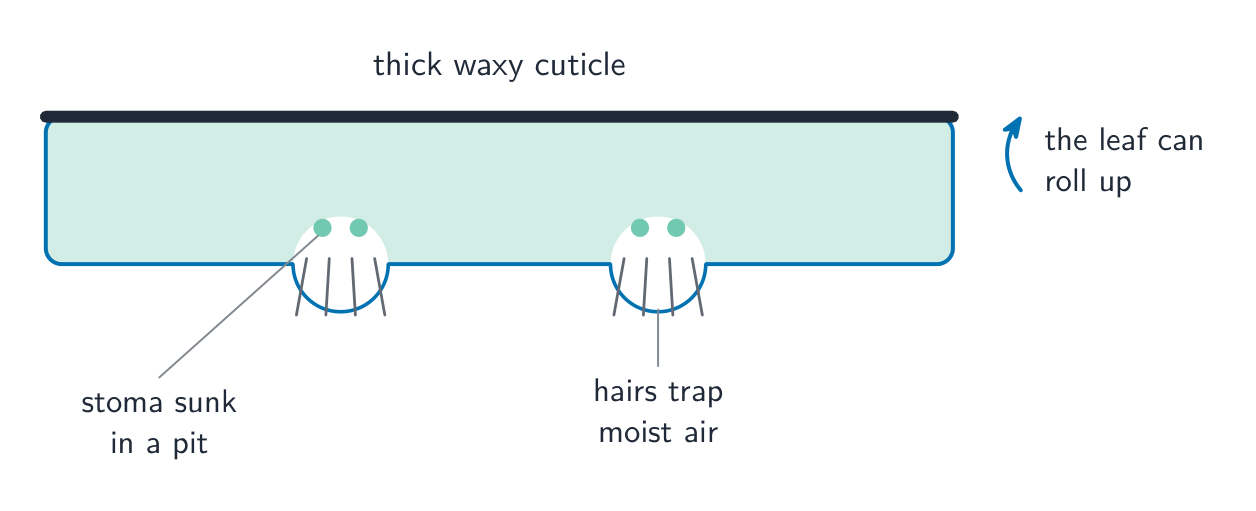
Xerophyte leaf adaptations that reduce water loss
Which feature helps a xerophyte reduce water loss?
难度 1/5 · 今日首次完成可获 100 金币及少量额外奖励
Sunken stomata, a thick cuticle, trapped moist air and rolled leaves all cut transpiration.
Xerophytes have large, thin leaves with many surface stomata to increase water loss.
难度 1/5 · 今日首次完成可获 100 金币及少量额外奖励
False. Xerophytes are adapted to reduce water loss, with small or rolled leaves, a thick waxy cuticle, hairs and sunken stomata.
Worked example: a potometer reading
In a potometer, an air bubble moves 36 mm along a capillary tube in 5 minutes. The tube has a cross-sectional area of 0.8 mm². Calculate the rate of water uptake, and say what happens when a fan blows on the shoot.
- Volume = distance × area = $36\times0.8=28.8\ \text{mm}^3$, so the rate = $28.8\div5=$ 5.76 mm³ per minute.
- A fan removes the humid air near the leaf, keeping a steep water vapour gradient at the stomata, so transpiration and the bubble's speed increase. A potometer measures uptake, which is close to, but not exactly, the water lost.
A bubble moves 20 mm in 4 minutes in a tube of area 0.5 mm². What is the uptake rate, in mm³ per minute?
难度 2/5 · 今日首次完成可获 140 金币及少量额外奖励
20 × 0.5 = 10 mm³; 10 ÷ 4 = 2.5 mm³ per minute.
Raising the humidity of the air around a leaf lowers the rate of transpiration.
难度 1/5 · 今日首次完成可获 100 金币及少量额外奖励
The water vapour gradient between leaf and air is smaller.
Xerophyte adaptations and how they work
| Adaptation | Example | How it reduces water loss |
|---|---|---|
| leaf rolled, stomata on the inside | marram grass | traps humid air, so the water vapour gradient is small |
| sunken stomata in pits | marram grass, pine | still, humid air collects in the pit |
| hairs on the leaf surface | marram grass | trap a layer of moist air |
| thick waxy cuticle | holly, cacti | waterproof barrier; less evaporation from the surface |
| leaves reduced to spines | cacti | much smaller surface area for transpiration |
| stomata open at night | many cacti | less evaporation when it is cool |
How does a rolled leaf reduce water loss in marram grass?
难度 1/5 · 今日首次完成可获 100 金币及少量额外奖励
With humid air next to the stomata, less water vapour diffuses out.
Why do cacti have spines instead of broad leaves?
难度 1/5 · 今日首次完成可获 100 金币及少量额外奖励
Less leaf surface means fewer stomata and less evaporation; the green stem photosynthesises instead.
You've got it
- transpiration = loss of water vapour: evaporates inside the leaf, diffuses out the stomata
- cohesion (hydrogen bonds) holds the water column together; it's pulled up under tension
- adhesion = water sticking to the cell walls
- xerophytes cut water loss: thick cuticle, sunken stomata, hairs, rolled leaves
Write from this case
- A xerophyte leaf has stomata sunk in pits.
- The air in the pits stays humid.
How does this feature cut water loss?
Humid air around the pore reduces the diffusion gradient.
What do sunken stomata do?
难度 1/5 · 今日首次完成可获 100 金币及少量额外奖励
Trapped humidity slows evaporation.