Nucleotides and the structure of DNA · 核苷酸与 DNA 的结构
| English | 中文 | Pinyin · 拼音 |
|---|---|---|
| nucleotide/ˈnjuːklɪɒtaɪd/ | 核苷酸 | hé gān suān |
| nucleic acid/njuːˈklɪɪk ˈæsɪd/ | 核酸 | hé suān |
| double helix/ˈdʌbl ˈhiːlɪks/ | 双螺旋 | shuāng luó xuán |
| purine/ˈpjʊəriːn/ | 嘌呤 | piào líng |
| pyrimidine/ˈpɪrɪmɪdiːn/ | 嘧啶 | mì dìng |
| deoxyribose/diːˈɒksɪrɪbəʊs/ | 脱氧核糖 | tuō yǎng hé táng |
| phosphodiester bond/ˈfɒsfəʊdɪstə bɒnd/ | 磷酸二酯键 | lín suān èr zhǐ jiàn |
| antiparallel/ˌæntɪˈpærəlel/ | 反平行 | fǎn píng xíng |
| complementary base pairing/ˌkɒmplɪˈmentəri beɪs ˈpeərɪŋ/ | 碱基互补配对 | jiǎn jī hù bǔ pèi duì |
Nucleotides 核苷酸 and DNA
- DNA and RNA are nucleic acids 核酸 — polymers of small units called nucleotides.
- The same building block also powers the cell as ATP.
- DNA's famous shape, the double helix 双螺旋, comes from how its bases pair up.
核苷酸和 DNA
- DNA 和 RNA 是 核酸(nucleic acids)——由叫 核苷酸(nucleotides) 的小单元构成的聚合物。
- 同样的构建块也作为 ATP 为细胞提供动力。
- DNA 著名的形状,双螺旋(double helix),来自它的碱基如何配对。
Nucleotides and bases
- Each nucleotide has three parts: a phosphate, a 5-carbon sugar, and a base.
- ATP is a nucleotide with the base adenine, the sugar ribose, and three phosphates — breaking off the last one releases energy.
- Five bases, in two groups:
- purines 嘌呤 (double ring): adenine (A), guanine (G).
- pyrimidines 嘧啶 (single ring): cytosine (C), thymine (T), uracil (U).
Purines (A, G) have a double ring; pyrimidines (C, T, U) have a single ring
A space-filling model of the DNA double helix, showing its twisted-ladder shape
核苷酸和碱基
- 每个 核苷酸 有三个部分:一个 磷酸(phosphate)、一个五碳 糖(sugar),和一个 碱基(base)。
- ATP 是一个带碱基腺嘌呤、糖核糖和 三个 磷酸的核苷酸——断开最后一个释放 能量。
- 五种碱基,分两组:
- 嘌呤(purines)(双环):腺嘌呤(A)、鸟嘌呤(G)。
- 嘧啶(pyrimidines)(单环):胞嘧啶(C)、胸腺嘧啶(T)、尿嘧啶(U)。

嘌呤(A、G)有双环;嘧啶(C、T、U)有单环

DNA 双螺旋的空间填充模型,显示它扭曲的梯子形状
A single nucleotide is made of: · 一个单独的核苷酸由以下构成:
Every nucleotide has three parts: a phosphate group, a pentose sugar, and a nitrogen-containing base. · 每个核苷酸有三个部分:一个磷酸基团、一个戊糖,和一个含氮的碱基。
ATP releases energy for the cell when: · ATP 在以下情况为细胞释放能量:
ATP has three phosphates; breaking off the terminal phosphate releases energy. · ATP 有三个磷酸;断开末端的磷酸释放能量。
The DNA backbone
- DNA is two strands twisted into a double helix.
- Each strand has a backbone of alternating deoxyribose 脱氧核糖 sugar and phosphate, joined by phosphodiester bonds 磷酸二酯键.
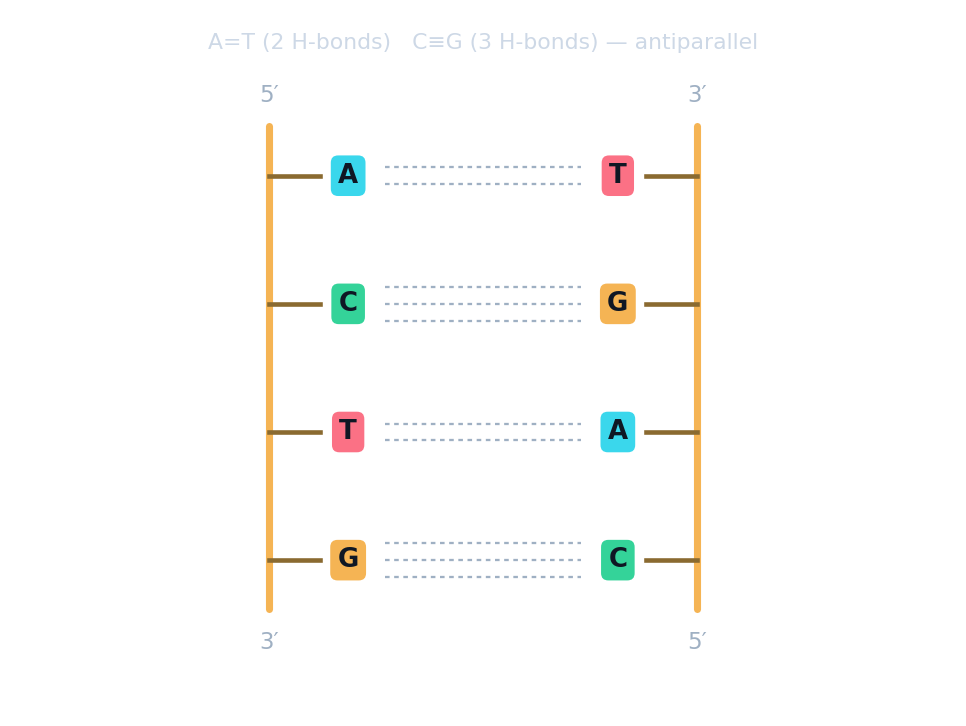
- The two strands run in opposite directions — they are antiparallel 反平行 (one 5′→3′, the other 3′→5′).
A nucleotide and ATP
DNA 骨架
- DNA 是 两条链 扭成一个 双螺旋。
- 每条链有一个交替的 脱氧核糖(deoxyribose) 糖和磷酸的骨架,由 磷酸二酯键(phosphodiester bonds) 连接。
- 两条链朝 相反的方向 走——它们是 反平行的(antiparallel)(一条 5′→3′,另一条 3′→5′)。

一个核苷酸和 ATP
Explore the DNA ladder · 探索 DNA 梯子
Tap each part of the double helix — two antiparallel backbones with complementary base pairs as the rungs. · 点击双螺旋的每个部分——两条反平行的骨架,互补碱基对作为梯级。
The two DNA strands are described as antiparallel because they: · 两条 DNA 链被描述为反平行,因为它们:
Antiparallel means the strands point in opposite directions: 5′→3′ on one, 3′→5′ on the other. · 反平行意味着链指向相反的方向:一条上 5′→3′,另一条上 3′→5′。
Complementary base pairing 碱基互补配对
- The strands are held together by their bases in the middle, paired exactly:
- A pairs with T — 2 hydrogen bonds.
- C pairs with G — 3 hydrogen bonds (so C–G is harder to separate).
互补碱基配对
- 两条链由它们中间的碱基保持在一起,精确配对:
- A 与 T 配对——2 个氢键。
- C 与 G 配对——3 个氢键(所以 C–G 更难分开)。
Match each group of bases to its description. · 把每组碱基与它的描述配对。
A purine (double ring) always pairs with a pyrimidine (single ring): A–T and C–G. · 一个嘌呤(双环)总是与一个嘧啶(单环)配对:A–T 和 C–G。
In DNA, A always pairs with T, and C always pairs with ______. · 在 DNA 中,A 总是与 T 配对,C 总是与 ______ 配对。
Complementary base pairing: A–T (2 hydrogen bonds) and C–G (3 hydrogen bonds). · 互补碱基配对:A–T(2 个氢键)和 C–G(3 个氢键)。
A DNA sample contains 30% adenine. Because A pairs with T, what percentage is thymine? · 一个 DNA 样品含 30% 腺嘌呤。因为 A 与 T 配对,胸腺嘧啶的百分比是多少?
A always pairs with T, so %A = %T. With 30% adenine there is 30% thymine (leaving 40% split between C and G). · A 总是与 T 配对,所以 %A = %T。有 30% 腺嘌呤就有 30% 胸腺嘧啶(剩下 40% 在 C 和 G 之间分配)。
C–G base pairs have 3 hydrogen bonds, so they are harder to separate than A–T pairs. · C–G 碱基对有 3 个氢键,所以它们比 A–T 对更难分开。
C–G is held by 3 hydrogen bonds and A–T by only 2, so DNA with more C–G is more stable. · C–G 由 3 个氢键保持,A–T 只由 2 个,所以 C–G 更多的 DNA 更稳定。
You've got it
- nucleotide = phosphate + sugar + base; ATP = adenine + ribose + 3 phosphates (energy)
- purines (A, G, double ring) vs pyrimidines (C, T, U, single ring)
- DNA = double helix; backbone = deoxyribose + phosphate (phosphodiester bonds); strands antiparallel
- A–T (2 H-bonds), C–G (3 H-bonds) — complementary base pairing
你掌握了
- 核苷酸 = 磷酸 + 糖 + 碱基;ATP = 腺嘌呤 + 核糖 + 3 个磷酸(能量)
- 嘌呤(A、G,双环)对 嘧啶(C、T、U,单环)
- DNA = 双螺旋;骨架 = 脱氧核糖 + 磷酸(磷酸二酯键);链 反平行
- A–T(2 个氢键)、C–G(3 个氢键)——互补碱基配对