Surface area to volume ratio · 表面积与体积之比
| English | 中文 | Pinyin · 拼音 |
|---|---|---|
| volume/ˈvɒljuːm/ | 体积 | tǐ jī |
| surface area/ˈsɜːfɪs ˈeərɪə/ | 表面积 | biǎo miàn jī |
| agar/ˈeɪɡɑː/ | 琼脂 | qióng zhī |
| dialysis tubing/daɪˈæləsɪs ˈtjuːbɪŋ/ | 透析袋 | tòu xī dài |
| exchange surface/eksˈtʃeɪndʒ ˈsɜːfɪs/ | 交换表面 | jiāo huàn biǎo miàn |
Why cells stay small
- A cell takes in food and oxygen, and removes waste, across its surface.
- But as something grows, its volume 体积 grows faster than its surface area 表面积.
- So big cells struggle to supply their inside fast enough.
为什么细胞保持小
- 一个细胞穿过它的 表面 摄入食物和氧气,并排出废物。
- 但当一个东西长大,它的 体积 比它的 表面积 长得更快。
- 所以大细胞难以足够快地供应它的内部。
The ratio falls as size grows
For a cube of side $L$:
- A bigger $L$ gives a smaller ratio.
比值随大小增长而下降
对于一个边长为 $L$ 的立方体:
- 更大的 $L$ 给出 更小 的比值。
Diffusion across the surface · 跨表面的扩散
Particles spread on their own from crowded to sparse. A small cell has a large surface-area-to-volume ratio, so substances diffuse in and out fast enough. · 粒子自发地从密集处扩散到稀疏处。小细胞的表面积与体积之比大,所以物质进出扩散得足够快。
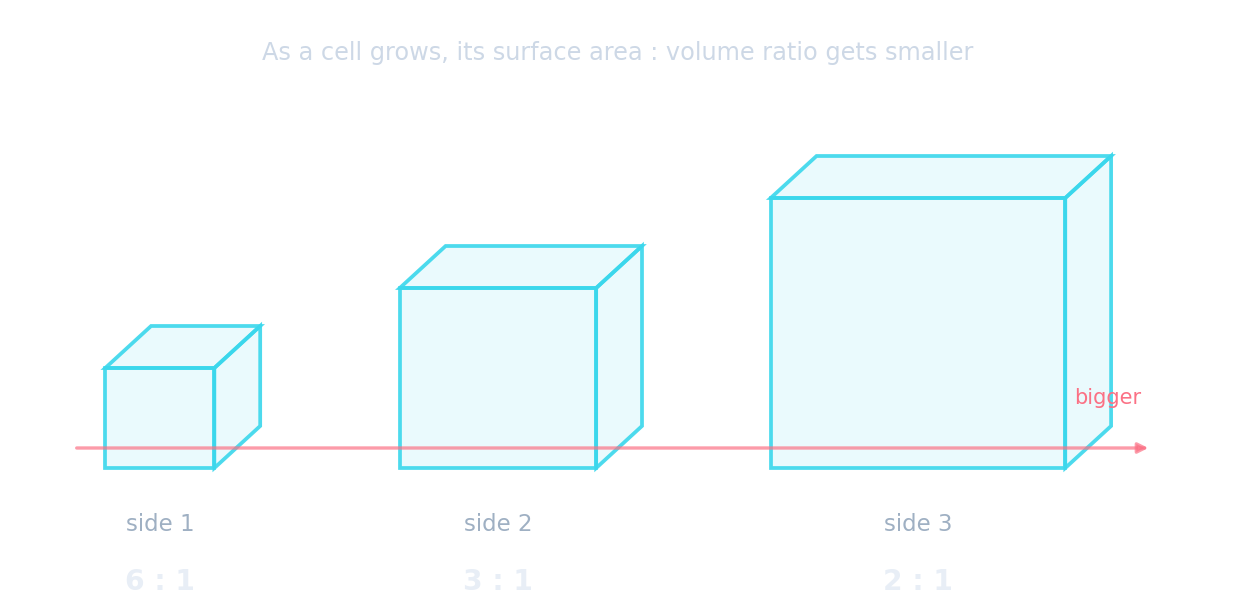
As a cell gets larger, its surface area to volume ratio: · 当一个细胞变大时,它的表面积与体积之比:
Volume (L³) grows faster than surface area (6L²), so the ratio 6/L falls as L increases. · 体积(L³)比表面积(6L²)长得更快,所以比值 6/L 随 L 增大而下降。
A cube has side length 2. Using ratio = 6/L, what is its surface-area-to-volume ratio? · 一个立方体边长为 2。用比值 = 6/L,它的表面积与体积之比是多少?
ratio = 6 / L = 6 / 2 = 3 (i.e. 3 : 1). · 比值 = 6 / L = 6 / 2 = 3(即 3 : 1)。
A cube has side length 3. Using ratio = 6/L, what is its surface-area-to-volume ratio? · 一个立方体边长为 3。用比值 = 6/L,它的表面积与体积之比是多少?
ratio = 6 / L = 6 / 3 = 2 (i.e. 2 : 1) — smaller than the side-2 cube, because it is bigger. · 比值 = 6 / L = 6 / 3 = 2(即 2 : 1)——比边长 2 的立方体小,因为它更大。
Order these cubes by surface-area-to-volume ratio, largest ratio first. · 把这些立方体按表面积与体积之比排序,最大的比值在前。
The smallest cube has the largest ratio; as the side grows, 6/L falls. · 最小的立方体有最大的比值;随着边长增大,6/L 下降。
Why it matters
- A large surface area to volume ratio = fast exchange. So small cells and thin, flat shapes exchange materials quickly.
- Large cells cannot rely on diffusion alone — they need transport systems.
- You can show this with agar 琼脂 blocks of different sizes soaked in dye: the smallest block (largest ratio) changes colour all the way through fastest. (Diffusion through non-living material is studied with dialysis tubing 透析袋.)
为什么它重要
- 大的 表面积与体积之比 = 快速交换。所以 小细胞 和 薄而扁 的形状快速交换物质。
- 大 细胞不能只靠扩散——它们需要运输系统。
- 你可以用浸在染料中的不同大小的 琼脂(agar) 块来展示这一点:最小的 块(最大的比值)最 快 地完全变色。(穿过非活材料的扩散用 透析管(dialysis tubing) 来研究。)
Surface area : volume · 表面积比体积
Make the cube bigger: its volume grows faster than its surface, so the SA:V ratio falls — which is why exchange surfaces and cells stay small. · 把立方体变大:体积比表面增长得更快,所以表面积比体积下降——这就是交换表面和细胞保持小的原因。
Why do small cells and thin, flat shapes exchange materials quickly? · 为什么小细胞和薄而扁的形状快速交换物质?
A large ratio means lots of surface for each unit of volume, so exchange by diffusion is fast. · 大的比值意味着每单位体积有大量表面,所以通过扩散的交换很快。
Small cells exchange materials quickly because they have a ______ surface-area-to-volume ratio. · 小细胞快速交换物质,因为它们有一个 ______ 的表面积与体积之比。
A large ratio gives plenty of surface for each unit of volume, so diffusion supplies the whole cell quickly. · 大的比值给出每单位体积大量的表面,所以扩散快速供应整个细胞。
In the agar-block experiment, which block changes colour all the way through fastest? · 在琼脂块实验中,哪个块最快地完全变色?
The smallest block has the largest ratio, so dye/acid diffuses to its centre fastest. · 最小的块有最大的比值,所以染料/酸最快地扩散到它的中心。
Exchange surfaces 交换表面 solve the problem
- Large organisms can't rely on their small surface, so they evolve specialised exchange surfaces (lungs, gills, root hairs, villi).
- These give a huge surface area, thin walls and a good blood supply for fast exchange.
A bigger organism has a smaller surface-area-to-volume ratio. That's why a mouse loses heat fast but a whale doesn't, and why big organisms need exchange and transport systems that single cells don't.
交换表面解决了这个问题
- 大生物不能只靠它们小的表面,所以它们进化出 专门的交换表面(肺、鳃、根毛、绒毛)。
- 这些给出巨大的表面积、薄的壁和良好的血液供应以便快速交换。
一个更大的生物有更小的表面积与体积之比。 这就是为什么一只老鼠很快散热而一头鲸不会,以及为什么大生物需要单个细胞不需要的交换和运输系统。
You've got it
- volume grows faster than surface area → bigger means a smaller ratio
- cube: $\text{SA}=6L^2$, $V=L^3$, ratio $=\dfrac{6}{L}$
- large ratio = fast exchange → small cells and thin, flat shapes win
- agar-block demo: the smallest block colours through fastest
你掌握了
- 体积比表面积长得更快 → 更大意味着更小的比值
- 立方体:$\text{SA}=6L^2$,$V=L^3$,比值 $=\dfrac{6}{L}$
- 大的比值 = 快速交换 → 小细胞和 薄而扁 的形状胜出
- 琼脂块演示:最小的块最快地完全变色