Mode of action of enzymes · 酶的作用方式
| English | 中文 | Pinyin · 拼音 |
|---|---|---|
| enzyme/ˈenzaɪm/ | 酶 | méi |
| catalyst/ˈkætəlɪst/ | 催化剂 | cuī huà jì |
| intracellular/ˌɪntrəˈseljʊlə/ | 细胞内 | xì bāo nèi |
| extracellular/ˌekstrəˈseljʊlə/ | 细胞外 | xì bāo wài |
| active site/ˈæktɪv saɪt/ | 活性位点 | huó xìng wèi diǎn |
| substrate/ˈsʌbstreɪt/ | 底物 | dǐ wù |
| complementary/ˌkɒmplɪˈmentəri/ | 互补 | hù bǔ |
| induced fit/ɪnˈdjuːst fɪt/ | 诱导契合 | yòu dǎo qì hé |
| activation energy/ˌæktɪˈveɪʃn ˈenədʒi/ | 活化能 | huó huà néng |
Enzymes 酶: nature's catalysts 催化剂
- Most reactions in a cell would be far too slow to keep you alive.
- Enzymes speed them up — by millions of times — without being used up.
- They are globular proteins, and their shape is everything.
酶:大自然的催化剂
- 细胞中大多数反应会太慢,无法让你活着。
- 酶(enzymes) 加快它们——快上百万倍——而自己不被用掉。
- 它们是 球状蛋白质(globular proteins),它们的形状就是一切。
Which best describes an enzyme? · 哪个最好地描述一个酶?
Enzymes are globular protein catalysts: they speed reactions and are not used up, so each one works again and again. · 酶是球状蛋白质催化剂:它们加快反应而不被用掉,所以每一个都一次又一次地工作。
Where enzymes work
- Intracellular 细胞内 enzymes work inside the cell that made them — e.g. catalase, which breaks down harmful hydrogen peroxide.
- Extracellular 细胞外 enzymes are secreted to work outside the cell — e.g. amylase, released into the gut to digest starch.
- Either way, an enzyme is a catalyst: it speeds a reaction and is not used up, so it works again and again.
Yeast enzymes ferment sugar, giving off bubbles of carbon dioxide.
酶在哪里工作
- 胞内(intracellular) 酶在制造它们的细胞 内部 工作——例如 过氧化氢酶(catalase),它分解有害的过氧化氢。
- 胞外(extracellular) 酶被 分泌 到细胞外工作——例如 淀粉酶(amylase),被释放到肠道中消化淀粉。
- 无论哪种方式,酶都是一种 催化剂(catalyst):它加快反应而 不被用掉,所以它一次又一次地工作。

酵母的酶发酵糖,放出二氧化碳气泡。
Select all · 所有 the correct statements about where enzymes work. · 选出关于酶在哪里工作的所有正确陈述。
Catalase is intracellular and amylase is extracellular. Extracellular means it works outside the cell, so the third statement is false. · 过氧化氢酶是胞内的,淀粉酶是胞外的。胞外意味着它在细胞 外部 工作,所以第三条陈述是假的。
The active site 活性位点 and specificity
- Each enzyme has a pocket called the active site. The molecule it acts on is the substrate 底物.
- The substrate binds to form an enzyme–substrate complex; the reaction happens, then the products leave and free the site.
- An enzyme is specific — its active site is complementary 互补 to just one substrate's shape, and no other.
Biological washing powders contain enzymes that digest food and blood stains.
活性位点和专一性
- 每个酶有一个叫 活性位点(active site) 的口袋。它作用的分子是 底物(substrate)。
- 底物结合形成一个 酶–底物复合物(enzyme–substrate complex);反应发生,然后 产物(products) 离开并释放位点。
- 一个酶是 专一的(specific)——它的活性位点与恰好一种底物的形状 互补,没有别的。

生物洗衣粉含有消化食物和血渍的酶。
Match each term to its meaning. · 把每个术语与它的含义配对。
The substrate binds in the active site to form the enzyme–substrate complex; the reaction makes the product, which is then released. · 底物在活性位点结合形成酶–底物复合物;反应制造产物,然后被释放。
An enzyme is specific because: · 一个酶是专一的,因为:
Specificity comes from the active site's shape being complementary to one substrate and no other. · 专一性来自活性位点的形状与一种底物互补而没有别的。
The catalytic cycle
- The substrate slots into the active site, forming an enzyme–substrate complex.
- Bonds are strained, the reaction happens, and the products are released.
- The enzyme is left unchanged — free to bind again, thousands of times a second.
催化循环
- 底物嵌入 活性位点,形成一个酶–底物复合物。
- 键被拉紧,反应发生,产物 被释放。
- 酶保持 不变——自由地再次结合,一秒钟成千上万次。
The catalytic cycle · 催化循环
Step through the cycle. The enzyme binds its substrate, the reaction happens, the products leave — and the same · 相同 enzyme is free to go again. · 一步步走过这个循环。酶结合它的底物,反应发生,产物离开——而 同一个 酶自由地再次进行。
Put the steps of the catalytic cycle in order. · 把催化循环的步骤按顺序排列。
Bind → react → release → reset. The enzyme is unchanged, so it repeats the cycle thousands of times a second. · 结合 → 反应 → 释放 → 重置。酶不变,所以它一秒钟重复这个循环成千上万次。
Lock-and-key vs induced fit 诱导契合
- Lock-and-key: the active site is a fixed shape; only a substrate with the matching shape fits, like a key in a lock.
- Induced fit: the active site is not quite the right shape at first — when the substrate binds, the site moulds around it for a tight grip.
- Induced fit matches the evidence better.
The lock-and-key and induced-fit models of how a substrate fits the active site
锁钥模型与诱导契合
- 锁钥(lock-and-key):活性位点是一个固定的形状;只有形状匹配的底物才合适,像钥匙插入锁。
- 诱导契合(induced fit):活性位点起初 不太 是正确的形状——当底物结合时,位点 塑造 在它周围以紧紧抓住。
- 诱导契合更好地符合证据。

底物如何契合活性位点的锁钥模型和诱导契合模型
In the induced-fit model the active site is completely rigid and never changes shape. · 在诱导契合模型中,活性位点完全刚性且从不改变形状。
That describes lock-and-key. In induced fit the active site moulds around the substrate as it binds — a tighter grip that fits the evidence better. · 那描述的是锁钥。在诱导契合中,活性位点在底物结合时塑造在它周围——一个更好地符合证据的更紧的抓握。
The specific molecule that an enzyme acts on is called its ______. · 一个酶作用的特定分子叫做它的 ______。
The substrate binds in the active site, where the enzyme converts it into product. · 底物在活性位点结合,酶在那里把它转化成产物。
Lowering activation energy 活化能
- Every reaction needs a starting "push" of energy — the activation energy.
- An enzyme lowers the activation energy, so the reaction can run fast at the cell's normal temperature instead of needing high heat.
降低活化能
- 每个反应都需要一个起始的能量“推力”——活化能(activation energy)。
- 酶 降低 活化能,所以反应能在细胞的正常温度下快速进行,而不需要高温。
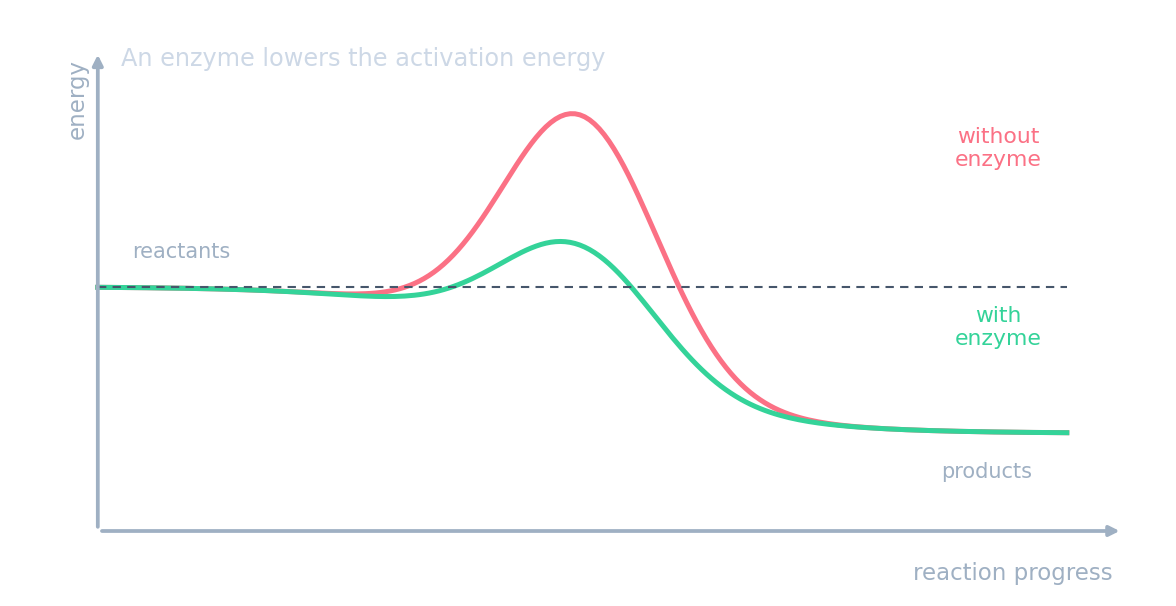
How does an enzyme speed up a reaction? · 一个酶如何加快一个反应?
Enzymes lower the activation energy, so the reaction proceeds quickly at normal cell temperatures. · 酶降低活化能,所以反应在正常细胞温度下快速进行。
You've got it
- enzymes = globular protein catalysts; not used up; intracellular (catalase) or extracellular (amylase)
- active site + substrate → enzyme–substrate complex → products leave
- specific: active site is complementary to one substrate (lock-and-key / induced fit)
- enzymes work by lowering the activation energy
你掌握了
- 酶 = 球状蛋白质催化剂;不被用掉;胞内(过氧化氢酶)或胞外(淀粉酶)
- 活性位点 + 底物 → 酶–底物复合物 → 产物 离开
- 专一:活性位点与一种底物 互补(锁钥 / 诱导契合)
- 酶通过 降低活化能 工作