What this course is, and how to use it
This is the seventh course in University Medicine: medical immunology 医学免疫学. The immune system is a distributed defence network with an identity problem: destroy everything foreign, spare everything self. Its failures in both directions are half of internal medicine.
Scope limit, stated once: a study course, not a medical degree; every case below is fictional and nothing here licenses or guides treatment.
- Unit 7.1 is the fast response: innate immunity.
- Units 7.2–7.4 are the learned response: recognition, activation, memory.
- Units 7.5–7.7 are the failures: allergy, autoimmunity, deficiency, and the transplant boundary.
The medicine habit: mechanism predicts lesion — every defect below is traced to the cell or signal that failed, and every number (cell counts, response ratios, timelines) is something you recompute.
Innate immunity
Why it matters. Innate immunity is the response you are born with: minutes to hours, no learning, no memory. It holds the line while the adaptive response gears up — and its cells are the ones that DECIDE whether the adaptive response happens at all.
The idea, with a picture. Barriers (skin, acid, mucus) → the complement 补体 system (cascade that opsonises and lyses) → phagocytes 吞噬细胞: neutrophils 中性粒细胞 (50–70 % of white cells, first to arrive ✓, die in hours), macrophages 巨噬细胞 (tissue-resident, present antigen), natural killer cells 自然杀伤细胞 (NK cells; kill virus-infected and stressed cells without antibodies) → dendritic cells 树突状细胞 (the bridge: sample, migrate, present).

The derivation (why innate cannot learn but can teach). Innate receptors (pattern recognition receptors, PRRs) bind conserved microbial patterns (PAMPs) — fixed germline receptors, no gene rearrangement ✓ (contrast 7.2). But dendritic cells turn an innate detection event into an adaptive instruction: without their co-stimulation, T cells ignore antigen (7.3's two-signal rule). Innate is fast because it is generic; adaptive is precise because it rearranges genes — and the dendritic cell is the main courier between them.
Worked example 1 — the arithmetic of an abscess. A bacterial breach: neutrophils start arriving within the first hour (rolling, then squeezing between endothelial cells, diapedesis 白细胞渗出), dominate the first 6–24 hours and die in the pus; monocytes, which become macrophages, take over at 24–48 hours ✓. The marrow makes about 10¹¹ neutrophils a day in health — about 70 million a minute (10¹¹ ÷ 1440 ≈ 7 × 10⁷ ✓) — and can raise that several-fold in severe infection.
Worked example 2 — clinical link: the count that warns. (Fictional) fever with neutrophil count 0.3 × 10⁹/L (normal 2–7): chemotherapy has stripped the first responders; the risk is overwhelming sepsis within hours — febrile neutropenia is an emergency precisely because the innate tier is gone while the adaptive tier is too slow.
Common mistakes. Calling NK cells adaptive (they are innate lymphocytes — no rearranged receptor). Expecting complement to be an antibody-only system (the alternative and lectin pathways activate without antibody ✓). Forgetting eosinophils/basophils (parasites and allergy, 7.5).
Summary. Barriers → complement → neutrophils (fast, suicidal) → macrophages (sustain, present) → NK (innate killing) → dendritic cells (the courier to 7.2–7.3); PRRs are fixed receptors — no memory, but full teaching rights.
Antigen recognition: antibodies, receptors and MHC
Why it matters. Recognition is the immune system's core engineering: gene segments are shuffled to build receptors that can bind anything — and MHC molecules display samples of what is inside every cell for inspection. Both ideas explain vaccination, transplantation and most immunological tests.
The idea, with a picture. The antibody 抗体 (immunoglobulin, Ig): two heavy + two light chains; V regions bind antigen, C regions define class (IgM first, IgG memory/transfer, IgA mucosa, IgE allergy, IgD receptor). T-cell receptors T细胞受体 (TCRs) on T cells see antigen ONLY as peptides held by major histocompatibility complex 主要组织相容性复合体 (MHC) molecules on cell surfaces — MHC-I (nearly all cells, displays cytosolic samples, CD8 inspects) and MHC-II (professional presenters, displays endocytosed samples, CD4 inspects) ✓.

The derivation (how near-infinite diversity is built). Ig genes exist as segment libraries: V, D and J segments are recombined (combinatorial joining), junctions are trimmed and random nucleotides added (junctional diversity). Fewer than 200 working segments give about 2 × 10⁶ heavy–light combinations by joining alone, and junctional diversity takes the possible total past 10¹¹ ✓; one person carries perhaps 10⁷–10⁸ different clones at any time. Each B cell expresses ONE specificity, and antigen picks which clones grow (clonal selection 克隆选择); T cells undergo the same rearrangement in the thymus. The cost: the system cannot pre-know self — hence tolerance checkpoints (7.6).
Worked example 1 — the class switch arithmetic. IgM pentamer: 10 binding sites but low affinity; after class switching and somatic hypermutation (in the germinal centre), IgG affinity rises 10- to 1000-fold over weeks to months ✓ — the titre rise a vaccine series exploits. This affinity maturation 亲和力成熟 is why dose 2 given 4–8 weeks later yields higher-avidity antibody than dose 1 (7.4's curve).
Worked example 2 — clinical link: the mismatched 3 of 6. (Fictional transplant) HLA-A, -B, -DR are the typed loci; each parent contributes one haplotype, so siblings have a 25 % chance of a full match (2 identical haplotypes: 1/2 × 1/2) ✓. The more mismatches, the higher the risk of rejection (7.7): T cells see mismatched MHC directly as foreign — MHC is, by design, the most polymorphic gene family in the body.
Common mistakes. Saying antibodies kill (they neutralise and mark — complement and phagocytes kill). Expecting T cells to see free antigen (they never do — peptide + MHC only ✓). Forgetting MHC-I displays what a cell is MAKING (cytosol) and MHC-II what it has EATEN (endosome).
Summary. Two recognition chemistries: Ig/BCR (free antigen, whole shape) and TCR (peptide in MHC); V(D)J recombination + junctional diversity → over 10¹¹ possible receptors; IgM→IgG class switch with 10- to 1000-fold affinity maturation; MHC-I/CD8 cytosolic, MHC-II/CD4 endocytosed; sibling full-match 1/4.
Adaptive responses: T and B cells
Why it matters. Adaptive responses are the system's precision tier: clonal expansion, division of labour, and regulation — and their failure modes (7.5–7.7) all trace to signals described here.
The idea, with a picture. T cells: CD4 "helpers" (macrophage activation, B-cell help, cytokine orchestration) vs CD8 "killers" (cytotoxic granules, Fas–FasL). B cells: antibody factories (plasma cells: thousands of molecules per second ✓) and memory. The two-signal rule: antigen binding alone tolerises; full activation needs signal 1 (TCR + peptide-MHC) + signal 2 (co-stimulation 共刺激, e.g. B7–CD28) from an activated dendritic cell ✓.

The derivation (why the gate exists). A receptor library this large MUST bind some self — so evolution put the decision at activation: signal 1 alone (a quiet cell presenting self) → anergy or deletion; signal 1 + signal 2 (danger-PAMPs driving B7 expression) → clonal expansion ✓. The gate explains vaccination (adjuvants PROVIDE signal 2 — that is their whole job), autoimmunity (bypassed when tissue damage makes self look dangerous) and transplant rejection (injury at harvest supplies signal 2).
Worked example 1 — the clonal arithmetic. Only about 1 naive T cell in 10⁵–10⁶ recognises a given viral peptide. Once activated it divides every ~6 hours; after 3 days, 2¹² ≈ 4000 daughters; after 5 days ~2²⁰ ≈ 10⁶ ✓ — the proliferation that makes an adaptive response 4–7 days late but overwhelming. CD8 expansion during acute infection can be >1000-fold of the specific population: 10⁴-fold or more.
Worked example 2 — clinical link: help and the broken bridge. (Fictional) X-linked hyper-IgM: CD40L is missing, so T cells cannot give B cells the CD40 signal — IgM accumulates but class switching fails; the patient suffers pyogenic infections (no IgG) AND opportunistic ones (no macrophage activation). One molecule, both arms of the T-helper role severed: helper signals are wiring, not decorations.
Common mistakes. Equating "helper" with gentle (TH1 activates macrophages to kill intracellular bugs — aggressive help). Forgetting regulatory T cells 调节性T细胞 (Tregs, the fourth population: suppressor gate, 7.6's tolerance). Timing errors: primary response peaks day 7–14; a positive test on day 1 is unlikely to be the acute antibody ✓.
Summary. CD4 helps, CD8 kills, B secretes and remembers; signal 1
- co-stimulation (B7–CD28) is the gate that tolerises or activates; clonal expansion from one cell to 10⁶ in days; CD40L–CD40 bridges T help to B switching; adjuvant = signal 2.
Immunological memory and vaccination
Why it matters. Immune memory 免疫记忆 is the adaptive system's dividend: a second encounter is faster, higher and better-targeted. Vaccination is memory engineered deliberately — the single most cost-effective medical intervention ever measured.
The idea, with a picture. The primary response: lag 4–7 days, IgM then IgG, peak ~day 10–14, low titre. The secondary response: lag hours–2 days, IgG immediately, titre 10–100× higher, higher affinity ✓ — memory B and T cells wait at higher frequency and in better locations (lymph node memory, tissue-resident memory).
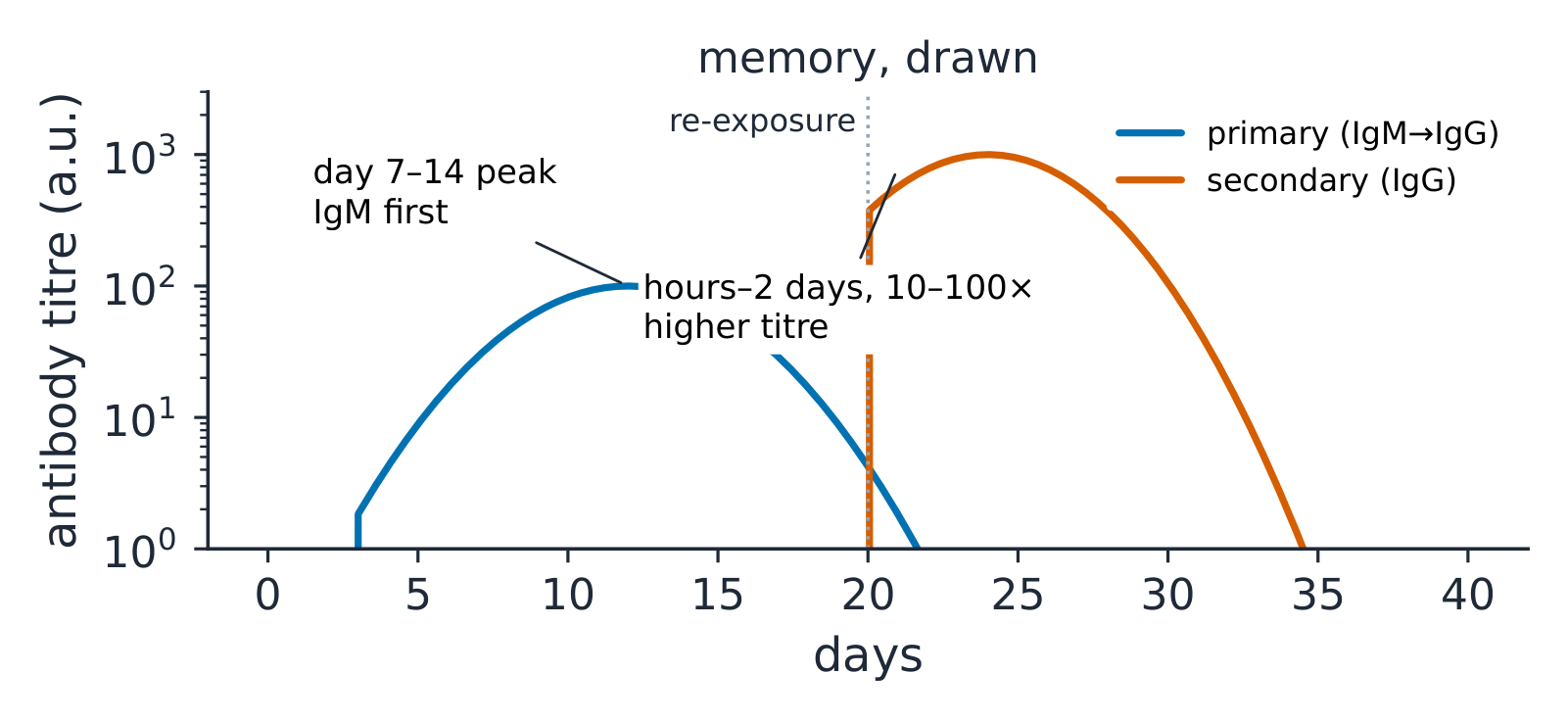
The derivation (why memory changes the curve). Memory cells skip the naive-to-activation gate partially (higher sensitivity to antigen, faster division) and exist at 10–100× the naive frequency ✓; affinity maturation pre-tuned in the first response's germinal centres. Herd immunity 群体免疫 follows from the same curve: transmission breaks when the susceptible fraction falls below $1/R_0$, so the immune fraction must exceed $1 - 1/R_0$ — for measles ($R_0 \approx 12–18$) that is ~92–94 % immune ✓; for influenza ($R_0 \approx 1.3$) ~25 %. One equation explains why measles needs near-universal coverage.
Worked example 1 — reading a serology. (Fictional) day 4 post-rash IgM positive / IgG negative; day 14 IgM positive / IgG up 4-fold or more: acute infection, seroconversion ✓. IgG only, stable titre: past infection or vaccination. The class and the rise ARE the timeline.
Worked example 2 — clinical link: the schedule's logic. (Fictional clinic) hepatitis B vaccine at 0, 1, 6 months: dose 1 primes (only about a third to a half respond), dose 2 boosts most, dose 3 matures affinity and catches slow responders — the 3-dose arc mirrors the primary/secondary curve with the third dose as a settled secondary peak ✓. Live vaccines (MMR) replicate gently: one dose immunises ~95 %, the second catches the remainder.
Common mistakes. Expecting the first vaccine dose to protect (it primes; protection is measurable after dose 2 in multi-dose series). Equating antibody titre with T-cell memory (both exist; titres wane while protection persists via memory B and T cells). Interpreting a single IgG titre without a baseline (only the RISE or known exposure dates make it diagnostic).
Summary. Primary: day 7–14, IgM→IgG, modest. Secondary: hours–2 days, IgG, 10–100×. Memory cells: higher frequency, better location, pre-matured affinity; herd threshold $1 - 1/R_0$ (measles ~95 %); schedules are the curve, engineered.
Hypersensitivity
Why it matters. The immune system can overreact in four distinct ways, together called hypersensitivity 超敏反应 — each with its own timescale and cell types. Naming the type predicts the test, the treatment and the timeline: allergy clinics are this taxonomy applied.
The idea, with a picture. Type I: IgE + mast cells, IMMEDIATE (minutes) — allergy, anaphylaxis. Type II: IgG against a CELL or tissue, minutes–hours — transfusion, autoimmune haemolysis. Type III: immune COMPLEX deposition, hours–days — serum sickness, glomerulonephritis. Type IV: T-cell mediated, 48–72 hours — contact dermatitis, tuberculosis skin test ✓.
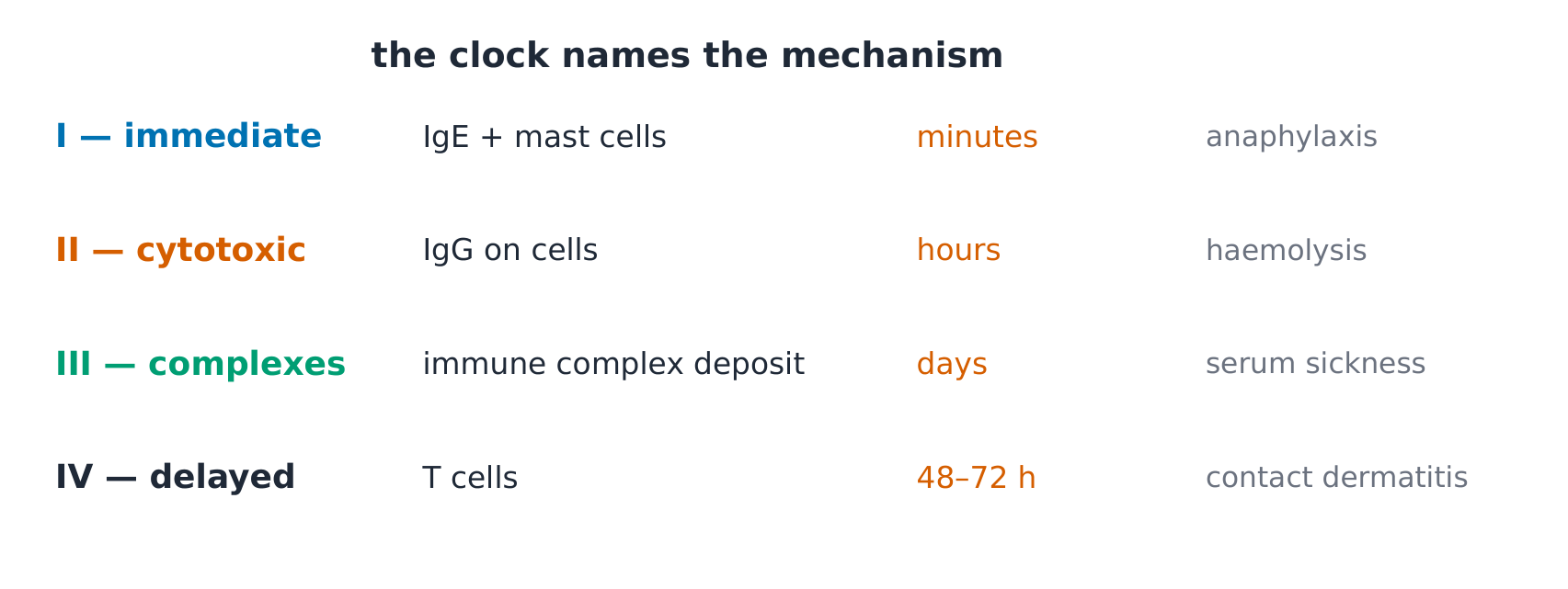
The derivation (why the clock tells you the mechanism). Type I is limited by pre-formed IgE waiting on mast cells → seconds. Type II needs antibody to reach the target and recruit effectors → hours. Type III needs complexes to form AND deposit → days. Type IV needs T-cell recruitment and macrophage activation → 48–72 hours ✓. The delay is the biology: each later type has one more transport/assembly step.
Worked example 1 — the anaphylaxis arithmetic. (Fictional) bee sting, previous mild reaction; now urticaria + wheeze + hypotension within 8 minutes: type I, adrenaline intramuscular immediately ✓ (the antihistamine is adjunct; the adrenaline is the decision). The earlier sting sensitised: it made IgE, which now sits on mast cells; this sting cross-links it. Type I needs a previous exposure, which is why a first sting cannot cause anaphylaxis by this route.
Worked example 2 — clinical link: the day-3 itch. (Fictional) nickel watch strap: eczematous, itchy plaque at 48–72 hours exactly where metal touched — type IV, T cells meeting hapten-presenting Langerhans cells in the skin. Patch testing reads at 48 h and 72 h BECAUSE the mechanism needs that long ✓; antihistamines do nothing (no histamine-first step), topical steroids do (they quiet T cells).
Common mistakes. Treating all allergy as type I (contact dermatitis is type IV — antihistamines useless). Forgetting type II includes drug-induced cytopenias (the drug coats the cell; IgG clears it). Expecting skin-prick tests to diagnose type IV (they test IgE, type I only).
Summary. I = IgE/mast cells/minutes; II = IgG on cells/hours; III = complexes/days; IV = T cells/48–72 h. The clock names the mechanism; the mechanism names the treatment.
Autoimmunity and tolerance
Why it matters. The immune system's hardest problem is self/not-self at the molecular level, and it is solved by checkpoints, not by perfection. When checkpoints fail, the result is autoimmunity — lifelong, organ-specific or systemic — and each disease is a named checkpoint failure.
The idea, with a picture. Central tolerance 中枢耐受: in the thymus and marrow, strongly self-reactive developing lymphocytes are DELETED (negative selection); the thymus also breeds Tregs (regulatory T cells, FOXP3⁺). Peripheral tolerance 外周耐受: anergy (no co-stimulation), suppression (Treg cytokines IL-10/TGF-β), regulation by inhibitory receptors ✓.
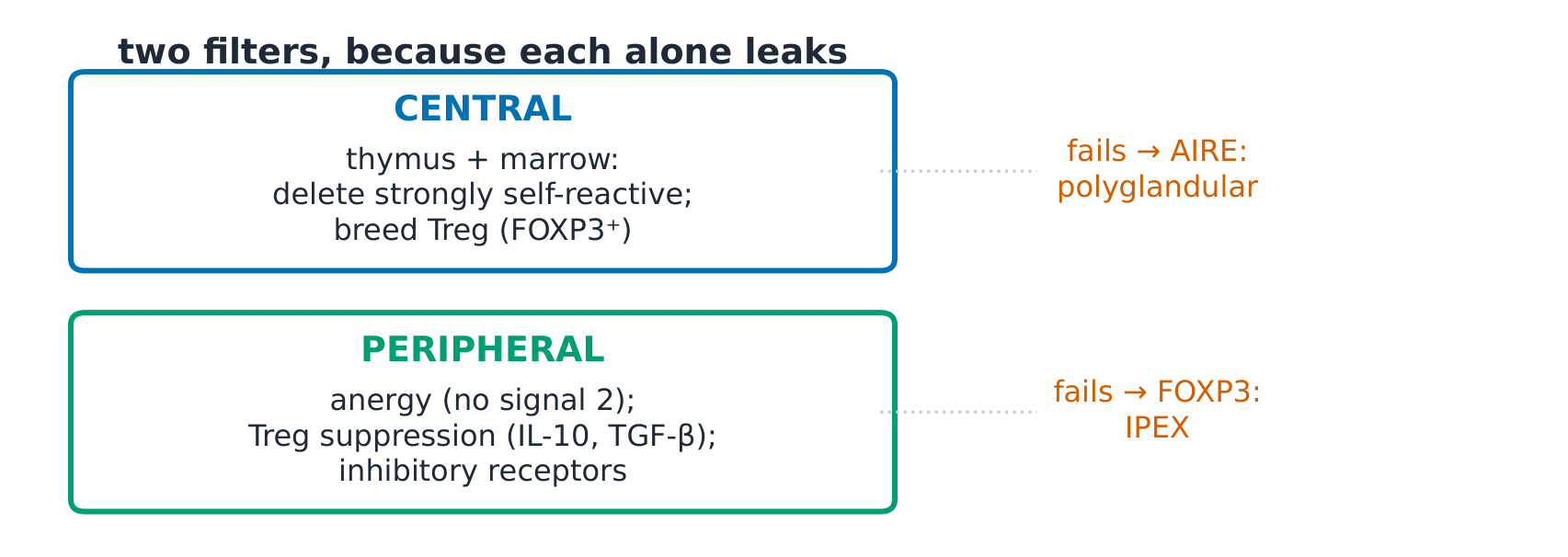
The derivation (why checkpoints, not a perfect library). A receptor library built by random rearrangement cannot pre-exclude self; so the system over-generates then deletes/suppresses ✓ — two filters because each alone leaks. The check-point map predicts disease: AIRE failure → autoimmune polyglandular syndrome (thymic self-display broken); FOXP3 failure → IPEX (Treg-less: allergy, enteropathy, endocrinopathy); and blocking the checkpoints CTLA-4 or PD-1 in cancer immunotherapy causes autoimmune side effects (colitis, thyroiditis) by design ✓.
Worked example 1 — the twin arithmetic. Twin studies put type-1 diabetes concordance at ~30–50 % in identical twins ✓: genes load the gun (HLA-DR3/DR4), environment (viral trigger, diet) and stochastic T-cell selection pull the trigger. Genetic HLA associations imply recognition thresholds, not determinism.
Worked example 2 — clinical link: molecular mimicry's bill. (Fictional) sore throat → 2 weeks later migratory arthritis and carditis: anti-streptococcal antibodies cross-reacting with heart and joint tissue (molecular mimicry 分子模拟; rheumatic fever) ✓ — a type II attack on self by a response built for the microbe. The ASO titre RISE confirms the trigger; penicillin treats the strep, anti-inflammation treats the crossfire.
Common mistakes. Reading ANA positivity as lupus (~5–15 % of healthy adults are low-positive; titer and pattern matter ✓). Equating autoimmunity with immunodeficiency's opposite (they overlap: one mechanism's failure often exposes another's). Forgetting organ-specific (thyroid, T1D) vs systemic (SLE) frames.
Summary. Central: delete + breed Treg. Peripheral: anergy, suppression. Failure genes name diseases (AIRE, FOXP3); twin concordance ~30–50 % = genes + environment; mimicry turns infection into self-attack.
Immunodeficiency and transplantation
Why it matters. The immune system's two edges meet here: too little (immunodeficiency 免疫缺陷) → infection by organism and timing; too much (or mismatched) → rejection. Both are read from the same cell map built in this course.
The idea, with a picture. The defect-to-infection map: neutrophil defects → catalase-positive bacteria and fungi (abscesses, Aspergillus); complement (C5–9) → Neisseria meningitis ✓; T-cell (SCID, HIV) → opportunists (Pneumocystis, Candida, viruses, mycobacteria); B-cell (X-linked agammaglobulinaemia) → recurrent sinopulmonary infection with encapsulated bacteria after maternal IgG wanes (~6 months) ✓. Transplant rejection: hyperacute (pre-formed anti-blood-group or anti-HLA antibody, minutes–hours), acute (T-cell, days–weeks), chronic (antibody + scarring, months–years).

The derivation (why the organism names the defect). Each immune arm specialises: neutrophils clear extracellular bacteria/fungi; complement punches holes in Neisseria's thin outer membrane, and the membrane attack complex is the body's main defence against it ✓; T cells police intracellular and opportunistic life; IgG opsonises encapsulated bacteria. A recurring organism at the wrong age is a pointer to the failed arm — the map is applied cell biology.
Worked example 1 — the age-of-onset clock. (Fictional infant boy) recurrent pneumonia and ear infections from 6 months (maternal IgG gone), very low immunoglobulins, almost no B cells, tiny tonsils: X-linked agammaglobulinaemia ✓. T-cell defects present EARLIER (thrush, diarrhoea, failure to thrive in the first months); neutrophil defects can show in the first weeks (delayed separation of the umbilical cord in leukocyte adhesion deficiency). Age at first presentation is the first clue to the arm.
Worked example 2 — clinical link: matching and the drug list. (Fictional transplant) ABO-compatible, 3/6 HLA-mismatched kidney: acute rejection is blunted by calcineurin inhibitors (tacrolimus blocks the calcium–calcineurin path from the T-cell receptor, signal 1, so IL-2 is not made), belatacept blocks B7–CD28 (signal 2), sirolimus blocks mTOR downstream of the IL-2 receptor, and mycophenolate starves dividing lymphocytes of purines ✓. Each immunosuppressive turns down a named step from 7.3: the drug list is the cell map, priced.
Common mistakes. Forgetting HIV is an acquired T-cell defect (the course's most common cause of opportunistic infection). Timing errors: hyperacute rejection = antibody (immediate, surgical), acute = T cells (days), chronic = fibrosis (months). Expecting vaccination to work in severe combined defects (live vaccines are CONTRAINDICATED ✓).
Summary. The defect names the organism: neutrophils → catalase-positive/fungi; C5–9 → Neisseria; T cells → opportunists; B cells → encapsulated after maternal IgG wanes. Rejection clock: antibody/T cell/scarring. Immunosuppressives = 7.3 signals turned down; live vaccines contraindicated in severe T defects.