Skip to content
科目

SAT · SAT · SAT

  • 1

    RW.I · Information and Ideas

    学习计划即将上线

    Handout

    Scope and prerequisites

    Digital SAT framework; original paper practice is nonadaptive and gives no scaled-score prediction.

    • Identify central ideas and supporting details
    • Make inferences warranted by the text
    • Select textual evidence 证据 and interpret quantitative evidence

    Prerequisites: Identify a paragraph's subject; distinguish stated fact from inference 推断.

    Explain and choose the method

    A central idea 中心思想 includes the author’s main point, not just a vivid detail 细节. Summarise each sentence before choosing.

    An inference joins stated information without adding a new cause. Check every word of an answer against the passage.

    For evidence questions, identify the claim first. A result can be real but irrelevant to that claim.

    For a table or graph, read labels, units and groups before values. Compare the requested groups; never infer a trend outside the data.

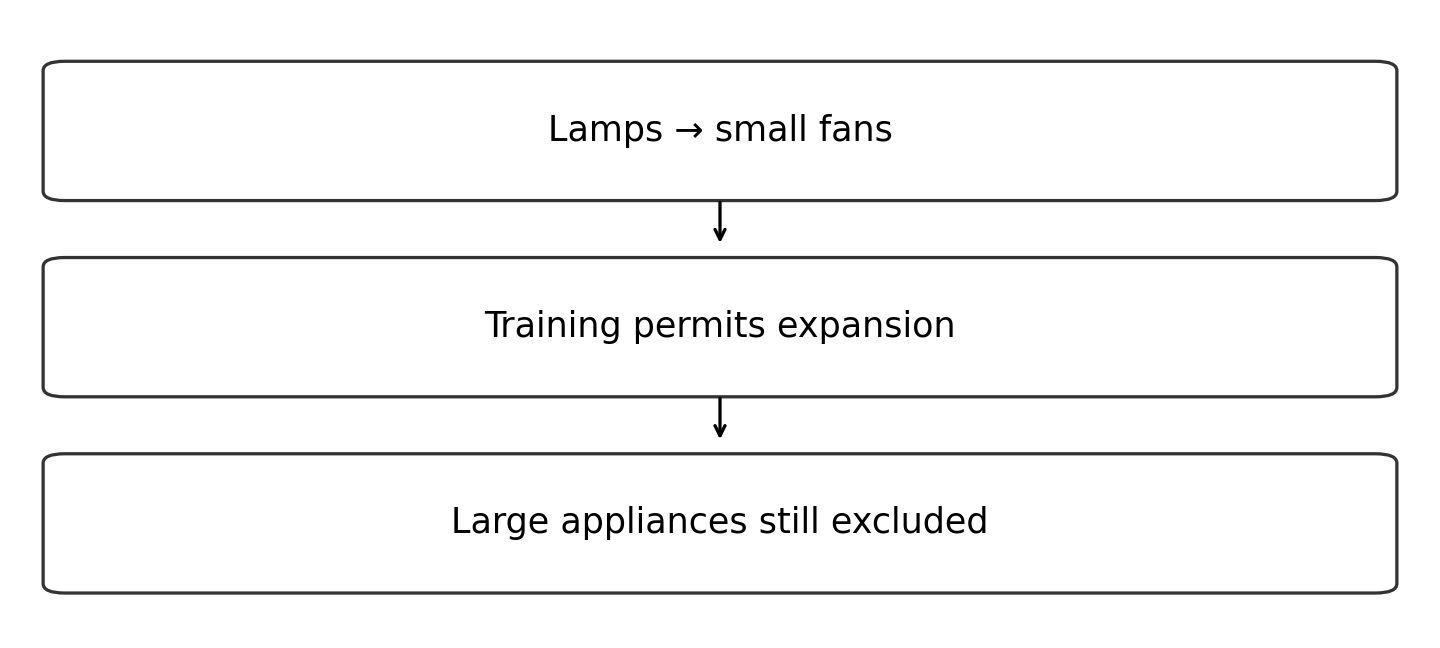
    The central idea is the relationship that holds the passage together. Read: “The repair café first accepted only lamps. It later added small fans after volunteers received training. Large appliances still went to specialist shops.” A sound summary is: the café expanded its repairs within limits. “It repaired everything” ignores the last sentence. “It repaired lamps” omits the change.
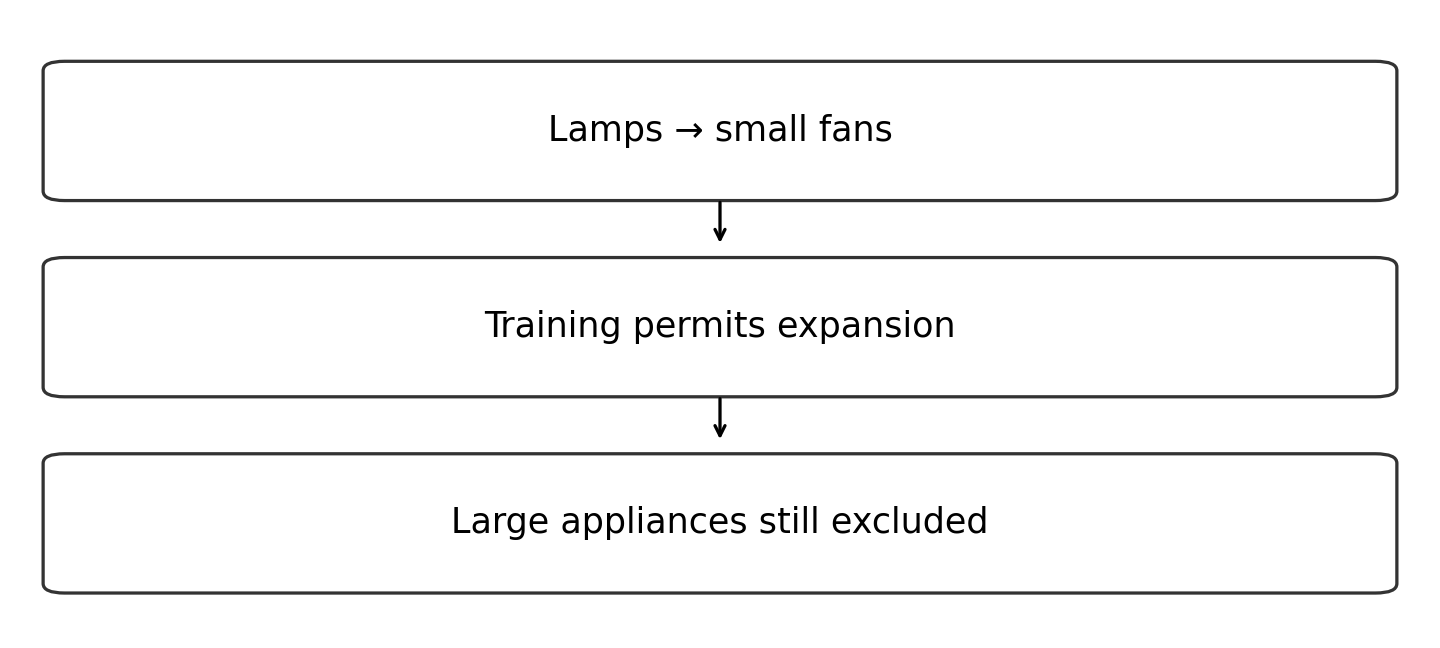
    Original diagram of the worked relationship; read the full wording and qualifications.
    Original diagram of the worked relationship; read the full wording and qualifications.

    Existing worked example: A study measured two streets at noon. The shaded street was 29°C; the unshaded street was 33°C. This supports a difference of 4°C at those sites and time. It cannot establish city-wide cooling or causation because the streets may differ in other ways.

    Complete original context

    Original passage: The city archive began a trial in which readers could search handwritten shipping registers using an online index. Volunteers entered names and dates, while staff checked entries that were difficult to read. The index often helped researchers locate a likely page before travelling to the archive. It did not replace the register images: two people with the same name could still be distinguished only by reading nearby entries. Staff therefore described the index as a route into the records rather than a final answer to every question. They also kept a public list of corrected entries so that researchers could see how the index changed.

    Independent practice and checked reasoning

    This overview is completed through the detailed skill sequence: 20, 21, 22. Work those references and sheets in order; this orientation does not replace them.

    Transfer 1

    State the central idea in one sentence, preserving both benefit and limit.

    Reasoning: The checked index helps researchers find relevant records, but consulting the underlying register remains necessary for some distinctions. This covers the search benefit and same-name limitation without claiming complete accuracy.

    Transfer 2

    Which detail explains why register images remain necessary? Distinguish that from the purpose of the corrections list.

    Reasoning: People with the same name may require nearby register entries to distinguish them. The corrections list instead makes revisions visible; it does not itself identify every person.

    Transfer 3

    Reject each proposed summary with specific evidence — A “Volunteers replaced staff”; B “The index made all archive visits unnecessary”; C “The archive hid changes to the index”.

    Reasoning: A contradicts staff checking difficult entries. B overstates “often” and the need to consult underlying records; the passage does not say every visit is replaced. C contradicts the public corrections list. None preserves the stated scope.

    Limits and next use

    An answer that sounds scientifically plausible may add information absent from the passage.

    All tasks here are public original practice with authored guidance. They are not official questions or fresh diagnostics. Existing protected tests and mocks remain separate.
    词汇
    English 中文 拼音
    central idea/ˈsentrəl aɪˈdɪə/ 中心思想 zhōng xīn sī xiǎng
    inference/ˈɪnfərəns/ 推断 tuī duàn
    evidence/ˈevɪdəns/ 证据 zhèng jù
    detail/ˈdiːteɪl/ 细节 xì jié
  • 2

    RW.C · Craft and Structure

    学习计划即将上线

    Handout

    Scope and prerequisites

    Digital SAT framework; original paper practice is nonadaptive and gives no scaled-score prediction.

    • Determine words in context
    • Analyse text structure and purpose
    • Compare related texts and viewpoints

    Prerequisites: Sentence meaning; contrast 对比 and explanation clues.

    Explain and choose the method

    Replace a tested word with your own plain phrase before viewing options. The sentence controls the meaning.

    Find what a sentence does: presents evidence 证据, qualifies a claim, explains a method or introduces a contrast.

    Separate the author’s view from a quoted view. Reporting a claim does not always endorse it.

    Cross-text questions ask about a relationship. Identify the exact point of agreement or disagreement, not the shared topic.

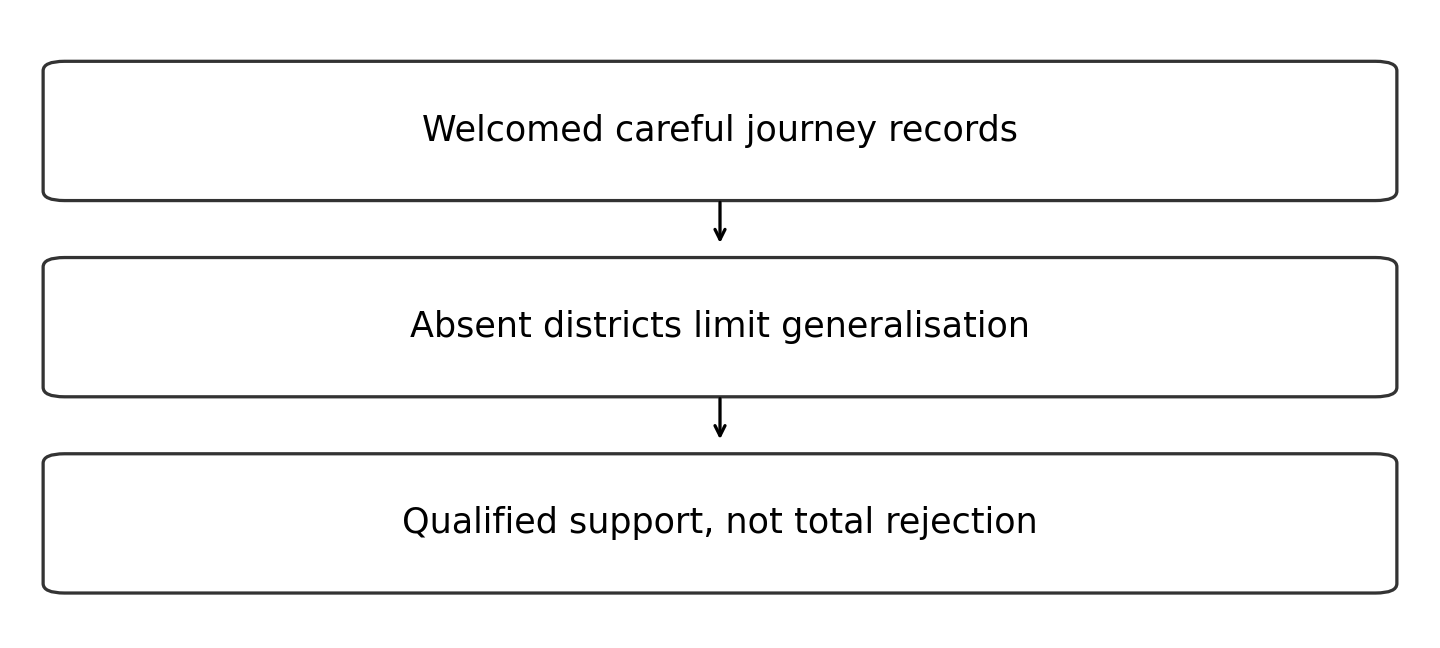
    A word in context 语境中的词义 must fit the relationship, not just a dictionary entry. In “The evidence is thin, so the conclusion remains provisional”, provisional means open to revision. It does not mean temporary employment or physical thinness. Paraphrase before choosing.

    Original diagram of the worked relationship; read the full wording and qualifications.
    Original diagram of the worked relationship; read the full wording and qualifications.

    Existing worked example: Text 1: A small trial suggests the filter could help. Text 2: The trial is too small to establish effectiveness. Both allow that the trial is limited. Text 2 is more cautious about the conclusion; it does not say the filter certainly fails.

    Complete original context

    Original passage: The reviewers welcomed the survey's careful record of individual journeys, but they gave its city-wide conclusions only qualified support. The routes had been chosen for convenience, and several districts were absent. One reviewer called the record illuminating: it made previously overlooked travel difficulties easier to understand. Another cautioned that extending the conclusions would require a broader sample. The authors accepted this reservation and proposed a second survey.

    Independent practice and checked reasoning

    This overview is completed through the detailed skill sequence: 23, 24, 25. Work those references and sheets in order; this orientation does not replace them.

    Transfer 1

    Explain qualified, illuminating and reservation in this passage. Quote a clue for each.

    Reasoning: Qualified means limited or conditional, supported by absent districts and a need for broader sampling. Illuminating means revealing or clarifying, supported by difficulties becoming easier to understand. Reservation means a concern or limitation, supported by caution about extending conclusions; it is not a booked seat.

    Transfer 2

    Compare “The reviewers dismissed the survey” with “The reviewers endorsed its conclusions without reservation”. Why does neither fit?

    Reasoning: Dismissed ignores their welcome for its careful records. Endorsed without reservation erases the sampling concern. The attitude combines appreciation of the records with limited support for broader conclusions.

    Transfer 3

    Replace illuminating with revealing, dazzling or visible. Which best preserves meaning and why do the others fail here?

    Reasoning: Revealing preserves the idea that the record makes difficulties understood. Dazzling introduces brilliance or admiration beyond the stated clarification. Visible describes perceptibility, not the survey's explanatory contribution. This is a contextual meaning decision, not a rule that those words are always wrong.

    Limits and next use

    The everyday meaning of a word may differ from its meaning in the supplied sentence.

    All tasks here are public original practice with authored guidance. They are not official questions or fresh diagnostics. Existing protected tests and mocks remain separate.
    词汇
    English 中文 拼音
    word in context 语境中的词义 yǔ jìng zhōng de cí yì
    evidence/ˈevɪdəns/ 证据 zhèng jù
    contrast/ˈkɒntræst/ 对比 duì bǐ
  • 3

    RW.E · Expression of Ideas

    学习计划即将上线

    Handout

    Scope and prerequisites

    Digital SAT framework; original paper practice is nonadaptive and gives no scaled-score prediction.

    • Select transitions expressing logical relationships
    • Synthesize notes for a stated rhetorical goal

    Prerequisites: Read a stated rhetorical goal; preserve names, units and relations.

    Explain and choose the method

    Classify the relationship before choosing a transition 衔接词: contrast, consequence, addition or example.

    Read both sides of a blank. A transition must link their meanings, not merely sound natural.

    For notes questions, underline the requested goal. Comparison, introduction and emphasis require different selections.

    Use only necessary notes. Keep names, dates and quantities attached to the correct object.

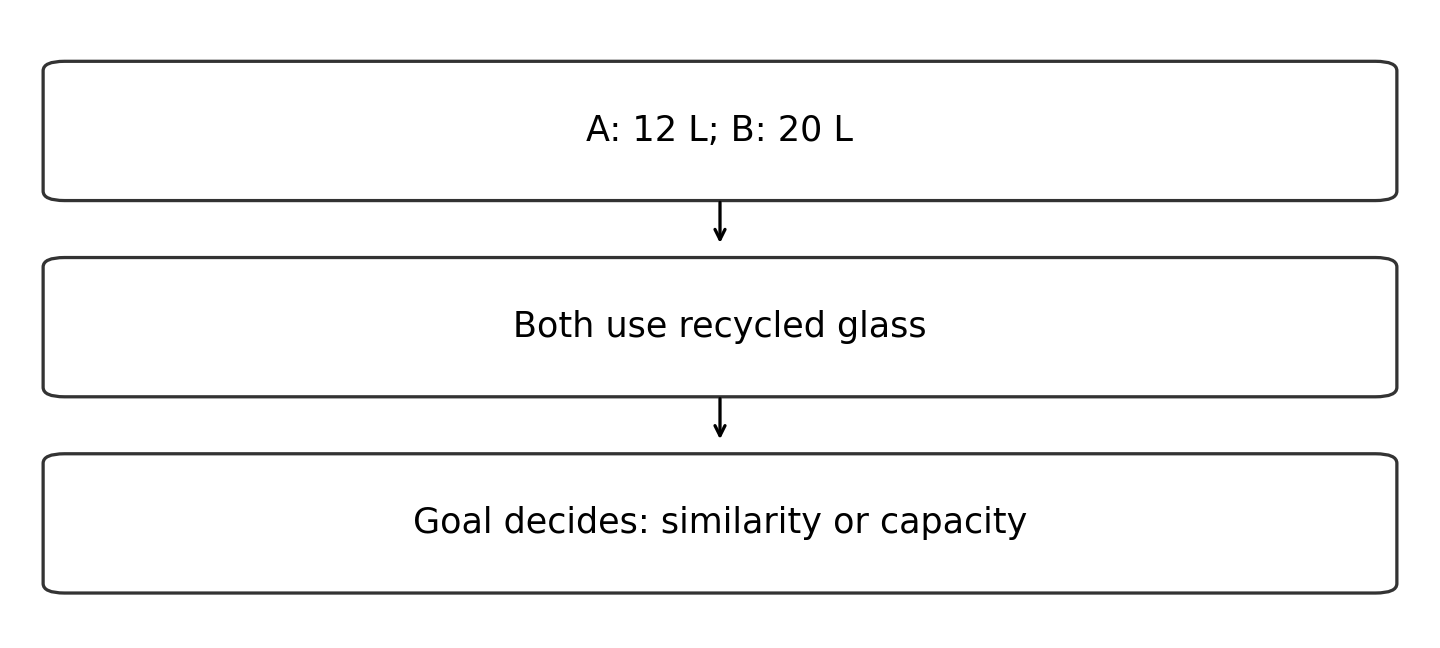
    Rhetorical synthesis 综合 修辞综合 selects facts for a purpose. Notes: A stores 12 litres; B stores 20; both use recycled glass. For a material similarity 相似: “Both containers use recycled glass.” For a capacity difference: “B stores 8 litres more than A.” The same notes support different sentences.

    Original diagram of the worked relationship; read the full wording and qualifications.
    Original diagram of the worked relationship; read the full wording and qualifications.

    Existing worked example: Notes: Route A is 8 km and has six stops. Route B is 8 km and has ten stops. Goal: emphasise a similarity. “Both routes are 8 km long” meets the goal. Discussing stops emphasises a difference instead.

    Complete original context

    Original research notes:

    • The Bay project restored 3 km of walking paths in 2024.
    • The Hill project restored 5 km of walking paths in 2024.
    • Both projects used volunteer teams.
    • Bay used local stone for boundary markers.
    • Hill used recycled timber for boundary markers.
    • The notes give no costs, visitor counts or durability measurements.

    Independent practice and checked reasoning

    This overview is completed through the detailed skill sequence: 26, 27. Work those references and sheets in order; this orientation does not replace them.

    Transfer 1

    Write one sentence emphasising a similarity in staffing and a second emphasising the difference in distance restored.

    Reasoning: “Both Bay and Hill used volunteer teams.” “Hill restored 5 km of paths, 2 km more than Bay.” These select staffing and distance respectively without adding a cause.

    Transfer 2

    A student writes “Hill restored more paths because recycled timber lasts longer.” Identify every unsupported relationship.

    Reasoning: The notes do not report why Hill restored a longer distance, nor any durability comparison. They report kilometres, not the number of separate paths. A valid sentence is “Hill restored a longer total distance and used recycled timber for its markers,” without a causal link.

    Transfer 3

    Goal — contrast marker 转折标记 materials without including irrelevant detail 细节. Write a sentence, then explain why the shared year can be omitted.

    Reasoning: “Bay used local stone for boundary markers, whereas Hill used recycled timber.” The shared year does not establish the requested material contrast. Omitting it meets this goal; a historical comparison could require it under a different goal.

    Limits and next use

    Do not include every note. Extra detail can distract from the requested rhetorical purpose.

    All tasks here are public original practice with authored guidance. They are not official questions or fresh diagnostics. Existing protected tests and mocks remain separate.
    词汇
    English 中文 拼音
    rhetorical synthesis 修辞综合 xiū cí zōng hé
    contrast marker/ˈkɒntræst ˈmɑːkə/ 转折标记 zhuǎn zhé biāo jì
    similarity/ˌsɪmɪˈlærɪti/ 相似 xiāng sì
    transition/trænˈsɪʃn/ 衔接词 xián jiē cí
    synthesis/ˈsɪnθəsɪs/ 综合 zōng hé
    detail/ˈdiːteɪl/ 细节 xì jié
  • 4

    RW.S · Standard English Conventions

    学习计划即将上线

    Handout

    Scope and prerequisites

    Digital SAT framework; original paper practice is nonadaptive and gives no scaled-score prediction.

    • Use sentence boundaries and punctuation
    • Maintain subject–verb agreement and pronoun clarity
    • Choose verb forms and modifiers fitting context

    Prerequisites: Subjects and finite verbs; independent/dependent clauses.

    Explain and choose the method

    Find the finite verb 限定动词 and subject in each clause 分句. A dependent clause cannot stand alone as a full sentence.

    Join two complete clauses with a full stop, semicolon, or comma plus a coordinating conjunction.

    A colon 冒号 follows a complete clause. A semicolon joins complete clauses. Keep essential modifiers attached to what they describe.

    Check the head noun for agreement. “The list of measurements is long”: list, not measurements, controls is.

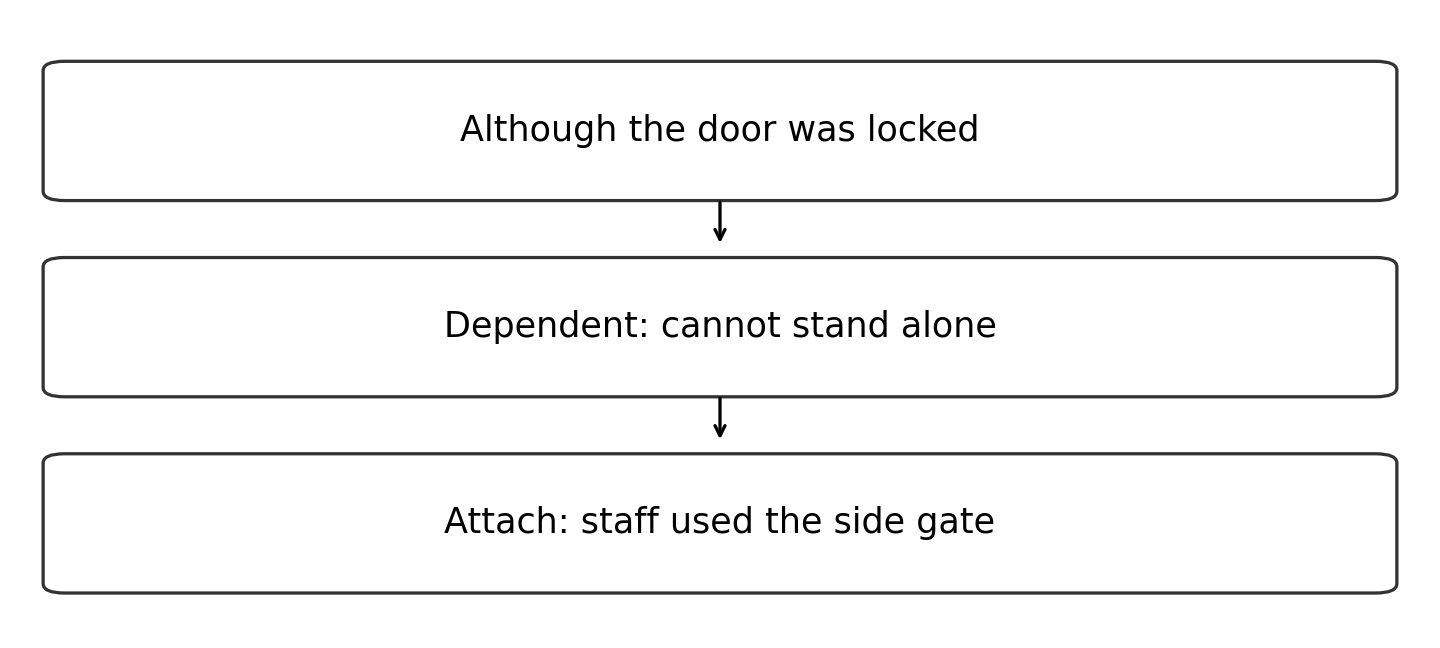
    A sentence boundary 句子边界 depends on clause structure. “Although the door was locked” is dependent; attach it to a complete clause. “Although the door was locked, staff could enter through the side gate.” A colon follows a complete introductory clause: “Staff used one entrance: the side gate.”

    Original diagram of the worked relationship; read the full wording and qualifications.
    Original diagram of the worked relationship; read the full wording and qualifications.

    Existing worked example: The sensor failed; the team replaced it. Each side has a subject and verb, so a semicolon works. “Because the sensor failed; the team replaced it” is wrong: because makes the first part dependent.

    Complete original context

    Original editing passage: Although the old station was closed [1] its clock still worked. The mechanism was simple [2] however, repairing the hands required a specialist. One part needed replacement [3] the narrow axle behind the dial. The clock [4] which stood above the entrance [5] had become a meeting point. For this exercise there is one clock, and the which-clause adds nonessential information.

    Independent practice and checked reasoning

    This overview is completed through the detailed skill sequence: 28, 29. Work those references and sheets in order; this orientation does not replace them.

    Transfer 1

    Supply punctuation at [1]–[5]. Give at least two valid boundaries at [2] and explain the clause test.

    Reasoning: [1] comma attaches the introductory dependent clause. [2] semicolon or full stop, because the mechanism clause and repairing clause are independent; capitalise However after a full stop. [3] colon follows the complete clause “One part needed replacement” and introduces the part. [4],[5] paired commas mark the specified nonessential clause; matching dashes or parentheses also work.

    Transfer 2

    Explain why “One part needed: a replacement” differs from the valid colon sentence in the passage.

    Reasoning: Needed directly requires its object “a replacement”; placing a colon there interrupts that grammatical unit. In “One part needed replacement: the narrow axle”, the independent clause is already complete and the explanation follows.

    Transfer 3

    Repair “The clock, above the entrance, and the bell was restored” while preserving the two restored objects. Explain agreement and any optional punctuation.

    Reasoning: “The clock above the entrance and the bell were restored.” The compound subject takes were. Commas around “above the entrance” could be used if it is supplementary rather than identifying; that contextual choice does not change the compound agreement.

    Limits and next use

    Long noun phrases hide the subject. Do not choose a verb merely to match the nearest noun.

    All tasks here are public original practice with authored guidance. They are not official questions or fresh diagnostics. Existing protected tests and mocks remain separate.
    词汇
    English 中文 拼音
    sentence boundary 句子边界 jù zi biān jiè
    finite verb/ˈfaɪnaɪt vɜːb/ 限定动词 xiàn dìng dòng cí
    clause/klɔːz/ 分句 fēn jù
    colon/ˈkəʊlən/ 冒号 mào hào
  • 5

    M.A · Algebra

    学习计划即将上线

    Handout

    Scope and prerequisites

    Digital SAT framework; original paper practice is nonadaptive and gives no scaled-score prediction.

    • Solve linear equations and inequalities in one variable
    • Represent and solve two-variable linear systems
    • Interpret linear functions and parameters in context

    Prerequisites: Collect like terms; substitute ordered pairs; signed arithmetic.

    Explain and choose the method

    Write a variable definition with units before an equation. The intercept 截距 represents an initial amount.

    A linear slope 斜率 is change in output divided by change in input. Keep both quantities in the right order.

    Solve systems by substitution or elimination. A solution must satisfy both equations.

    An inequality reverses direction when multiplied or divided by a negative number. Test a value to check the final region.

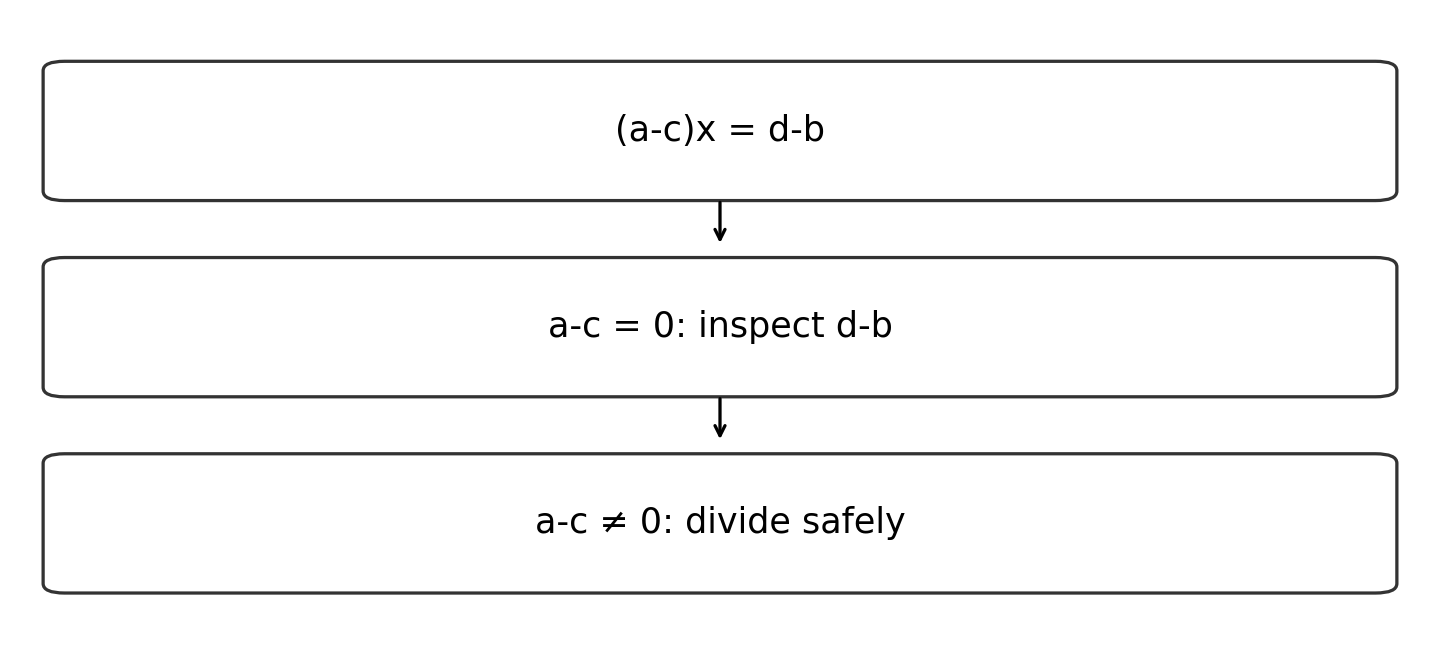
    An identity holds for every permitted input. Start with $ax+b=cx+d$. Collect terms: $(a-c)x=d-b$. Inspect $a-c$ before dividing. If $a=c$ and $b=d$, every real input works. If only $a=c$, no input works. Otherwise $x=(d-b)/(a-c)$ gives one solution.

    Original worked example from existing native teaching; transfer tasks use their own data.
    Original worked example from existing native teaching; transfer tasks use their own data.

    Existing worked example: Let f be the fixed fee and r the cost per kilometre. f+3r=11 and f+7r=19. Subtract the equations: 4r=8, so r=2. Then f=11−3(2)=5. Both journeys fit; the fixed fee is 5.

    Complete original context

    Every transfer question states all data it needs.

    Independent practice and checked reasoning

    This overview is completed through the detailed skill sequence: 9. Work those references and sheets in order; this orientation does not replace them.

    Transfer 1

    Classify the solutions of $(p-1)x+3=2x+p$ for every real $p$.

    Reasoning: Collect terms to get $(p-3)x=p-3$. At $p=3$, the equation is $0=0$, so every real $x$ works. At $p\ne3$, divide by $p-3$ to get $x=1$. There is no value of $p$ giving no solution. Substitution of $x=1$ gives $p+2$ on both sides.

    Transfer 2

    A hire charge $C$ yuan has a fixed fee $f$ yuan and rate 速率 $r$ yuan per hour. Three hours cost 31 yuan; seven hours cost 59 yuan. Find $f,r$ and the greatest affordable whole number of hours with 80 yuan.

    Reasoning: Use $C=f+rt$. The equations are $31=f+r(3\,\mathrm{h})$ and $59=f+r(7\,\mathrm{h})$. Subtract: $r=(59-31)\,\mathrm{yuan}/(7-3)\,\mathrm{h}=7\,\mathrm{yuan/h}$. Then $f=31\,\mathrm{yuan}-(7\,\mathrm{yuan/h})(3\,\mathrm{h})=10\,\mathrm{yuan}$. Budget: $10+7t\le80$, so $t\le10$ hours. Ten whole hours is affordable; eleven costs 87 yuan.

    Transfer 3

    Describe all points satisfying $y>2x-1$ and $y\le-x+5$. Is $(2,3)$ included? State the possible $x$-values.

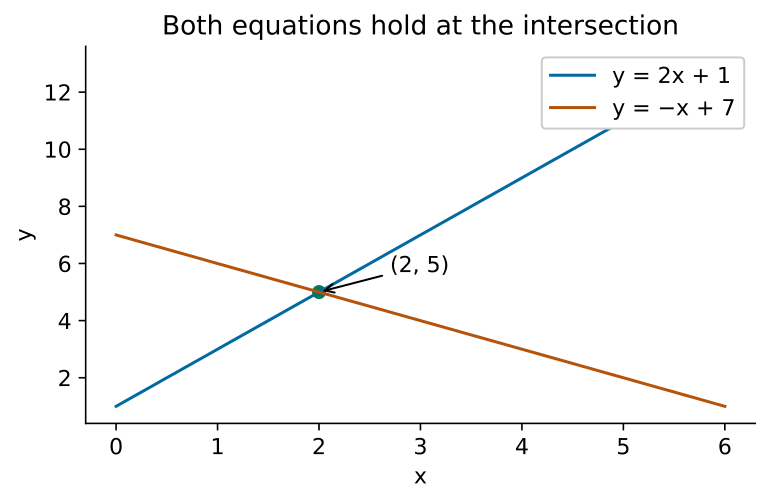
    Reasoning: The first boundary is dashed and the second solid. The common region is above the first line and on or below the second. At $(2,3)$ the first condition is $3>3$, which fails. For the vertical interval to exist, $2x-1<-x+5$, hence $x<2$. The lines meet at $(2,3)$ but their meeting point is excluded.

    Limits and next use

    The intercept is not always the actual starting value if zero lies outside the model’s stated domain.

    All tasks here are public original practice with authored guidance. They are not official questions or fresh diagnostics. Existing protected tests and mocks remain separate.
    词汇
    English 中文 拼音
    intercept/ˌɪntəˈsept/ 截距 jié jù
    slope/sləʊp/ 斜率 xié lǜ
    rate/reɪt/ 速率 sù lǜ
  • 6

    M.Q · Advanced Math

    学习计划即将上线

    Handout

    Scope and prerequisites

    Digital SAT framework; original paper practice is nonadaptive and gives no scaled-score prediction.

    • Transform equivalent polynomial and rational expressions
    • Solve nonlinear equations and systems
    • Interpret quadratic and exponential functions

    Prerequisites: Distributive law; difference of squares; real square roots.

    Explain and choose the method

    Factor a quadratic when possible. The zero-product rule applies to a product equal to zero.

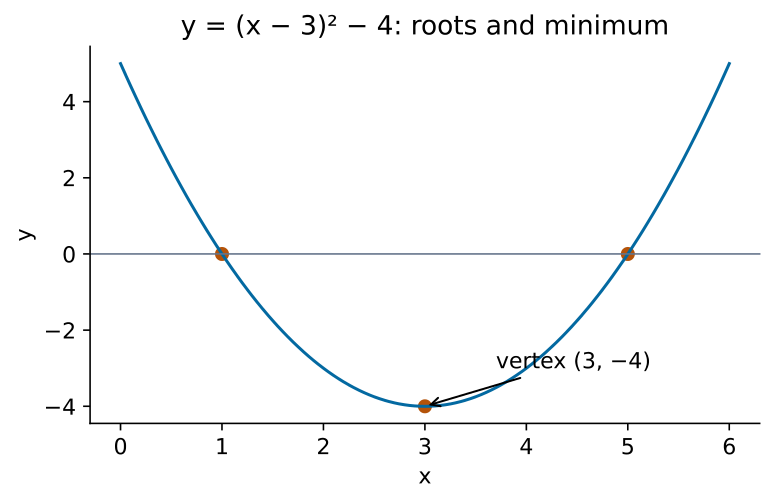
    Completing the square reveals a vertex: x²−6x+5=(x−3)²−4.

    For rational expressions, record excluded denominator values before cancelling factors.

    An exponential model multiplies by a fixed factor per interval. A 20% increase means multiply by 1.2, not add 0.2.

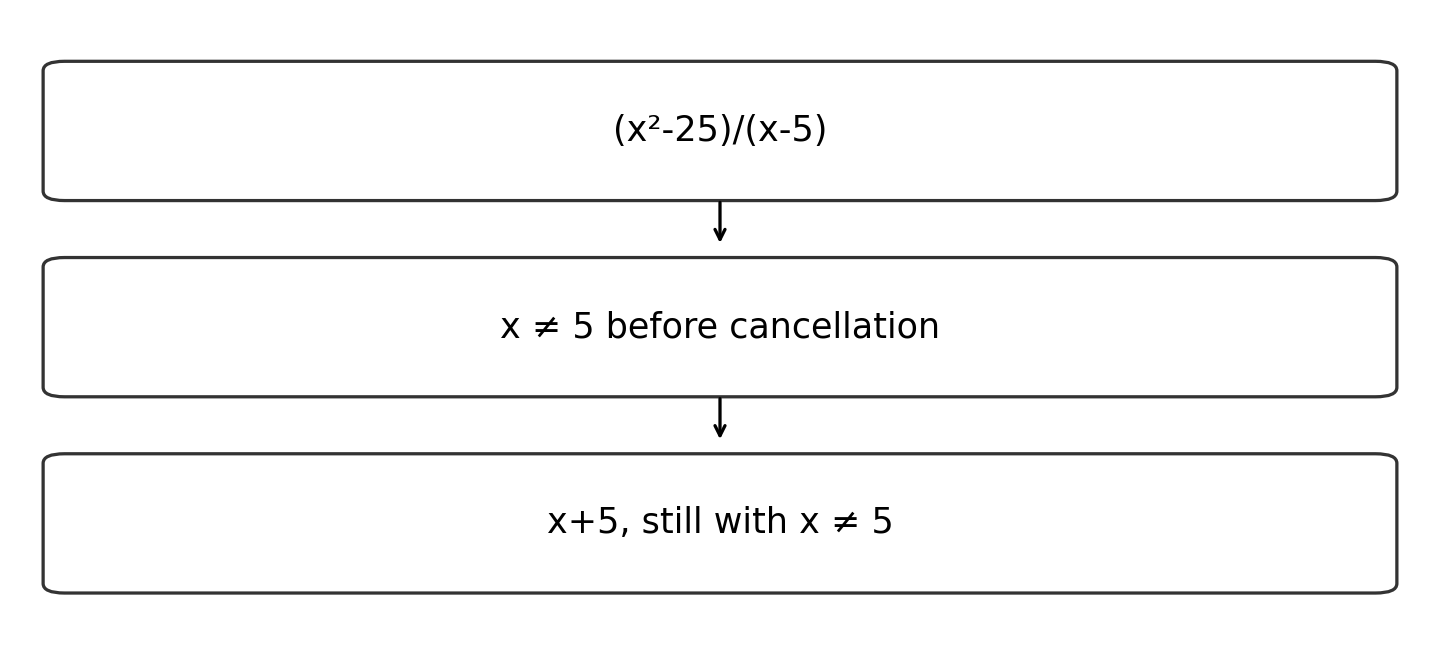
    Equivalent expressions 等价表达式 must agree on the stated domain 定义域 . $E(x)=(x^2-25)/(x-5)=(x+5)$ only for $x\ne5$. Cancellation removes a factor, but it cannot restore an excluded input. Also $\sqrt{x^2}=|x|$, because the principal square root 根 cannot be negative.

    Original worked example from existing native teaching; transfer tasks use their own data.
    Original worked example from existing native teaching; transfer tasks use their own data.

    Existing worked example: Solve x²−5x+6=0. Factor: (x−2)(x−3)=0. Thus x=2 or 3. If instead (x²−5x+6)/(x−2)=0, x=2 is excluded; only 3 remains.

    Complete original context

    Every transfer question states all data it needs.

    Independent practice and checked reasoning

    This overview is completed through the detailed skill sequence: 10, 11, 12. Work those references and sheets in order; this orientation does not replace them.

    Transfer 1

    Simplify $F(x)=(x^2-4x)/(x^2-16)$. State every original restriction and explain why $F$ is not identical to $x/(x+4)$ on that latter formula's whole domain.

    Reasoning: Factor numerator $x(x-4)$ and denominator $(x-4)(x+4)$. The original domain excludes $x=4,-4$. Cancellation gives $F(x)=x/(x+4)$ for $x\ne4,-4$. The latter formula alone permits $4$, where it gives $1/2$, while $F(4)$ is undefined.

    Transfer 2

    Find the coefficient of $x$ in $(3x-2)(x+5)$ and evaluate $\sqrt{(x-5)^2}$ when $x=1$.

    Reasoning: Expansion gives $3x^2+15x-2x-10=3x^2+13x-10$, so the coefficient is 13. The root is $|x-5|$; at $x=1$, it is $|-4|=4$, not $-4$ or 16.

    Transfer 3

    A student tests $x=2$ and concludes that $x^2$ and $2x$ are equivalent. Refute the conclusion and solve where they actually agree.

    Reasoning: At $x=3$ the outputs are 9 and 6, so one matching test is not proof. Solve $x^2=2x$ as $x(x-2)=0$, giving only $x=0,2$.

    Limits and next use

    Squaring an equation can add extraneous roots. Substitute into the original equation, not just the transformed one.

    All tasks here are public original practice with authored guidance. They are not official questions or fresh diagnostics. Existing protected tests and mocks remain separate.
    词汇
    English 中文 拼音
    equivalent expressions 等价表达式 děng jià biǎo dá shì
    domain/dəˈmeɪn/ 定义域 dìng yì yù
    root/ruːt/ 根 gēn
  • 7

    M.D · Problem-Solving and Data Analysis

    学习计划即将上线

    Handout

    Scope and prerequisites

    Digital SAT framework; original paper practice is nonadaptive and gives no scaled-score prediction.

    • Use ratios, rates and percentages
    • Interpret distributions and compare centre and spread
    • Calculate probabilities and assess sample claims

    Prerequisites: Fractions; unit conversion; percentage base.

    Explain and choose the method

    Percent change uses the original value as the denominator. Percentage points compare percentages directly.

    Convert units explicitly. A rate 速率 denominator describes the amount of time or distance used.

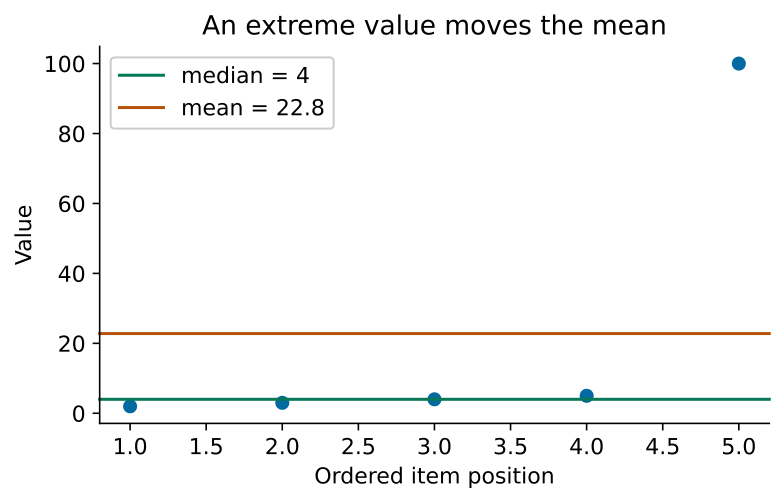
    The median 中位数 resists extreme values more than the mean. Spread describes variation, not the average.

    A random sample 随机样本 supports generalisation to its sampling population. Random assignment concerns causal comparison, a different issue.

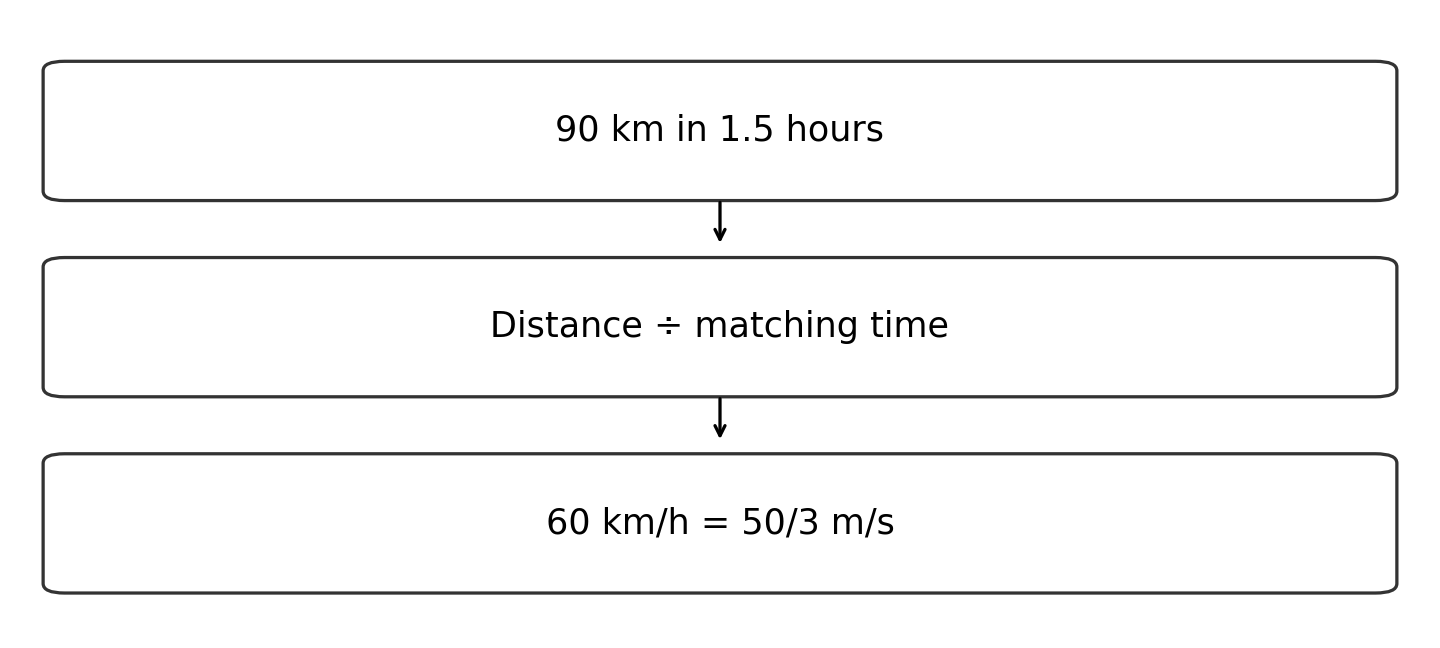
    A rate compares quantities with their units. $v=d/t=(90\,\mathrm{km})/(1.5\,\mathrm{h})=60\,\mathrm{km/h}$. Convert using cancelling units: $v=(60\,\mathrm{km/h})(1000\,\mathrm{m/km})/(3600\,\mathrm{s/h})=50/3\,\mathrm{m/s}$. Do not convert only the numerator of a compound rate.

    Original worked example from existing native teaching; transfer tasks use their own data.
    Original worked example from existing native teaching; transfer tasks use their own data.

    Existing worked example: A price of 80 falls by 20%: 80×0.8=64. It then rises by 20%: 64×1.2=76.8. The final value is below 80 because the two percentage changes use different bases.

    Complete original context

    Every transfer question states all data it needs.

    Independent practice and checked reasoning

    This overview is completed through the detailed skill sequence: 13, 14, 15, 16, 17. Work those references and sheets in order; this orientation does not replace them.

    Transfer 1

    Mix red and blue paint in ratio 4:7 to make 33 litres. Find each amount. Red paint costs 18 yuan per litre and blue 12. Find total cost.

    Reasoning: There are 11 parts, so each is 3 L. Red volume $V_r=33(4/11)=12\,\mathrm{L}$; blue volume $V_b=33(7/11)=21\,\mathrm{L}$. Cost $C=p_rV_r+p_bV_b=(18\,\mathrm{yuan/L})(12\,\mathrm{L})+(12\,\mathrm{yuan/L})(21\,\mathrm{L})=468\,\mathrm{yuan}$.

    Transfer 2

    A 400-yuan item falls 15% then rises 10%. Find the final price and the single overall percentage change.

    Reasoning: Use successive multipliers. $P=P_0(1-0.15)(1+0.10)=(400\,\mathrm{yuan})(0.85)(1.10)=374\,\mathrm{yuan}$. Relative change $r=(P-P_0)/P_0=(374-400)/400=-0.065$, a 6.5% decrease.

    Transfer 3

    A pump supplies 0.15 litres per second. How long does 54 litres take? If a square has side 30 cm, give its area in square metres.

    Reasoning: $t=V/q=(54\,\mathrm{L})/(0.15\,\mathrm{L/s})=360\,\mathrm{s}=6\,\mathrm{min}$. Convert side before squaring: $A=s^2=(0.30\,\mathrm{m})^2=0.09\,\mathrm{m^2}$; the area conversion factor is 10000, not 100.

    Limits and next use

    A sample from volunteers is not automatically representative, even when it is large.

    All tasks here are public original practice with authored guidance. They are not official questions or fresh diagnostics. Existing protected tests and mocks remain separate.
    词汇
    English 中文 拼音
    random sample/ˈrændəm ˈsæmpl/ 随机样本 suí jī yàng běn
    median/ˈmiːdiːən/ 中位数 zhōng wèi shù
    rate/reɪt/ 速率 sù lǜ
  • 8

    M.G · Geometry and Trigonometry

    学习计划即将上线

    Handout

    Scope and prerequisites

    Digital SAT framework; original paper practice is nonadaptive and gives no scaled-score prediction.

    • Use area, volume and similarity 相似
    • Apply right-triangle ratios and the Pythagorean theorem
    • Use circle equations, arcs and angle relationships

    Prerequisites: Triangle sum; Pythagoras; length/area/volume units.

    Explain and choose the method

    Similarity preserves corresponding angles and length ratios. Areas scale by k² and volumes by k³.

    For a right triangle, sin is opposite/hypotenuse, cos adjacent/hypotenuse, and tan opposite/adjacent.

    A circle with centre (h,k) and radius r has (x−h)²+(y−k)²=r².

    A full turn is 360° or 2π radians. Arc length 弧长 is rθ only when θ is in radians.

    A scale factor 比例因子 $k$ changes every corresponding length. $A_2=k^2A_1$ and $V_2=k^3V_1$ for similar shapes. If $k=3/2$ and $A_1=24\,\mathrm{cm^2}$, $A_2=(3/2)^2(24\,\mathrm{cm^2})=54\,\mathrm{cm^2}$. Changing only one dimension does not justify these similarity rules.

    Original worked example from existing native teaching; transfer tasks use their own data.
    Original worked example from existing native teaching; transfer tasks use their own data.

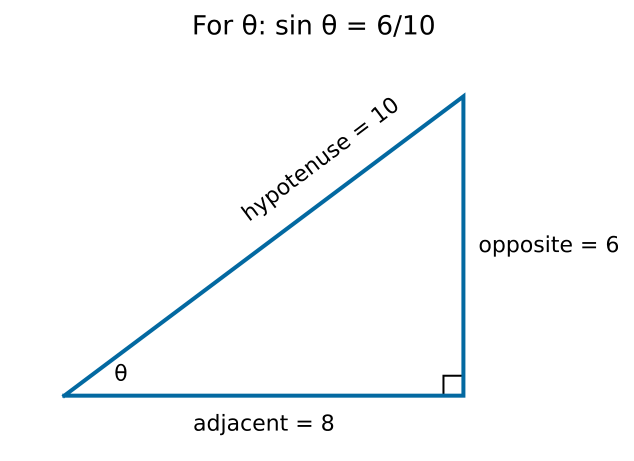
    Existing worked example: A right triangle has legs 6 and 8. c²=6²+8²=100, so c=10. For the angle opposite 6, sin θ=6/10=0.6. A similar triangle enlarged by factor 3 has area nine times the original.

    Complete original context

    Every transfer question states all data it needs.

    Independent practice and checked reasoning

    This overview is completed through the detailed skill sequence: 18, 19. Work those references and sheets in order; this orientation does not replace them.

    Transfer 1

    Similar containers have surface areas 96 and 216 square centimetres. The smaller volume is 160 cubic centimetres. Find the larger volume.

    Reasoning: $k=\sqrt{A_2/A_1}=\sqrt{216/96}=3/2$. Volume uses the cube: $V_2=k^3V_1=(3/2)^3(160\,\mathrm{cm^3})=540\,\mathrm{cm^3}$. Using area ratio directly would give the wrong volume.

    Transfer 2

    A right triangle has hypotenuse 13 cm and one leg 5 cm. Find the other leg, its area, and the sine of the angle opposite the 5 cm leg.

    Reasoning: $b=\sqrt{c^2-a^2}=\sqrt{(13\,\mathrm{cm})^2-(5\,\mathrm{cm})^2}=12\,\mathrm{cm}$. $A=ab/2=(5\,\mathrm{cm})(12\,\mathrm{cm})/2=30\,\mathrm{cm^2}$. $\sin\theta=a/c=(5\,\mathrm{cm})/(13\,\mathrm{cm})=5/13$.

    Transfer 3

    Two interior angles of a triangle are 42° and 73°. Find the third angle and its adjacent exterior angle. Would those angles alone determine all side lengths?

    Reasoning: Third angle is $180-42-73=65$ degrees. Its adjacent exterior angle is $180-65=115$ degrees, also $42+73$. Angles establish shape, not scale; similar triangles can have different side lengths.

    Transfer 4

    Two parallel lines are cut by a transversal. One corresponding angle is 68°. Find its matching corresponding angle and the adjacent angle on the second line. Explain which given condition justifies each step.

    Reasoning: Parallelism gives the matching corresponding angle 68°. The adjacent pair forms a straight angle, so the other is 180°−68°=112°. Equal corresponding angles require the stated parallel lines; the straight-angle sum uses adjacency on one line. A similar-looking sketch without parallelism would not justify the first equality.

    Limits and next use

    Radius and diameter differ by a factor of two. Using diameter in πr² makes the area four times too large.

    All tasks here are public original practice with authored guidance. They are not official questions or fresh diagnostics. Existing protected tests and mocks remain separate.
    词汇
    English 中文 拼音
    scale factor/skeɪl ˈfæktə/ 比例因子 bǐ lì yīn zi
    arc length/ɑːk leŋθ/ 弧长 hú zhǎng
    similarity/ˌsɪmɪˈlærɪti/ 相似 xiāng sì
  • 9

    ALG-parameters · Linear parameters, solution counts and inequalities

    学习计划即将上线

    Handout

    Scope and prerequisites

    Digital SAT framework; original paper practice is nonadaptive and gives no scaled-score prediction.

    • Solve and classify one-variable linear equations with parameters
    • Interpret two-variable linear equations as sets of ordered pairs
    • Interpret slope and intercept of a contextual linear function
    • Classify two-equation linear systems and check their intersections
    • Represent strict and inclusive inequalities in one or two variables

    Prerequisites: Collect like terms; substitute ordered pairs; signed arithmetic.

    Explain and choose the method

    Collect variable terms and constants separately. An equation ax+b=cx+d becomes (a-c)x=d-b. If a-c is nonzero there is one solution; if both sides reduce to zero there are infinitely many; if the variable coefficient is zero but the constant is nonzero there are none. Never divide by a parameter before checking whether it can be zero.

    A two-variable equation gives a set of ordered pairs. In y=mx+b, m is the change in y per unit x and b is y at x=0. For a contextual model, attach units to both: a taxi charge C=3t+5 has a 5-unit initial fee and 3 units per time unit. The intercept may be outside the practical domain even when it exists algebraically.

    For a system, compare both coefficients and constants. Multiplying one whole equation by a nonzero number produces the same line; matching variable coefficients with different constants gives parallel distinct lines. Otherwise an intersection supplies the pair satisfying both equations. Substitute the pair into both original equations to check it.

    Multiplying or dividing an inequality by a negative number reverses its direction. A strict inequality excludes the boundary, while ≤ or ≥ includes it. For two variables, draw the corresponding line and test a point away from it to identify the allowed half-plane. The diagram is a representation of all solutions, not a single preferred point.

    An identity 恒等式 holds for every permitted input. Start with $ax+b=cx+d$. Collect terms: $(a-c)x=d-b$. Inspect $a-c$ before dividing. If $a=c$ and $b=d$, every real input works. If only $a=c$, no input works. Otherwise $x=(d-b)/(a-c)$ gives one solution.

    Original diagram of the worked relationship; read the full wording and qualifications.
    Original diagram of the worked relationship; read the full wording and qualifications.

    Existing worked example: For kx+6=2x+6, k=2 gives 0=0 and infinitely many solutions; k≠2 gives x=0. For -2x+3<11, subtract 3 and divide by -2 to get x>-4. For y≤2x+1, (0,0) works and the solid boundary is included. The system 2x+4y=10 and x+2y=6 has no solution because doubling the second gives the same left side equal to 12, not 10.

    Complete original context

    Every transfer question states all data it needs.

    Independent practice and checked reasoning

    Transfer 1

    Classify the solutions of $(p-1)x+3=2x+p$ for every real $p$.

    Reasoning: Collect terms to get $(p-3)x=p-3$. At $p=3$, the equation is $0=0$, so every real $x$ works. At $p\ne3$, divide by $p-3$ to get $x=1$. There is no value of $p$ giving no solution. Substitution of $x=1$ gives $p+2$ on both sides.

    Transfer 2

    A hire charge $C$ yuan has a fixed fee $f$ yuan and rate 速率 $r$ yuan per hour. Three hours cost 31 yuan; seven hours cost 59 yuan. Find $f,r$ and the greatest affordable whole number of hours with 80 yuan.

    Reasoning: Use $C=f+rt$. The equations are $31=f+r(3\,\mathrm{h})$ and $59=f+r(7\,\mathrm{h})$. Subtract: $r=(59-31)\,\mathrm{yuan}/(7-3)\,\mathrm{h}=7\,\mathrm{yuan/h}$. Then $f=31\,\mathrm{yuan}-(7\,\mathrm{yuan/h})(3\,\mathrm{h})=10\,\mathrm{yuan}$. Budget: $10+7t\le80$, so $t\le10$ hours. Ten whole hours is affordable; eleven costs 87 yuan.

    Transfer 3

    Describe all points satisfying $y>2x-1$ and $y\le-x+5$. Is $(2,3)$ included? State the possible $x$-values.

    Reasoning: The first boundary is dashed and the second solid. The common region is above the first line and on or below the second. At $(2,3)$ the first condition is $3>3$, which fails. For the vertical interval to exist, $2x-1<-x+5$, hence $x<2$. The lines meet at $(2,3)$ but their meeting point is excluded.

    Limits and next use

    Do not confuse x=0 with a vanished variable coefficient, reverse only when multiplying/dividing by a negative, or shade a half-plane from the line’s slope alone.

    All tasks here are public original practice with authored guidance. They are not official questions or fresh diagnostics. Existing protected tests and mocks remain separate.
    词汇
    English 中文 拼音
    identity/aɪˈdentɪti/ 恒等式 héng děng shì
    rate/reɪt/ 速率 sù lǜ
  • 10

    AM-equivalence · Equivalent expressions and domain restrictions

    学习计划即将上线

    Handout

    Scope and prerequisites

    Digital SAT framework; original paper practice is nonadaptive and gives no scaled-score prediction.

    • Factor 因式 and expand expressions without changing their values
    • Simplify rational and radical expressions on the original domain
    • Use expression structure to identify zeros and coefficients

    Prerequisites: Distributive law; difference of squares; real square roots.

    Explain and choose the method

    Expansion distributes each factor across the others; factorisation reverses that process. x²-5x+6=(x-2)(x-3), so the product form exposes zeros while the expanded form exposes coefficients. Choose the form that serves the question rather than treating one representation as always preferable.

    Cancel factors, never terms in a sum. (x²-4)/(x-2) becomes x+2 only for x≠2, because the original expression is undefined at 2. A restriction may remain after every denominator disappears from the simplified formula. State it before cancelling, then carry it through comparisons or equation solving.

    Exponent rules depend on their setting: a^m a^n=a^(m+n) and (a^m)^n=a^(mn) in the permitted real domain. Negative exponents form reciprocals and require nonzero bases. With real square roots, √(x²)=|x|, because the principal square root is nonnegative; it is not x for every real x.

    To check equivalence, a numerical substitution can expose a mistake, but one matching value does not prove two expressions equal. A valid algebraic identity plus matching domain does. When the question requests a coefficient, expand only as far as needed and account for every contribution to that power.

    Equivalent expressions 等价表达式 must agree on the stated domain . $E(x)=(x^2-25)/(x-5)=(x+5)$ only for $x\ne5$. Cancellation removes a factor, but it cannot restore an excluded input. Also $\sqrt{x^2}=|x|$, because the principal square root cannot be negative.

    Original diagram of the worked relationship; read the full wording and qualifications.
    Original diagram of the worked relationship; read the full wording and qualifications.

    Existing worked example: (x²-9)/(x-3)=(x-3)(x+3)/(x-3)=x+3 for x≠3. At x=3 the original is undefined. For x=-5, √(x²)=5=|x|. In (2x+1)(x-4), the x coefficient is -8+1=-7 and the full expression is 2x²-7x-4.

    Complete original context

    Every transfer question states all data it needs.

    Independent practice and checked reasoning

    Transfer 1

    Simplify $F(x)=(x^2-4x)/(x^2-16)$. State every original restriction and explain why $F$ is not identical to $x/(x+4)$ on that latter formula's whole domain.

    Reasoning: Factor numerator $x(x-4)$ and denominator $(x-4)(x+4)$. The original domain excludes $x=4,-4$. Cancellation gives $F(x)=x/(x+4)$ for $x\ne4,-4$. The latter formula alone permits $4$, where it gives $1/2$, while $F(4)$ is undefined.

    Transfer 2

    Find the coefficient of $x$ in $(3x-2)(x+5)$ and evaluate $\sqrt{(x-5)^2}$ when $x=1$.

    Reasoning: Expansion gives $3x^2+15x-2x-10=3x^2+13x-10$, so the coefficient is 13. The root is $|x-5|$; at $x=1$, it is $|-4|=4$, not $-4$ or 16.

    Transfer 3

    A student tests $x=2$ and concludes that $x^2$ and $2x$ are equivalent. Refute the conclusion and solve where they actually agree.

    Reasoning: At $x=3$ the outputs are 9 and 6, so one matching test is not proof. Solve $x^2=2x$ as $x(x-2)=0$, giving only $x=0,2$.

    Limits and next use

    A simplified formula is not automatically an equivalent function on a larger domain; cancelling terms across addition is invalid.

    All tasks here are public original practice with authored guidance. They are not official questions or fresh diagnostics. Existing protected tests and mocks remain separate.
    词汇
    English 中文 拼音
    equivalent expressions 等价表达式 děng jià biǎo dá shì
    factor/ˈfæktə/ 因式 yīn shì
  • 11

    AM-equations · Nonlinear equations and mixed systems

    学习计划即将上线

    Handout

    Scope and prerequisites

    Digital SAT framework; original paper practice is nonadaptive and gives no scaled-score prediction.

    • Solve quadratic, absolute-value, rational and radical equations
    • Reject candidate roots violating the original equation or domain
    • Find intersections of a line and a nonlinear curve

    Prerequisites: Factorisation; substitution; domain restrictions.

    Explain and choose the method

    Use structure before expanding. A factored quadratic equals zero when at least one factor is zero. An absolute-value equation |u|=a has no real solution for a<0, one condition u=0 when a=0 and two conditions u=±a when a>0. Account for all allowed cases, not just the positive branch.

    For a rational equation, exclude denominator zeros before multiplying through. Multiplication may create a candidate at an excluded value. For a radical equation, note that a principal square root is nonnegative, isolate it and square carefully. Squaring is a one-way implication until every resulting candidate is checked in the original.

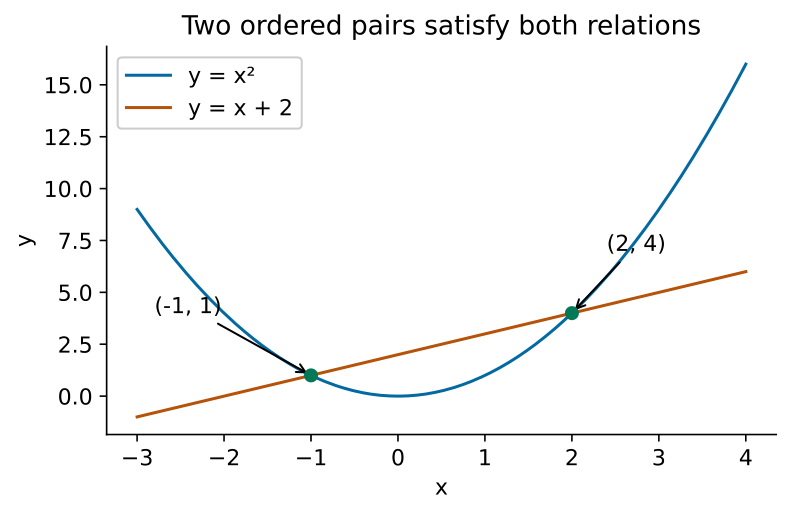
    To solve a line–parabola 抛物线 system, substitute the line expression into the quadratic. The real roots give x-values; use the line to recover each y. No real root means no real intersection 交点. A repeated quadratic root gives tangency, while two different real roots give two intersections.

    A graph or calculator can help locate candidates and check scale, but rounded intersections are not exact proof when the question asks an exact value or solution count. Relate graphical behaviour to the algebraic equation. A double root should not be counted twice as two different ordered pairs.

    A candidate root 候选根 must satisfy the original equation. In $\sqrt{x+6}=x$, the right side must be nonnegative. Squaring gives $x^2-x-6=0$, so candidates are $3,-2$. Only $3$ survives the original check: $\sqrt9=3$.

    Original worked example from existing native teaching; transfer tasks use their own data.
    Original worked example from existing native teaching; transfer tasks use their own data.

    Existing worked example: √(x+2)=x requires x≥0. Squaring yields x²-x-2=0, so x=2 or -1; only 2 works in the original. For y=x+2 and y=x², solve x²-x-2=0: x=2,-1, giving (2,4) and (-1,1). For |2x-1|=5, solve 2x-1=5 or -5 to obtain x=3 or -2.

    Complete original context

    Every transfer question states all data it needs.

    Independent practice and checked reasoning

    Transfer 1

    Solve $\sqrt{2x+3}=x$ over the real numbers, showing why any candidate is rejected.

    Reasoning: Require $x\ge0$. Squaring yields $x^2-2x-3=(x-3)(x+1)=0$. Candidates are 3 and -1. The original gives $\sqrt9=3$ at 3, but $\sqrt1=1\ne-1$ at -1. Only $x=3$ works.

    Transfer 2

    Solve simultaneously $y=x+2$ and $y=(x-1)^2$. Give exact ordered pairs and verify the number of intersections.

    Reasoning: Equate outputs to get $x+2=x^2-2x+1$, or $x^2-3x-1=0$. Thus $x=(3\pm\sqrt{13})/2$ and $y=(7\pm\sqrt{13})/2$ with matching signs. The discriminant 13 is positive, so there are two distinct real intersections; both expressions for $y$ agree by the derived equation.

    Transfer 3

    Solve $|3x+2|=7$ and $(x^2-9)/(x-3)=6$. Explain why these equations have different solution counts.

    Reasoning: The absolute value gives $3x+2=7$ or $-7$, hence $x=5/3$ or $-3$. The rational equation requires $x\ne3$ and simplifies to $x+3=6$, whose sole candidate 3 is excluded. It has no solution.

    Limits and next use

    Do not report every root of a transformed equation before checking the original restriction and branch.

    All tasks here are public original practice with authored guidance. They are not official questions or fresh diagnostics. Existing protected tests and mocks remain separate.
    词汇
    English 中文 拼音
    candidate root 候选根 hòu xuǎn gēn
    intersection/ˌɪntəˈsekʃn/ 交点 jiāo diǎn
    parabola/pəˈræbələ/ 抛物线 pāo wù xiàn
  • 12

    AM-functions · Nonlinear functions, transformations and growth

    学习计划即将上线

    Handout

    Scope and prerequisites

    Digital SAT framework; original paper practice is nonadaptive and gives no scaled-score prediction.

    • Interpret zeros, vertices and parameters from useful function forms
    • Distinguish additive linear change from multiplicative exponential change
    • Transform a graph while tracking its input and output

    Prerequisites: Function notation; squares; growth multipliers.

    Explain and choose the method

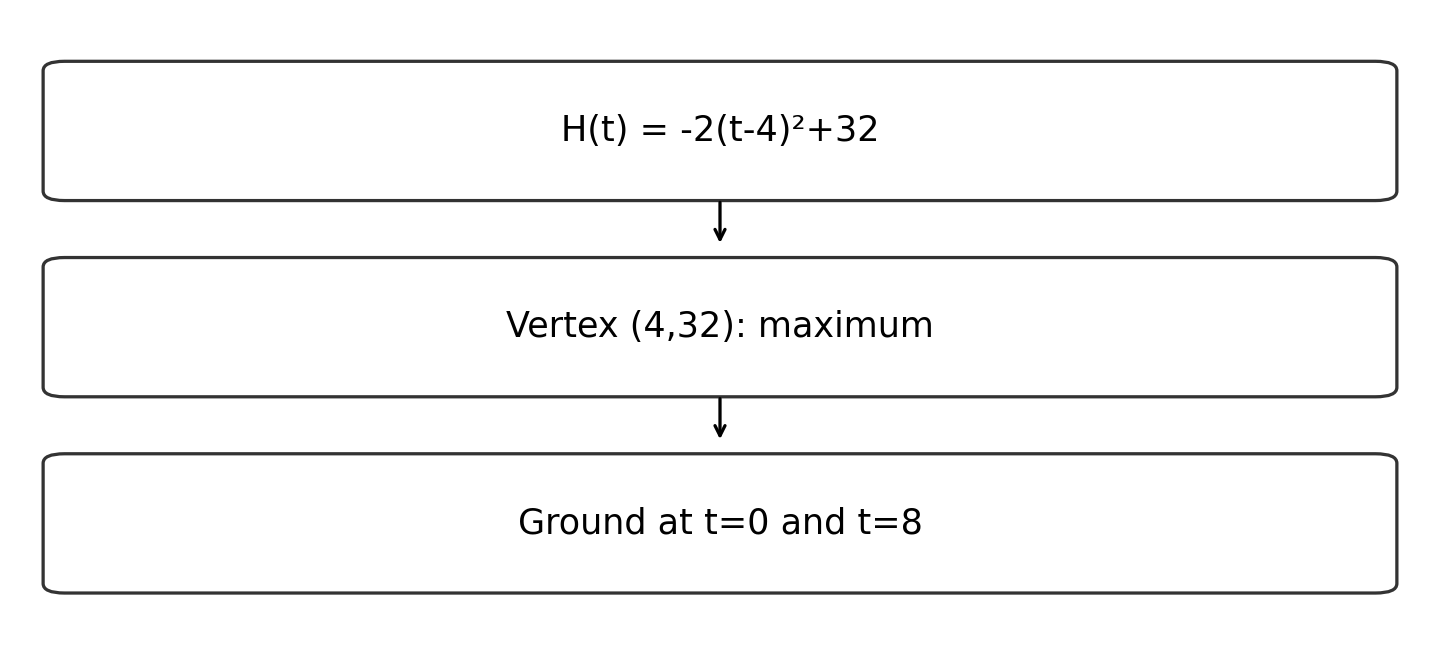
    Vertex form 顶点式 a(x-h)²+k identifies the vertex (h,k) and opening direction; factored form identifies zeros. The same function can have both forms. In context, determine which features are meaningful: a maximum height occurs at the vertex of a downward parabola 抛物线, while a zero can represent returning to ground level.

    For y=A b^t, A is the value at t=0 and b is the factor per unit time. A growth rate 速率 r gives b=1+r; decay gives b=1-r. Equal differences indicate a linear model, while equal ratios indicate an exponential model for equal input steps. Neither model should be extrapolated beyond a justified domain without a contextual reason.

    An output shift f(x)+k moves every point vertically by k. An input shift f(x-h) moves the graph right by h: the same old input is reached when the new x is larger. A multiplier outside scales output; a negative outside reflects across the x-axis. Determine the transformation 转化 algebraically instead of memorising a direction without checking a point.

    For an exponential factor given over several time units, distinguish that interval from one unit. Doubling every three hours means 2^(t/3), not 2^t. For a quadratic, use the requested representation to read an extremum or solve for an input. Keep initial values, growth factors and growth percentages separate.

    Vertex form $a(x-h)^2+k$ reveals the turning point $(h,k)$. For $H(t)=-2(t-4)^2+32$, the maximum is 32 when $t=4$. Setting $H(t)=0$ gives $(t-4)^2=16$, hence $t=0,8$. Restrict time to the physical interval when the problem represents a flight.

    Original diagram of the worked relationship; read the full wording and qualifications.
    Original diagram of the worked relationship; read the full wording and qualifications.

    Existing worked example: h(t)=-4(t-3)²+36 has a maximum 36 at t=3, with zeros t=0 and 6. N(t)=80(1.25)^t starts at 80 and grows 25% per unit; N(2)=125. A quantity doubling every three hours is 80·2^(t/3), so after six hours it is 320. If f(x)=x², f(x-2)+5 has vertex (2,5).

    Complete original context

    Every transfer question states all data it needs.

    Independent practice and checked reasoning

    Transfer 1

    A model height is $H(t)=-3(t-2)^2+12$ metres, with $t$ seconds from launch until return to ground. Find the domain, greatest height, and time interval with height at least 9 metres.

    Reasoning: Ground means $H=0$, so $(t-2)^2=4$ and $t=0,4$. Domain is $0\le t\le4\,\mathrm{s}$. The negative square coefficient gives maximum $H(2)=12\,\mathrm{m}$. For $H\ge9\,\mathrm{m}$, $(t-2)^2\le1$, so $1\le t\le3\,\mathrm{s}$.

    Transfer 2

    A culture model starts with 120 cells and grows by a factor of 1.5 every two hours. Write $N(t)$ for hours $t$, find $N(4)$, and distinguish factor from percentage growth.

    Reasoning: $N(t)=120(1.5)^{t/2}$ cells. $N(4)=120(1.5)^2=270$ cells. The growth is 50% per two hours, not 150%; the four-hour factor is 2.25. The hourly factor would be $\sqrt{1.5}$.

    Transfer 3

    If $f(x)=(x+1)^2$, find the vertex of $g(x)=-2f(x-3)+5$ and its maximum or minimum.

    Reasoning: Substitute the input before interpreting signs. $g(x)=-2(x-2)^2+5$ has vertex $(2,5)$ and maximum 5. The old vertex at $-1$ moved three units right to 2.

    Limits and next use

    A 1.25 factor means 25% growth, not 125% growth; f(x-2) shifts right, and a repeated percentage uses the updated amount.

    All tasks here are public original practice with authored guidance. They are not official questions or fresh diagnostics. Existing protected tests and mocks remain separate.
    词汇
    English 中文 拼音
    transformation/trænsfɔːˈmeɪʃn/ 转化 zhuǎn huà
    vertex form/ˈvɜːteks fɔːm/ 顶点式 dǐng diǎn shì
    parabola/pəˈræbələ/ 抛物线 pāo wù xiàn
    rate/reɪt/ 速率 sù lǜ
  • 13

    PSDA-rates · Ratios, unit conversion and successive percentages

    学习计划即将上线

    Handout

    Scope and prerequisites

    Digital SAT framework; original paper practice is nonadaptive and gives no scaled-score prediction.

    • Use proportional relationships while preserving units
    • Convert rates and distinguish direct from inverse relationships
    • Calculate successive changes and percentage comparisons using the correct base

    Prerequisites: Fractions; unit conversion; percentage base.

    Explain and choose the method

    A ratio compares quantities in a chosen order. If red:blue=3:5 and the total is 64, the eight equal parts each contain eight, so red is 24 and blue 40. The ratio 3/5 describes red relative to blue; 3/8 describes red relative to the total. Read the requested denominator rather than using the first visible fraction.

    A unit rate 速率 单位率 divides quantity by its corresponding time, distance or count. Write conversion factors so unwanted units cancel: 72 km/hour times 1000 m/km divided by 3600 s/hour is 20 m/s. Area and volume conversions square and cube the length factor. A one-centimetre square is not one metre squared divided by one hundred.

    In direct proportion y=kx, doubling x doubles y; in inverse proportion xy=k, doubling x halves y. Constant work shared by identical workers gives an inverse time model only when productivity and conditions are fixed. A fixed initial fee added to a rate makes an affine linear model, not direct proportion through the origin.

    A percentage change divides the change by the original comparison base. Successive percentage changes multiply their factors: a 20% discount followed by 20% increase gives 0.8·1.2=0.96 of the original. Distinguish percentage points from relative percent: 30% to 36% is six points, but a 20% relative increase.

    A rate compares quantities with their units. $v=d/t=(90\,\mathrm{km})/(1.5\,\mathrm{h})=60\,\mathrm{km/h}$. Convert using cancelling units: $v=(60\,\mathrm{km/h})(1000\,\mathrm{m/km})/(3600\,\mathrm{s/h})=50/3\,\mathrm{m/s}$. Do not convert only the numerator of a compound rate.

    Original diagram of the worked relationship; read the full wording and qualifications.
    Original diagram of the worked relationship; read the full wording and qualifications.

    Existing worked example: A 250-unit price discounted 20% becomes 200; increasing that result 20% gives 240, four percent below 250. A pump delivers 18 litres in 3 minutes, so its rate is 6 L/min or 0.1 L/s. At a fixed rate, 45 litres takes 7.5 minutes. If a share rises from 40% to 50%, the rise is 10 percentage points and 25% relative to the old share.

    Complete original context

    Every transfer question states all data it needs.

    Independent practice and checked reasoning

    Transfer 1

    Mix red and blue paint in ratio 4:7 to make 33 litres. Find each amount. Red paint costs 18 yuan per litre and blue 12. Find total cost.

    Reasoning: There are 11 parts, so each is 3 L. Red volume $V_r=33(4/11)=12\,\mathrm{L}$; blue volume $V_b=33(7/11)=21\,\mathrm{L}$. Cost $C=p_rV_r+p_bV_b=(18\,\mathrm{yuan/L})(12\,\mathrm{L})+(12\,\mathrm{yuan/L})(21\,\mathrm{L})=468\,\mathrm{yuan}$.

    Transfer 2

    A 400-yuan item falls 15% then rises 10%. Find the final price and the single overall percentage change.

    Reasoning: Use successive multipliers. $P=P_0(1-0.15)(1+0.10)=(400\,\mathrm{yuan})(0.85)(1.10)=374\,\mathrm{yuan}$. Relative change $r=(P-P_0)/P_0=(374-400)/400=-0.065$, a 6.5% decrease.

    Transfer 3

    A pump supplies 0.15 litres per second. How long does 54 litres take? If a square has side 30 cm, give its area in square metres.

    Reasoning: $t=V/q=(54\,\mathrm{L})/(0.15\,\mathrm{L/s})=360\,\mathrm{s}=6\,\mathrm{min}$. Convert side before squaring: $A=s^2=(0.30\,\mathrm{m})^2=0.09\,\mathrm{m^2}$; the area conversion factor is 10000, not 100.

    Limits and next use

    State which amount is the percentage base and cancel units visibly. Equal positive and negative percentage changes use different bases.

    All tasks here are public original practice with authored guidance. They are not official questions or fresh diagnostics. Existing protected tests and mocks remain separate.
    词汇
    English 中文 拼音
    unit rate/ˈjuːnɪt reɪt/ 单位率 dān wèi lǜ
    rate/reɪt/ 速率 sù lǜ
  • 14

    PSDA-spread · Distributions, transformations and spread

    学习计划即将上线

    Handout

    Scope and prerequisites

    Digital SAT framework; original paper practice is nonadaptive and gives no scaled-score prediction.

    • Compare mean, median 中位数, range and standard deviation 标准差 qualitatively
    • Predict the effect of adding or multiplying every data value
    • Read frequency 频数 information without confusing values and counts

    Prerequisites: Ordered data; frequency; mean and median.

    Explain and choose the method

    The mean uses the sum of all observations divided by their count; the median is the middle of the ordered observations. Frequency means a value repeats: if 2 occurs three times and 8 once, the mean is (3·2+8)/4=3.5, not (2+8)/2. The horizontal positions on a display are values and the frequencies determine how many observations they represent.

    The range is maximum minus minimum; standard deviation describes typical distances from the mean. You need not memorise a full formula to compare simple equally centred distributions: data clustered close to the mean have smaller standard deviation than data moved further away symmetrically. An outlier can alter mean and spread substantially while leaving the median stable.

    Adding c to every observation raises both mean and median by c but leaves range and standard deviation unchanged, because pairwise distances do not change. Multiplying every observation by a positive k multiplies mean, median, range and standard deviation by k. More generally spread scales by |k|, while a negative multiplier reverses ordering.

    When comparing plots, inspect the scale and the number of observations before judging apparent width. A graph stretched horizontally can look more variable without representing different values. A claim about equality of standard deviations needs the actual distributions, not merely equal ranges or equal means.

    A frequency counts repeated observations. Values 1, 3, 7 with frequencies 2, 1, 1 represent four observations: 1, 1, 3, 7. $\bar x=\sum fx/\sum f=(2(1)+1(3)+1(7))/4=3$. The median is $(1+3)/2=2$; it need not equal the mean.

    Original worked example from existing native teaching; transfer tasks use their own data.
    Original worked example from existing native teaching; transfer tasks use their own data.

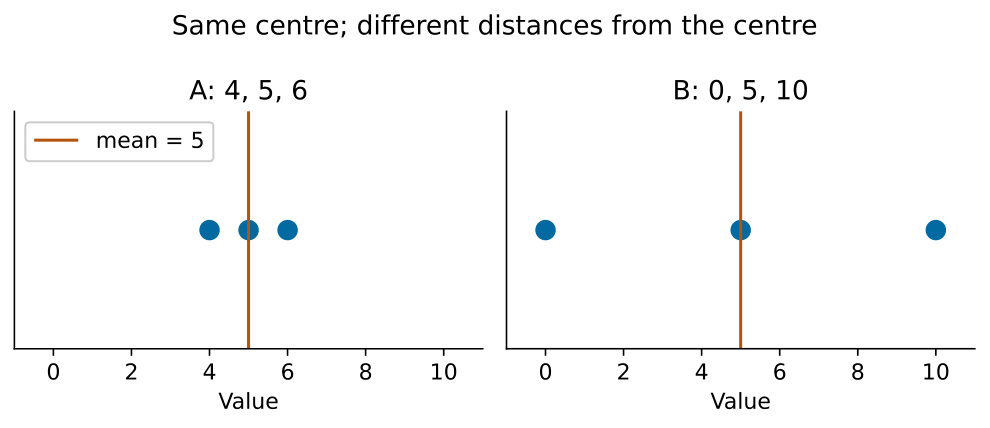
    Existing worked example: A={4,5,6} and B={0,5,10} both have mean and median 5, but B has greater spread. Adding 7 gives A+7={11,12,13}, mean 12 and the same standard deviation as A. Multiplying A by 2 gives {8,10,12}; its mean is 10 and its range and standard deviation double. Equal range alone does not guarantee equal standard deviation.

    Complete original context

    Every transfer question states all data it needs.

    Independent practice and checked reasoning

    Transfer 1

    Values 2, 5, 8 have frequencies 3, 2, 1. Find mean, median and range.

    Reasoning: Data are 2,2,2,5,5,8. $\bar x=(3(2)+2(5)+1(8))/6=4$. Median is the average of positions 3 and 4, $(2+5)/2=3.5$. Range $R=8-2=6$.

    Transfer 2

    Every observation above is changed by $z=3x-4$. Find the new mean, median and range. State how standard deviation changes without computing it.

    Reasoning: Mean $\bar z=3\bar x-4=3(4)-4=8$. Median is $3(3.5)-4=6.5$. Range is $3(6)=18$. Standard deviation triples; subtracting 4 changes no distance from the mean.

    Transfer 3

    Compare A = {0, 0, 10, 10} and B = {0, 5, 5, 10}. Both have range 10. Must their standard deviations agree? Justify.

    Reasoning: Both means are 5. Every A observation is 5 from its mean; B distances are 5,0,0,5. B therefore has smaller mean squared deviation and smaller standard deviation. Equal range alone is insufficient.

    Limits and next use

    Do not average distinct category labels when frequencies differ, or confuse a shifted distribution with a more spread-out one.

    All tasks here are public original practice with authored guidance. They are not official questions or fresh diagnostics. Existing protected tests and mocks remain separate.
    词汇
    English 中文 拼音
    standard deviation/ˈstændəd ˌdiːvɪˈeɪʃn/ 标准差 biāo zhǔn chà
    frequency/ˈfriːkwənsi/ 频数 pín shuò
    median/ˈmiːdiːən/ 中位数 zhōng wèi shù
  • 15

    PSDA-models · Scatterplots, model residuals and predictions

    学习计划即将上线

    Handout

    Scope and prerequisites

    Digital SAT framework; original paper practice is nonadaptive and gives no scaled-score prediction.

    • Interpret slope and intercept of a fitted model in context
    • Calculate a residual 残差 and distinguish interpolation from extrapolation 外推
    • Choose linear or exponential patterns from equal-step data

    Prerequisites: Linear functions; signed subtraction; scatterplot labels.

    Explain and choose the method

    A scatterplot pairs two quantitative variables, one point per paired observation. A fitted line summarises a trend rather than connecting each point. In a model y=a+bx, b predicts the change in y for one-unit increase in x; its units are y-units per x-unit. The intercept a predicts y when x=0, which may lie outside the data range.

    A residual is observed y minus predicted y. Positive means the observation lies above the model; negative means below. Substitute the observed x into the model before subtracting. A large residual marks a poor prediction for that point, not automatically an error in measurement or proof that the trend is absent.

    Interpolation predicts inside the observed x-range; extrapolation goes beyond it and needs stronger caution because the relationship may change. Use a model’s contextual domain as well as its algebraic form. A negative predicted travel time, for example, can reveal an unjustified extrapolation rather than a physically possible outcome.

    For equal input steps, nearly constant output differences suggest a linear model; nearly constant output ratios suggest an exponential model. Scatter can make either pattern approximate. Association does not identify a cause: both variables may reflect a third factor. A fitted trend is evidence 证据 about prediction, not by itself about intervention.

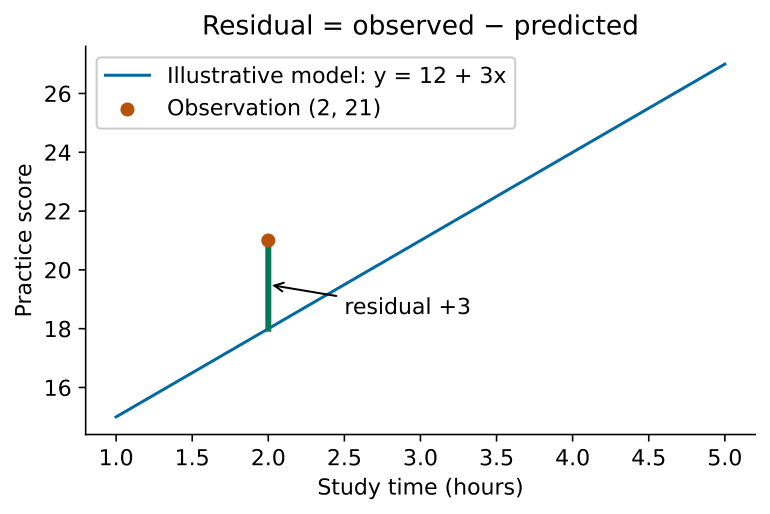
    A residual is observed minus predicted output. A journey model $T=5+2d$ uses minutes for $T$ and kilometres for $d$. $T(4)=5\,\mathrm{min}+(2\,\mathrm{min/km})(4\,\mathrm{km})=13\,\mathrm{min}$. For observed time 16 minutes, $e=T_{obs}-T_{pred}=16\,\mathrm{min}-13\,\mathrm{min}=3\,\mathrm{min}$.

    Original worked example from existing native teaching; transfer tasks use their own data.
    Original worked example from existing native teaching; transfer tasks use their own data.

    Existing worked example: For study time x hours and predicted practice score y=12+3x, the slope is 3 score points/hour. At x=2 the prediction is 18. If the observed score is 21, residual=21-18=3. With x-values observed from 1 to 5, predicting at x=3 interpolates and x=12 extrapolates. Outputs 5,10,20,40 at equal input steps suggest factor-two exponential growth.

    Complete original context

    Every transfer question states all data it needs.

    Independent practice and checked reasoning

    Transfer 1

    A fitted delivery model is $T=8+1.5d$ minutes for observed distances 2–10 km. Interpret both parameters. At 6 km the observed time is 15 minutes; find its residual.

    Reasoning: The intercept predicts 8 minutes at zero distance; zero lies outside the observed range, so this interpretation is extrapolated. The slope predicts an extra 1.5 minutes per kilometre. $T(6)=8\,\mathrm{min}+(1.5\,\mathrm{min/km})(6\,\mathrm{km})=17\,\mathrm{min}$. Residual $e=15\,\mathrm{min}-17\,\mathrm{min}=-2\,\mathrm{min}$, below the line.

    Transfer 2

    Predictions are requested at 7 km and 20 km. Classify each, and explain why a fitted slope does not prove distance alone causes all time variation.

    Reasoning: Seven is inside 2–10, so interpolation. Twenty is outside, so extrapolation with weaker support. Traffic, loading and other conditions can influence time; a fitted association does not isolate their effects.

    Transfer 3

    At equally spaced inputs 0,1,2,3, outputs are 6,18,54,162. Choose a simple linear or exponential rule and predict at 4, stating the assumption.

    Reasoning: Ratios are all 3, while differences vary. The exponential rule is $y=6(3)^x$. Under continued factor-three growth, $y(4)=6(3)^4=486$. This is a model-based extrapolation, not a guaranteed next observation.

    Limits and next use

    Keep observed minus predicted in that order. Do not turn a model slope into a causal treatment effect.

    All tasks here are public original practice with authored guidance. They are not official questions or fresh diagnostics. Existing protected tests and mocks remain separate.
    词汇
    English 中文 拼音
    extrapolation/ekˈstræpəleɪʃn/ 外推 wài tuī
    residual/rɪˈsɪdʒuːəl/ 残差 cán chà
    evidence/ˈevɪdəns/ 证据 zhèng jù
  • 16

    PSDA-conditional · Probability from a table and a restricted group

    学习计划即将上线

    Handout

    Scope and prerequisites

    Digital SAT framework; original paper practice is nonadaptive and gives no scaled-score prediction.

    • Calculate event and complement probabilities from counts
    • Use the conditioning group as the denominator
    • Distinguish independence from disjointness

    Prerequisites: Fractions; table totals; event and complement.

    Explain and choose the method

    A probability based on equally represented observations is favourable count divided by the relevant total. A two-way table has joint counts in cells, group totals on the margins and a grand total. Read whether the question asks about a joint event, either event or one event given another before choosing the denominator.

    For P(A given B), restrict attention to the B group and divide the A-and-B count by the B total. It is not generally equal to P(B given A), because the conditioning groups differ. A fraction with the correct numerator but the wrong population still answers the wrong question.

    The complement probability is 1-P(A). For either A or B, adding separate probabilities double-counts overlap, so subtract P(A and B). Disjoint events have no overlap; independent events 独立事件 satisfy P(A and B)=P(A)P(B). Two positive-probability disjoint events cannot be independent, since observing one rules out the other.

    For without-replacement draws, update both the remaining favourable count and total at each step. For independent repeated choices the probabilities multiply without that update. State the sampling assumptions before calculating. A table of observed relative frequencies supports empirical probabilities for that population, not a guarantee about every future draw.

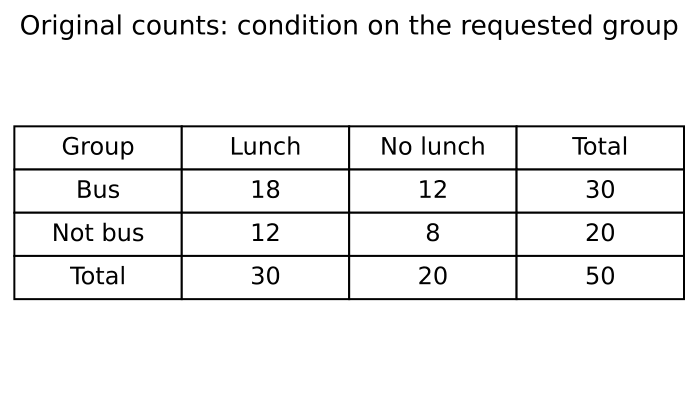
    Conditional probability 条件概率 restricts the denominator. Of 40 club members, 12 cycle; 8 of those cyclists wear a helmet. $P(H\mid C)=n(H\cap C)/n(C)=8/12=2/3$. The group is cyclists, so 40 is not this denominator.

    Original worked example from existing native teaching; transfer tasks use their own data.
    Original worked example from existing native teaching; transfer tasks use their own data.

    Existing worked example: Original counts: bus users—18 carry a packed lunch, 12 do not; non-bus users—12 carry lunch, 8 do not. Total 50. P(lunch)=30/50=0.6; P(lunch given bus)=18/30=0.6; P(bus given lunch)=18/30=0.6 in this particular balanced table. Change one cell and these need not stay equal. P(bus and lunch)=18/50=0.36, equal here to 0.6·0.6, so the table shows independence of these categories.

    Complete original context

    Every transfer question states all data it needs.

    Independent practice and checked reasoning

    Transfer 1

    A survey records 12 tea drinkers and 8 non-tea drinkers among 20 cyclists; among 30 walkers it records 9 tea drinkers and 21 non-tea drinkers. Find $P(tea)$, $P(tea\mid cyclist)$ and $P(cyclist\mid tea)$.

    Reasoning: Total tea drinkers are 21 of 50, so $P(T)=21/50$. Within cyclists, $P(T\mid C)=12/20=3/5$. Within tea drinkers, $P(C\mid T)=12/21=4/7$. These different denominators make the conditional probabilities unequal.

    Transfer 2

    In the same survey, are tea drinking and cycling independent? Are they disjoint? Use numbers for both answers.

    Reasoning: They are not independent because $P(T\mid C)=3/5\ne21/50=P(T)$. They are not disjoint because 12 respondents do both: $P(T\cap C)=12/50>0$.

    Transfer 3

    One respondent is chosen uniformly. Find the probability of walking or drinking tea, including those who do both.

    Reasoning: Use inclusion–exclusion. $P(W\cup T)=(30+21-9)/50=42/50=21/25$. The 9 tea-drinking walkers must not be counted twice. Equivalently exclude the 8 cyclists who do not drink tea.

    Limits and next use

    Equal conditional answers in one table are coincidence or structure to check, not a universal rule. Condition first, then count.

    All tasks here are public original practice with authored guidance. They are not official questions or fresh diagnostics. Existing protected tests and mocks remain separate.
    词汇
    English 中文 拼音
    conditional probability/kənˈdɪʃənl ˌprɒbəˈbɪlɪti/ 条件概率 tiáo jiàn gài lǜ
    independent events/ˌɪndɪˈpendənt ɪˈvents/ 独立事件 dú lì shì jiàn
  • 17

    PSDA-inference · Sampling, margin of error and causal claims

    学习计划即将上线

    Handout

    Scope and prerequisites

    Digital SAT framework; original paper practice is nonadaptive and gives no scaled-score prediction.

    • Interpret a sample estimate and its stated margin of error 误差范围
    • Distinguish random sampling from random assignment 随机分组
    • Identify the population and causal scope supported by a study

    Prerequisites: Percentages; populations; random selection versus assignment.

    Explain and choose the method

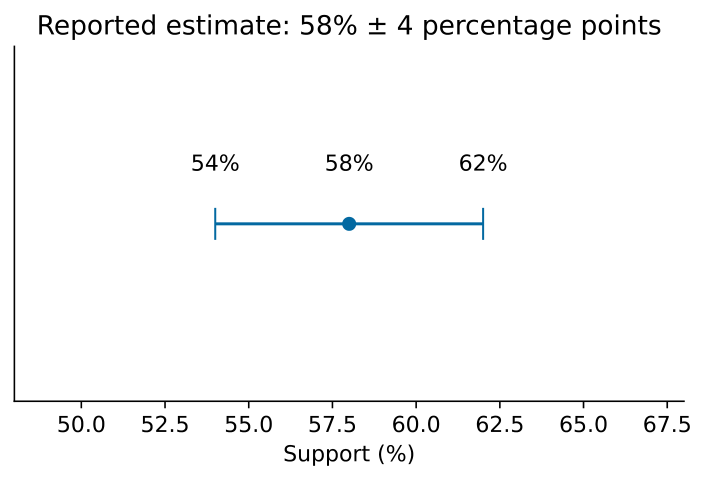
    A sample statistic estimates a population quantity. A reported estimate of 58% with margin of error 4 percentage points gives an interval from 54% to 62% under the stated procedure. It does not mean 58% of respondents answered with an error of four percent, nor does it guarantee that every individual sample contains the true value.

    A representative random sample helps generalise to the population from which it was drawn. Convenience or voluntary-response samples can be biased even when large. Increasing a well-designed sample generally reduces sampling variability and margin of error at the same confidence level, but cannot automatically cure a systematically excluded group.

    Random assignment distributes participants among treatment groups and supports causal inference 推断 by balancing competing factors on average. Random sampling selects who participates. A randomised experiment conducted only with volunteers may support a treatment effect for its participants without establishing that all people share the same effect.

    An observational study measures existing differences without assigning treatment; association can reflect confounding. A comparison of students who choose extra tutoring against those who do not may mix tutoring with motivation or prior attainment. To judge a claim, identify selection, assignment, comparison, measured outcome and the exact population before accepting causation or broad generalisation.

    A margin of error is added and subtracted in percentage points. Estimate 63% with margin 4 points gives 59%–67%. It is an interval from a procedure, not a guarantee that each person's response is near 63%. Random sampling supports population inference; random assignment addresses treatment comparisons.

    Original worked example from existing native teaching; transfer tasks use their own data.
    Original worked example from existing native teaching; transfer tasks use their own data.

    Existing worked example: A random sample of 400 school students yields 58% support ±4 percentage points: stated interval 54%–62%. This estimates the sampled school population, not all students worldwide. If volunteers are randomly assigned to two revision methods, a controlled outcome difference can support a causal comparison among participants; volunteer selection still limits wider generalisation.

    Complete original context

    Every transfer question states all data it needs.

    Independent practice and checked reasoning

    Transfer 1

    A random sample of 500 registered library members reports 62% support for a change, with stated margin 4 percentage points. State the interval and population. Does it establish support among every town resident?

    Reasoning: Interval is $62\%-4\%=58\%$ to $62\%+4\%=66\%$, where the subtraction denotes points. The population is registered members in the sampling frame. Nonmembers were not sampled, so the estimate does not establish all residents' support.

    Transfer 2

    Forty volunteers are randomly assigned to old or new instructions, with the same task and conditions. The new group finishes faster. What causal and population claims are reasonable?

    Reasoning: Random assignment supports a causal comparison of the instruction versions for these participants under the tested conditions, subject to variation. Volunteer selection limits population generalisation. It does not establish that every future user will finish faster.

    Transfer 3

    A poll of 10000 website volunteers has a narrow reported margin. Explain why size alone cannot repair selection bias, and propose a better recruitment method.

    Reasoning: People choosing to respond can differ systematically from those who do not. A margin for sampling variability does not remove that bias. Select randomly from the defined target population and follow up nonresponse; still report limitations.

    Limits and next use

    Sample size, random selection and random assignment are not interchangeable. A narrow margin does not remove selection bias.

    All tasks here are public original practice with authored guidance. They are not official questions or fresh diagnostics. Existing protected tests and mocks remain separate.
    词汇
    English 中文 拼音
    random assignment/ˈrændəm əˈsaɪnmənt/ 随机分组 suí jī fēn zǔ
    margin of error/ˈmɑːdʒɪn ɒv ˈerə/ 误差范围 wù chā fàn wéi
    inference/ˈɪnfərəns/ 推断 tuī duàn
  • 18

    GT-scale · Scale factors, angle relationships and triangles

    学习计划即将上线

    Handout

    Scope and prerequisites

    Digital SAT framework; original paper practice is nonadaptive and gives no scaled-score prediction.

    • Apply length, area and volume scaling to similar figures
    • Use parallel-line angles and triangle sums to find unknowns
    • Distinguish similarity 相似 from congruence 全等 and adequate information

    Prerequisites: Triangle sum; Pythagoras; length/area/volume units.

    Explain and choose the method

    For similar figures with length scale k, corresponding lengths scale by k, areas by k² and volumes by k³. These laws apply when all corresponding dimensions change together. A cylinder with only radius doubled and fixed height has four times the volume, not eight times. State which dimensions are scaled before choosing the power.

    Use the correct geometric measure: triangle area is half base times perpendicular height 垂直高度; cylinder volume is base area times height. Surface area adds exposed faces, while volume measures enclosed space. A slant length is not automatically the perpendicular height required by an area formula. Attach square or cubic units to the result.

    Vertical angles are equal. For parallel lines cut by a transversal, corresponding and alternate interior angles are equal, and same-side interior angles sum to 180°. A triangle’s interior angles sum to 180°; its exterior angle equals the sum of the two remote interior angles. These rules depend on stated or marked parallelism, not the drawing’s appearance.

    Similar triangles share corresponding angles and proportional corresponding sides; congruent triangles also have equal corresponding lengths. Two angles establish similarity but not size equality. Maintain correspondence when writing a ratio. A side–side–angle arrangement does not universally guarantee congruence, whereas side–angle–side includes the angle between the two sides.

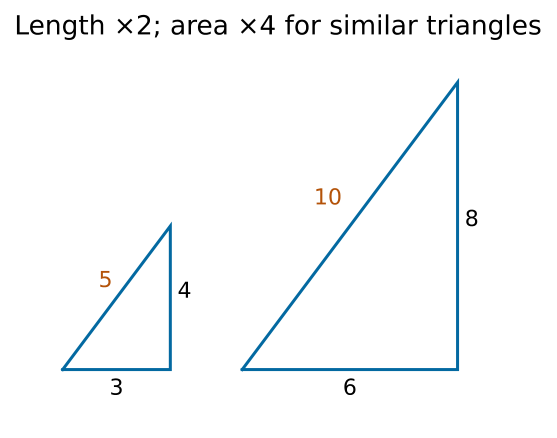
    A scale factor 比例因子 $k$ changes every corresponding length. $A_2=k^2A_1$ and $V_2=k^3V_1$ for similar shapes. If $k=3/2$ and $A_1=24\,\mathrm{cm^2}$, $A_2=(3/2)^2(24\,\mathrm{cm^2})=54\,\mathrm{cm^2}$. Changing only one dimension does not justify these similarity rules.

    Original worked example from existing native teaching; transfer tasks use their own data.
    Original worked example from existing native teaching; transfer tasks use their own data.

    Existing worked example: Two similar solids have edge ratio 2:3, so surface-area ratio is 4:9 and volume ratio 8:27. A triangular garden with base 12 m and perpendicular height 5 m has area 30 m². If a triangle has interior angles 48° and 67°, its third is 65° and the adjacent exterior angle is 115°=48°+67°.

    Complete original context

    Every transfer question states all data it needs.

    Independent practice and checked reasoning

    Transfer 1

    Similar containers have surface areas 96 and 216 square centimetres. The smaller volume is 160 cubic centimetres. Find the larger volume.

    Reasoning: $k=\sqrt{A_2/A_1}=\sqrt{216/96}=3/2$. Volume uses the cube: $V_2=k^3V_1=(3/2)^3(160\,\mathrm{cm^3})=540\,\mathrm{cm^3}$. Using area ratio directly would give the wrong volume.

    Transfer 2

    A right triangle has hypotenuse 13 cm and one leg 5 cm. Find the other leg, its area, and the sine of the angle opposite the 5 cm leg.

    Reasoning: $b=\sqrt{c^2-a^2}=\sqrt{(13\,\mathrm{cm})^2-(5\,\mathrm{cm})^2}=12\,\mathrm{cm}$. $A=ab/2=(5\,\mathrm{cm})(12\,\mathrm{cm})/2=30\,\mathrm{cm^2}$. $\sin\theta=a/c=(5\,\mathrm{cm})/(13\,\mathrm{cm})=5/13$.

    Transfer 3

    Two interior angles of a triangle are 42° and 73°. Find the third angle and its adjacent exterior angle. Would those angles alone determine all side lengths?

    Reasoning: Third angle is $180-42-73=65$ degrees. Its adjacent exterior angle is $180-65=115$ degrees, also $42+73$. Angles establish shape, not scale; similar triangles can have different side lengths.

    Transfer 4

    Two parallel lines are cut by a transversal. One corresponding angle is 68°. Find its matching corresponding angle and the adjacent angle on the second line. Explain which given condition justifies each step.

    Reasoning: Parallelism gives the matching corresponding angle 68°. The adjacent pair forms a straight angle, so the other is 180°−68°=112°. Equal corresponding angles require the stated parallel lines; the straight-angle sum uses adjacency on one line. A similar-looking sketch without parallelism would not justify the first equality.

    Limits and next use

    Use k² or k³ only when the entire shape is scaled; do not infer parallel lines or a perpendicular height from an unmarked sketch.

    All tasks here are public original practice with authored guidance. They are not official questions or fresh diagnostics. Existing protected tests and mocks remain separate.
    词汇
    English 中文 拼音
    perpendicular height/ˌpɜːpənˈdɪkjʊlə haɪt/ 垂直高度 chuí zhí gāo dù
    scale factor/skeɪl ˈfæktə/ 比例因子 bǐ lì yīn zi
    similarity/ˌsɪmɪˈlærɪti/ 相似 xiāng sì
    congruence/ˈkɒŋɡruːəns/ 全等 quán děng
  • 19

    GT-circles · Circle equations, arcs and unit-circle trigonometry

    学习计划即将上线

    Handout

    Scope and prerequisites

    Digital SAT framework; original paper practice is nonadaptive and gives no scaled-score prediction.

    • Recover circle centre and radius by completing the square
    • Convert central angles and calculate arc length 弧长 and sector area
    • Use tangent 切线, inscribed-angle and unit-circle relationships

    Prerequisites: Complete the square; radius; radians; right-triangle ratios.

    Explain and choose the method

    A circle with centre (h,k) and radius r satisfies (x-h)²+(y-k)²=r². For an expanded equation, complete the square in x and y and add the balancing constants to the other side. The resulting right side must be positive for a real nondegenerate circle. Keep the radius distinct from its square.

    A central angle θ in radians gives arc length rθ and sector area r²θ/2. In degrees, use the fraction θ/360 of the full circumference or area. A full turn is 2π radians=360°. The formulas rθ and r²θ/2 require radians; inserting degrees without conversion gives a wrong scale.

    A tangent at a circle point is perpendicular to the radius there. An inscribed angle is half the central angle subtending the same arc; an angle subtending a diameter is a right angle. Identify the actual shared arc and centre before applying these statements. A chord is not a tangent and need not be perpendicular to a radius unless further conditions establish it.

    On the unit circle, a point at angle θ has coordinates (cos θ,sin θ), so cos²θ+sin²θ=1. Signs depend on quadrant. For acute complementary angles, sin θ=cos(90°-θ). Use special triangles for exact values: at 30° the sine is 1/2 and cosine √3/2; at 45° both are √2/2.

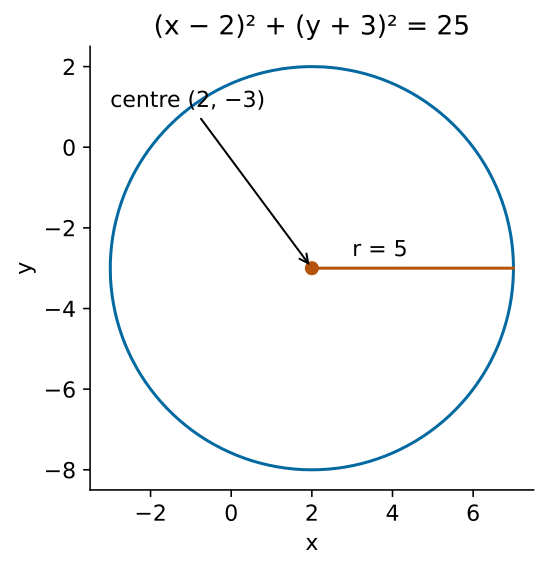
    Complete both squares in a circle equation 圆方程 . $x^2+y^2+6x-8y=0$ becomes $(x+3)^2+(y-4)^2=25$. The centre is $(-3,4)$ and radius is 5. Arc length is $s=r\theta$ only for radian 弧度 angle $\theta$.

    Original worked example from existing native teaching; transfer tasks use their own data.
    Original worked example from existing native teaching; transfer tasks use their own data.

    Existing worked example: x²+y²-4x+6y-12=0 becomes (x-2)²+(y+3)²=25, giving centre (2,-3), radius 5. For radius 6 and central angle π/3, arc length is 2π and sector area 6π. An inscribed angle on that same 60° arc is 30°. At 150°, cosine is -√3/2 and sine 1/2 because the point is in quadrant II.

    Complete original context

    Every transfer question states all data it needs.

    Independent practice and checked reasoning

    Transfer 1

    Find the centre and radius of $x^2+y^2-8x+2y+8=0$. Does $(7,-1)$ lie on it?

    Reasoning: Complete squares to get $(x-4)^2+(y+1)^2=9$. Centre $(4,-1)$, radius 3. Substitution of $(7,-1)$ gives $3^2+0^2=9$, so it is on the circle.

    Transfer 2

    A sector has radius 8 cm and angle 135°. Find its angle in radians, arc length and area. An inscribed angle elsewhere on the circle intercepts this same arc; find it.

    Reasoning: $\theta=135\pi/180=3\pi/4$ radians. $s=r\theta=(8\,\mathrm{cm})(3\pi/4)=6\pi\,\mathrm{cm}$. $A=r^2\theta/2=(8\,\mathrm{cm})^2(3\pi/4)/2=24\pi\,\mathrm{cm^2}$. The inscribed angle is half the central angle: 67.5 degrees.

    Transfer 3

    A unit-circle point is in quadrant III and has $y=-1/2$. Find its $x$-coordinate and one angle between 0° and 360°.

    Reasoning: $x^2+y^2=1$ gives $x^2=3/4$. Quadrant III requires $x<0$, so $x=-\sqrt3/2$. The point is at 210 degrees, with reference angle 30 degrees.

    Limits and next use

    Check degree/radian units, centre signs and whether an angle is central or inscribed before applying the formula.

    All tasks here are public original practice with authored guidance. They are not official questions or fresh diagnostics. Existing protected tests and mocks remain separate.
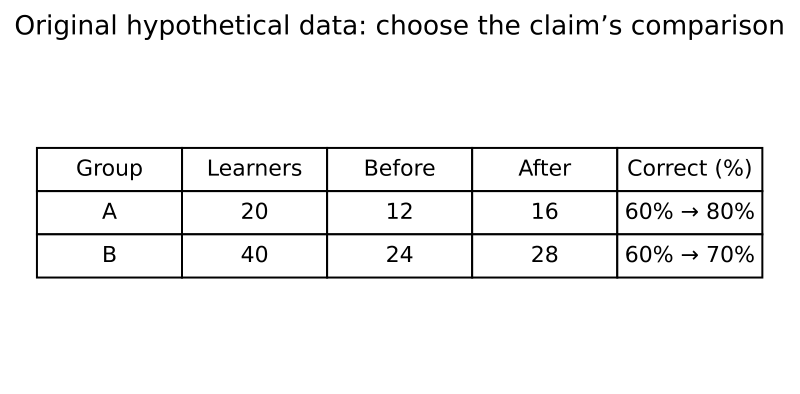
    词汇
    English 中文 拼音
    circle equation 圆方程 yuán fāng chéng
    arc length/ɑːk leŋθ/ 弧长 hú zhǎng
    tangent/ˈtændʒənt/ 切线 qiè xiàn
    radian/ˈreɪdɪən/ 弧度 hú dù
  • 20

    RW-central · Central ideas, details and the scope of a claim

    学习计划即将上线

    Handout

    Scope 范围 and prerequisites

    Digital SAT framework; original paper practice is nonadaptive and gives no scaled-score prediction.

    • Distinguish the passage’s central claim from a supporting example
    • Interpret details without widening their stated scope
    • Choose an accurate summary covering the whole passage

    Prerequisites: Identify a paragraph's subject; distinguish stated fact from inference 推断.

    Explain and choose the method

    Read for the passage’s controlling relationship: a problem and response, a contrast, an explanation or a qualified claim. A topic label such as museum collections identifies the subject but not what the author says about it. State the main point in a short sentence before comparing options.

    A supporting detail 细节 illustrates, explains or qualifies that point. It may be memorable without being the central idea 中心思想. If the passage gives two examples of improved access, a summary about only one example is too narrow. If it reports one collection, a conclusion about all collections is too broad.

    Preserve scope and certainty. Some, may and in this study are meaningful limitations. An answer can reuse the passage’s vocabulary while changing its claim from possible to guaranteed. Check the answer’s subject, action and qualification against the passage, not simply the number of shared words.

    When a question asks about a specific detail, answer that narrower task rather than choosing the central idea by habit. Locate the relevant sentence, read nearby context and distinguish what is directly stated from a proposed reason. Prior subject knowledge is unnecessary and should not supply missing evidence 证据.

    The central idea is the relationship that holds the passage together. Read: “The repair café first accepted only lamps. It later added small fans after volunteers received training. Large appliances still went to specialist shops.” A sound summary is: the café expanded its repairs within limits. “It repaired everything” ignores the last sentence. “It repaired lamps” omits the change.

    Original diagram of the worked relationship; read the full wording and qualifications.
    Original diagram of the worked relationship; read the full wording and qualifications.

    Existing worked example: Original passage: “The town archive digitised its most frequently requested maps first. Researchers could then inspect those maps remotely, reducing repeated handling of fragile originals. Staff continued to offer supervised access to items not yet scanned.” Central idea: selective digitisation improved access and protection while physical access continued. “All maps became available online” overstates coverage; “the archive ended visits” contradicts the final sentence.

    Complete original context

    Original passage: The city archive began a trial in which readers could search handwritten shipping registers using an online index. Volunteers entered names and dates, while staff checked entries that were difficult to read. The index often helped researchers locate a likely page before travelling to the archive. It did not replace the register images: two people with the same name could still be distinguished only by reading nearby entries. Staff therefore described the index as a route into the records rather than a final answer to every question. They also kept a public list of corrected entries so that researchers could see how the index changed.

    Independent practice and checked reasoning

    Transfer 1

    State the central idea in one sentence, preserving both benefit and limit.

    Reasoning: The checked index helps researchers find relevant records, but consulting the underlying register remains necessary for some distinctions. This covers the search benefit and same-name limitation without claiming complete accuracy.

    Transfer 2

    Which detail explains why register images remain necessary? Distinguish that from the purpose of the corrections list.

    Reasoning: People with the same name may require nearby register entries to distinguish them. The corrections list instead makes revisions visible; it does not itself identify every person.

    Transfer 3

    Reject each proposed summary with specific evidence — A “Volunteers replaced staff”; B “The index made all archive visits unnecessary”; C “The archive hid changes to the index”.

    Reasoning: A contradicts staff checking difficult entries. B overstates “often” and the need to consult underlying records; the passage does not say every visit is replaced. C contradicts the public corrections list. None preserves the stated scope.

    Limits and next use

    A true detail can still be a wrong main-idea answer. Watch for all, always and only where the passage makes a narrower claim.

    All tasks here are public original practice with authored guidance. They are not official questions or fresh diagnostics. Existing protected tests and mocks remain separate.
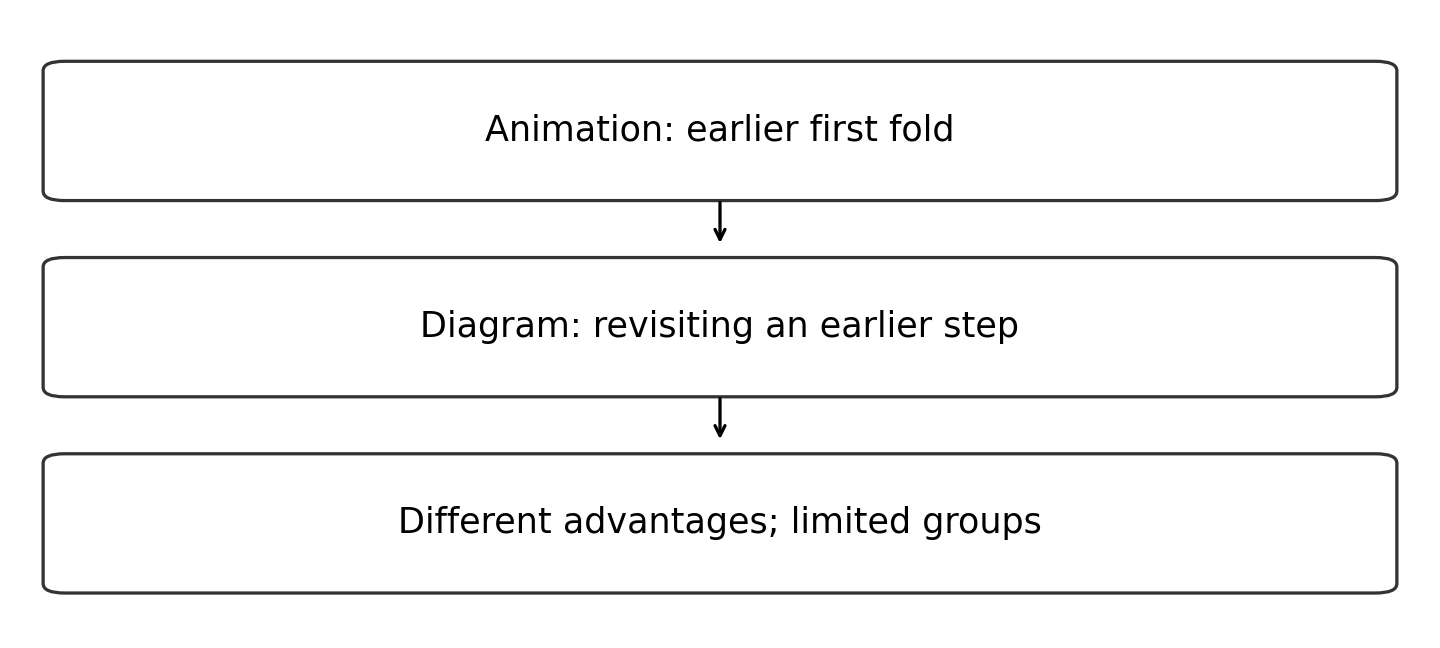
    词汇
    English 中文 拼音
    central idea/ˈsentrəl aɪˈdɪə/ 中心思想 zhōng xīn sī xiǎng
    inference/ˈɪnfərəns/ 推断 tuī duàn
    evidence/ˈevɪdəns/ 证据 zhèng jù
    detail/ˈdiːteɪl/ 细节 xì jié
    scope/skəʊp/ 范围 fàn wéi
  • 21

    RW-evidence · Choose evidence for a precise textual or numerical claim

    学习计划即将上线

    Handout

    Scope and prerequisites

    Digital SAT framework; original paper practice is nonadaptive and gives no scaled-score prediction.

    • Choose a detail 细节 that directly supports or challenges a stated claim
    • Use a table’s labels, quantities and comparison base 比较基准 correctly
    • Separate relevance 相关性 from evidence 证据 that discriminates between explanations

    Prerequisites: Read table headings; compare proportions and counts.

    Explain and choose the method

    First translate the target claim into an evidence requirement. A claim that repeated practice helps retention needs information about retention under differing practice conditions, not simply a statement that learners enjoyed the activity. An interesting related fact may fail to support the specific relationship asserted.

    For textual evidence, identify whose claim is being tested and whether the task asks for support, challenge or completion. A quotation with familiar nouns is not enough. Ask what would become more credible or less credible if that detail were true, while preserving the passage’s actual degree of certainty.

    For quantitative evidence, read title, axes or headers, units and groups before calculating. Use before/after differences when the claim concerns improvement, final values when it concerns outcomes and proportions when group sizes differ. A larger count can represent a smaller share in a larger group.

    A numerical pattern may support a descriptive comparison without proving why it occurred. If no random assignment or controlled causal evidence is stated, avoid a causal conclusion. The original table in this lesson is a hypothetical teaching dataset, not a published study; its purpose is to practise reading the relationship.

    Evidence must support the exact claim, including its comparison base. If 9 of 15 tasks succeed, $p=n_{success}/n_{total}=9/15=60\%$. A group with more successes may still have a lower success rate 速率. Before/after data describe changes; without controlled assignment they do not prove a cause.

    Original worked example from existing native teaching; transfer tasks use their own data.
    Original worked example from existing native teaching; transfer tasks use their own data.

    Existing worked example: Original hypothetical table: Group A has 20 learners, 12 correct before and 16 after; Group B has 40 learners, 24 correct before and 28 after. Both gain four correct responses, but A’s correct share rises from 60% to 80% (20 points), while B rises from 60% to 70% (10 points). This supports “A had the larger percentage-point improvement”, not “A had more correct final responses” or a causal claim about the method.

    Complete original context

    Original hypothetical study: Two groups used a revised catalogue for a second search session. No random assignment is reported. Group P had 30 users, with 12 successful searches before and 21 after. Group Q had 50 users, with 30 successful searches before and 35 after. Each user completed one search in each session. The researchers claimed that P showed the larger percentage-point improvement, while Q still had more successful searches in the second session. A separate comment said the revision must have caused every improvement.

    Independent practice and checked reasoning

    Transfer 1

    Give the before and after success percentages and percentage-point changes for both groups.

    Reasoning: $p_P=12/30=40\%$ before and $21/30=70\%$ after, a 30-point increase. $p_Q=30/50=60\%$ before and $35/50=70\%$ after, a 10-point increase. P has the larger change; both final rates are equal.

    Transfer 2

    Which claim is supported by 35 compared with 21, and which is supported by 30 points compared with 10 points?

    Reasoning: The final counts support Q having more second-session successes. The percentage-point changes support P improving more. Exchanging those pieces of evidence would confuse final outcome with change and counts with proportions.

    Transfer 3

    Explain why the causal comment is too strong. Give one additional observation that would help investigate an alternative explanation.

    Reasoning: Session order, practice or different tasks could contribute; no randomised comparison is described. A control group using the original catalogue in both sessions under otherwise matched conditions could estimate practice effects. It would help test causation, not automatically prove that every user's improvement has one cause.

    Limits and next use

    Use the quantity named by the claim. Raw counts, relative percentages and percentage-point changes answer different questions.

    All tasks here are public original practice with authored guidance. They are not official questions or fresh diagnostics. Existing protected tests and mocks remain separate.
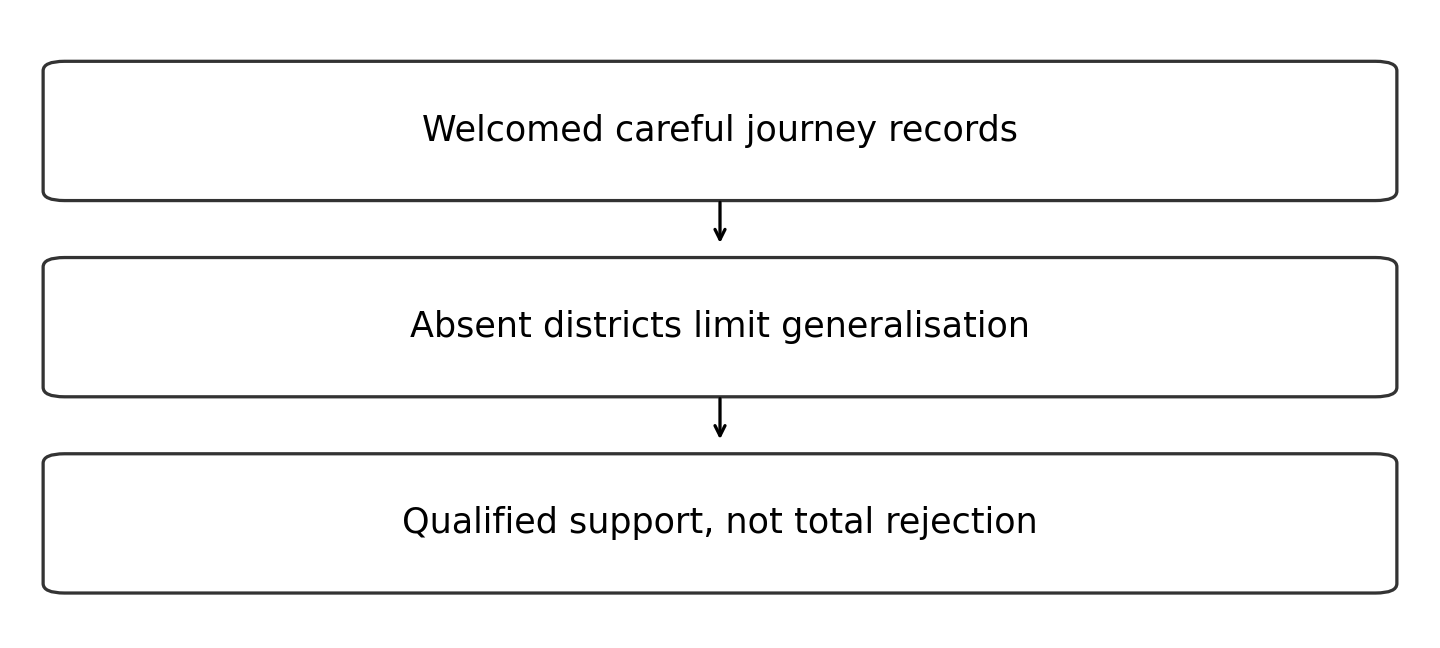
    词汇
    English 中文 拼音
    comparison base/kəmˈpærɪsn beɪs/ 比较基准 bǐ jiào jī zhǔn
    relevance/ˈrelɪvəns/ 相关性 xiāng guān xìng
    evidence/ˈevɪdəns/ 证据 zhèng jù
    detail/ˈdiːteɪl/ 细节 xì jié
    rate/reɪt/ 速率 sù lǜ
  • 22

    RW-inferences · Complete a passage with a warranted inference

    学习计划即将上线

    Handout

    Scope and prerequisites

    Digital SAT framework; original paper practice is nonadaptive and gives no scaled-score prediction.

    • Combine stated facts to draw a supported conclusion
    • Distinguish necessary support from a plausible outside explanation
    • Preserve uncertainty and avoid causal overstatement

    Prerequisites: Track contrasts; retain uncertainty and scope.

    Explain and choose the method

    Separate the facts stated from the connection you must infer. If two observations establish a contrast, the conclusion should preserve that contrast. Write a short bridge linking the evidence 证据 before reading the options; this makes an attractive but unrelated explanation easier to detect.

    An inference 推断 need not copy a sentence verbatim, but each essential step must be supported. A passage saying a tool detects a feature missed by another supports a difference in detection, not that the first tool is superior for every purpose. Domain knowledge cannot fill an unstated requirement.

    Track qualifiers and alternative explanations. A pattern can suggest a possibility rather than establish certainty. If the passage acknowledges several possible causes, a completion blaming one cause exclusively is too strong. Check whether an option introduces new people, settings, motives or time periods.

    For a conclusion at the end of a short passage, inspect the logical transition 衔接词: therefore requests a consequence, while however may introduce a limitation. A grammatically smooth continuation can still be logically unsupported. Prefer the option whose claims require the fewest unsupported assumptions while fully answering the task.

    A warranted inference 有依据的推断 connects supplied facts without importing a cause. “Short labels helped beginners; experts preferred detailed labels” supports a benefit depending on reader experience. It does not support “short labels are always best” or “experts dislike museums”.

    Original diagram of the worked relationship; read the full wording and qualifications.
    Original diagram of the worked relationship; read the full wording and qualifications.

    Existing worked example: Original passage: “Two sensors monitored the same bridge. Sensor A recorded brief vibrations that Sensor B did not register, but Sensor B operated successfully during colder periods when A stopped recording.” Warranted conclusion: the sensors had complementary strengths under the observed conditions. It does not follow that either is universally more accurate or that temperature caused every difference in detection.

    Complete original context

    Original passage: A workshop offered a printed diagram and an animated demonstration of a folding process. Participants using the animation began the first fold sooner on average. However, when asked to repair a mistake later, participants using the diagram more often returned to the correct earlier step without help. The groups were small, and the organisers did not report whether participants had equal experience. They concluded that choosing a teaching aid should take account of the stage of the task.

    Independent practice and checked reasoning

    Transfer 1

    Complete the conclusion with a warranted inference about the two aids.

    Reasoning: The animation may help people begin, while the diagram may help them revisit earlier steps during correction. The evidence supports different observed advantages, qualified by the small, potentially unequal groups.

    Transfer 2

    Explain why “animations prevent mistakes” and “diagrams are useless for starting” are both unsupported.

    Reasoning: The study reports correction performance, not the absence of mistakes. Starting sooner with animation does not establish that diagram users cannot start. Both statements replace relative observations with absolute claims.

    Transfer 3

    A new study balances prior experience and finds equal correction rates. Explain how this affects the earlier conclusion without claiming the first observations were fabricated.

    Reasoning: It weakens a general claim of diagram superiority for correction and raises experience as a possible explanation of the earlier difference. Different samples or methods can yield different results without making the first observations false.

    Limits and next use

    Do not turn observed co-occurrence into a unique cause or widen a limited comparison into universal superiority.

    All tasks here are public original practice with authored guidance. They are not official questions or fresh diagnostics. Existing protected tests and mocks remain separate.
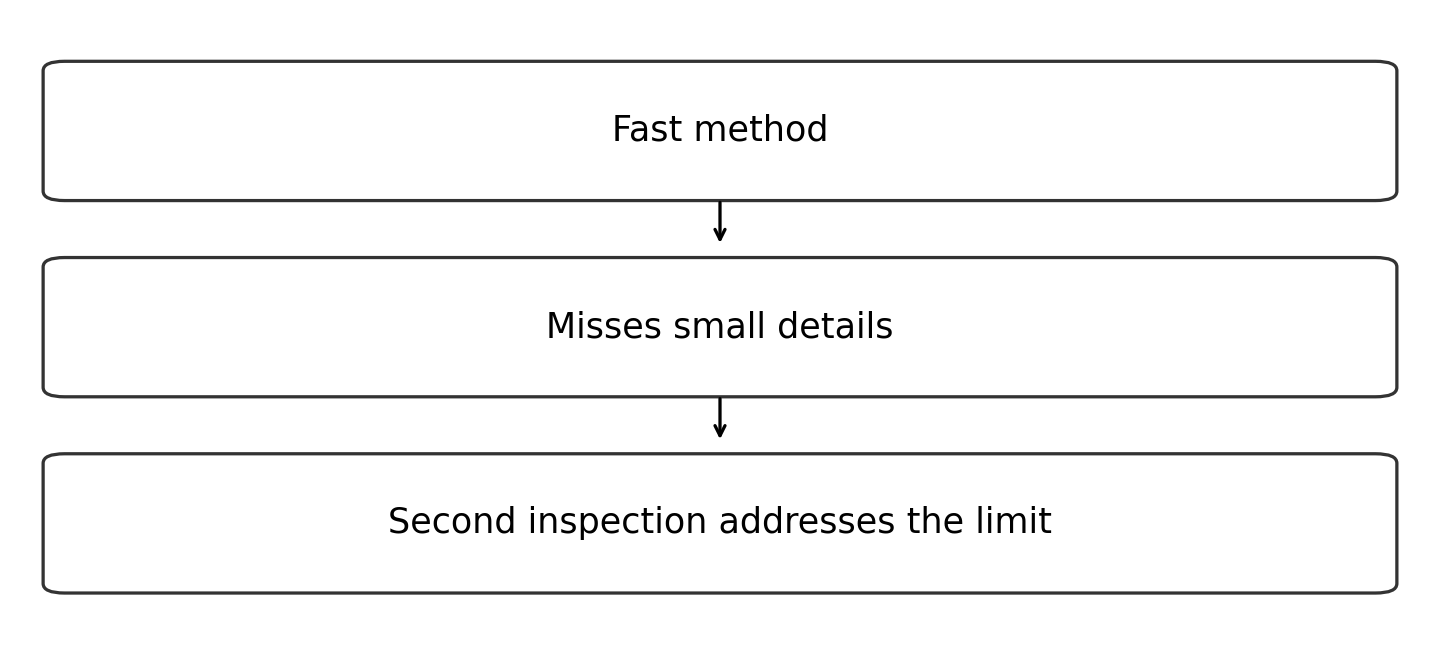
    词汇
    English 中文 拼音
    warranted inference/ˈwɒrəntɪd ˈɪnfərəns/ 有依据的推断 yǒu yī jù de tuī duàn
    transition/trænˈsɪʃn/ 衔接词 xián jiē cí
    inference/ˈɪnfərəns/ 推断 tuī duàn
    evidence/ˈevɪdəns/ 证据 zhèng jù
  • 23

    RW-words · Words in context: meaning, polarity and collocation

    学习计划即将上线

    Handout

    Scope and prerequisites

    Digital SAT framework; original paper practice is nonadaptive and gives no scaled-score prediction.

    • Infer a word’s intended meaning from its sentence and nearby logic
    • Use contrast and explanation to determine a missing word
    • Choose a word fitting syntax 句法, degree and collocation 词语搭配

    Prerequisites: Sentence meaning; contrast and explanation clues.

    Explain and choose the method

    A familiar word may have several senses. Substitute a simple paraphrase into the sentence and test whether it preserves the relationship. Context, rather than the first dictionary meaning, determines whether check means inspect, restrain or mark a response.

    For a blank, decide the needed meaning and polarity before looking at choices. A contrast introduced by but may reverse an expectation; an explanation after because can narrow the intended sense. If the sentence says evidence 证据 is promising yet incomplete, a word meaning cautious or provisional is more plausible than certain.

    Check grammatical fit and collocation as well as meaning. A verb must work with its object and complement; an adjective must modify the intended noun. A near synonym can fail if it implies a stronger degree, a different subject or a relationship the passage does not establish.

    Avoid treating difficult vocabulary as a contest to choose the most impressive word. Use a neutral paraphrase, eliminate options of the wrong polarity and then compare remaining shades of meaning. Keep a record of words learned in their full phrase, because context and typical combinations help later retrieval.

    A word in context 语境中的词义 must fit the relationship, not just a dictionary entry. In “The evidence is thin, so the conclusion remains provisional”, provisional means open to revision. It does not mean temporary employment or physical thinness. Paraphrase before choosing.

    Original diagram of the worked relationship; read the full wording and qualifications.
    Original diagram of the worked relationship; read the full wording and qualifications.

    Existing worked example: Original sentence: “The committee gave the proposal 提案 qualified support: members approved its aim but requested a smaller trial before expansion.” Here qualified means limited or conditional, not certified or skilled. Original blank: “Because the observations were few, the author described the conclusion as ___ rather than definitive.” Provisional fits the explicit contrast with definitive.

    Complete original context

    Original passage: The reviewers welcomed the survey's careful record of individual journeys, but they gave its city-wide conclusions only qualified support. The routes had been chosen for convenience, and several districts were absent. One reviewer called the record illuminating: it made previously overlooked travel difficulties easier to understand. Another cautioned that extending the conclusions would require a broader sample. The authors accepted this reservation and proposed a second survey.

    Independent practice and checked reasoning

    Transfer 1

    Explain qualified, illuminating and reservation in this passage. Quote a clue for each.

    Reasoning: Qualified means limited or conditional, supported by absent districts and a need for broader sampling. Illuminating means revealing or clarifying, supported by difficulties becoming easier to understand. Reservation means a concern or limitation, supported by caution about extending conclusions; it is not a booked seat.

    Transfer 2

    Compare “The reviewers dismissed the survey” with “The reviewers endorsed its conclusions without reservation”. Why does neither fit?

    Reasoning: Dismissed ignores their welcome for its careful records. Endorsed without reservation erases the sampling concern. The attitude combines appreciation of the records with limited support for broader conclusions.

    Transfer 3

    Replace illuminating with revealing, dazzling or visible. Which best preserves meaning and why do the others fail here?

    Reasoning: Revealing preserves the idea that the record makes difficulties understood. Dazzling introduces brilliance or admiration beyond the stated clarification. Visible describes perceptibility, not the survey's explanatory contribution. This is a contextual meaning 语境义 decision, not a rule that those words are always wrong.

    Limits and next use

    A recognisable synonym may still carry the wrong strength or grammatical use. Do not ignore the explanation after the colon 冒号.

    All tasks here are public original practice with authored guidance. They are not official questions or fresh diagnostics. Existing protected tests and mocks remain separate.
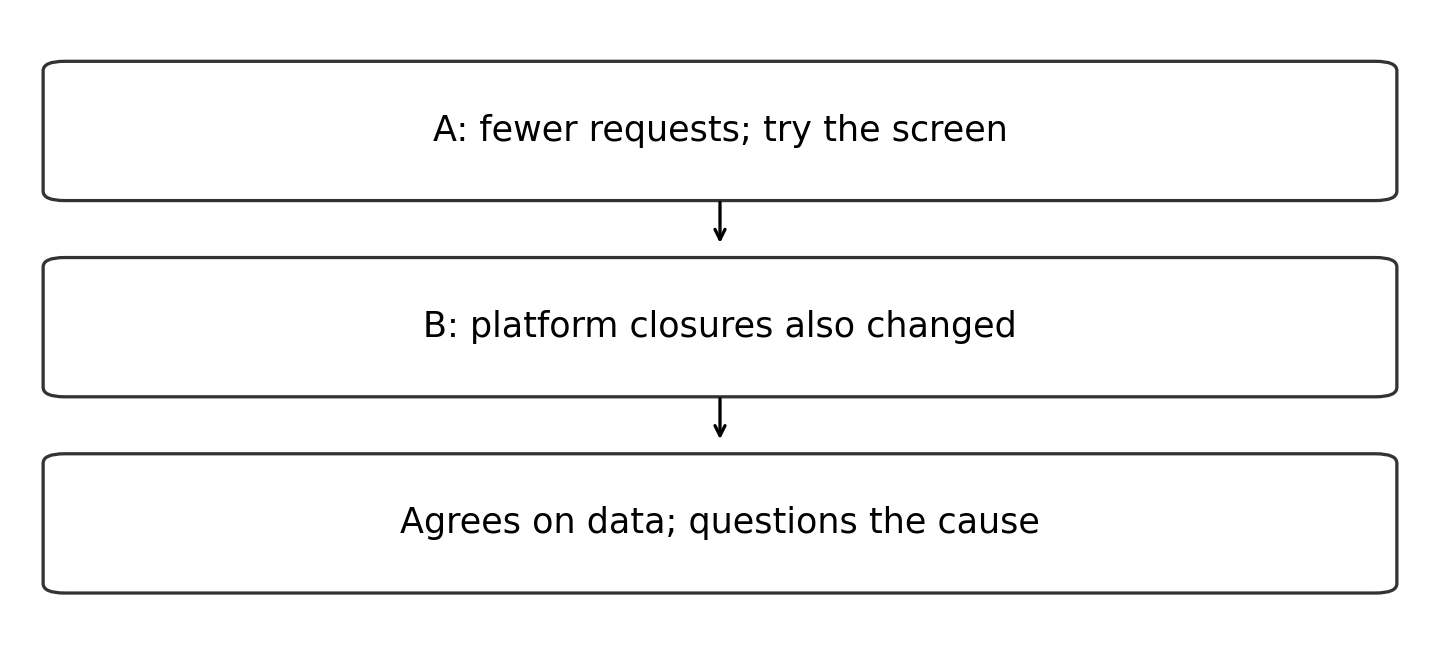
    词汇
    English 中文 拼音
    contextual meaning/kənˈtekstʃuːəl ˈmiːnɪŋ/ 语境义 yǔ jìng yì
    word in context 语境中的词义 yǔ jìng zhōng de cí yì
    collocation/ˌkɒləˈkeɪʃn/ 词语搭配 cí yǔ dā pèi
    evidence/ˈevɪdəns/ 证据 zhèng jù
    proposal/prəˈpəʊzl/ 提案 tí àn
    syntax/ˈsɪntæks/ 句法 jù fǎ
    colon/ˈkəʊlən/ 冒号 mào hào
  • 24

    RW-structure · Text structure, sentence function and rhetorical purpose

    学习计划即将上线

    Handout

    Scope and prerequisites

    Digital SAT framework; original paper practice is nonadaptive and gives no scaled-score prediction.

    • Identify how a passage develops its central point
    • Explain a sentence’s role in the larger argument 论证
    • Distinguish a text’s purpose from its subject matter

    Prerequisites: Follow a problem–response sequence; distinguish reported views.

    Explain and choose the method

    Summarise each part with an action: introduces a problem, describes an approach, presents evidence 证据 or notes a limitation. The ordered actions describe structure more precisely than a list of subject nouns. Look for a shift where the author moves from background to a claim or from a claim to a qualification 限定.

    For the function of a marked sentence, compare what comes before and after. If it contradicts an earlier expectation and the next sentence explains that surprise, its role may be to introduce an unexpected result. It is not automatically the author’s conclusion just because it appears late.

    Purpose states what the author is trying to do with the information: explain a distinction, challenge an assumption, evaluate a method or describe a response. An option that merely names the topic is incomplete. An option that says persuade readers to take action needs actual advocacy, not an informative description alone.

    Distinguish an objection the author presents from a view the author endorses. Reported claims, examples and hypothetical situations can serve an argument without becoming the author’s final position. Use the passage’s wording and relationship markers to assign roles rather than imposing a favourite argument structure.

    Sentence function 句子作用 states what a sentence does in its context. “The machine was fast. It damaged thin sheets. The team added a gentler setting.” The middle sentence limits an advantage and motivates a response. Calling it merely “about sheets” names a topic, not a function.

    Original diagram of the worked relationship; read the full wording and qualifications.
    Original diagram of the worked relationship; read the full wording and qualifications.

    Existing worked example: Original passage: “Catalogues once grouped these objects by the material from which they were made. That approach placed tools with different uses together. The revised catalogue therefore adds a function label to each entry.” Structure: describe an existing approach, identify its limitation, then explain a response. The middle sentence supplies the limitation motivating the revision; it does not claim material is irrelevant.

    Complete original context

    Original passage: Early walking maps marked every route with the same solid line. This kept the map simple, but walkers could not tell whether a route included steps. Some designers proposed adding a written note beside every staircase. A trial instead used a distinct line pattern for routes without steps and explained it in a clear legend. Walkers then identified these routes more accurately in the trial, although some readers needed help noticing the legend. The designers retained the pattern and made the legend more prominent.

    Independent practice and checked reasoning

    Transfer 1

    State the overall structure using actions rather than a list of subjects.

    Reasoning: The passage introduces an earlier design, identifies an access problem, reports one proposal 提案 and a different tested response, qualifies the trial's success, and describes a refinement.

    Transfer 2

    What does “although some readers needed help noticing the legend” do? Why is it not proof the whole trial failed?

    Reasoning: It qualifies improved accuracy by identifying a remaining obstacle. The trial still reports more accurate identification, so a total-failure interpretation contradicts the stated improvement.

    Transfer 3

    Does the writer endorse written notes beside every staircase? Explain the difference between reporting that proposal and describing the retained design.

    Reasoning: The notes are a reported proposal, not the design tested and retained. The retained approach is a line pattern with a more prominent legend. Attributing the proposal to the writer as the final recommendation merges different stages.

    Limits and next use

    Do not confuse what a sentence is about with what it does, or turn a described method into a recommendation without textual support.

    All tasks here are public original practice with authored guidance. They are not official questions or fresh diagnostics. Existing protected tests and mocks remain separate.
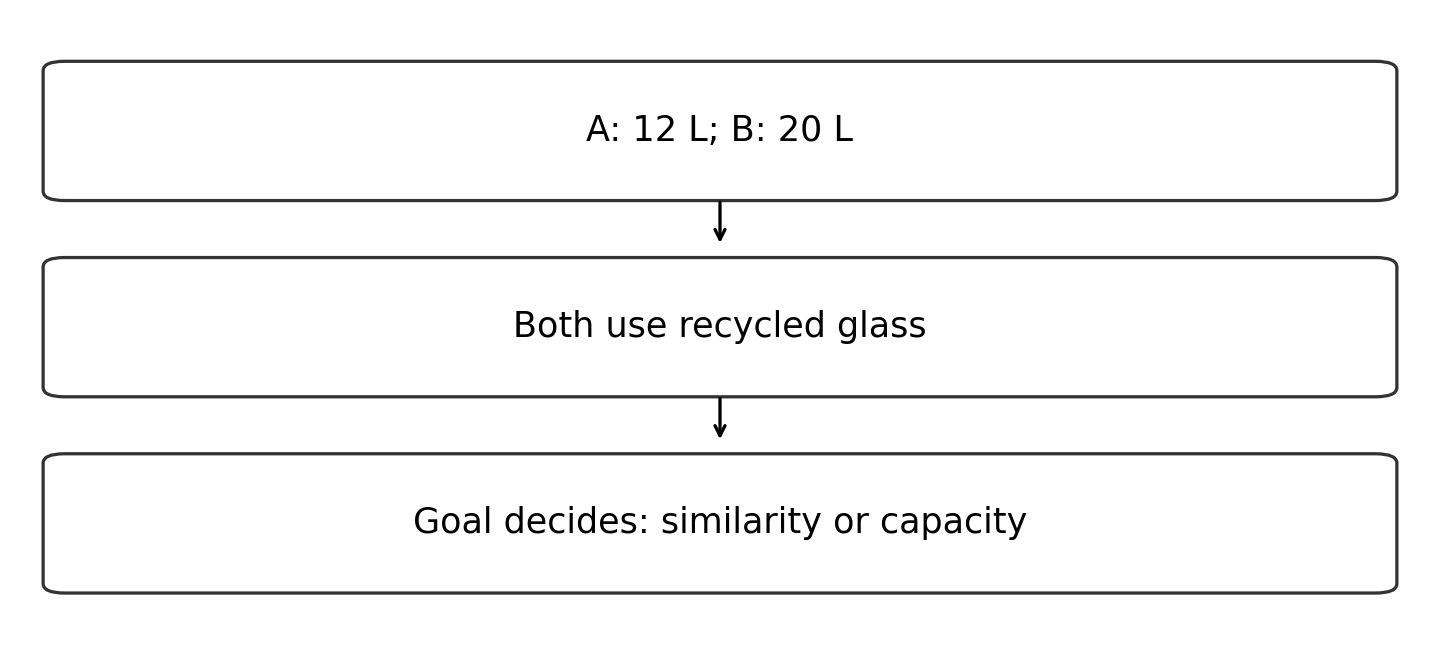
    词汇
    English 中文 拼音
    sentence function 句子作用 jù zi zuò yòng
    qualification/ˌkwɒlɪfɪˈkeɪʃn/ 限定 xiàn dìng
    evidence/ˈevɪdəns/ 证据 zhèng jù
    argument/ˈɑːɡjuːmənt/ 论证 lùn zhèng
    proposal/prəˈpəʊzl/ 提案 tí àn
  • 25

    RW-cross-text · Compare two texts without merging their claims

    学习计划即将上线

    Handout

    Scope and prerequisites

    Digital SAT framework; original paper practice is nonadaptive and gives no scaled-score prediction.

    • Identify each author’s claim and degree of certainty separately
    • Explain agreement, disagreement or qualification on the same issue
    • Predict one author’s response using their stated reasoning

    Prerequisites: Keep speakers separate; distinguish observation from explanation.

    Explain and choose the method

    Build a brief claim record for each text: topic, position, evidence 证据 and limit. Keep the speakers separate. If Text 1 reports a possibility and Text 2 reports a concern, a response that makes both certain has altered both positions.

    Compare claims about the same relationship, not just shared vocabulary. Agreement may concern a benefit while disagreement concerns generalisation. One text may supply evidence absent from the other rather than directly contradict it. Identify exactly which proposition is supported, challenged or narrowed.

    When asked how one author would respond, use that author’s reasoning and scope. Do not choose your preferred opinion or a compromise that neither text supports. A response can acknowledge the other text’s evidence while resisting its broad conclusion if that matches the stated limitation.

    Check every clause of the answer. A choice may describe Text 1 correctly and misrepresent Text 2, or identify a real disagreement then exaggerate its importance. Trace each assertion back to its source. The final choice must accurately connect both texts, not merely summarise one.

    Cross-text comparison 跨文本比较 connects claims about the same issue. “Signs reduced wrong turns” and “lighting also changed during the trial” can coexist. The second statement challenges a causal explanation, not necessarily the recorded reduction.

    Original diagram of the worked relationship; read the full wording and qualifications.
    Original diagram of the worked relationship; read the full wording and qualifications.

    Existing worked example: Original Text 1: “A trial in one gallery found that longer labels increased the time visitors spent at exhibits, suggesting that detailed labels can promote engagement.” Original Text 2: “Time spent reading does not necessarily indicate deeper engagement; visitors may be trying to understand unclear wording.” Text 2 would question whether time alone supports Text 1’s engagement inference 推断, not deny that the trial recorded more time.

    Complete original context

    Original Text A: During a two-week trial, a station displayed route information on a large screen. Requests for platform directions fell from 60 in the preceding fortnight to 36. The screen seems a promising way to help travellers find their platforms, and other stations should consider a trial.

    Original Text B: Fewer requests were recorded during the screen trial, but several platforms were closed for repairs at the same time. The remaining journeys may have been easier to navigate. Before treating the screen as the explanation, compare similar periods with the same platform arrangement. A further trial is reasonable if it separates these changes.

    Independent practice and checked reasoning

    Transfer 1

    Identify one agreement and the precise disagreement or qualification.

    Reasoning: Both accept that recorded requests fell and allow a further trial. B questions attributing the reduction to the screen because platform closures also changed navigation. B does not claim the screen certainly fails.

    Transfer 2

    How would B most likely respond to “The screen caused a 40% reduction at every station”? Check every part of the claim.

    Reasoning: The observed reduction is $(60-36)/60=40\%$ at one station, but B would reject the causal certainty and every-station scope. The simultaneous closures leave an alternative explanation and no observations at other stations are supplied.

    Transfer 3

    Propose evidence that would address B's concern, and explain why interviewing the screen's designer about its colour would not.

    Reasoning: Compare otherwise similar periods or randomised station trials with matched platform arrangements, recording requests and traveller numbers. This addresses confounding and rates. A colour preference interview does not isolate the screen's navigation effect.

    Limits and next use

    Disagreeing with an interpretation 解释 is different from denying the observation. Keep each author’s evidence and conclusion distinct.

    All tasks here are public original practice with authored guidance. They are not official questions or fresh diagnostics. Existing protected tests and mocks remain separate.
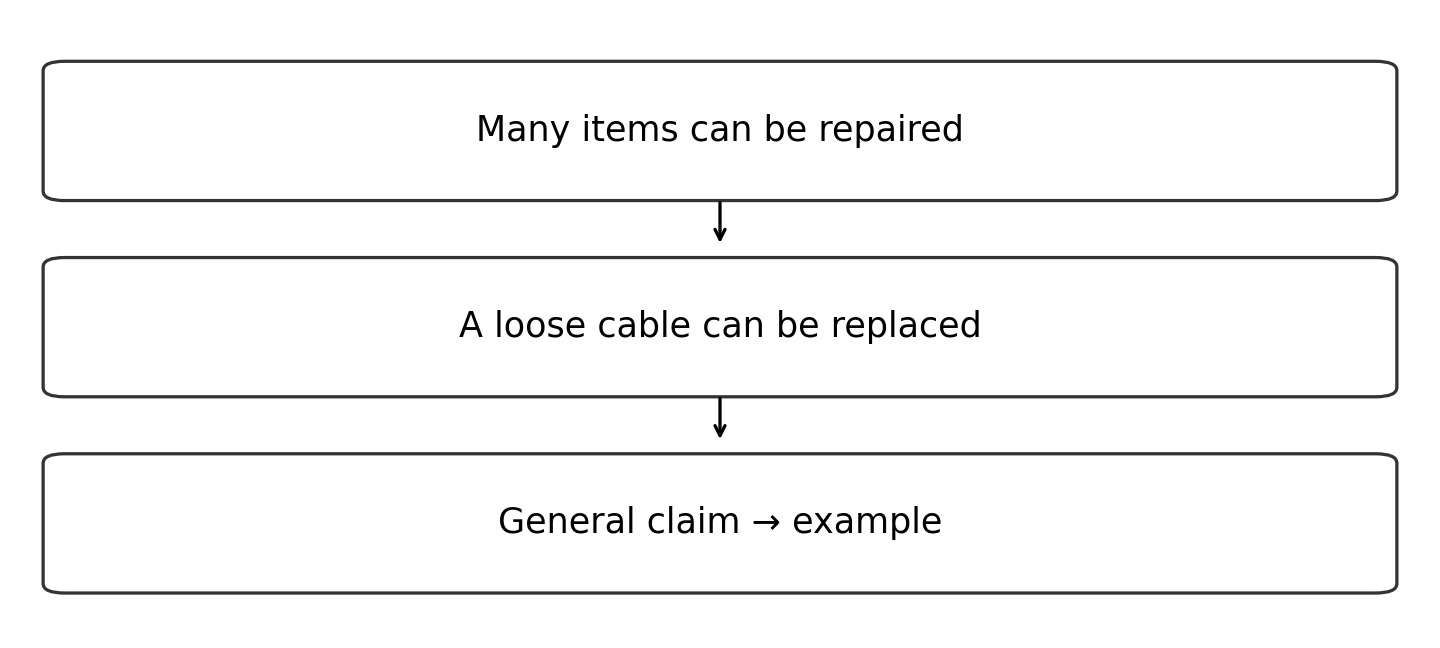
    词汇
    English 中文 拼音
    cross-text comparison 跨文本比较 kuà wén běn bǐ jiào
    inference/ˈɪnfərəns/ 推断 tuī duàn
    evidence/ˈevɪdəns/ 证据 zhèng jù
    interpretation/ɪnˌtɜːprɪˈteɪʃn/ 解释 jiě shì
  • 26

    RW-synthesis · Use research notes for the requested rhetorical goal

    学习计划即将上线

    Handout

    Scope and prerequisites

    Digital SAT framework; original paper practice is nonadaptive and gives no scaled-score prediction.

    • Translate a rhetorical goal 修辞目标 into a specific information requirement
    • Select relevant accurate details from notes
    • Combine notes without inventing a relationship or including irrelevant material

    Prerequisites: Read a stated rhetorical goal; preserve names, units and relations.

    Explain and choose the method

    Read the goal before the notes. Identify the action: introduce a subject, emphasise a similarity 相似, contrast two cases, give an example or explain significance. Turn it into a brief requirement such as mention both objects and their different materials. This determines which facts matter.

    Select details that carry out that action. Accurate but irrelevant information can still fail the question. For a contrast, both compared objects and the relevant difference should be present; for a similarity, a shared property should be explicit. Do not assume that including more notes makes a stronger sentence.

    Preserve relationships when combining facts. Notes saying a researcher visited a site and later published a book do not prove the visit caused the book. Avoid adding evaluative language such as revolutionary or superior unless the notes support it. Keep time, identity and numerical facts consistent.

    Compare answer choices against both goal and factual accuracy. A sentence can meet the goal while misreporting a detail 细节, or be fully accurate while answering a different goal. The correct choice must satisfy both conditions. Clear referents and concise structure help make the requested relationship explicit.

    Rhetorical synthesis 综合 修辞综合 selects facts for a purpose. Notes: A stores 12 litres; B stores 20; both use recycled glass. For a material similarity: “Both containers use recycled glass.” For a capacity difference: “B stores 8 litres more than A.” The same notes support different sentences.

    Original diagram of the worked relationship; read the full wording and qualifications.
    Original diagram of the worked relationship; read the full wording and qualifications.

    Existing worked example: Original notes: Project Alder used recycled wood; Project Birch used clay; both were temporary outdoor installations; Alder opened in May; Birch opened in June. Goal: emphasise a difference in materials. Suitable synthesis: “Although both were temporary outdoor installations, Alder used recycled wood whereas Birch used clay.” Opening months are accurate but unnecessary for this goal.

    Complete original context

    Original research notes:

    • The Bay project restored 3 km of walking paths in 2024.
    • The Hill project restored 5 km of walking paths in 2024.
    • Both projects used volunteer teams.
    • Bay used local stone for boundary markers.
    • Hill used recycled timber for boundary markers.
    • The notes give no costs, visitor counts or durability measurements.

    Independent practice and checked reasoning

    Transfer 1

    Write one sentence emphasising a similarity in staffing and a second emphasising the difference in distance restored.

    Reasoning: “Both Bay and Hill used volunteer teams.” “Hill restored 5 km of paths, 2 km more than Bay.” These select staffing and distance respectively without adding a cause.

    Transfer 2

    A student writes “Hill restored more paths because recycled timber lasts longer.” Identify every unsupported relationship.

    Reasoning: The notes do not report why Hill restored a longer distance, nor any durability comparison. They report kilometres, not the number of separate paths. A valid sentence is “Hill restored a longer total distance and used recycled timber for its markers,” without a causal link.

    Transfer 3

    Goal — contrast marker 转折标记 materials without including irrelevant detail. Write a sentence, then explain why the shared year can be omitted.

    Reasoning: “Bay used local stone for boundary markers, whereas Hill used recycled timber.” The shared year does not establish the requested material contrast. Omitting it meets this goal; a historical comparison could require it under a different goal.

    Limits and next use

    Do not mistake a factually accurate sentence for one that satisfies the rhetorical goal. Avoid unsupported causal or evaluative additions.

    All tasks here are public original practice with authored guidance. They are not official questions or fresh diagnostics. Existing protected tests and mocks remain separate.
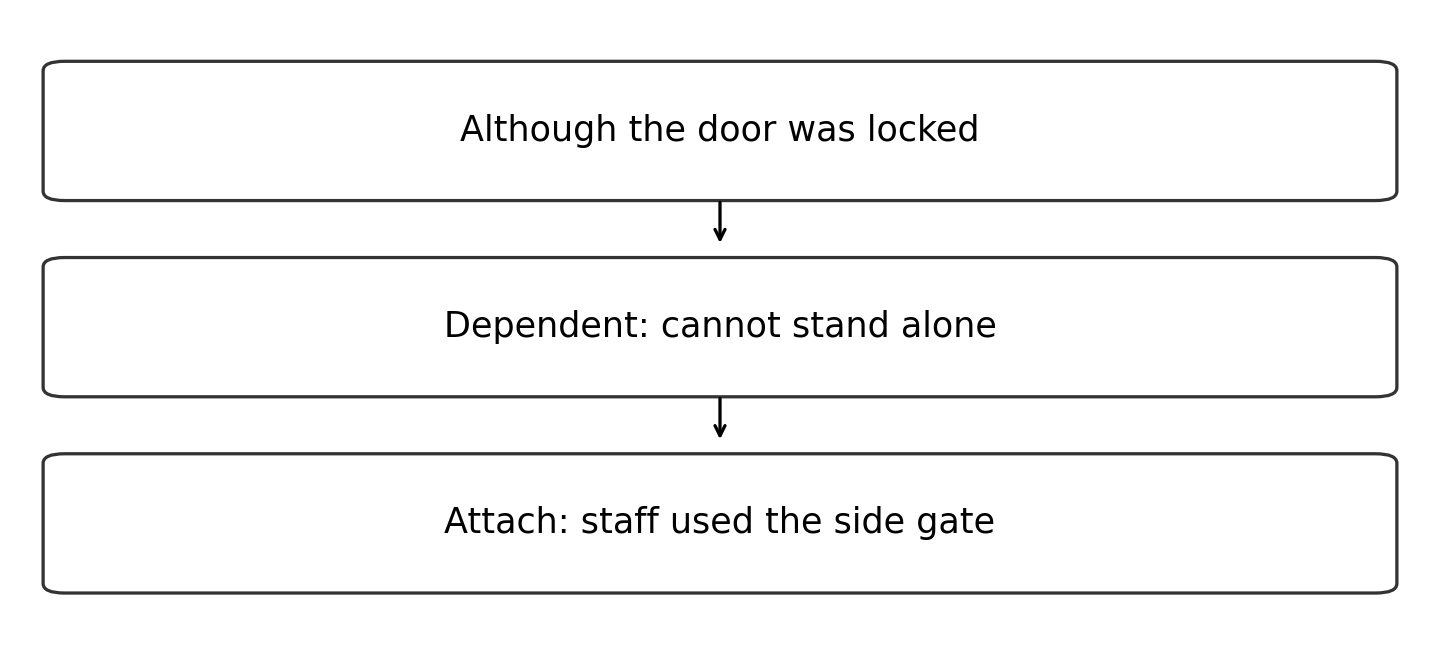
    词汇
    English 中文 拼音
    rhetorical synthesis 修辞综合 xiū cí zōng hé
    contrast marker/ˈkɒntræst ˈmɑːkə/ 转折标记 zhuǎn zhé biāo jì
    rhetorical goal/reˈtɒrɪkl ɡəʊl/ 修辞目标 xiū cí mù biāo
    similarity/ˌsɪmɪˈlærɪti/ 相似 xiāng sì
    synthesis/ˈsɪnθəsɪs/ 综合 zōng hé
    detail/ˈdiːteɪl/ 细节 xì jié
  • 27

    RW-transitions · Transitions: choose the logical relationship first

    学习计划即将上线

    Handout

    Scope and prerequisites

    Digital SAT framework; original paper practice is nonadaptive and gives no scaled-score prediction.

    • Identify contrast, consequence 结果, example and continuation relationships
    • Choose a transition 衔接词 that preserves the argument 论证’s logic
    • Distinguish logical linking from punctuation requirements

    Prerequisites: Read both sides of a blank; distinguish logic from punctuation.

    Explain and choose the method

    Temporarily ignore the blank and state how the two ideas relate. Does the next sentence add another instance, give a result, present an example, correct an expectation or shift to a different topic? A short label such as contrast is more useful than choosing a familiar connective immediately.

    Consequential transitions such as therefore need a supported result. However and nevertheless introduce contrast or concession 让步, while for example introduces an instance of a broader claim. Similarly compares a matching relationship, not merely two sentences mentioning the same noun. Use the meaning of both sides, including negatives.

    A concession acknowledges a point while maintaining a different conclusion. “The route is shorter; nevertheless, it takes longer at rush hour” contrasts distance with travel time. In fact can strengthen or correct a statement; it is not a generic substitute for additionally. Test the chosen word by paraphrasing the relationship aloud.

    Logical correctness does not remove sentence-boundary rules. However is not a coordinating conjunction joining independent clauses with a comma alone. In a transition question, supplied punctuation may already be fixed; in an editing task, punctuation also needs checking. Keep these two decisions distinct.

    A transition names a logical relationship. “The line is shorter. However, it moves more slowly” contrasts size with the expected speed benefit. “Many items can be repaired. For example, a loose cable can be replaced” moves from general statement to instance. Neither relationship is caused merely by sharing a subject.

    Original diagram of the worked relationship; read the full wording and qualifications.
    Original diagram of the worked relationship; read the full wording and qualifications.

    Existing worked example: Original passage: “The new device is smaller than its predecessor. However, it requires more frequent charging.” The second sentence limits an expected benefit; therefore would incorrectly make frequent charging a logical result of small size without evidence 证据. “Several birds use tools. For example, one species uses twigs to retrieve food” moves from a general claim to an instance.

    Complete original context

    Original passage: The new catalogue can be searched from home. [1] Readers no longer need to travel merely to find a likely shelf number. It still omits several collections. [2] A reader looking for an unlisted item must contact staff. Some entries also use abbreviations. [3] “MS” identifies a manuscript rather than a printed book.

    Independent practice and checked reasoning

    Transfer 1

    Choose the best relationships at [1], [2], [3], then supply suitable transitions. Explain each link.

    Reasoning: [1] consequence: “Therefore,” links remote search to avoiding a search-only trip. [2] consequence: “Consequently,” links missing entries to contacting staff for those items. [3] example: “For example,” introduces one abbreviation. Equivalent transitions expressing those relations are acceptable.

    Transfer 2

    Rewrite the second pair with a contrast between remote access and incomplete coverage, using however and correct sentence boundaries.

    Reasoning: “The catalogue can be searched from home; however, it still omits several collections.” A full stop before “However,” also works. However expresses a limitation but cannot join two independent clauses with a comma alone.

    Transfer 3

    Why would similarly be weak at [3], and why would therefore be weak in “The guide is free. ___, it is only available on weekdays”?

    Reasoning: The abbreviation is an instance of a general category, not a second parallel comparison, so for example is clearer. Weekday-only availability limits an advantage; being free does not by itself cause that schedule. However can express that contrast.

    Limits and next use

    Shared subject matter does not decide the link. Do not choose therefore unless a consequence is actually supported.

    All tasks here are public original practice with authored guidance. They are not official questions or fresh diagnostics. Existing protected tests and mocks remain separate.
    词汇
    English 中文 拼音
    consequence/ˈkɒnsɪkwəns/ 结果 jié guǒ
    transition/trænˈsɪʃn/ 衔接词 xián jiē cí
    concession/kənˈseʃn/ 让步 ràng bù
    evidence/ˈevɪdəns/ 证据 zhèng jù
    argument/ˈɑːɡjuːmənt/ 论证 lùn zhèng
  • 28

    RW-boundaries · Sentence boundaries, colons and nonessential information

    学习计划即将上线

    Handout

    Scope and prerequisites

    Digital SAT framework; original paper practice is nonadaptive and gives no scaled-score prediction.

    • Distinguish independent and dependent clauses before choosing punctuation
    • Join complete clauses without a comma splice 逗号拼接错误
    • Place colons and paired punctuation according to sentence structure

    Prerequisites: Subjects and finite verbs; independent/dependent clauses.

    Explain and choose the method

    An independent clause 独立分句 has a subject and finite predicate and can stand as a sentence. A dependent clause introduced by although, because or when cannot stand alone in that role. Identify the clause structure before choosing punctuation; a long clause is not necessarily complete and a short one may be.

    Two independent clauses can be separated by a period or semicolon, or joined with a comma and coordinating conjunction such as and or but. A comma alone creates a splice. A conjunctive adverb such as however does not replace the coordinating conjunction: use “The test was brief; however, it was demanding.”

    A colon 冒号 can introduce an explanation, example or list after a complete independent clause. Do not place it between a verb and its direct object or after a preposition introducing its object. “The box contains three tools: a ruler, a compass and a square” has a complete introductory clause; “The tools include: a ruler…” improperly interrupts the include construction.

    Nonessential material can be enclosed by matching commas, dashes or parentheses, while essential identifying material should not be separated in that way. Removing a nonessential insertion leaves the core sentence intact. Watch both boundaries of an insertion and avoid placing a comma between the subject and main verb merely because the subject is long.

    A sentence boundary 句子边界 depends on clause structure. “Although the door was locked” is dependent; attach it to a complete clause. “Although the door was locked, staff could enter through the side gate.” A colon follows a complete introductory clause: “Staff used one entrance: the side gate.”

    Original diagram of the worked relationship; read the full wording and qualifications.
    Original diagram of the worked relationship; read the full wording and qualifications.

    Existing worked example: Original: “The catalogue was incomplete; however, the surviving entries were useful.” Both clauses are complete; the semicolon separates them and however is followed by a comma. “The team chose one method: a supervised trial” uses a colon after a complete clause. “The catalogue, revised last year, includes new photographs” encloses a removable modifier 修饰语 with two commas.

    Complete original context

    Original editing passage: Although the old station was closed [1] its clock still worked. The mechanism was simple [2] however, repairing the hands required a specialist. One part needed replacement [3] the narrow axle behind the dial. The clock [4] which stood above the entrance [5] had become a meeting point. For this exercise there is one clock, and the which-clause adds nonessential information.

    Independent practice and checked reasoning

    Transfer 1

    Supply punctuation at [1]–[5]. Give at least two valid boundaries at [2] and explain the clause test.

    Reasoning: [1] comma attaches the introductory dependent clause. [2] semicolon or full stop, because the mechanism clause and repairing clause are independent; capitalise However after a full stop. [3] colon follows the complete clause “One part needed replacement” and introduces the part. [4],[5] paired commas mark the specified nonessential clause; matching dashes or parentheses also work.

    Transfer 2

    Explain why “One part needed: a replacement” differs from the valid colon sentence in the passage.

    Reasoning: Needed directly requires its object “a replacement”; placing a colon there interrupts that grammatical unit. In “One part needed replacement: the narrow axle”, the independent clause is already complete and the explanation follows.

    Transfer 3

    Repair “The clock, above the entrance, and the bell was restored” while preserving the two restored objects. Explain agreement and any optional punctuation.

    Reasoning: “The clock above the entrance and the bell were restored.” The compound subject takes were. Commas around “above the entrance” could be used if it is supplementary rather than identifying; that contextual choice does not change the compound agreement.

    Limits and next use

    Punctuation follows structure, not a pause imagined while reading. A comma before however does not by itself repair two independent clauses.

    All tasks here are public original practice with authored guidance. They are not official questions or fresh diagnostics. Existing protected tests and mocks remain separate.

    词汇
    English 中文 拼音
    independent clause/ˌɪndɪˈpendənt klɔːz/ 独立分句 dú lì fēn jù
    sentence boundary 句子边界 jù zi biān jiè
    comma splice/ˈkɒmə splaɪs/ 逗号拼接错误 dòu hào pīn jiē cuò wù
    modifier/ˈmɒdɪfaɪə/ 修饰语 xiū shì yǔ
    colon/ˈkəʊlən/ 冒号 mào hào
  • 29

    RW-form · Agreement, verb forms, modifiers and logical parallelism

    学习计划即将上线

    Handout

    Scope and prerequisites

    Digital SAT framework; original paper practice is nonadaptive and gives no scaled-score prediction.

    • Match verbs and pronouns to their actual referents
    • Choose tense and verb form from the passage’s time relationship
    • Place modifiers and parallel elements so their logical subject is clear

    Prerequisites: Subject head; verb timelines; participles and infinitives.

    Explain and choose the method

    Find the head of the subject rather than agreeing with the nearest noun. A singular collection takes is even when a following of-phrase contains plural maps. A pronoun must agree with and clearly refer to its antecedent 先行词. If two possible antecedents make a pronoun ambiguous, a precise noun can restore the intended reference.

    Choose verb tense from the surrounding timeline and logical relationship, not an isolated word. A completed event at a stated past time normally takes a past form. Perfect forms can mark an event before another reference time. An infinitive or participle is not automatically a finite verb 限定动词 and cannot alone supply the main predicate.

    An introductory modifier 修饰语 must attach to the appropriate subject. “Walking through the gallery, Maya noticed the new labels” makes Maya the walker. “Walking through the gallery, the labels attracted Maya” incorrectly makes the labels walk. Identify the performer of the introductory action, then check the main subject.

    Parallel structures put comparable ideas into compatible grammatical forms: “to collect, to classify and to display” or “collecting, classifying and displaying”. A comparison must compare like things, such as one museum’s hours with another’s hours, not hours with a museum. Meaning and structure work together; a grammatically shaped choice can still create an illogical reference.

    Agreement follows the subject head, not the nearest noun. “The set of keys is missing” has singular set. An introductory modifier must describe the correct actor: “Opening the drawer, Mina found the keys.” “Opening the drawer, the keys appeared” incorrectly makes keys do the opening.

    Original diagram of the worked relationship; read the full wording and qualifications.
    Original diagram of the worked relationship; read the full wording and qualifications.

    Existing worked example: Original agreement: “The list of proposed changes includes a longer opening period.” List is singular, so includes is correct. Modifier repair: “After examining the samples, the researchers revised their prediction.” Researchers examine; a version beginning “After examining the samples, the prediction…” dangles. Parallel repair: “The team aimed to record, analyse and publish the findings.”

    Complete original context

    Original editing passage: The collection of donated tools [1: include/includes] three old drills. Examining the smallest drill, [2: a crack surprised Jo/Jo noticed a crack]. Yesterday Jo [3: repairs/repaired] the casing. The volunteer team plans to clean, [4: label/labelling], and display the tools. The museum's opening hours are longer than [5: the archive/the archive's opening hours].

    Independent practice and checked reasoning

    Transfer 1

    Choose forms at [1]–[5] and explain their grammatical and logical roles.

    Reasoning: [1] includes agrees with collection. [2] Jo noticed a crack makes Jo the examiner. [3] repaired matches yesterday. [4] label parallels clean and display after to. [5] the archive's opening hours compares hours with hours, not hours with an institution.

    Transfer 2

    “Before the shop opened last Monday, Jo had checked the drills.” Explain the relationship conveyed by had checked. Is the past perfect required in every sentence about two past events?

    Reasoning: The check was completed before the past reference point, opening. Past perfect makes that sequence explicit. It is not compulsory in every two-event account; before or after and context can sometimes make simple past order clear. Judge the actual sentence rather than a universal rule.

    Transfer 3

    Repair “When Jo met Mina, she showed her the repaired drill” so that Jo is clearly the person presenting and Mina receives it. Give a parallel list of three possible maintenance actions.

    Reasoning: “Jo showed Mina the repaired drill when they met.” This removes ambiguous she/her reference. One parallel list is “checking cables, replacing screws, and cleaning handles”; all three use -ing forms.

    Limits and next use

    Do not agree with a noun inside a prepositional phrase or let an introductory action attach to an inanimate subject that cannot perform it.

    All tasks here are public original practice with authored guidance. They are not official questions or fresh diagnostics. Existing protected tests and mocks remain separate.

    词汇
    English 中文 拼音
    finite verb/ˈfaɪnaɪt vɜːb/ 限定动词 xiàn dìng dòng cí
    antecedent/ˌæntɪˈsiːdənt/ 先行词 xiān xíng cí
    modifier/ˈmɒdɪfaɪə/ 修饰语 xiū shì yǔ

登录或创建账户

IGCSE、A-Level 与 AP