Scope and prerequisites
Digital SAT framework; original paper practice is nonadaptive and gives no scaled-score prediction.
- Calculate event and complement probabilities from counts
- Use the conditioning group as the denominator
- Distinguish independence from disjointness
Prerequisites: Fractions; table totals; event and complement.
Explain and choose the method
A probability based on equally represented observations is favourable count divided by the relevant total. A two-way table has joint counts in cells, group totals on the margins and a grand total. Read whether the question asks about a joint event, either event or one event given another before choosing the denominator.
For P(A given B), restrict attention to the B group and divide the A-and-B count by the B total. It is not generally equal to P(B given A), because the conditioning groups differ. A fraction with the correct numerator but the wrong population still answers the wrong question.
The complement probability is 1-P(A). For either A or B, adding separate probabilities double-counts overlap, so subtract P(A and B). Disjoint events have no overlap; independent events 独立事件 satisfy P(A and B)=P(A)P(B). Two positive-probability disjoint events cannot be independent, since observing one rules out the other.
For without-replacement draws, update both the remaining favourable count and total at each step. For independent repeated choices the probabilities multiply without that update. State the sampling assumptions before calculating. A table of observed relative frequencies supports empirical probabilities for that population, not a guarantee about every future draw.
Conditional probability 条件概率 restricts the denominator. Of 40 club members, 12 cycle; 8 of those cyclists wear a helmet. $P(H\mid C)=n(H\cap C)/n(C)=8/12=2/3$. The group is cyclists, so 40 is not this denominator.
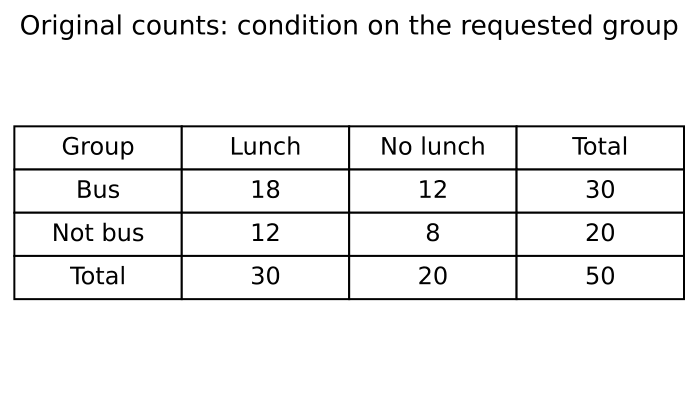
Existing worked example: Original counts: bus users—18 carry a packed lunch, 12 do not; non-bus users—12 carry lunch, 8 do not. Total 50. P(lunch)=30/50=0.6; P(lunch given bus)=18/30=0.6; P(bus given lunch)=18/30=0.6 in this particular balanced table. Change one cell and these need not stay equal. P(bus and lunch)=18/50=0.36, equal here to 0.6·0.6, so the table shows independence of these categories.
Complete original context
Every transfer question states all data it needs.
Independent practice and checked reasoning
Transfer 1
A survey records 12 tea drinkers and 8 non-tea drinkers among 20 cyclists; among 30 walkers it records 9 tea drinkers and 21 non-tea drinkers. Find $P(tea)$, $P(tea\mid cyclist)$ and $P(cyclist\mid tea)$.
Reasoning: Total tea drinkers are 21 of 50, so $P(T)=21/50$. Within cyclists, $P(T\mid C)=12/20=3/5$. Within tea drinkers, $P(C\mid T)=12/21=4/7$. These different denominators make the conditional probabilities unequal.
Transfer 2
In the same survey, are tea drinking and cycling independent? Are they disjoint? Use numbers for both answers.
Reasoning: They are not independent because $P(T\mid C)=3/5\ne21/50=P(T)$. They are not disjoint because 12 respondents do both: $P(T\cap C)=12/50>0$.
Transfer 3
One respondent is chosen uniformly. Find the probability of walking or drinking tea, including those who do both.
Reasoning: Use inclusion–exclusion. $P(W\cup T)=(30+21-9)/50=42/50=21/25$. The 9 tea-drinking walkers must not be counted twice. Equivalently exclude the 8 cyclists who do not drink tea.
Limits and next use
Equal conditional answers in one table are coincidence or structure to check, not a universal rule. Condition first, then count.
All tasks here are public original practice with authored guidance. They are not official questions or fresh diagnostics. Existing protected tests and mocks remain separate.