Scope and prerequisites
Digital SAT framework; original paper practice is nonadaptive and gives no scaled-score prediction.
- Apply length, area and volume scaling to similar figures
- Use parallel-line angles and triangle sums to find unknowns
- Distinguish similarity 相似 from congruence 全等 and adequate information
Prerequisites: Triangle sum; Pythagoras; length/area/volume units.
Explain and choose the method
For similar figures with length scale k, corresponding lengths scale by k, areas by k² and volumes by k³. These laws apply when all corresponding dimensions change together. A cylinder with only radius doubled and fixed height has four times the volume, not eight times. State which dimensions are scaled before choosing the power.
Use the correct geometric measure: triangle area is half base times perpendicular height 垂直高度; cylinder volume is base area times height. Surface area adds exposed faces, while volume measures enclosed space. A slant length is not automatically the perpendicular height required by an area formula. Attach square or cubic units to the result.
Vertical angles are equal. For parallel lines cut by a transversal, corresponding and alternate interior angles are equal, and same-side interior angles sum to 180°. A triangle’s interior angles sum to 180°; its exterior angle equals the sum of the two remote interior angles. These rules depend on stated or marked parallelism, not the drawing’s appearance.
Similar triangles share corresponding angles and proportional corresponding sides; congruent triangles also have equal corresponding lengths. Two angles establish similarity but not size equality. Maintain correspondence when writing a ratio. A side–side–angle arrangement does not universally guarantee congruence, whereas side–angle–side includes the angle between the two sides.
A scale factor 比例因子 $k$ changes every corresponding length. $A_2=k^2A_1$ and $V_2=k^3V_1$ for similar shapes. If $k=3/2$ and $A_1=24\,\mathrm{cm^2}$, $A_2=(3/2)^2(24\,\mathrm{cm^2})=54\,\mathrm{cm^2}$. Changing only one dimension does not justify these similarity rules.
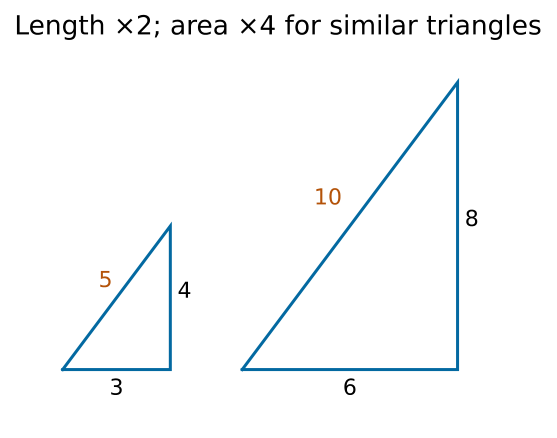
Existing worked example: Two similar solids have edge ratio 2:3, so surface-area ratio is 4:9 and volume ratio 8:27. A triangular garden with base 12 m and perpendicular height 5 m has area 30 m². If a triangle has interior angles 48° and 67°, its third is 65° and the adjacent exterior angle is 115°=48°+67°.
Complete original context
Every transfer question states all data it needs.
Independent practice and checked reasoning
Transfer 1
Similar containers have surface areas 96 and 216 square centimetres. The smaller volume is 160 cubic centimetres. Find the larger volume.
Reasoning: $k=\sqrt{A_2/A_1}=\sqrt{216/96}=3/2$. Volume uses the cube: $V_2=k^3V_1=(3/2)^3(160\,\mathrm{cm^3})=540\,\mathrm{cm^3}$. Using area ratio directly would give the wrong volume.
Transfer 2
A right triangle has hypotenuse 13 cm and one leg 5 cm. Find the other leg, its area, and the sine of the angle opposite the 5 cm leg.
Reasoning: $b=\sqrt{c^2-a^2}=\sqrt{(13\,\mathrm{cm})^2-(5\,\mathrm{cm})^2}=12\,\mathrm{cm}$. $A=ab/2=(5\,\mathrm{cm})(12\,\mathrm{cm})/2=30\,\mathrm{cm^2}$. $\sin\theta=a/c=(5\,\mathrm{cm})/(13\,\mathrm{cm})=5/13$.
Transfer 3
Two interior angles of a triangle are 42° and 73°. Find the third angle and its adjacent exterior angle. Would those angles alone determine all side lengths?
Reasoning: Third angle is $180-42-73=65$ degrees. Its adjacent exterior angle is $180-65=115$ degrees, also $42+73$. Angles establish shape, not scale; similar triangles can have different side lengths.
Transfer 4
Two parallel lines are cut by a transversal. One corresponding angle is 68°. Find its matching corresponding angle and the adjacent angle on the second line. Explain which given condition justifies each step.
Reasoning: Parallelism gives the matching corresponding angle 68°. The adjacent pair forms a straight angle, so the other is 180°−68°=112°. Equal corresponding angles require the stated parallel lines; the straight-angle sum uses adjacency on one line. A similar-looking sketch without parallelism would not justify the first equality.
Limits and next use
Use k² or k³ only when the entire shape is scaled; do not infer parallel lines or a perpendicular height from an unmarked sketch.
All tasks here are public original practice with authored guidance. They are not official questions or fresh diagnostics. Existing protected tests and mocks remain separate.