This handout teaches E.5 Fusion and stars in full, for the course first assessed in 2025. There is no additional higher level content in E.5, so SL and HL students study the same material.
Prerequisites: binding energy, the binding energy curve and $E = mc^2$ from E.3; fission from E.4; black-body radiation, the Stefan–Boltzmann law, Wien's law and apparent brightness from B.1; Coulomb repulsion from D.2 (the barrier-energy estimate is introduced here); emission and absorption spectra from E.1. Use $1\ \text{u} = 931.5\ \text{MeV}\,c^{-2}$, the Sun's luminosity $L_\odot = 3.83 \times 10^{26}$ W, mass $M_\odot = 1.99 \times 10^{30}$ kg, radius $R_\odot = 6.96 \times 10^{8}$ m and surface temperature $T_\odot = 5800$ K.
19.2
处于平衡状态的恒星
English
How can a hot star be faint?
Temperature alone does not tell us a star's total power. A very hot white dwarf can have a small emitting area and low luminosity; a cooler giant can radiate much more because its area is enormous. Distance adds a second ambiguity: a luminous distant star can look as faint as a less luminous nearby one. We need several measurements and a physical model to distinguish these cases.
Area matters as much as temperature
Worked stellar calculations below use assigned data, not reported measurements of named stars, except the explicitly stated rounded solar reference values. The model links fusion and pressure support to luminosity, distance, radius and stellar evolution.
A balance of forces
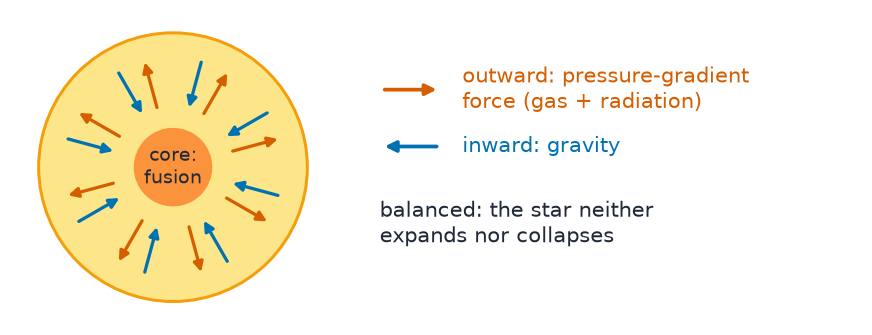
A star is a huge ball of hot gas, mostly hydrogen and helium. Two effects act on every layer of it:
The Sun, seen in ultraviolet light: a stable main-sequence star in which gravity and outward pressure balance
Gravity pulls all the gas inwards, towards the centre.
The outward force comes from a pressure gradient: gas pressure and radiation pressure 辐射压 are greater at smaller radius, so the inner face of a layer feels more pressure than the outer face. Absolute pressure is not itself a net outward force.
Hydrostatic support: the outward pressure-gradient force balances gravity in each layer
In a stable star these two effects balance, so the star is in equilibrium 平衡: it neither collapses nor expands. The balance controls itself:
If fusion speeds up, the pressure rises and the star expands slightly. The core cools, fusion slows down again, and the star settles back.
If fusion slows down, gravity squeezes the core. It heats up, and fusion speeds up again.
This is hydrostatic equilibrium, not motionlessness of every particle and not simply equality of the nuclear and gravitational energy totals. Main-sequence thermal regulation links temperature-sensitive fusion to expansion/contraction. Exhausting a core fuel changes the structure; later quasi-equilibrium stages can still exist.
gas pressure and radiation pressure/ɡæs ˈpreʃə ænd ˌreɪdɪˈeɪʃn ˈpreʃə/
辐射压
fú shè yā
equilibrium/ˌiːkwɪˈlɪbrɪəm/
平衡
píng héng
19.3
核聚变:恒星的能量来源
English
Nuclear fusion 核聚变 is the joining of two light nuclei to form a heavier nucleus. Suitable light-nucleus reactions increase total binding energy and release energy. Compare the actual initial and final masses; not every possible fusion reaction is exothermic.
The proton–proton chain
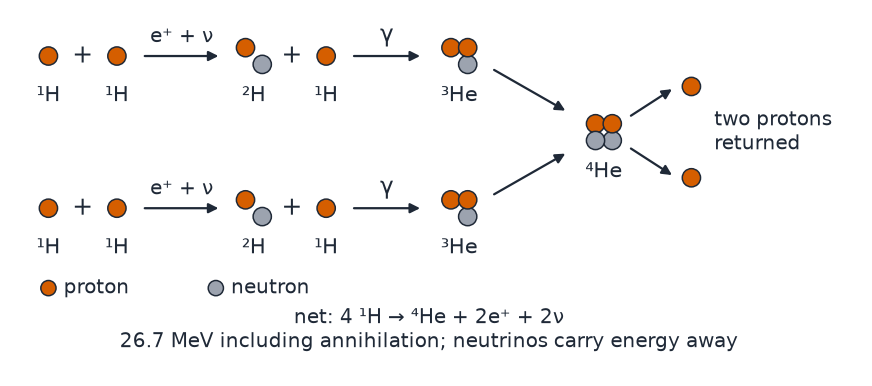
In the Sun, hydrogen becomes helium in the proton–proton chain 质子质子链:
The first step makes a positron 正电子 and a neutrino 中微子, through a weak-interaction conversion of a proton into a neutron during fusion. This is not spontaneous beta-plus decay of an isolated free proton. No stable two-proton nucleus is implied. The overall result is
$\Delta m = 0.028697\ \text{u}$, so $E = 0.028697 \times 931.5 = 26.7\ \text{MeV}$.
Using atomic masses also counts the energy released when the two positrons annihilate with two electrons. A small part of the energy is carried away by the neutrinos, which escape from the Sun.
Only $0.028697/4.031300=0.71\,\%$ of the initial hydrogen mass is released as energy; most remains in helium. For these hydrogen-to-helium and uranium-fission examples, the fusion energy per kilogram is greater. That comparison is reaction-specific.
How long will the Sun shine?
Using photon luminosity alone, the radiated mass-equivalent rate is $\dfrac{L_\odot}{c^2} = \dfrac{3.83 \times 10^{26}}{(3.00 \times 10^8)^2} = 4.3 \times 10^9\ \text{kg s}^{-1}$: about four million tonnes each second.
In an assigned photon-only model with mass-conversion fraction 0.0071, hydrogen consumption is about $(4.26\times10^9)/0.0071=6.0\times10^{11}\ \text{kg s}^{-1}$. This is much larger than the converted mass; most fuel mass remains in products.
For a rough lifetime model, assume an effective available hydrogen fuel mass of 10% of the solar mass. This is not a claim that exactly 10% of the star is pure hydrogen at one temperature. Available energy: $E_\mathrm{avail}=0.10 \times 1.99 \times 10^{30} \times 0.0071 \times (3.00 \times 10^8)^2=1.27161\times10^{44}$ J before final rounding.
Time: $t=E_\mathrm{avail}/L_\odot$. Using the unrounded energy, $t=(1.27161\times10^{44})/(3.83\times10^{26})\approx3.32\times10^{17}\ \text{s}\approx1\times10^{10}$ years. This estimates the total main-sequence lifetime, not time remaining. The model treats luminosity and available fuel approximately; photon luminosity excludes escaping neutrino energy, and solar-wind mass loss is a separate contribution.
A budget for the Sun's lifetime
Fusion and fission compared
Fission
Fusion
Nuclei
one heavy nucleus splits
two light nuclei join
Where on the binding energy curve
from the right, towards the peak
from the left, towards the peak
Energy per kilogram of fuel
about $8 \times 10^{13}$ J (uranium-235)
about $6 \times 10^{14}$ J (hydrogen to helium)
Conditions
a suitable neutron balance; thermal and fast reactors differ
suitable temperature, density and confinement time for the reaction
Products
many radioactive fragments and emitted neutrons
depend on the reaction: helium and neutrons for D–T; tritium is radioactive
In fusion two light nuclei join into a heavier one, releasing a neutron and energy — the deuterium–tritium reaction used in fusion reactors
One studied terrestrial fusion reaction uses deuterium and tritium, ${}^{2}_{1}\text{H} + {}^{3}_{1}\text{H} \rightarrow {}^{4}_{2}\text{He} + {}^{1}_{0}\text{n}$, which releases 17.6 MeV. Confinement, energy balance and materials are engineering challenges. D–T neutrons can activate surrounding materials, while tritium itself is radioactive; fusion is not automatically free of radioactive waste.
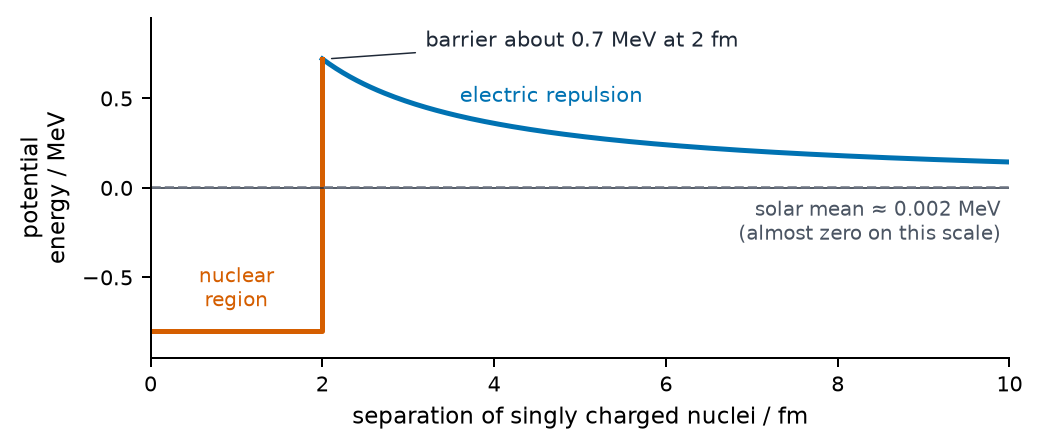
Nuclei are positive, so they repel each other. Nuclear interactions become important at femtometre separations. Reaching that region requires penetration of the electric repulsion, called the Coulomb barrier 库仑势垒.
Schematic barrier penetration; tunnelling does not require classical energy above the barrier, and the well does not represent a stable diproton
Worked example: how hot?
The electric potential energy of two protons $2.0 \times 10^{-15}$ m apart: $E = \dfrac{ke^2}{r} = \dfrac{8.99 \times 10^9 \times (1.60 \times 10^{-19})^2}{2.0 \times 10^{-15}} = 1.2 \times 10^{-13}\ \text{J} \approx 0.7\ \text{MeV}$.
If the average kinetic energy $\tfrac{3}{2}kT$ had to equal this: $T = \dfrac{2E}{3k_\text{B}} = \dfrac{2 \times 1.2 \times 10^{-13}}{3 \times 1.38 \times 10^{-23}} = 6 \times 10^9\ \text{K}$.
The Sun's core is only about $1.5 \times 10^7$ K, four hundred times cooler. Fusion still happens because:
the particles have a range of speeds, and a very small fraction move much faster than average;
quantum physics lets a proton sometimes pass through the barrier without enough energy to go over it (quantum tunnelling 量子隧穿).
Only a small fraction of encounters fuse. In the proton–proton chain, the weak-interaction first step further limits the rate; tunnelling plus a high-energy tail is not a claim that any close proton pair instantly becomes stable helium.
The conditions for fusion in a star are therefore:
high temperature for the relevant stellar reaction, giving a distribution of collision energies and appreciable barrier penetration;
very high density, so that collisions happen often enough. Density and a long confinement time supplied by gravity sustain the stellar reaction rate. Temperature and density alone do not specify a universal rate or ignition threshold for every fuel.
Gravity provides both. As a cloud of gas collapses, it becomes denser, and gravitational potential energy is transferred to thermal energy until the core is hot enough for fusion.
Stars are so far away that metres are inconvenient. Three larger units are used.
Unit
Definition
Value
astronomical unit 天文单位 (AU)
a defined length scale close to the Earth–Sun orbital semimajor axis
$1.50 \times 10^{11}$ m
light year 光年 (ly)
the distance light travels in one year
$9.46 \times 10^{15}$ m
parsec 秒差距 (pc)
the distance at which 1 AU makes an angle of one arc-second
$3.09 \times 10^{16}$ m $= 3.26$ ly
One arc-second is $\tfrac{1}{3600}$ of a degree. The nearest star other than the Sun, Proxima Centauri, is about 1.30 pc (4.24 ly) away; the centre of our galaxy is about 8000 pc away.
Stellar parallax
As the Earth moves round the Sun, a nearby star seems to move slightly against the background of much more distant stars. This is stellar parallax 恒星视差. You see the same effect if you hold up a finger and look at it with each eye in turn.
The parallax angle p is half the total apparent shift (angle exaggerated)
Measure the star's position against the background, then again six months later.
The parallax angle$p$ is half the angle through which the star appears to move. It is the angle at the star made by one astronomical unit.
Example: $p=0.050''$ gives $d=20$ pc $=65.2$ ly $=6.18\times10^{17}$ m with the stated conversions. In the ideal geometry shown the total shift is $2p$; in real observations the annual parallax pattern is fitted separately from proper motion.
As distance grows, the angle becomes harder to distinguish from instrumental uncertainty. There is no universal 100 pc cutoff for every ground instrument or one distance limit for all stars. Space astrometry improves precision, but distance estimates still need uncertainties and an appropriate fit. For small relative error, $\Delta d/d\approx\Delta p/p$; if $p=0.050\pm0.002$ arc-seconds, the approximate distance uncertainty is 4%, or 0.8 pc. Very uncertain parallaxes should not be inverted as though exact.
The luminosity 光度$L$ of a star is the total power it emits, in W. For a black body, $L = \sigma A T^4 = 4\pi R^2 \sigma T^4$.
The apparent brightness 视亮度$b$ is the power received per unit area at the observer, in W m⁻². For approximately isotropic emission, bolometric brightness includes radiation across all wavelengths. Correct for extinction before using the unattenuated model; the power spreads over a sphere, so
The same power spreads over a sphere of area $4\pi d^2$
$$b = \frac{L}{4\pi d^2}$$
A star can look bright because it is very luminous or because it is close. Knowing $b$ and the distance $d$ from parallax gives $L$.
What the spectrum tells us
Surface temperature: a stellar continuum can be approximated by a black-body wavelength spectrum, with effective temperature and atmospheric departures kept in mind. Wien's law, $\lambda_\text{max} T = 2.9 \times 10^{-3}$ m K, gives the temperature from the peak wavelength. The Sun peaks at about 500 nm; hot stars peak in the ultraviolet and look blue-white, cool stars peak in the infrared and look red.
Composition: the cooler outer gas absorbs particular wavelengths, giving dark absorption lines. Several calibrated line positions can indicate elements and ionisation states. Line visibility and strength also depend on temperature, populations and atmospheric conditions; one weak line does not by itself prove low abundance.
Reading a stellar spectrum
Worked example: an assigned hot star
A hot star has a parallax of $0.379''$, a bolometric apparent brightness of $1.1 \times 10^{-7}$ W m⁻², and an ideal wavelength-continuum peak at 293 nm. Neglect extinction and retain unrounded intermediate values.
Distance: $d = 1/0.379 = 2.6385$ pc $\approx 2.6385 \times 3.09 \times 10^{16} = 8.153 \times 10^{16}$ m.
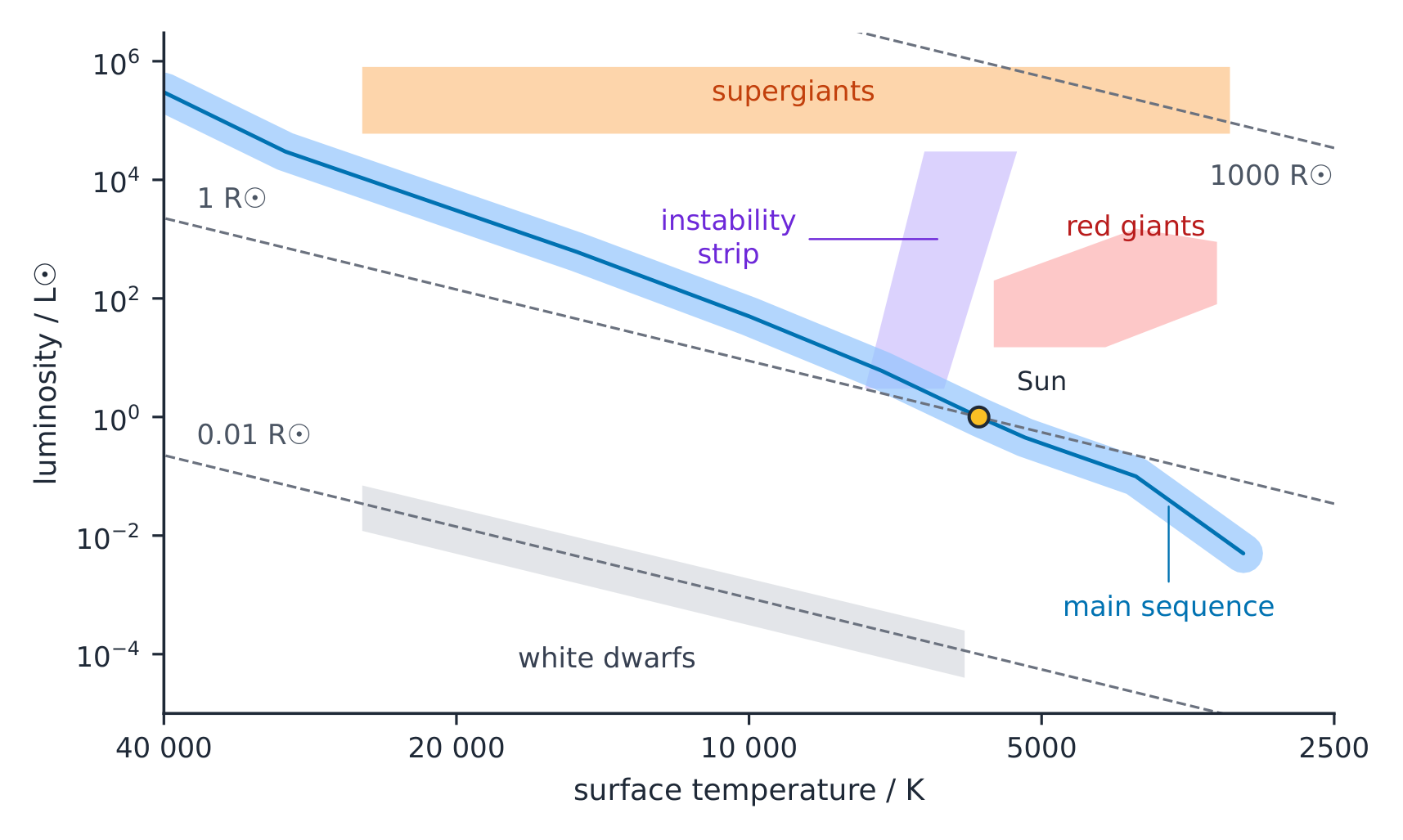
A Hertzsprung–Russell diagram 赫罗图 (HR diagram) plots the luminosity of stars against their surface temperature.
Luminosity is on the vertical axis, often as a multiple of the Sun's luminosity, on a logarithmic scale.
Temperature is on the horizontal axis, also logarithmic, and it decreases to the right.
Stars fall into a few clear groups on the HR diagram
Region
Where
Properties
main sequence 主序
a band from top left to bottom right
stars fusing hydrogen in their core; more massive ones are hotter and more luminous
red giants 红巨星
above the main sequence, on the right
cool (3000–5000 K) but luminous, so very large
supergiants 超巨星
across the top
the most luminous stars, up to a million times the Sun's luminosity; red supergiants are up to about 1000 times the Sun's radius
white dwarfs 白矮星
below the main sequence, on the left
hot but dim, so very small, about the size of the Earth
instability strip 不稳定带
a narrow band crossing the main sequence upwards
a region containing many pulsating variable stars; being drawn inside a schematic strip does not guarantee every object has the same variability
Lines of constant radius
From $L = 4\pi R^2 \sigma T^4$, stars with the same radius lie on a straight line on the logarithmic axes. Radius increases towards the top right: a cool star can only be very luminous if it is very large. This is how we know that red giants are giant and that white dwarfs are small, without seeing their size.
so the radius comes from the luminosity (from brightness and distance) and the temperature (from the spectrum). Most stars are unresolved by ordinary images, but suitable interferometry can measure angular diameters of some stars; ESO describes this technique. Combining angular size with distance provides another radius estimate.
Red-supergiant example: $L = 1.2 \times 10^5\,L_\odot$, $T = 3500$ K. $R = \sqrt{1.2 \times 10^5} \times (5800/3500)^2\,R_\odot = 346 \times 2.75\,R_\odot = 950\,R_\odot$, a red supergiant larger than the orbit of Mars.
Hot-white-dwarf example: $L = 0.026\,L_\odot$, $T = 25\,000$ K. $R = \sqrt{0.026} \times (5800/25\,000)^2\,R_\odot = 0.0087\,R_\odot = 6 \times 10^6$ m, a white dwarf about the size of the Earth.
19.9
质量如何决定恒星的一生
English
Birth and the main sequence
A cloud of gas and dust, a nebula 星云, collapses under gravity. It heats up and becomes a protostar 原恒星.
When the core reaches about $10^7$ K, hydrogen fusion starts and the star joins the main sequence, in equilibrium.
Hydrogen-core burning is usually the longest luminous nuclear-burning stage; the fraction and duration depend on mass and composition. Where it sits depends on its mass: more massive stars are hotter and more luminous.
The Pillars of Creation: dense columns of gas and dust where new stars are forming; each star's mass will decide its life
More massive stars have more fuel, but they use it much faster. A star of 10 solar masses is thousands of times as luminous as the Sun, so it lives only tens of millions of years, not ten billion.
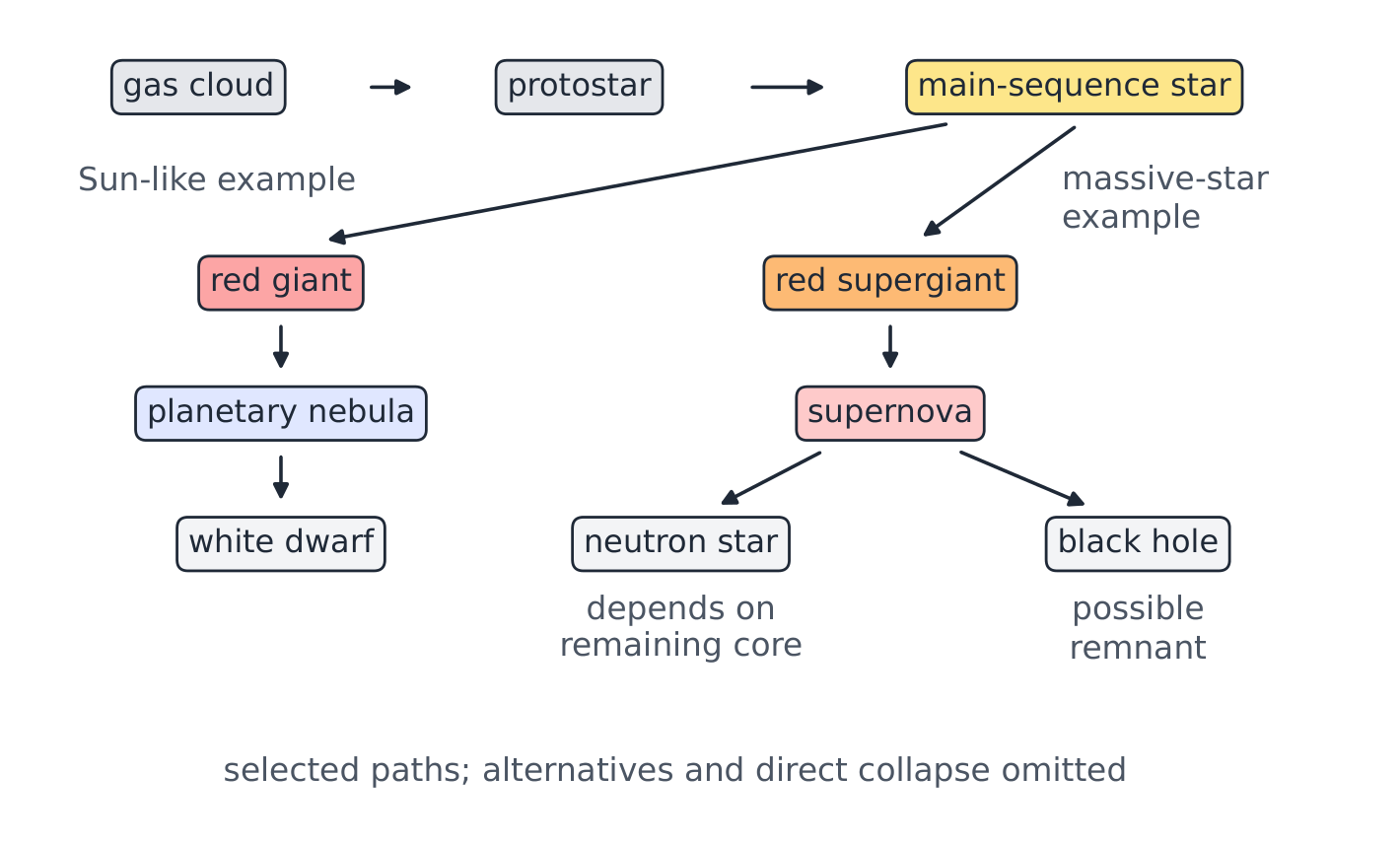
Initial mass strongly affects evolution; these selected paths omit binary effects and alternatives such as direct collapse
A Sun-like single-star path
When the hydrogen in the core runs out, fusion there stops. The core contracts and heats up; hydrogen fuses in a shell around it, and the outer layers expand and cool. The star becomes a red giant: it moves up and to the right on the HR diagram.
The core becomes hot enough (about $10^8$ K) for helium to fuse into carbon and oxygen.
When this fuel runs out, the outer layers drift away as a glowing shell of gas, a planetary nebula 行星状星云.
The hot core is left as a white dwarf: no sustained core fusion, made mostly of carbon and oxygen, about the size of the Earth. It is held up by the pressure of electrons packed closely together, which is possible only if its mass is less than about 1.4 solar masses. It cools slowly and generally moves down and to the right on the HR diagram. The approximate 1.4 solar-mass limit concerns the electron-degenerate remnant, not the initial star. Very low-mass stars can have different, much slower paths and may never ignite core helium.
Massive stars (more than about 8 solar masses)
A massive star can pass through a red supergiant phase; not every massive star follows the same red path.
Its core is so hot that fusion continues to heavier and heavier elements: carbon, neon, oxygen, silicon and finally iron, in layers like an onion.
The iron-group region is tightly bound, so continued fusion to substantially heavier products does not provide the same exothermic support. An iron-group core can temporarily be supported without further core burning; continued evolution can destabilise that support and cause rapid collapse.
The outer layers are blown off in a huge explosion, a supernova 超新星, which can for a while be as luminous as a whole galaxy.
A remaining compact core can become a neutron star 中子星 or a black hole 黑洞. Neutron stars have masses of order a few solar masses or less and sizes of order tens of kilometres. A black-hole event horizon prevents outward light signals escaping.
Initial mass and final core mass are different. Approximate classroom mass boundaries are not exact universal thresholds: mass loss, composition, rotation, binary interaction and the high-density equation of state affect outcomes. Some massive stars can collapse to black holes without a bright visible supernova.
Onion layers in a late massive star: heavier elements fuse deeper inside, around an iron-group core (not to scale).
How elements are made
The early universe made hydrogen, much of the helium and some lithium. Stellar burning produces many heavier nuclei, including carbon and oxygen and iron-group material; the origin of every element is not the same single fusion sequence.
Slow neutron capture in evolved stars can build nuclei heavier than iron, as illustrated by ESO's lead-star observations. Rapid neutron capture in extreme neutron-rich events, including neutron-star mergers, makes other heavy nuclei. The relative contributions of different sites are a research question; not all heavy nuclei must come from one type of explosion.
Explosions and stellar winds disperse enriched material, from which later stars and planets form. This explains why a later-generation system can contain material made by several earlier processes.
State the two effects that are balanced in a main-sequence star, and explain what happens if the rate of fusion in the core increases.
In the last step of the proton–proton chain, two helium-3 nuclei (3.016029 u each) fuse to form helium-4 (4.002603 u) and two hydrogen-1 atoms (1.007825 u each). Find the energy released in MeV.
For the D–T fusion reaction, use ${}^{2}_{1}\text{H} + {}^{3}_{1}\text{H} \rightarrow {}^{4}_{2}\text{He} + {}^{1}_{0}\text{n}$. The masses are hydrogen-2 2.014102 u, hydrogen-3 3.016049 u, helium-4 4.002603 u and neutron 1.008665 u. Find the energy released.
Using photon luminosity alone, calculate the Sun's radiated mass-equivalent rate. Explain why this is not its hydrogen consumption rate or its complete mass-loss budget.
(a) Explain why fusion in a star needs both a very high temperature and a very high density. (b) Estimate the temperature at which the average kinetic energy of protons would let them reach a separation of $1.0 \times 10^{-15}$ m. Explain why fusion in the Sun happens at a much lower temperature.
Convert 4.2 ly into parsecs and into metres.
(a) A star has a parallax angle of $0.050''$. Find its distance in parsecs, light years and metres. (b) Explain why stellar parallax can be used only for relatively nearby stars.
The spectrum of a star peaks at 350 nm. Find its surface temperature, and state one other property of the star that its spectrum can show.
A star of luminosity $3.0 \times 10^{28}$ W is 50 pc from the Earth. Find its apparent brightness.
The star in question 9 has a surface temperature of 4000 K. Find its radius in metres and as a multiple of the Sun's radius, and suggest which region of the HR diagram it is in.
Star A has the same luminosity as star B but twice its surface temperature. Find the ratio of their radii, $R_A/R_B$.
State the region of the HR diagram for each star: (a) $T = 20\,000$ K, $L = 0.01\,L_\odot$; (b) $T = 3500$ K, $L = 10^5\,L_\odot$; (c) $T = 6000$ K, $L = 1\,L_\odot$.
Describe what happens to a star like the Sun after it leaves the main sequence, including its path on the HR diagram.
Explain why fusion in a massive star stops at iron, and state where elements heavier than iron are made. State the possible remnants of a star of 20 solar masses.
Answers.
The outward pressure-gradient force balances inward gravity. In the stable main-sequence feedback picture, a higher energy-generation rate can cause expansion and cooling, reducing fusion; hydrostatic equilibrium does not imply that every gas particle is stationary.
Before: $2 \times 3.016029 = 6.032058$ u. After: $4.002603 + 2 \times 1.007825 = 6.018253$ u. $\Delta m = 0.013805$ u, $E = 12.9$ MeV.
Before: $5.030151$ u. After: $5.011268$ u. $\Delta m = 0.018883$ u, $E = 17.6$ MeV $= 2.8 \times 10^{-12}$ J.
$\dot m_\gamma=L_\odot/c^2=(3.83\times10^{26})/(3.00\times10^8)^2=4.26\times10^9\ \text{kg s}^{-1}$. Photon energy escaping reduces solar mass-energy by that equivalent amount. Most consumed hydrogen mass remains as helium; neutrino energy and solar-wind mass loss are separate from the given photon-luminosity budget.
(a) High temperature gives a distribution of collision energies; tunnelling allows barrier penetration even when typical kinetic energy lies below the classical barrier. High stellar density and long gravitational confinement sustain enough encounters. The proton–proton weak-interaction step also limits its rate; temperature alone is not a universal ignition rule. (b) $E = ke^2/r = [8.99 \times 10^9 \times (1.60 \times 10^{-19})^2]/(1.0 \times 10^{-15}) = 2.3 \times 10^{-13}$ J; $T = 2E/(3k_\text{B}) = 1.1 \times 10^{10}$ K. In the Sun a small fraction of protons move much faster than average, and quantum tunnelling lets some pass through the barrier.
(a) $d = 1/0.050 = 20$ pc $= 65$ ly $= 6.2 \times 10^{17}$ m. (b) The angular amplitude decreases as distance grows. For a fixed absolute angular uncertainty, relative distance uncertainty grows roughly as Δp/p. The useful range depends on the instrument and observations, not one universal ground-based cutoff.
$T = (2.9 \times 10^{-3})/(350 \times 10^{-9}) = 8300$ K. Its absorption lines show which elements are in its outer layers.
$d = 50 \times 3.09 \times 10^{16} = 1.545 \times 10^{18}$ m, retained for the next step; $b = L/(4\pi d^2) = 3.0 \times 10^{28}/(4\pi \times (1.545 \times 10^{18})^2) \approx 1.0 \times 10^{-9}$ W m⁻².
$R = \sqrt{3.0 \times 10^{28}/(4\pi \times 5.67 \times 10^{-8} \times 4000^4)} = 1.3 \times 10^{10}$ m $= 18\,R_\odot$. Cool and large: a red giant.
$R \propto \sqrt{L}/T^2$, so $R_A/R_B = 1/2^2 = 1/4$.
(a) white dwarf; (b) red supergiant (or the supergiant region); (c) main sequence.
The core runs out of hydrogen and contracts and heats; hydrogen fuses in a shell, and the star expands and cools into a red giant (moving up and right on the HR diagram). Helium fuses to carbon and oxygen. The outer layers are lost as a planetary nebula, and the core becomes a white dwarf (moving to the lower left), which slowly cools.
Iron-group material is near the broad binding-energy maximum, so continued fusion to substantially heavier products does not supply the earlier exothermic support. Heavier nuclei can form through slow neutron capture in evolved stars and rapid capture in extreme neutron-rich events such as neutron-star mergers. A 20-solar-mass initial star can leave a neutron star or black hole; the actual outcome depends on the remaining core and evolution, not an exact initial-mass-only threshold.
19.11
考试技巧
English
Use parallax semi-amplitude $p$ in arc-seconds for $d=1/p$ in parsecs; convert distance units afterwards.
Square $d$ in $b=L/(4\pi d^2)$ and use $T^4$ in $L=4\pi R^2\sigma T^4$.