This handout teaches A.1 Kinematics in full, for the course first assessed in 2025. There is no additional higher level content in A.1, so SL and HL students study the same material.
Prerequisites: rearranging equations, gradients of straight lines, areas of rectangles and triangles, and sine and cosine in a right-angled triangle. You will use $g = 9.8\ \text{m s}^{-2}$ near the Earth's surface.
1.2
描述运动
English
Where is it, and where is it going?
A delivery drone leaves a roof, flies 300 m east, then 300 m back west to land on the same roof. Its trip meter shows 600 m, but it ends exactly where it started. Physics needs two different quantities for these two answers. Kinematics 运动学 describes motion with numbers — position, velocity and acceleration — without asking what causes it. Causes (forces) come in A.2.
Distance and displacement
Distance 路程 is the total length of the path travelled. It is a scalar 标量: it has size only.
Displacement 位移 is the change in position: how far, and in which direction, from start to finish. It is a vector 矢量: it has size and direction.
For the drone, distance = 600 m and displacement = 0. In one dimension, choose a positive direction (for example "east is +") and write the direction as a sign: 300 m west is $-300\ \text{m}$.
Distance adds the path lengths; displacement adds them with their signs
Speed, velocity and acceleration
Speed 速率 is the magnitude of instantaneous velocity (a scalar). Average speed over an interval is total distance divided by elapsed time.
Velocity 速度 is the rate of change of displacement (a vector).
Acceleration 加速度 is the rate of change of velocity, in $\text{m s}^{-2}$. Over a finite interval, $\bar a = \dfrac{\Delta v}{\Delta t}$ is the average acceleration. Instantaneous acceleration is the tangent gradient on a velocity–time graph; the two agree throughout an interval of constant acceleration.
An object accelerates whenever its velocity changes: when it speeds up, slows down or changes direction. A car going round a bend at a steady 15 m s⁻¹ is accelerating.
Average and instantaneous values
An average 平均 value uses a whole interval: average velocity = total displacement ÷ total time.
An instantaneous 瞬时 value is the value at one moment: the average over an interval so short that the value has no time to change.
A speedometer shows instantaneous speed. A 120 km journey that takes 2 hours has an average speed of 60 km/h, even if the car stopped at traffic lights and reached 100 km/h on the motorway. For the drone, the average speed is $600 \div 120 = 5\ \text{m s}^{-1}$ if the trip took 120 s, but the average velocity is zero.
A speedometer shows speed: the distance travelled per unit time.
In the lab: measure instantaneous speed with a light gate: a card of known length $L$ cuts the beam for a time $\Delta t$, so $v \approx L / \Delta t$. A shorter card reduces the averaging interval, but card-length uncertainty and timer resolution still limit the estimate; an arbitrarily short card does not guarantee a better measurement. Video analysis with a known scale and frame interval also works. Avoid hand timing over short intervals: human reaction time (about 0.2 s) is then a large fraction of the measurement.
A light gate times how long the card blocks the beam: $v \approx L/\Delta t$
Displacement = area of the trapezium $= \dfrac{(2 + 10)}{2} \times 4 = 24\ \text{m}$.
Curved graphs: use a tangent
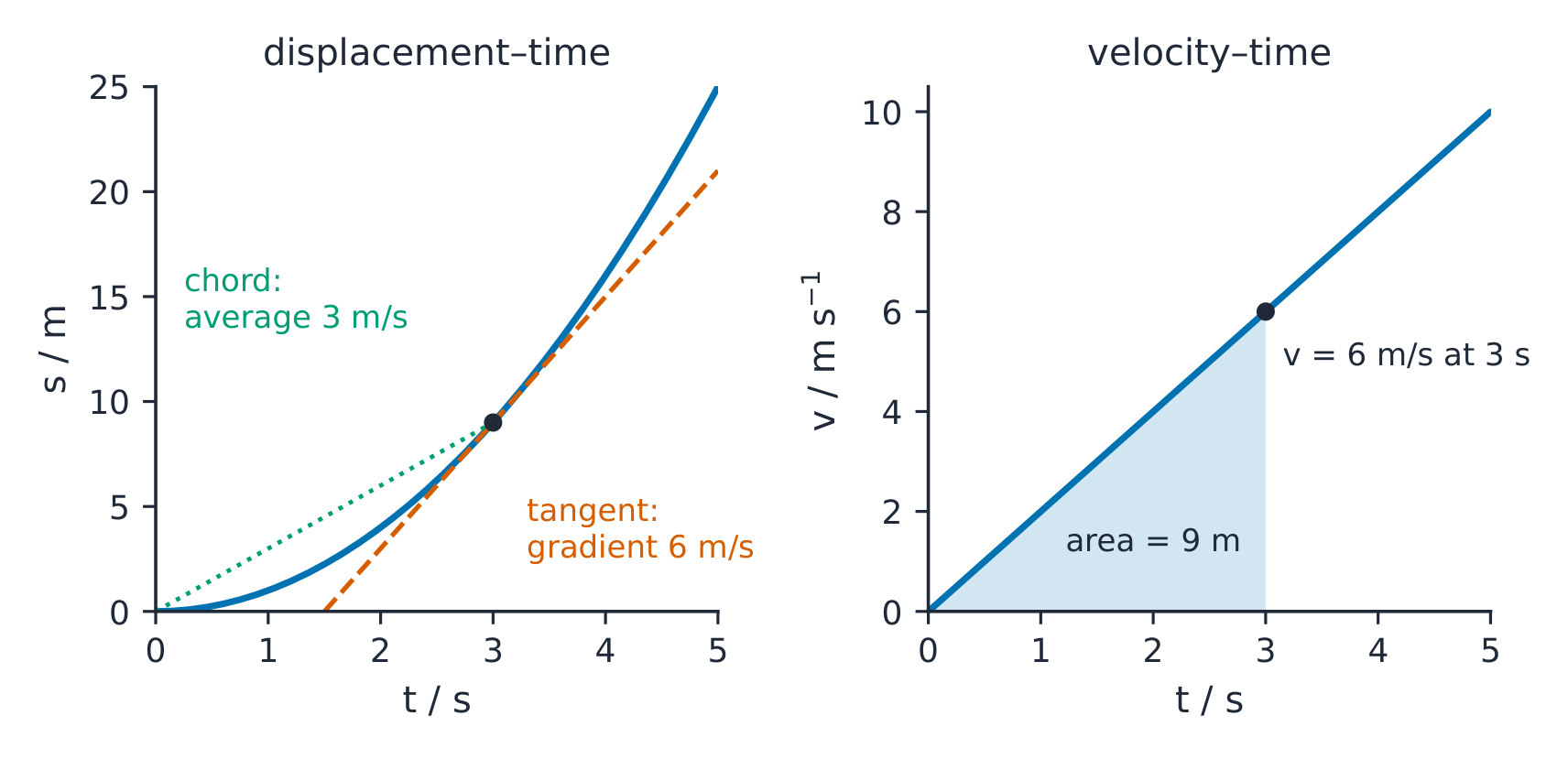
When the gradient changes, the velocity (or acceleration) is changing. The instantaneous value at a point is the gradient of the tangent 切线 drawn at that point.
The tangent's gradient at 3 s (6 m/s) is the velocity there; the shaded v–t area (9 m) is the displacement after 3 s
Worked example: a trolley's displacement is $s = t^2$ (s in m, t in s).
At $t = 3\ \text{s}$, the tangent passes through (1.5 s, 0 m) and (5 s, 21 m). Gradient $= \dfrac{21 - 0}{5 - 1.5} = 6.0\ \text{m s}^{-1}$: the instantaneous velocity.
Over the first 3 s, the average velocity is $\dfrac{9 - 0}{3} = 3.0\ \text{m s}^{-1}$: the gradient of the chord from (0, 0) to (3, 9), not the tangent.
On a $v$–$t$ graph, area below the time axis is displacement in the negative direction. Add areas with their signs for displacement; add their sizes for distance.
Reading the shape of a graph
$s$–$t$: a straight line means constant velocity; a curve getting steeper means speeding up; a flat line means at rest.
$v$–$t$: a straight line means uniform acceleration 匀加速; a flat line means constant velocity; a line crossing the time axis means the object reverses.
$a$–$t$: the area between $t_1$ and $t_2$ is the change in velocity, even when the acceleration varies.
A separate motion: constant positive acceleration followed by constant negative acceleration
An object moving only under gravity is in free fall 自由落体: its acceleration is $g = 9.8\ \text{m s}^{-2}$ downwards, whether it is rising, at the top, or falling. At the top of a purely vertical throw the velocity is zero, but the acceleration is still $9.8\ \text{m s}^{-2}$ down.
Measuring $g$: the electromagnet releases the ball and starts the timer; the trapdoor stops it. Then $h = \tfrac{1}{2}gt^2$
Worked example: a ball is thrown straight up at 12 m s⁻¹. Take up as positive, so $a = -9.8\ \text{m s}^{-2}$.
Maximum height ($v = 0$): $0 = 144 - 19.6s$, so $s = 7.3\ \text{m}$.
Time to the top: $0 = 12 - 9.8t$, so $t = 1.2\ \text{s}$. By symmetry it returns to the same level after 2.4 s, moving at 12 m s⁻¹ downwards.
A negative velocity does not always mean slowing down. The object slows down only when acceleration and velocity have opposite signs. Falling back down, the ball has negative velocity and negative acceleration: it speeds up.
A bouncing ball: every sloping line has gradient $g$; the velocity flips sign and shrinks at each bounce
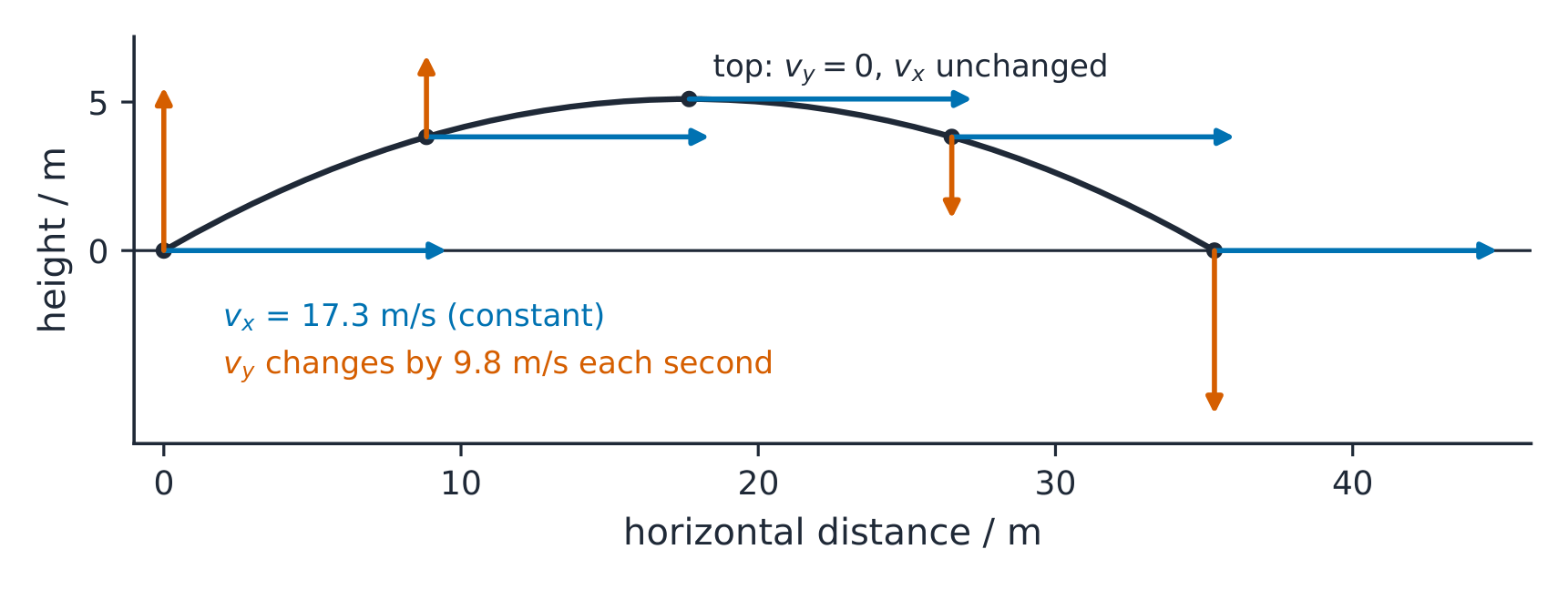
A projectile 抛体 is an object that moves through the air after launch, acted on only by gravity (when fluid resistance can be neglected). Split its velocity into horizontal and vertical components 分量:
Horizontal: no force, so no acceleration. $u_x$ stays constant: $x = u_x t$.
Vertical: acceleration $g$ downwards, so use the equations of motion with $u_y$ and $a = -9.8\ \text{m s}^{-2}$ (up positive).
Time$t$ is the same for both, and links them.
For a launch at speed $u$ and angle $\theta$ above the horizontal: $u_x = u\cos\theta$ and $u_y = u\sin\theta$. Without fluid resistance the trajectory 轨迹 is a parabola.
The horizontal component never changes; the vertical component changes by 9.8 m/s every secondVelocity–time sketches for a projectile: the horizontal component stays constant; the vertical component falls in a straight line through zero at the top
Launched horizontally
A ball rolls off a 1.25 m high table at 3.0 m s⁻¹.
When only the landing speed is asked for, energy conservation (A.3) is quicker: $\frac{1}{2}mv^2 = \frac{1}{2}mu^2 + mgh$, so $v = \sqrt{u^2 + 2gh}$. For the cliff stone, $v = \sqrt{15^2 + 2(9.8)(30)} = 29\ \text{m s}^{-1}$, whatever the launch angle.
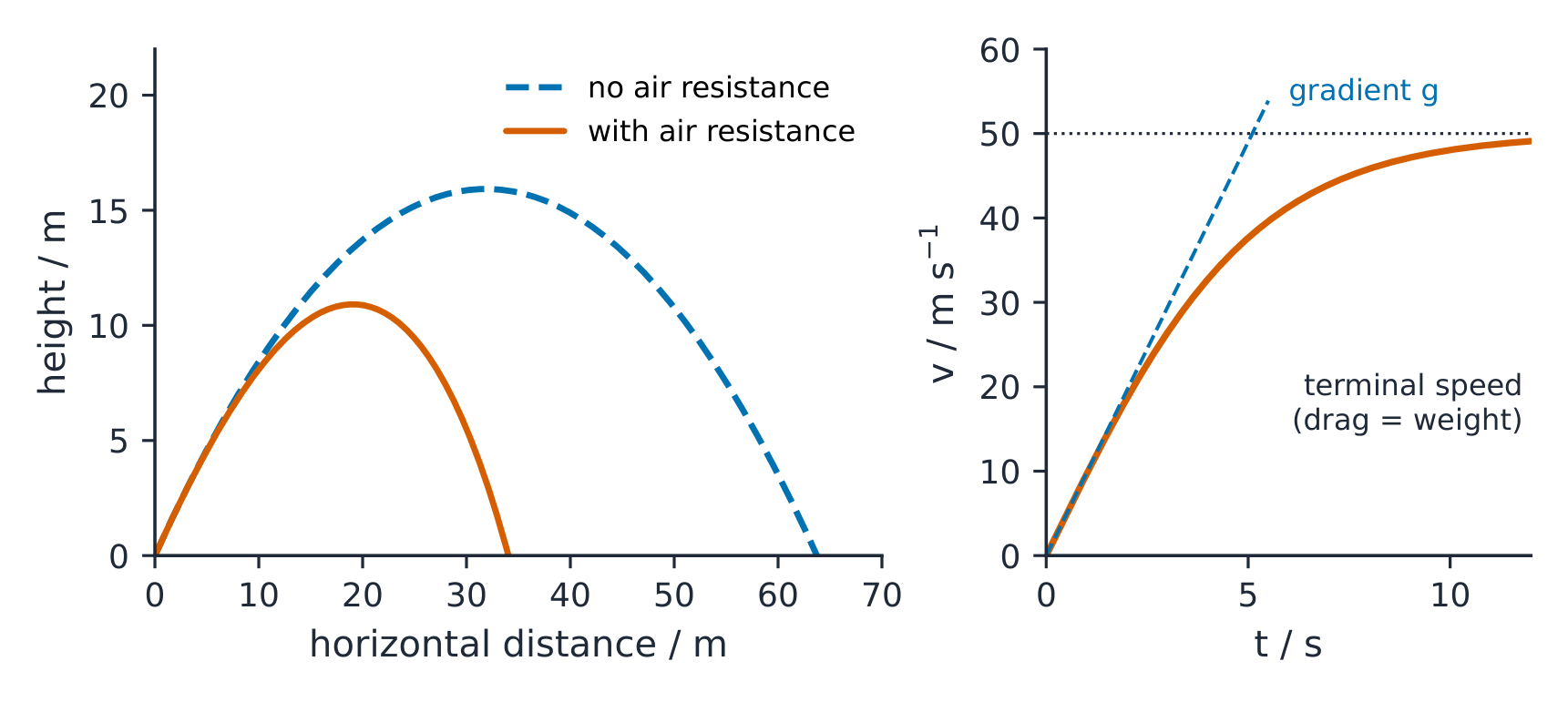
Fluid resistance 流体阻力 (drag 阻力) is the force from a gas or liquid that opposes motion through it. It grows as speed increases. Compared with the same launch in a vacuum, a projectile with fluid resistance has:
a shorter range and a lower maximum height;
a non-parabolic, asymmetric trajectory: the way down is steeper than the way up;
a horizontal velocity that decreases throughout the flight;
a shorter time to reach the top, and a lower landing speed;
an acceleration that is not constant and not just $g$: during ascent its vertical component is more downward than $g$; during descent the upward drag component opposes weight. The total acceleration magnitude also depends on horizontal drag, so it need not be smaller than $g$ throughout descent.
Drag shortens and skews the trajectory; a falling object's speed levels off at terminal speed
Terminal speed
A skydiver steps out of a plane.
At first the speed is low, drag is small, and the acceleration is close to $g$.
As speed rises, drag rises, so the resultant force and the acceleration both decrease. The $v$–$t$ graph gets less steep.
When drag equals weight, the resultant force is zero: the skydiver falls at a constant terminal speed 终端速度 (about 55 m s⁻¹ in a spread position).
Opening the parachute suddenly increases drag above the weight, so the skydiver decelerates until drag again equals weight at a much lower terminal speed (about 5 m s⁻¹).
A larger area facing the flow, or a less streamlined shape, means a lower terminal speed. A heavier object of the same shape needs more drag to balance its weight, so its terminal speed is higher.
Why the spread-eagle pose? Spreading out gives the largest area, so the most drag. The bigger the drag, the sooner drag balances weight — and the lower the steady terminal velocity they fall at
A runner completes one lap of a 400 m track in 80 s. Find the distance, the displacement, the average speed and the average velocity.
A cyclist's velocity rises from 3.0 m s⁻¹ to 15 m s⁻¹ in 6.0 s. Find the acceleration.
A train starts from rest and accelerates at 0.50 m s⁻² for 40 s. Find its final velocity and the distance travelled.
A velocity–time graph rises uniformly from 0 to 8.0 m s⁻¹ in 4.0 s, stays at 8.0 m s⁻¹ for 6.0 s, then falls uniformly to 0 in 2.0 s. Find the total displacement and the average speed.
A driver at 30 m s⁻¹ sees a hazard. The reaction time is 0.70 s, then the car decelerates uniformly at 6.0 m s⁻². Find the total stopping distance.
A ball is thrown vertically up at 15 m s⁻¹. Find the maximum height and the time until it returns to the thrower's hand.
A dart is thrown horizontally at 12 m s⁻¹ towards a board 3.0 m away. How far does it drop before it hits the board?
A football is kicked from flat ground at 25 m s⁻¹, 40° above the horizontal. Neglect air resistance. Find the time of flight, the range and the maximum height.
A ball is thrown at 8.0 m s⁻¹, 30° below the horizontal, from a window 12 m above the ground. Find how far from the wall it lands.
Describe and explain how air resistance changes the range, the maximum height and the shape of the trajectory of the football in question 8.
Sketch and explain the velocity–time graph of a skydiver from leaving the plane until landing with an open parachute.
Answers.
Distance 400 m; displacement 0; average speed $400 / 80 = 5.0\ \text{m s}^{-1}$; average velocity 0.
Drag opposes the velocity throughout, so the horizontal component falls and the range is shorter. On the way up drag adds to weight, so the ball stops rising sooner: lower maximum height. The path is no longer a parabola: the descent is steeper than the ascent because the horizontal speed is smaller by then.
Gradient starts at about 9.8 m s⁻² and decreases as drag grows, levelling at the first terminal speed (drag = weight). When the parachute opens, velocity drops steeply (drag > weight, so the resultant force is upward) and levels at a much lower terminal speed. Landing: velocity falls quickly to zero.
1.8
考试技巧
English
State your positive direction before you substitute; keep every sign consistent with it.
"Gradient of a tangent" gives an instantaneous value; "gradient of a chord" gives an average value.
List $s, u, v, a, t$, mark the three you know, and choose the equation that leaves out the one you do not need.
Use the equations of motion only for constant acceleration; say so if a question asks you to justify them.
In projectile questions, never put a horizontal velocity into a vertical equation. Time is the only quantity the two directions share.
At the top of a vertical throw, $v = 0$ but $a = g$. At the top of a projectile path, only $v_y = 0$.
Air-resistance answers are qualitative: compare with the no-drag path (range, height, symmetry, time) and explain each change with the direction of the drag force.