This handout teaches B.2 Greenhouse effect in full, for the course first assessed in 2025. There is no additional higher level content in B.2, so SL and HL students study the same material.
Prerequisites: the Stefan–Boltzmann law, Wien's law and luminosity from B.1; the electromagnetic spectrum; resonance as a driven oscillation at the natural frequency. Use $\sigma = 5.67 \times 10^{-8}\ \text{W m}^{-2}\ \text{K}^{-4}$ and $S = 1360\ \text{W m}^{-2}$ for the Earth.
5.2
能量平衡与太阳常数
English
Why does an atmosphere change the energy balance?
A planet's orbital distance alone does not determine its surface temperature: reflection, heat redistribution and atmospheric radiation also matter. This unit first builds an ideal uniform-temperature radiative model, then adds a layer that absorbs and emits infrared. The numerical layer diagram is a calculation, not a complete measured Earth energy budget.
Conservation of energy for a planet
A planet gains energy as radiation from its star and loses energy as radiation to space. When the two powers are equal the planet is in radiative equilibrium 辐射平衡 and its temperature stays constant:
$$\text{power absorbed} = \text{power radiated}$$
If the planet absorbs more than it radiates, its temperature rises. A warmer planet radiates more ($\propto T^4$), so it settles at a new, higher equilibrium temperature.
The solar constant
The solar constant 太阳常数$S$ is the intensity of the Sun's radiation at the Earth's distance, measured above the atmosphere on a surface perpendicular to the rays: $S \approx 1360\ \text{W m}^{-2}$. It is the apparent brightness of the Sun from B.1, $S = L_\odot / 4\pi d^2$. At Mars, 1.52 times further from the Sun, it is $1360 / 1.52^2 = 590\ \text{W m}^{-2}$.
Why the mean intensity is S/4
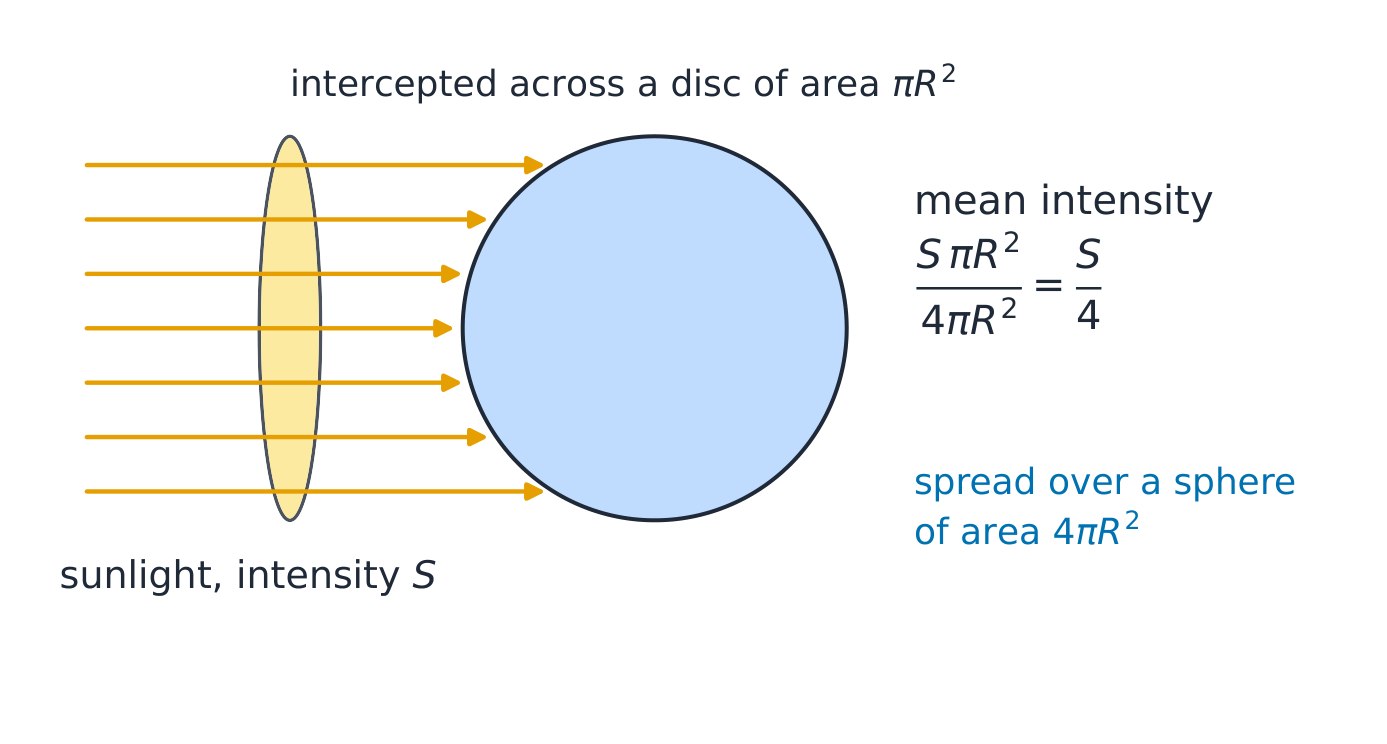
The Earth intercepts sunlight across a disc of area $\pi R^2$ but has full surface area $4\pi R^2$. The whole-sphere mean incoming intensity is $S\pi R^2/(4\pi R^2)=S/4$, about 340 W m⁻² here, irrespective of rotation. This geometric mean does not imply uniform local temperatures.
The Earth intercepts sunlight across a disc but radiates from its whole surface
The albedo 反照率$\alpha$ of a body is the fraction of the incident power it scatters or reflects:
Melt ponds on Arctic sea ice: dark water absorbs far more sunlight than bright ice, so a lower albedo speeds further meltingAlbedo is the fraction reflected; the fraction absorbed is 1 − α
Fresh snow has an albedo of about 0.85, ocean about 0.06 and the Earth as a whole about 0.30. The fraction absorbed is $1 - \alpha$. The Earth's albedo varies from day to day and with latitude: it is higher where there is cloud cover, ice or snow, and where sunlight strikes at a low angle near the poles.
Emissivity
Real surfaces radiate less than a black body at the same temperature. The emissivity 发射率$e$ is
$$e = \frac{\text{power radiated per unit area}}{\sigma T^4}$$
so a body of emissivity $e$ radiates $P = e\sigma AT^4$. A black body has $e = 1$; every real surface has $e < 1$. A surface at 300 K radiating 410 W m⁻² has $e = 410 / (5.67 \times 10^{-8} \times 300^4) = 0.89$.
Do not confuse the two: albedo is about reflecting incoming radiation (mostly visible), emissivity about emitting radiation (mostly infrared).
$T = \left(\dfrac{238}{5.67 \times 10^{-8}}\right)^{1/4} = 255\ \text{K}$, about −18 °C.
A conventional representative surface value of 288 K is about 33 K above this 255 K effective-temperature comparison, illustrating the greenhouse effect 温室效应. This keeps albedo fixed and is not a claim that removing the atmosphere would leave every other property unchanged.
Body
$S$ / W m⁻²
Albedo
Predicted $T$ / K
Measured mean surface $T$ / K
Earth
1360
0.30
255
288
Mars
590
0.25
210
about 210
Venus
2600
0.75
231
737
Mars, with a very thin atmosphere, matches the prediction. Venus, with a thick carbon dioxide atmosphere, is 500 K hotter than predicted, even though it reflects most sunlight.
Using an effective emissivity
One way to include the atmosphere is to treat the Earth as a body with an effective emissivity below 1: the atmosphere stops some of the surface's radiation from reaching space. For a 288 K surface to radiate only 238 W m⁻² to space:
A better model treats the surface and the atmosphere as two bodies that exchange energy. All values are mean intensities in W m⁻².
Every layer is in balance: each arrow into a layer is matched by arrows out of it
Sunlight: 340 arrives, 102 is reflected ($\alpha = 0.30$), 238 is absorbed by the surface.
The surface at 288 K emits $\sigma T^4 = 390$. The atmosphere absorbs 78% of it, 304; 86 escapes through to space.
The atmosphere radiates the 304 it absorbs equally in all directions: 152 up to space and 152 back down to the surface.
Check each part:
Part
In
Out
surface
$238 + 152 = 390$
390
atmosphere
304
$152 + 152 = 304$
top of atmosphere
340
$102 + 86 + 152 = 340$
The surface receives energy from the Sun and from the atmosphere, so it must be warmer than 255 K to radiate it all away. That back-radiation is the greenhouse effect.
What changes when the atmosphere absorbs more
If more greenhouse gas makes the atmosphere absorb 80% of the surface's radiation, it absorbs 312 and sends 156 back down. The surface then receives $238 + 156 = 394 > 390$: it gains energy and warms until it radiates enough to restore the balance, at about 289 K in this model.
5.6
温室气体
English
A greenhouse gas 温室气体 absorbs infrared radiation. The main ones are water vapour, carbon dioxide, methane and nitrous oxide. Each has both natural and human sources.
Gas
Natural sources
Human sources
water vapour H₂O
evaporation from oceans, lakes and plants
irrigation; more evaporation in a warmer climate
carbon dioxide CO₂
respiration, volcanoes, forest fires
burning fossil fuels, deforestation, cement
methane CH₄
wetlands, termites
rice paddies, cattle, landfill, gas leaks
nitrous oxide N₂O
bacteria in soil and oceans
nitrogen fertilizers, industry
Nitrogen and oxygen, 99% of dry air, are not greenhouse gases: they barely absorb infrared radiation.
Carbon dioxide measured at Mauna Loa, Hawaii (rounded annual means)
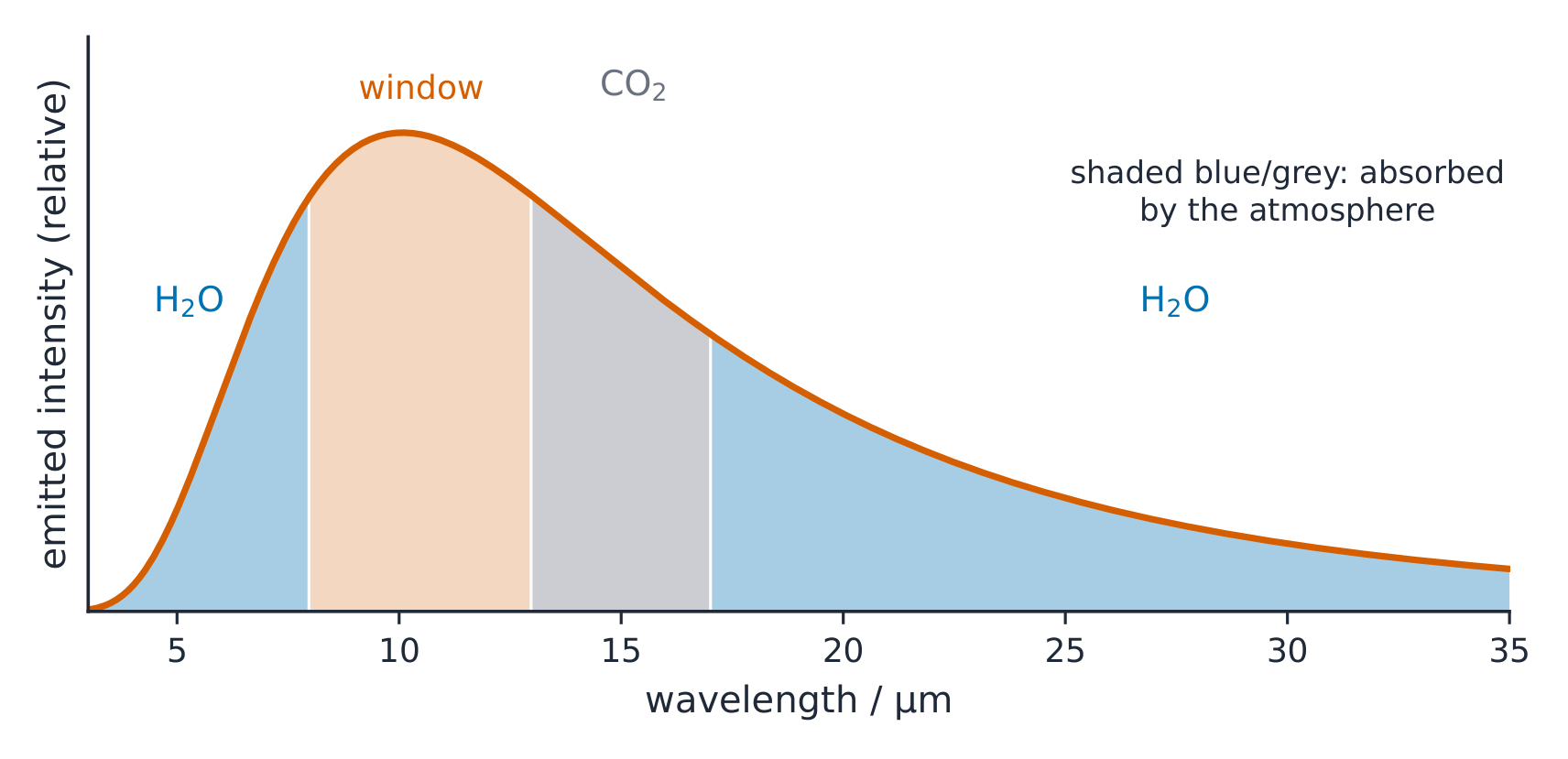
The Sun (5800 K) peaks in the visible at 500 nm, and the atmosphere is largely transparent to this radiation. The Earth's surface (288 K) peaks in the infrared at about 10 μm, and greenhouse gases absorb strongly in parts of this range. Energy gets in easily but gets out with difficulty.
Schematic: most of the Earth's infrared falls in bands absorbed by water vapour and carbon dioxide
The molecular energy level model
Molecules have discrete vibrational energy levels. A molecule absorbs an infrared photon 光子 only if the photon's energy $hf$ equals the gap between two levels. The absorbed energy can be redistributed through collisions as well as exchanged radiatively. A warm atmosphere emits infrared both upward and downward; the one-layer model assigns equal powers to those directions. This does not require every absorbed surface photon to be immediately re-emitted at the same energy by the same molecule.
Absorption needs $hf = \Delta E$; re-emission in a random direction sends about half back down
Worked example: carbon dioxide absorbs strongly at 15 μm. The energy gap is $E = hc/\lambda = 6.63 \times 10^{-34} \times 3.00 \times 10^8 / (15 \times 10^{-6}) = 1.3 \times 10^{-20}\ \text{J}$.
The resonance model
A molecule acts like masses (atoms) on springs (bonds). The bending of a CO₂ molecule has a natural frequency 固有频率 of about $2.0 \times 10^{13}\ \text{Hz}$. Infrared radiation of the same frequency, $c/\lambda = 3.00 \times 10^8 / (15 \times 10^{-6}) = 2.0 \times 10^{13}\ \text{Hz}$, drives the vibration at resonance 共振, so the molecule absorbs energy strongly at that frequency and hardly at all at others. Both models predict absorption at the same frequencies: the resonant frequency of the classical model corresponds to the energy gap $E = hf$ of the quantum model.
The bending mode of CO$_2$ resonates with 15 μm infrared
The conventional 255 K versus 288 K comparison illustrates natural greenhouse warming within the stated fixed-albedo model; it does not describe a fully modeled removal of every atmospheric influence. The enhanced greenhouse effect 增强温室效应 is the extra warming caused by human activities that increase the concentration of greenhouse gases. The primary cause is the burning of fossil fuels, which has raised the CO₂ concentration from roughly 280 ppm in the preindustrial comparison to much higher modern levels. The NOAA Annual Greenhouse Gas Index reports a 2025 global remote-marine-boundary-layer annual mean of 425.62 ± 0.05 ppm; this is a dated network average, not every local concentration.
More greenhouse gas absorbs more of the surface's infrared and sends more back down.
Less energy leaves at the top of the atmosphere, so the Earth absorbs more than it radiates.
The surface warms until it radiates enough to restore the balance.
Feedback loops amplify the change. A warmer ocean evaporates more water vapour, itself a greenhouse gas. Melting ice exposes darker land and sea, lowering the albedo so that more sunlight is absorbed.
Melting land and sea ice lowers the albedo of the polar regionsPositive feedback: each loop returns to warm the surface further
Responding to climate change and judging evidence
Mitigation addresses the causes of climate change, for example replacing fossil-fuel electricity with a lower-emission supply. Adaptation reduces harm from its impacts, for example protecting buildings against flooding. A flood barrier can reduce damage without reducing greenhouse gas emissions.
In a town decision, compare replacing diesel buses with electric buses against building a flood barrier. Estimate the buses' lifetime emissions using the electricity supply as well as vehicle use; estimate the barrier's protection using local flood evidence. Compare effectiveness, construction and running costs, and who pays and benefits. For an HL assessment, connect the choice to law (required permits and protection standards), economics (costs and avoided losses) and ethics (whether poorer households receive protection). A cheap proposal alone is not necessarily the best decision.
For a climate-data comparison, state the region, the years and the uncertainty. Compare multi-year averages using the same reference period for temperature changes; do not compare anomalies based on different baselines without converting them. A local hot year alone does not establish a global long-term trend.
Explain why the mean intensity of sunlight over the Earth's surface is $S/4$.
A snowfield receives 400 W m⁻² and reflects 340 W m⁻². Find its albedo and the power per square metre it absorbs.
A surface at 300 K radiates 410 W m⁻². Find its emissivity.
Find the equilibrium temperature of Mars ($S = 590\ \text{W m}^{-2}$, albedo 0.25, emissivity 1).
Melting ice lowers the Earth's albedo from 0.30 to 0.28. Find the new equilibrium temperature with no atmosphere, and explain the direction of the change.
A planet receives $S = 1000\ \text{W m}^{-2}$, has albedo 0.20 and emissivity 0.90. Find its equilibrium temperature.
In the one-layer model, show that the surface energy balance holds for a surface at 288 K.
Name the four main greenhouse gases, and give one natural and one human source of methane.
Explain, using molecular energy levels, how a greenhouse gas warms the surface below it.
Find the energy of a 15 μm infrared photon, and the frequency of the radiation.
Venus has an albedo of 0.75 and a predicted equilibrium temperature of 231 K, yet its surface is at 737 K. Explain.
Outline how burning fossil fuels leads to a rise in the Earth's mean surface temperature.
Answers.
The Earth intercepts sunlight over a disc of area $\pi R^2$, and dividing by the whole surface area $4\pi R^2$ gives the global geometric mean, irrespective of rotation: $S\pi R^2 / 4\pi R^2 = S/4$.
Absorbed $= 0.72 \times 340 = 245\ \text{W m}^{-2}$; $T = \left(\frac{244.8}{5.67 \times 10^{-8}}\right)^{1/4} = 256\ \text{K}$. A lower albedo means more sunlight is absorbed, so the planet must be warmer to radiate it all.
In: 238 from the Sun + 152 from the atmosphere = 390 W m⁻². Out: $\sigma(288)^4 = 390\ \text{W m}^{-2}$. They are equal.
Water vapour, carbon dioxide, methane, nitrous oxide. Methane: wetlands (natural); cattle, rice paddies or landfill (human).
The surface emits infrared. A photon whose energy matches the gap between vibrational levels of the molecule is absorbed. Absorbed energy can be redistributed by collisions, and the warm atmosphere emits infrared upward and downward. Downward radiation contributes to the surface balance; it is not necessary for each absorbed photon to be promptly re-emitted unchanged by the same molecule.
The prediction ignores the atmosphere. Venus's thick CO₂ atmosphere absorbs almost all the infrared from the surface and radiates much of it back down, a very strong greenhouse effect.
Burning fossil fuels releases CO₂. A higher concentration absorbs more of the surface's infrared and re-emits more back to the surface, so less energy leaves the Earth than it absorbs. The surface warms until it radiates enough to restore the balance.
5.10
考试技巧
English
Use $S/4$, not $S$, for the mean intensity over a planet's surface, and multiply by $1 - \alpha$ for the absorbed part.
Albedo is about reflected incoming radiation; emissivity is about emitted radiation. Do not swap them.
In an equilibrium question write power in = power out for each layer, then solve for $T^4$ before taking the fourth root.
In energy-flow diagrams check each layer separately: surface, atmosphere and top of the atmosphere.
When explaining the greenhouse effect, say the surface emits infrared, greenhouse gases absorb in infrared bands and the warm atmosphere emits upward and downward. Collisions can redistribute absorbed energy; check each layer’s balance.
Distinguish the natural greenhouse effect (keeps the Earth habitable) from the enhanced greenhouse effect (human-caused extra warming).