This handout teaches A.3 Work, energy and power in full, for the course first assessed in 2025. There is no additional higher level content in A.3, so SL and HL students study the same material.
Prerequisites: forces, momentum and free-body diagrams from A.2; the equations of motion from A.1; resolving a force into components. Use $g = 9.8\ \text{m s}^{-2}$.
3.2
功与能量传递
English
Where does the energy go?
A roller coaster is pulled slowly up a 20 m hill, then released. It races down, climbs the next hill and slows, and at the end brakes stop it completely. At every moment the energy is somewhere: in the motion, in the height, in the warm brakes and the noise. Energy is never made or destroyed, only moved between stores. This is the principle of conservation of energy 能量守恒: the total energy of an isolated system stays constant.
A coaster train hauled up the lift hill: the work done against gravity is stored as gravitational potential energy
Work is energy transferred by a force
When a force moves its point of application, it does work 功 and transfers energy. For a constant force $F$ that moves a body through a displacement $s$:
$$W = Fs\cos\theta$$
$\theta$ is the angle between the force and the displacement, so only the component of the force along the displacement does work. Work is a scalar measured in joules (1 J = 1 N m).
$\theta = 0$: all of the force does work, $W = Fs$.
$\theta = 90°$: no work. A centripetal force, or the normal force on a body sliding along a level floor, does no work.
$\theta > 90°$: the work is negative; the force takes energy away from the body. Friction on a sliding body does negative work.
Positive work ($W = +Fs$): force along the motion (top). Negative work ($W = -Fs$): force opposite to the motion, e.g. friction (bottom)
Worked example: a suitcase is pulled 20 m along level ground by a 50 N force at 30° above the horizontal. $W = 50 \times 20 \times \cos 30° = 870\ \text{J}$. The vertical component of the pull does no work, because the suitcase does not move vertically.
Only the component of the force along the displacement ($F\cos\theta$) does work
Work from a force–displacement graph
For motion along a fixed axis, plot the force component parallel to that axis against displacement. Work is the signed area under the force–displacement graph: area below the axis contributes negative work. A graph of force magnitude alone can lose the direction information. For a Hookean spring, the magnitude of a slow stretching force rises linearly from zero, so the supplied work is a triangular area.
The energy stored in a spring is the area under its force–compression graph: $\tfrac{1}{2} F_{0} x_{0}$, which equals $\tfrac{1}{2} k x_{0}^{2}$
The work–energy principle
For the constant-mass, non-relativistic translational model here, work done by the resultant force equals the change in kinetic energy. Include every force in this net work; the work of one applied force need not equal the kinetic-energy change:
$$W_{\text{net}} = \Delta E_k$$
A 1200 kg car speeds up from 10 m s⁻¹ to 20 m s⁻¹. $\Delta E_k = \frac{1}{2}(1200)(20^2 - 10^2) = 1.8 \times 10^5\ \text{J}$. If this happens over 100 m, the average resultant force is $1.8 \times 10^5 / 100 = 1800\ \text{N}$, found without any time or acceleration.
Mechanical energy 机械能 is the sum of kinetic, gravitational potential and elastic potential energy.
Store
Equation
Notes
kinetic energy 动能
$E_k = \frac{1}{2}mv^2 = \dfrac{p^2}{2m}$
doubling speed quadruples $E_k$
gravitational potential energy 重力势能
$\Delta E_p = mg\Delta h$
only near the Earth's surface, where $g$ is constant
elastic potential energy 弹性势能
$E_H = \frac{1}{2}k(\Delta x)^2$
linear elastic spring, measured from its unstretched length
The form $E_k = p^2/2m$ links energy to momentum: a 1200 kg car with $p = 18\,000\ \text{kg m s}^{-1}$ has $E_k = 18\,000^2 / 2400 = 1.35 \times 10^5\ \text{J}$.
The change in gravitational potential energy depends only on the height change, not on the path
Elastic energy in a spring
The expression $E_H=\frac{1}{2}k(\Delta x)^2$ assumes a constant spring stiffness in the linear elastic range and zero stored energy at the unstretched length. During slow stretching from zero extension, the applied force does positive work; the spring restoring force does negative work. The magnitude of each is the stored-energy increase. Beyond the linear range, use the actual force–extension area rather than this formula.
A spring with $k = 400\ \text{N m}^{-1}$ is compressed by 0.10 m: $E_H = \frac{1}{2}(400)(0.10^2) = 2.0\ \text{J}$. If it launches a 0.050 kg ball and all this energy becomes kinetic energy, $v = \sqrt{2(2.0)/0.050} = 8.9\ \text{m s}^{-1}$.
Kinetic energy and elastic potential energy exchange through a spring
Choose the mechanical system and include its relevant gravitational and spring potential energies. Mechanical energy stays constant when there is no net work from forces outside those included conservative interactions. No friction is not enough if an engine, a person or another external agent supplies work. With no such transfer, gravity or a spring exchanges energy between the included stores.
$$E_k + E_p + E_H = \text{constant}$$
This method avoids needing a time or acceleration history. It can be especially useful on a curved path, but curvature alone does not invalidate kinematics: the constant-acceleration equations require constant acceleration in the chosen direction.
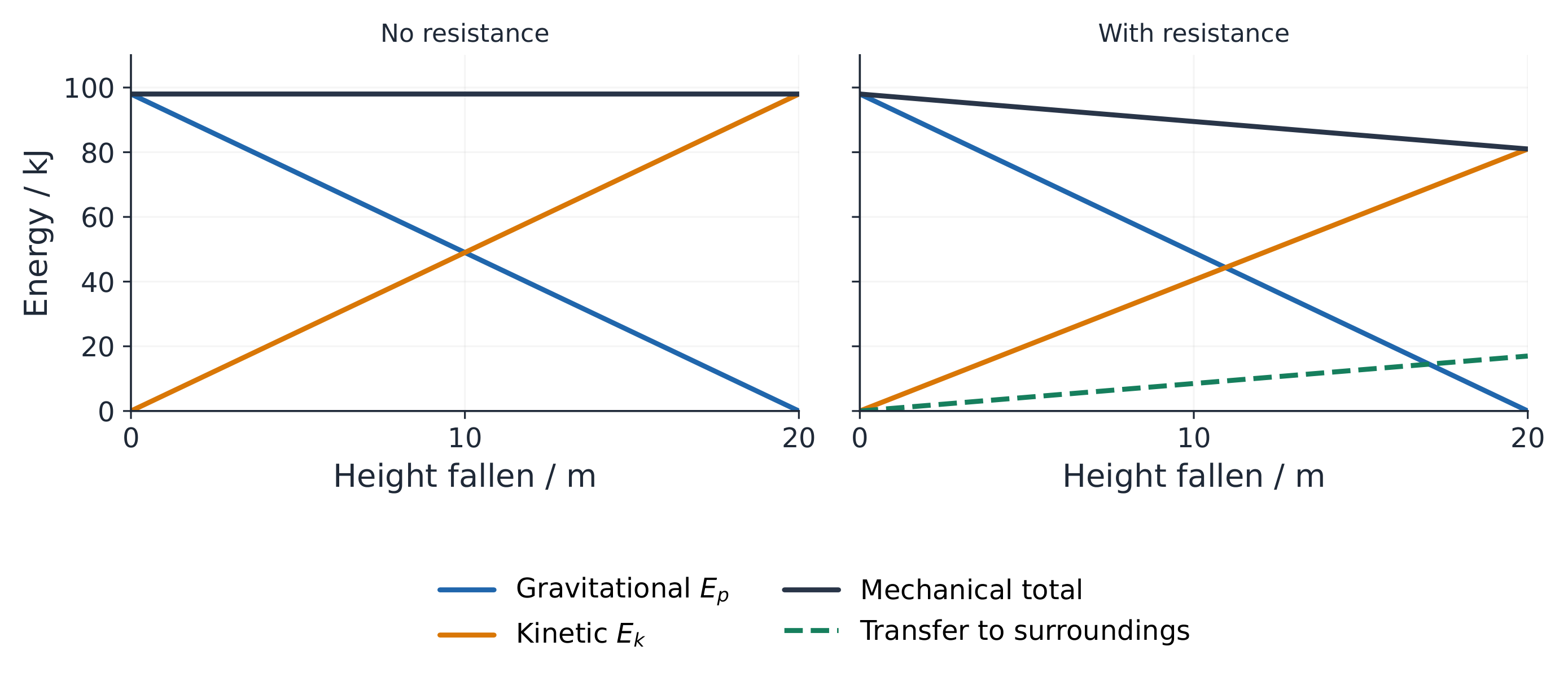
These models use the bottom as zero gravitational potential energy. The resistive case assumes dissipated energy proportional to height fallen; it is not a universal friction law.
Worked example: a roller-coaster car starts from rest at the top of a 20 m drop.
Energy at the top $= mgh$; at the bottom $= \frac{1}{2}mv^2$. So $v = \sqrt{2gh} = \sqrt{2(9.8)(20)} = 20\ \text{m s}^{-1}$.
The mass cancels: an empty car and a full car reach the same speed.
Without resistance the total stays fixed: gravitational potential energy becomes kinetic energy
For a feasible release height of 0.20 m, a point-like pendulum bob with a taut string and negligible losses reaches $\sqrt{2(9.8)(0.20)}=2.0\ \text{m s}^{-1}$ at the bottom. Length does not enter this energy calculation once the height change is specified.
A falling ball: GPE and KE both change in a straight line with height, and their sum is constant
With friction and resistance
Friction and air resistance are non-conservative forces: they transfer mechanical energy to thermal energy in the body and its surroundings. For a system whose gravitational and elastic interactions are included, the mechanical-energy change equals work from the remaining interactions. Resistive work can reduce it; an external driving force can increase it. In the following descent, assume resistance is the only such transfer.
Worked example: the 500 kg car above actually reaches the bottom at 18 m s⁻¹ after 60 m of track.
Mechanical energy at the top: $mgh = 500 \times 9.8 \times 20 = 98\,000\ \text{J}$.
At the bottom: $\frac{1}{2}(500)(18^2) = 81\,000\ \text{J}$.
Work done against friction $= 17\,000\ \text{J}$; average resistive force $= 17\,000 / 60 = 280\ \text{N}$.
The 17 000 J is not lost: it is dissipated into thermal energy and sound. Total energy is still conserved.
3.5
功率
English
The rate of energy transfer
Power 功率 is the rate at which work is done, or energy is transferred. Average power over a time interval is:
$$P_{\text{av}} = \frac{\Delta W}{\Delta t}$$
It is measured in watts (1 W = 1 J s⁻¹). Power describes how fast energy moves, not how much: a 2 kW kettle and a 1 kW kettle can transfer the same energy, the second taking twice as long.
The same work done in less time means more power
Power and velocity
The instantaneous power of a force is its component along the point-of-application velocity multiplied by speed. If the angle is $\theta$, $P=Fv\cos\theta$. For parallel force and velocity this becomes:
$$P = Fv$$
Constant velocity is not required for this instantaneous relation. Average power over an interval is total work divided by elapsed time; do not generally substitute average force and average speed into a product and assume the same result.
A car moving at a steady 25 m s⁻¹ against 600 N of resistive forces needs a driving force of 600 N (zero resultant force), so its engine delivers $P = 600 \times 25 = 15\ \text{kW}$ to the wheels. Since air resistance rises steeply with speed, the power needed rises even faster.
A hydroelectric station is rated in megawatts: the energy of the stored water, divided by the time it takes to release it
In the lab: to measure the output power of a small electric motor, let it lift a known load through a measured height, time the lift with a stopwatch or light gates, and record the current and potential difference supplied to it (B.5). Repeat the trials. The energy that does not lift the load is transferred as heating and friction; account for it, do not call it "missing".
It has no unit. For useful output divided by all relevant energy input over the same interval, $0\leq\eta\leq1$. A chosen ideal model, or a boundary counting all input as useful output, can give 100%; real machines often give less for the specified useful transfer. Energy transferred elsewhere is not destroyed. Decide what counts as useful before calculating: the useful output of a lamp is light, of a heater is thermal energy.
Worked example: a crane motor lifts a 500 kg load 12 m in 20 s while taking 4.2 kW of electrical power.
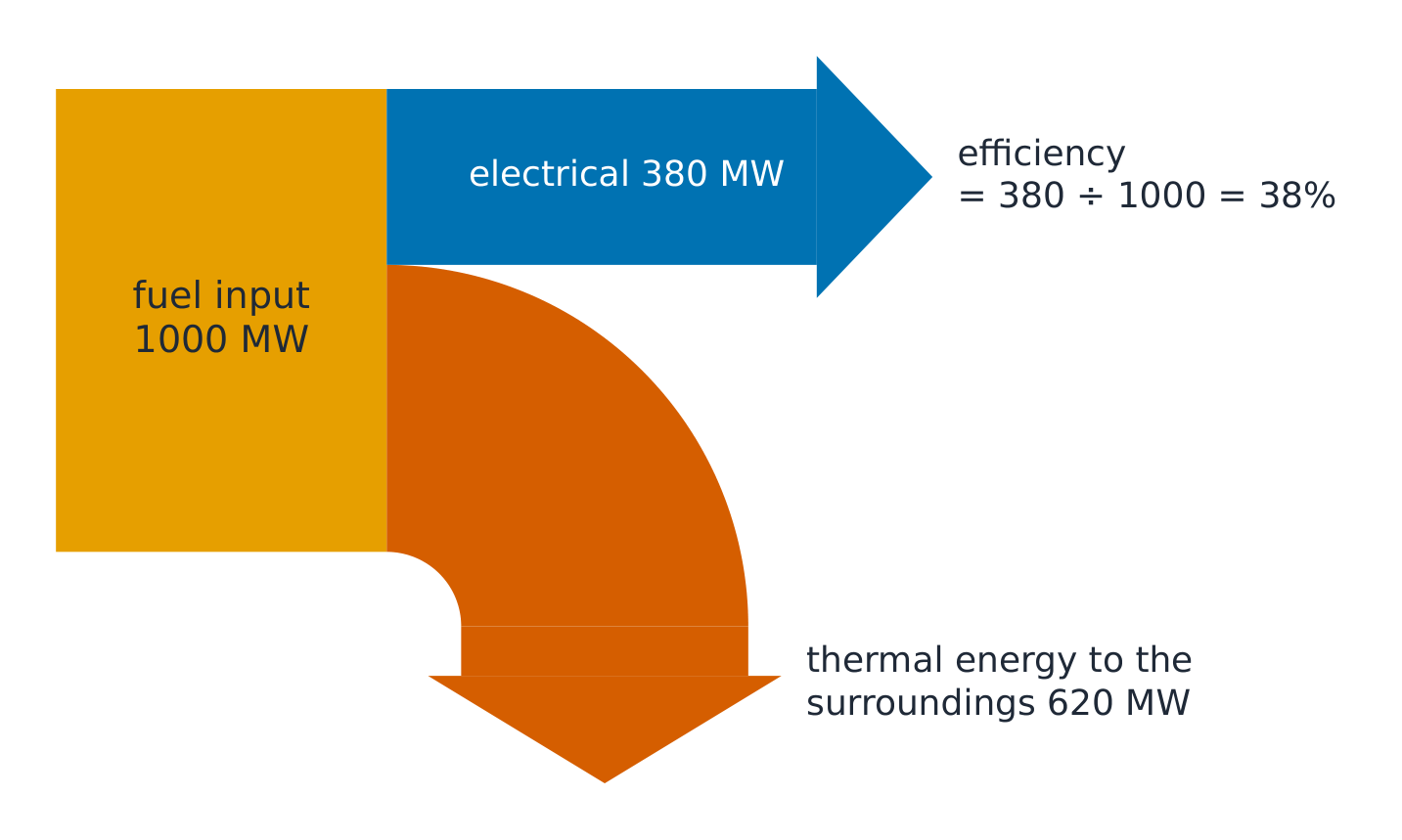
A Sankey diagram 桑基图 shows energy transfers as arrows whose widths are proportional to the energy (or power). The input arrow splits into a useful output arrow and arrows for the wasted transfers, which usually bend away. The widths must add up: the diagram shows conservation of energy at a glance.
Efficiency = useful ÷ input = 420 ÷ 600 = 70%; the other 180 J is dissipatedArrow widths are to scale: 1000 MW in = 380 MW useful + 620 MW to the surroundings
The energy density 能量密度 of a fuel is the energy released per kilogram (J kg⁻¹). Some books call energy per kilogram specific energy and use energy density for energy per cubic metre (J m⁻³); check the unit in the question.
On a log scale each grid step is ten times more: fission releases about a million times more energy per kilogram than chemical fuels
Fuel or store
Energy per kg / MJ kg⁻¹
wood
about 16
coal
about 30
petrol
46
natural gas (methane)
55
hydrogen
142
lithium-ion battery
about 0.7
uranium-235 (fission)
about $8 \times 10^7$
These rounded values illustrate magnitudes, not universal sample specifications. Fuel composition and the water-product phase affect combustion energy; battery charge state, chemistry and the mass boundary affect stored energy per kilogram. Use the supplied value and definition in a calculation.
Fission energy per kilogram is roughly a million times chemical-fuel values because nuclear binding-energy changes are much larger per particle. A battery stores less per kilogram than petrol in these examples, but whole-vehicle mass also depends on drivetrain efficiency, design and required range; fuel energy alone does not determine it.
Worked example: a coal power station delivers 500 MW of electrical power at 38% efficiency, burning coal with an energy density of 30 MJ kg⁻¹.
Input power $= 500 / 0.38 = 1316\ \text{MW}$.
Mass of coal per second $= 1316 \times 10^6 / (30 \times 10^6) = 44\ \text{kg s}^{-1}$, about 3800 tonnes per day.
A box is pushed 5.0 m across a floor by a 40 N force. Find the work done when the force is (a) horizontal, (b) at 60° to the horizontal.
In an ideal model a bag moves horizontally at fixed height and constant speed. Its supporting force from the person is vertical. Find the work done by that supporting force. Does this imply the person expends no metabolic energy?
A 0.50 kg ball is thrown vertically up at 12 m s⁻¹. Use energy to find its maximum height.
A 70 kg skier starts from rest and descends a slope with a vertical drop of 40 m. Friction and air resistance do 6000 J of work against the skier. Find the speed at the bottom.
A spring ($k = 250\ \text{N m}^{-1}$) is compressed by 8.0 cm and launches a 20 g dart horizontally. Find the dart's speed.
A 2.0 kg trolley has momentum 6.0 kg m s⁻¹. Find its kinetic energy without finding its speed.
The magnitude of a slow stretching force rises linearly from zero to 12 N at 6.0 cm extension, within the elastic range. Find the energy stored and the work done by the spring during that extension.
A motor lifts an 80 kg mass through 6.0 m in 12 s. The electrical input power is 600 W. Find the useful power and the efficiency.
A cyclist developing 300 W rides at a steady 10 m s⁻¹. Find the total resistive force.
A power station takes in 1000 MW from fuel and delivers 380 MW of electrical power. Find the efficiency and sketch a Sankey diagram.
A 25%-efficient car engine delivers 15 kW for one hour. Petrol releases 46 MJ kg⁻¹. Find the mass of petrol burned.
A 3.0 kg trolley starts from rest on a horizontal frictionless track. A constant 10 N horizontal push acts through 4.0 m. Find the mechanical-energy change and final speed. Explain why “no friction means constant mechanical energy” fails for the trolley system.
At an instant an accelerating body moves horizontally at 5.0 m/s. A 120 N applied force acts 30° above the horizontal. Find the instantaneous power of this force. Is it necessarily the net power changing kinetic energy? Explain.
For a 2.0 kg trolley moving along +x, the parallel force component is +12 N from x = 0 to 4.0 m and −4.0 N from x = 4.0 to 6.0 m. Initial speed is 4.0 m/s. Find the signed net work and the final speed, neglecting other work.
The specified supporting force is perpendicular to the horizontal displacement: $W=Fs\cos90°=0$. This is mechanical work on the bag, not the person’s metabolic energy expenditure. Real walking can include vertical motion, which this ideal model excludes.
$\frac{1}{2}mv^2 = mgh$, so $h = 12^2 / (2 \times 9.8) = 7.3\ \text{m}$; the mass cancels.
Stored energy equals positive stretching work: $E_H=\frac{1}{2}F_{\max}x=\frac{1}{2}(12)(0.060)=0.36\ \text{J}$. The spring force opposes extension, so its work is $-0.36\ \text{J}$.
At constant speed the driving force equals the resistance: $F = P/v = 300/10 = 30\ \text{N}$.
$\eta = 380/1000 = 38\%$. Sankey: a 1000 MW input arrow splitting into a 380 MW electrical arrow and a 620 MW arrow to the surroundings, widths in the ratio 38 : 62.
Work supplied is $W=Fs=10(4.0)=40$ J. With no height or spring change, mechanical energy rises by 40 J. From $\frac12mv^2=40$, $v=\sqrt{80/3.0}=5.2$ m/s. The person or device pushing transfers energy into the chosen trolley system despite the absence of friction.
$P=Fv\cos\theta=120(5.0)\cos30°=5.2\times10^2$ W. This is an instantaneous relation, valid during acceleration. It is the power of the stated force; other forces may also do work, so net kinetic-energy power requires the resultant or the sum of individual powers.
Signed work is $W=12(4.0)+(-4.0)(2.0)=40$ J. Initial $E_k=\frac12(2.0)(4.0)^2=16$ J; final $E_k=16+40=56$ J. Thus $v=\sqrt{2(56)/2.0}=7.5$ m/s. Adding the two unsigned areas would incorrectly give 56 J of work.
3.9
考试技巧
English
In $W = Fs\cos\theta$, $\theta$ is the angle between the force and the displacement, not the angle of a slope.
Net work changes kinetic energy. To conserve mechanical energy, also rule out external driving work and include the relevant potential-energy interactions.
If resistance is the only transfer out of the chosen mechanical stores, write: initial mechanical energy = final mechanical energy + energy dissipated. Include any driving work separately.
Energy is never "lost". Say it is dissipated or transferred to thermal energy of the surroundings.
Define useful output, all relevant inputs and the system boundary before finding efficiency; the stated conversion-efficiency ratio cannot exceed 100%.
Instantaneous $P=Fv\cos\theta$ does not require constant speed. A driving force equals the opposing resistance only when the relevant resultant force is zero.
Check units: kJ, MJ and kW h appear in questions, and $1\ \text{kW h} = 3.6\ \text{MJ}$.