This handout teaches C.5 Doppler effect in full, for the course first assessed in 2025.
Prerequisites: wavefronts from C.3; $v = f\lambda$, sound and electromagnetic waves from C.2; line spectra are met again in E.1. Use $c = 3.00 \times 10^8\ \text{m s}^{-1}$ and $340\ \text{m s}^{-1}$ for the speed of sound in air.
12.2
多普勒效应
English
Why does an ambulance siren change its note as it passes?
Recall a recording of a passing ambulance; do not stand near moving traffic for an experiment. While it comes towards you the siren sounds higher than it really is; near passage, the note falls rapidly, and it stays low as the ambulance drives away. The driver hears a steady note the whole time. Astronomers use the same effect with light to measure how fast stars and galaxies are moving, and doctors use it with ultrasound to measure how fast blood flows.
What the effect is
The Doppler effect 多普勒效应 is a change in observed frequency associated with source–observer motion. For mechanical waves, specify motion relative to the medium as well as the observer. A moving observer can change measured frequency without changing the wavelength in that medium.
When source and observer move towards each other, the observed frequency is higher.
When they move apart, the observed frequency is lower.
The first-order shift depends on velocity along the line of sight. The light approximation here neglects relativistic transverse shifts; it does not assert that perpendicular motion can never produce a shift.
Model received frequency indexed by emission position; zero marks the closest point on the road, not reception time
The effect happens for all waves: sound, water waves and electromagnetic waves.
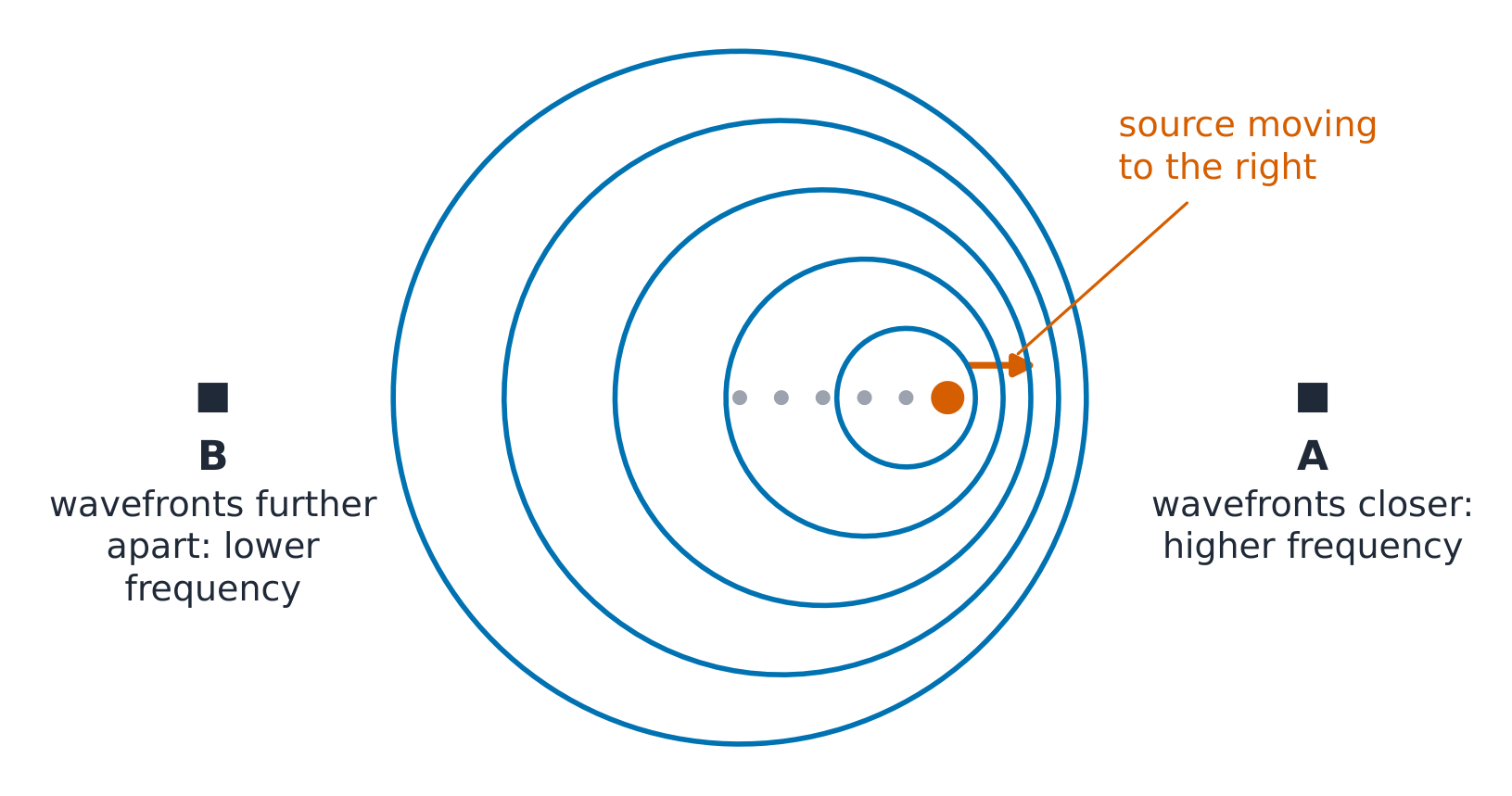
A moving source squeezes the wavefronts ahead of it and stretches them behind it
Each wavefront spreads out at the wave speed from the point where the source was when it emitted it. Because the source moves between emissions, the circles are not concentric:
Ahead of the source (observer A) the wavefronts are closer together. The wavelength is shorter, the waves still travel at the same speed, so more waves arrive each second: the observed frequency is higher.
Behind the source (observer B) the wavefronts are further apart: longer wavelength, lower frequency.
The speed of the waves does not change: it is set by the medium, not by the source.
A moving observer
When the source is at rest and the observer moves, the wavefronts are evenly spaced circles and the wavelength is unchanged. An observer moving towards the source meets the wavefronts more often than a stationary observer, so the observed frequency is higher. Moving away, they meet them less often and the frequency is lower.
A moving observer does not change the wavelength, but meets the wavefronts more often
12.4
光的多普勒效应
English
Light and other electromagnetic waves show the Doppler effect too. When the relative speed $v$ of source and observer is much smaller than the speed of light, the fractional changes in frequency and wavelength are:
Here changes are measured relative to emitted/rest values, and $v_r$ is radial relative velocity. Frequency and wavelength changes have opposite signs because $c = f\lambda$; their fractional magnitudes are equal only approximately at low speed. Signed redshift is $z = (\lambda_{\rm obs}-\lambda_0)/\lambda_0$, with $v_r \approx cz$ for low-speed Doppler motion, positive for recession.
A source moving away has a longer observed wavelength. In visible light this moves spectral lines towards the red end, so it is called redshift 红移.
A source moving towards the observer has a shorter observed wavelength: blueshift 蓝移.
Worked examples
A line emitted at 500 nm is observed at 501 nm. $\Delta\lambda/\lambda = 1/500 = 0.002$, so $v = 0.002 \times 3.00 \times 10^8 = 6.0 \times 10^5\ \text{m s}^{-1}$, moving away.
A satellite moving away at 7.5 km s⁻¹ transmits at 100 MHz. $\Delta f = 100 \times 10^6 \times 7.5 \times 10^3/3.00 \times 10^8 = 2500\ \text{Hz}$, so the received frequency is 2.5 kHz lower.
Police radar sends microwaves at a car and measures the frequency shift of the reflection to find the car's speed.
Every element absorbs and emits light at its own set of wavelengths, which appear as spectral lines 谱线. Measured in a laboratory, hydrogen has a red line at 656.3 nm. Identify several lines by their pattern and compare their fractional shifts. In a low-speed Doppler interpretation, a consistent shift estimates radial motion; it does not measure the transverse velocity or exclude other causes of redshift.
The Hubble Ultra Deep Field: almost every dot is a galaxy, and the light of the faintest is redshifted the mostLine-pattern comparison with exaggerated fractional shifts; the white dotted marks show the rest positions
Worked example: the hydrogen line at 656.3 nm is observed at 659.0 nm in a star's spectrum. $\Delta\lambda = 2.7\ \text{nm}$, so $v = c\,\Delta\lambda/\lambda = 3.00 \times 10^8 \times 2.7/656.3 = 1.2 \times 10^6\ \text{m s}^{-1}$, moving away from us.
What spectral shifts tell astronomers:
Stars in our galaxy show small redshifts or blueshifts as they move towards or away from the Sun.
Rotation: opposite sides can have opposite radial rotation components relative to the system's mean shift. Inclination matters: a face-on rotating disc gives little radial rotational signal. An unresolved rotating star may show broadened lines rather than separately imaged edges.
Binary stars orbit each other, so their lines shift back and forth regularly. Tiny regular shifts in a star's lines also reveal planets pulling it to and fro.
Distant galaxies show an overall redshift–distance trend associated with cosmic expansion, with local motions adding scatter. Cosmological redshift describes light stretched as space expands, not an exact low-speed source-motion measurement. See NASA's spectroscopy explanation.
The Andromeda galaxy is approaching the Milky Way: its spectrum is blueshifted, against the general trendHubble's law: a galaxy's recession speed is proportional to its distance, $v = H_0 d$
Draw a wavefront diagram for a source moving to the right. Mark where an observer would hear the highest frequency.
Explain, using wavefronts, why an observer moving towards a stationary source hears a higher frequency, although the wavelength does not change.
Explain why the note of a passing car's horn drops suddenly as it passes.
In a low-speed Doppler model, a 486.1 nm laboratory line is observed at 490.0 nm. Estimate radial velocity and state approach or recession.
A star moves towards the Earth at 30 km s⁻¹. Find the observed wavelength of a line emitted at 589.0 nm.
Explain how Doppler shifts can be used to measure the rotation of a galaxy.
State why $\Delta f/f \approx v/c$ can be used for light from stars in our galaxy, and state when it would not be accurate.
Rest lines at 500.0 and 600.0 nm appear at 500.5 and 600.6 nm. Test whether they have a common fractional shift and estimate radial velocity in the low-speed Doppler model.
A 500.0 nm rest line has measured shift +0.20 ± 0.02 nm. Treat the rest value and c as exact. Estimate radial velocity and its uncertainty.
A single observed line near 600 nm could be identified with different laboratory lines. Explain why this alone cannot establish a unique Doppler speed.
Answers.
A change in observed frequency associated with source–observer motion. For sound, specify the medium frame; a moving observer need not alter the wavelength in the medium.
Circles centred on the successive positions of the source, closer together ahead of it; the highest frequency is heard directly ahead.
The wavefronts are equally spaced, so the wavelength is unchanged, but the observer's motion means they meet more wavefronts per second, so the frequency they measure is higher.
While approaching, the car is moving towards the listener and the frequency heard is higher; as it passes, its velocity along the line to the listener changes quickly from towards to away, so the frequency drops to below the emitted value.
Compare opposite-side radial shifts relative to the galaxy's mean shift. They constrain projected rotation speed; inclination is needed to infer the full rotation speed. A face-on disc has little radial rotational signal.
These stars move at tens or hundreds of km s⁻¹, much less than $c$. For sources moving at a large fraction of $c$ the approximation is not accurate.
Both give $z = 0.0010$, consistent with a common shift; $v_r \approx 3.0 \times 10^5\ \text{m s}^{-1}$, receding. Line identification and calibration must still be checked.
The rest wavelength sets both shift and fractional denominator. Different identifications give different speeds or directions; use more lines and a calibrated wavelength scale.
12.7
考试技巧
English
The Doppler effect changes the observed frequency; the source still emits the same frequency.
For sound, a moving source changes the wavelength; a moving observer does not.
In the Doppler interpretation, redshift indicates recession and blueshift approach; identify the pattern and compare fractional shifts. Cosmological redshift needs its expansion model.
In $z \approx v_r/c$, use signed radial velocity and check the low-speed regime. A zero first-order radial shift does not prove the source is stationary.