This handout teaches E.3 Radioactive decay in full, for first assessment 2025. Sections marked AHL are for Higher Level only.
Prerequisites: nuclear notation and the electronvolt from E.1, energy conservation from A.3, and Coulomb's law plus exponentials and logarithms for the additional higher-level work. Use $c=3.00\times10^8\ \text{m s}^{-1}$, $1\ \text{u}=1.661\times10^{-27}\ \text{kg}=931.5\ \text{MeV}\,c^{-2}$, proton mass $1.007276\ \text{u}$ and neutron mass $1.008665\ \text{u}$.
22.2
同位素与强核力
English
How old is the Iceman?
Ötzi, the body discovered in the Alps in 1991, illustrates how nuclear measurements can date once-living material. Real dating includes sample preparation, contamination tests and calibration for past atmospheric carbon-14 variation. A radiocarbon remeasurement study reports calibrated prehistoric date intervals; a classroom halving calculation is not the complete analysis.
Reading an age off the decay curve
Our separate dating example has 52.5% of its assumed initial carbon-14 remaining. We will calculate its idealised decay age, without presenting that percentage as a measurement of Ötzi. Random nuclear events can support a statistical clock when the initial conditions and model are justified.
Isotopes
Isotopes 同位素 are nuclides with the same number of protons (same element) but different numbers of neutrons. They have very similar chemical behaviour because their electronic structures are similar, but different masses and often different nuclear stability. Mass-dependent isotope effects mean their chemistry is not exactly identical.
Carbon-12 (${}^{12}_{6}\text{C}$: 6 protons, 6 neutrons) is stable; carbon-14 (${}^{14}_{6}\text{C}$: 6 protons, 8 neutrons) is radioactive.
Chlorine-35 and chlorine-37 are both stable; natural chlorine is a mixture.
The three isotopes of hydrogen: the same one proton, different numbers of neutrons
The strong nuclear force
The protons in a nucleus repel each other strongly, yet the nucleus holds together. Something must attract the nucleons. This is the strong nuclear force 强核力:
A short-range force
the residual nuclear interaction can provide attraction between nucleons of all three pair types at suitable nuclear separations;
it is much stronger than the electric force at nuclear distances;
it has a very short range, about $10^{-15}$ m, so its main binding contribution comes from nearby nucleons (at very small separations it becomes repulsive, which stops the nucleus collapsing).
The mass of a bound nucleus is less than the total mass of its separate protons and neutrons. The difference is the mass defect 质量亏损$\Delta m$.
The assembled nucleus has less mass than its separate nucleons; the missing mass is released as binding energy
The binding energy 结合能 of a nucleus is the energy needed to separate it completely into its individual nucleons (equally, the energy released when it is formed from them). Mass and energy are equivalent:
$$E = mc^2$$
so the binding energy is $\Delta m\,c^2$. Masses in nuclear physics are given in kg, in unified atomic mass units 原子质量单位 (u) or in MeV $c^{-2}$. Since $1\ \text{u} = 931.5\ \text{MeV}\,c^{-2}$, a mass defect in u multiplied by 931.5 gives the binding energy in MeV directly.
Mass defect: $\Delta m = 4.031882 - 4.001506 = 0.030376\ \text{u}$.
Binding energy: $0.030376 \times 931.5 = 28.3\ \text{MeV}$, or $7.07$ MeV per nucleon.
The same in SI units: $\Delta m = 0.030376 \times 1.661 \times 10^{-27} = 5.045 \times 10^{-29}\ \text{kg}$, and $E = \Delta m\,c^2 = 4.54 \times 10^{-12}\ \text{J}$.
Use nuclear masses with separate proton and neutron masses. If atomic masses are supplied, account consistently for electrons; one can often use hydrogen-atom mass instead of bare proton mass so electron masses cancel. Do not mix conventions silently.
Energy released in a nuclear reaction
In any nuclear reaction or decay, if the sum of product rest masses is less than the initial rest-mass sum, the rest-energy decrease appears as kinetic energy and/or emitted radiation; total energy remains conserved: $E = \Delta m\,c^2$.
Worked example: radium-226 decays to radon-222 by alpha emission. Using atomic masses (the electrons balance on both sides): $226.025410 - (222.017578 + 4.002603) = 0.005229\ \text{u}$, so the energy released is $0.005229 \times 931.5 = 4.87\ \text{MeV}$.
unified atomic mass unit/ˈjuːnɪfaɪd əˈtɒmɪk mæs ˈjuːnɪt/
原子质量单位
yuán zi zhì liàng dān wèi
22.4
每个核子的结合能
English
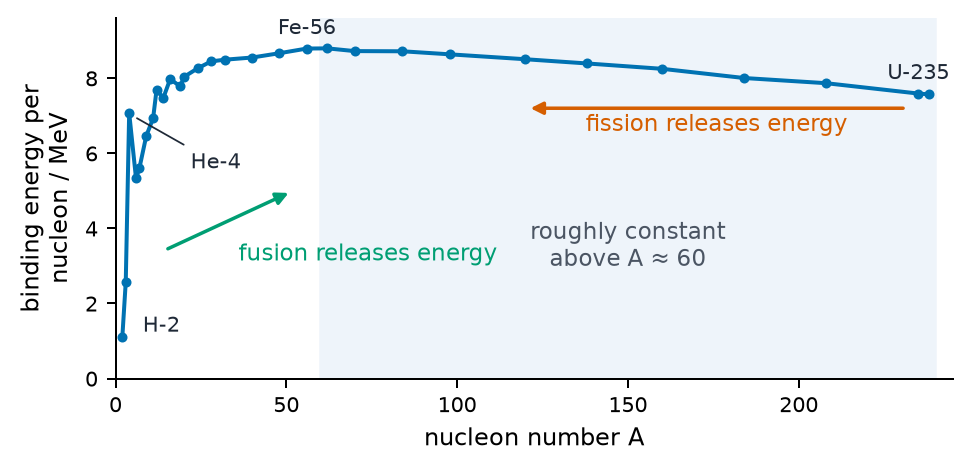
The binding energy per nucleon 比结合能 (binding energy ÷ nucleon number) measures how tightly each nucleon is held. A larger value means greater average binding against complete separation. This is not a guarantee against every possible radioactive decay; compare the total initial and final masses for the proposed process.
Selected binding energies: favourable fusion and fission products have greater total binding energy
Interpreting the curve:
Light nuclei have low binding energy per nucleon. Helium-4 is unusually tightly bound for its size, which is why alpha particles are emitted as a unit.
The peak is at about 8.8 MeV per nucleon, near iron-56 and nickel-62. These are among the most tightly bound nuclei per nucleon; nickel-62 is near the maximum.
Heavy nuclei have a little less binding energy per nucleon (about 7.6 MeV for uranium).
Fusion 核聚变: favourable reactions between light nuclei increase total binding energy and release energy; not every possible light-nucleus reaction is exothermic. This powers the stars (E.5).
Fission 核裂变: favourable heavy-nucleus splits increase total binding energy and release energy. Compare all products, including free neutrons. This powers nuclear reactors (E.4).
binding energy per nucleon/ˈbaɪndɪŋ ˈenədʒi pɜː ˈnjuːklɪən/
比结合能
bǐ jié hé néng
fusion/ˈfjuːʒn/
核聚变
hé jù biàn
fission/ˈfɪʃn/
核裂变
hé liè biàn
22.5
放射性衰变的本质
English
An unstable nucleus can change into a more stable one by emitting radiation. This is radioactive decay 放射性衰变. It is:
Tracks in a cloud chamber: each track marks a charged particle passing through the vapour, rather than necessarily one nuclear decay
random 随机的: it is impossible to predict when a particular nucleus will decay; each nucleus of a given nuclide has the same chance of decaying in the next second, however long it has existed;
spontaneous 自发的: it occurs without a triggering collision. For the ordinary classroom decay model, its rate is approximately unaffected by temperature, pressure or chemical state; this is a model assumption rather than a universal statement about every decay mechanism.
Because a sample contains huge numbers of nuclei, the randomness averages out and the overall pattern is very predictable, in the same way that the total of many dice throws is predictable.
In beta-minus decay a neutron in the nucleus changes into a proton, emitting an electron (the beta-minus particle) and an antineutrino 反中微子$\bar{\nu}$. The nucleon number stays the same and the proton number rises by 1:
In beta-plus decay a proton changes into a neutron, emitting a positron 正电子 (the antiparticle of the electron, charge $+e$) and a neutrino 中微子$\nu$. The proton number falls by 1:
Neutrinos and antineutrinos have no charge and almost no mass, and they hardly interact with matter, so they are very hard to detect.
Gamma decay
After alpha or beta decay the new nucleus is often left in an excited state. It can emit a gamma ray 伽马射线, a high-energy photon of electromagnetic radiation, on moving to a lower nuclear energy level. This may be the ground state or another excited state; several successive emissions can occur. The nucleon and proton numbers do not change:
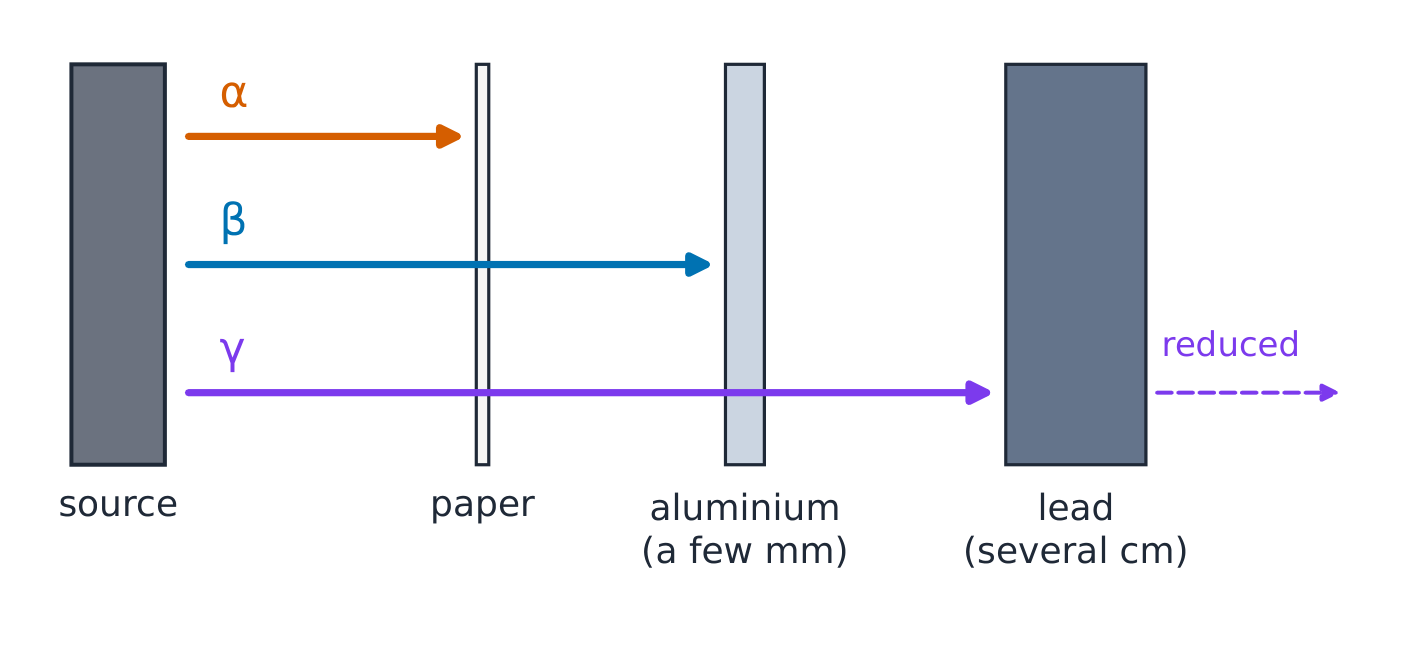
As the radiation passes through matter it can transfer energy that removes electrons from atoms, creating ions. Gamma photons cause ionisation indirectly through the charged particles they produce. This is ionisation 电离. The more strongly a radiation ionises, the faster it loses its energy, and so the less far it travels.
Typical classroom comparison; actual ranges and attenuation depend on energy and material
Alpha
Beta
Gamma
Nature
helium nucleus, charge $+2e$
electron or positron, charge $\mp e$
electromagnetic radiation, no charge
Ionising ability
strong
moderate
weak
Range in air
a few cm
about 1 m
very large (intensity falls gradually)
Stopped by
a sheet of paper or skin
a few mm of aluminium
reduced by several cm of lead or metres of concrete
For typical alpha energies, intact outer skin stops the alpha particles, while an internal alpha-emitting contaminant can deposit energy densely in tissue. The source may emit other radiation too. Risk depends on activity, energy, exposure route, time and shielding, not on a single label in this table.
Irradiation means exposure to radiation from a source; contamination means radioactive material is present on or inside an object. Removing an external source ends that irradiation, but contamination can remain and keep emitting. Under the school radiation procedure, sources are teacher-managed: reduce exposure time, increase distance and use shielding appropriate to the radiation.
The activity 活度$A$ of a sample is the number of nuclei that decay per second. Its unit is the becquerel 贝克勒尔 (Bq): $1\ \text{Bq} = 1$ decay per second. A detector such as a Geiger–Müller tube measures a count rate 计数率, which is only a fraction of the activity, since radiation goes in all directions and not every particle is detected. Background-corrected count rate is proportional to activity when geometry, detection efficiency and radiation yield stay fixed and detector dead-time effects are negligible. Counts are events recorded during an interval, not automatically the number of decays in the whole source.
Since the decay is random, the activity is proportional to the number of undecayed nuclei, and both fall in the same way. The half-life 半衰期$T_{1/2}$ is the time for the expected undecayed population, activity, or background-corrected count rate under fixed conditions to halve. A large sample closely follows this statistical pattern; a small set need not lose exactly half its members each half-life.
Every half-life halves what is left: the same time each time
After $n$ half-lives, the fraction remaining is $\left(\tfrac{1}{2}\right)^n$.
Half-lives
0
1
2
3
4
5
Fraction remaining
1
1/2
1/4
1/8
1/16
1/32
Half-lives range from fractions of a second to billions of years: technetium-99m has a half-life of 6.0 hours, carbon-14 5730 years, uranium-238 $4.5 \times 10^9$ years.
Worked examples
A source has an activity of 800 Bq and a half-life of 6.0 h. After 24 h (4 half-lives) its activity is $800 \times \tfrac{1}{16} = 50\ \text{Bq}$.
A sample's activity falls from 1200 Bq to 150 Bq in 15 days. $1200 \to 600 \to 300 \to 150$ is 3 half-lives, so $T_{1/2} = 5.0$ days.
After 3 half-lives, $\tfrac{1}{8}$ of the nuclei remain and $\tfrac{7}{8}$ have decayed.
Background radiation 本底辐射 is always present: from radon gas in the air, rocks and building materials, cosmic rays, food and medical sources. A detector can record it when the investigated source is absent; the rate depends on detector and surroundings.
A Geiger counter counts ionising events; even with no source nearby it records a background count rate
Measure the background count rate first, with the source far away, for a long time (to reduce the random uncertainty).
Subtract the background from every reading to get the count rate due to the source.
Forgetting this matters most when the source count rate is small. For example, readings of 100 and 55 counts per minute, with a background of 10 counts per minute, are really 90 and 45 from the source: consistent with one half-life apart in this idealised example. The uncorrected ratio 0.55 is a count-rate fraction, not a number of half-lives.
Determining a half-life
Under the teacher-managed procedure, measure background over a sufficiently long interval and repeat it to check whether it is stable.
Keep detector geometry and settings fixed. Record source-plus-background counts, duration and elapsed time. Count intervals should be short compared with the half-life or the interval average must be modelled.
Subtract the background from each reading.
Plot corrected count rate against time and draw a smooth curve.
Estimate halving times across several suitable portions of the fitted trend and report spread or uncertainty. Random counts need not lie exactly on the curve; avoid low corrected rates dominated by background uncertainty.
Subtract background, then read the half-life
For a very long half-life the activity hardly changes during an experiment, so other methods are needed.
The choice of isotope depends on the radiation it emits and on its half-life.
Radiotherapy: a mesh mask holds the patient still, and alignment lasers position the patient so the treatment beam reaches the tumour precisely
These are physics comparisons, not instructions to handle or administer sources.
Medical imaging. A common technetium-99m imaging principle uses escaping gamma photons and an approximately 6 h physical half-life. Suitable chemical targeting and the time needed for measurement matter. Biological removal and administered activity also affect dose; a short physical half-life alone does not guarantee a low dose. External gamma imaging does not use the alpha particle itself as its escaping signal.
Radiotherapy. A cobalt-60 source can supply gamma photons for controlled irradiation. Its roughly 5.3 year half-life lets a source operate for a long time, but activity declines and treatment needs professional planning and shielding.
Industrial tracers. A suitable tracer can reveal flow or leaks because radiation reaching an external detector changes with position. Penetration, chemical behaviour, detection sensitivity and managed containment all matter. A short half-life reduces later activity; it does not by itself make released material safe.
Thickness control. Choose radiation partly attenuated by the intended material: the count must change measurably across the working thickness range. A beta source can suit thin paper, while alpha may be stopped completely and gamma may change too little. Energy and thickness determine suitability; the ranking is not universal. Fixed geometry and a long half-life reduce unwanted drift, which calibration can monitor.
Radioactive dating. Once carbon exchange stops, the carbon-14 ratio decreases in a closed sample. Compare equivalent carbon quantities, justify the initial ratio, correct contamination and calibrate real dates. Potassium–argon dating instead uses appropriate minerals and accounts for branching and retention. A useful clock must leave a measurable parent/daughter signal over the age range; choosing a half-life equal to the age is not a universal optimum.
Thickness control: if the sheet thickens, fewer beta particles get through and the rollers press harder.
22.11
AHL:强核力存在的证据
English
Nuclei exist. Two protons 2.0 fm apart repel with an electric force of $\dfrac{8.99 \times 10^9 \times (1.60 \times 10^{-19})^2}{(2.0 \times 10^{-15})^2} = 58\ \text{N}$, a huge force on such small particles. The gravitational attraction is about $5 \times 10^{-35}$ N, around $10^{36}$ times too small. A much stronger attractive force must act.
Short range. The binding energy per nucleon is roughly constant for all but the lightest nuclei, and average nuclear density is approximately similar across many nuclei (E.1). These trends support short-range saturation: each nucleon gains most of its binding from nearby neighbours. They do not make real nuclei identical or remove surface and shell effects.
Scattering. When alpha particles or protons have enough energy to reach a nucleus, scattering no longer follows Rutherford's electric-force prediction (E.1): another force acts at very short range.
22.12
AHL:中子、质子与稳定性
English
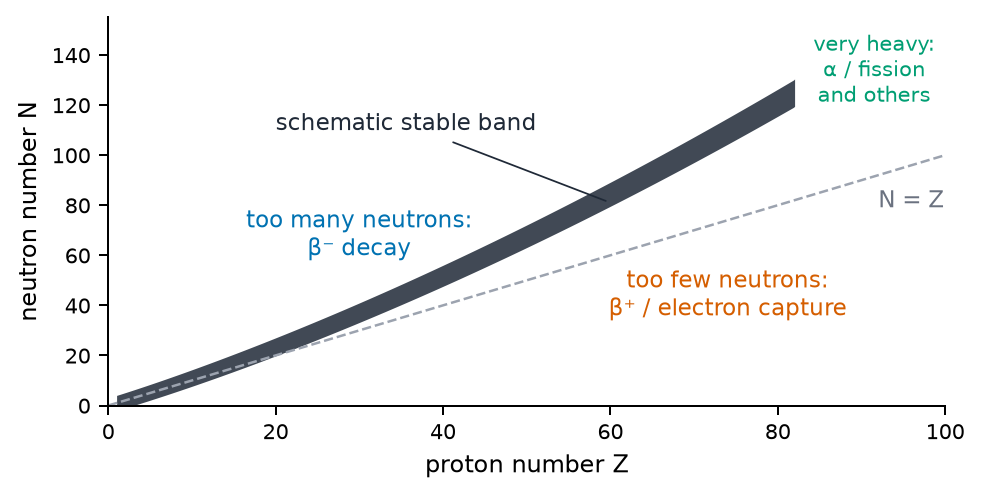
The ratio of neutrons to protons helps organise stability, together with total size, energy differences and nuclear structure. It cannot alone determine every allowed decay.
Heavier stable nuclei need more neutrons than protons
Light nuclei are stable with $N \approx Z$, for example ${}^{12}_{6}\text{C}$ and ${}^{16}_{8}\text{O}$.
Heavy nuclei need more neutrons than protons: lead-208 has $N/Z = 126/82 = 1.54$. Every proton repels every other proton (the electric force has a long range), but each nucleon is attracted only by its neighbours. Extra neutrons add strong-force attraction without adding repulsion.
Lead ($Z=82$) is the highest-proton-number element with stable nuclides. Even bismuth-209 is radioactive: its extremely slow alpha decay was detected experimentally. Long-lived is not the same as stable.
The band suggests likely directions of change, subject to energetics and other available modes:
too many neutrons (above the band): β⁻ decay turns a neutron into a proton, moving the nucleus towards the band;
too few neutrons (below the band): β⁺ decay or electron capture turns a proton into a neutron;
very heavy nuclei: α decay removes 2 protons and 2 neutrons, reducing the size; spontaneous fission and other decay modes can also occur.
22.13
AHL:质量数A = 60以上的结合能曲线
English
Above a nucleon number of about 60, the binding energy per nucleon stays roughly constant, between about 7.6 and 8.8 MeV.
Because the strong force has a short range, each nucleon is bound mainly to a small number of nearby nucleons. Once a nucleus is large enough that most nucleons are surrounded by neighbours, adding more nucleons adds about the same binding energy for each one.
The slow fall towards uranium is caused by the electric repulsion, which acts between all pairs of protons and grows faster than the number of nucleons.
For light nuclei, a large fraction of the nucleons are at the surface with fewer neighbours, so the binding energy per nucleon is smaller.
22.14
AHL:核能级
English
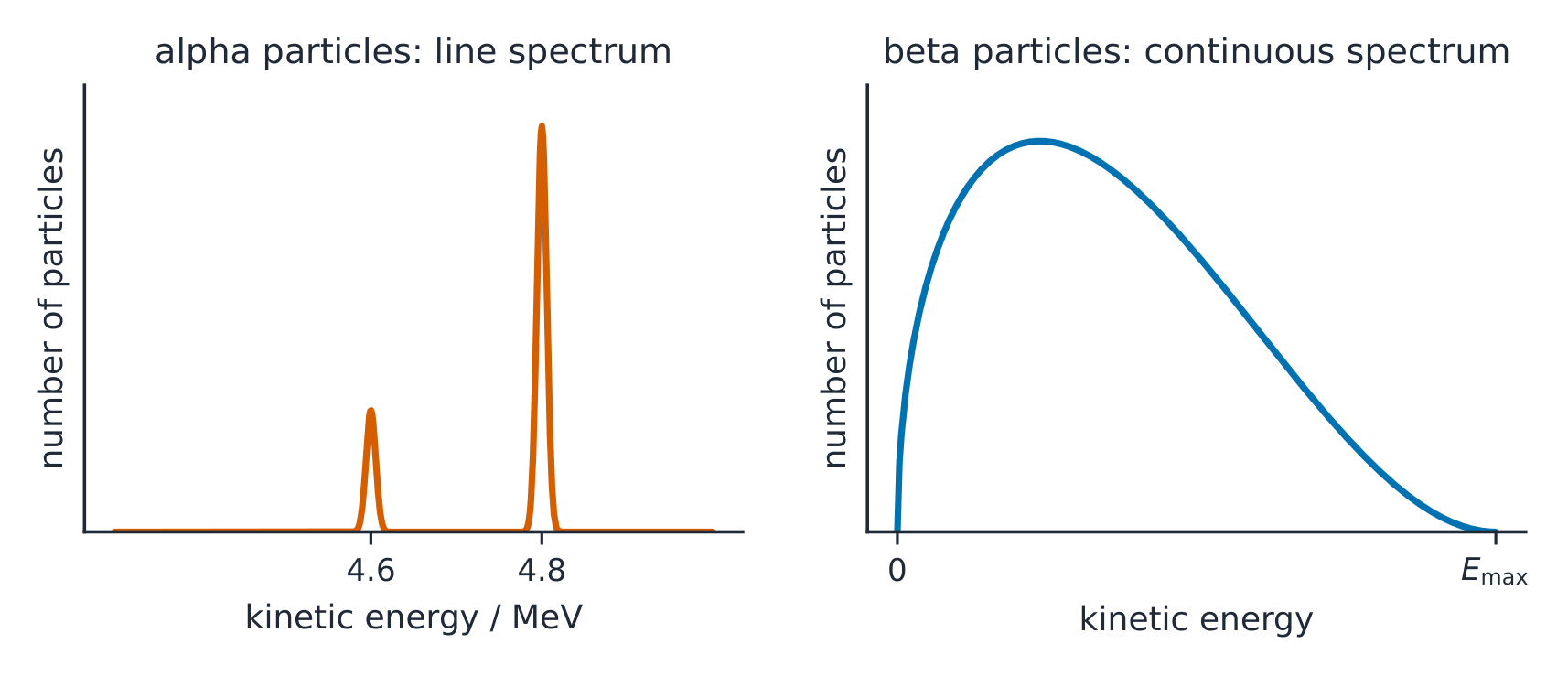
Alpha particles from a particular nuclide have one, or a small number of, definite energies. Gamma rays from a particular nuclide also have definite energies: a line spectrum, just like the photons emitted by atoms (E.1).
Level scheme, not to scale; neglect daughter recoil when comparing the alpha-energy gap with the gamma energy
This is evidence that nuclei have discrete energy levels. In this heavy-nucleus approximation, neglect daughter recoil: the alpha-energy difference (4.8 − 4.6 = 0.2 MeV) estimates the gamma energy. More precisely, the branch-energy difference includes changes in daughter recoil. In the approximation, the nucleus left in the excited state emits the difference as a gamma ray. Nuclear transitions often have keV-to-MeV gaps, far greater than ordinary visible atomic transitions. The exact gap depends on the nucleus; the diagram is not data for a named isotope.
Two-step example. Nuclear levels are at 0.50, 0.20 and 0 MeV. Neglecting daughter recoil, a transition from 0.50 to 0.20 MeV emits a photon of $0.50-0.20=0.30$ MeV; the next transition to the ground state emits $0.20-0=0.20$ MeV. Together the photons carry 0.50 MeV. Each photon corresponds to one level difference, not necessarily the whole initial excitation energy.
22.15
AHL:β谱与中微子
English
Unlike alpha particles, beta particles from one nuclide have a continuous range of kinetic energies, from small values up to an endpoint. The available energy is shared among beta particle, (anti)neutrino and daughter recoil; the endpoint is close to the available kinetic energy when recoil and neutrino mass are neglected.
Spectra
If only two particles (the daughter nucleus and the electron) were produced, conservation of energy and momentum would give the electron one definite energy, as for alpha decay.
Most beta particles have much less than $E_\text{max}$, so some energy seemed to be missing. In 1930 Wolfgang Pauli proposed that a third particle, neutral and very light, carries off the rest of the energy and some momentum. This is the (anti)neutrino.
The energy shared among the beta particle, (anti)neutrino and recoiling daughter varies from decay to decay, which gives the continuous spectrum. Neutrinos were finally detected in 1956.
22.16
AHL:放射性衰变定律
English
The decay constant 衰变常数$\lambda$ is the constant of proportionality between the rate of decay and the number of undecayed nuclei. For one independently decaying parent nuclide with constant $\lambda$ and no replenishment, the expected number left after time $t$ is
$$N = N_0 e^{-\lambda t}$$
and the activity, the rate of decay, is
$$A = \lambda N = \lambda N_0 e^{-\lambda t}$$
Setting $N = N_0/2$ at $t = T_{1/2}$ gives the link with the half-life:
$$T_{1/2} = \frac{\ln 2}{\lambda}$$
These equations work for any time, not just whole numbers of half-lives. The unit of $\lambda$ is s⁻¹ (or day⁻¹, year⁻¹, as long as the time units match).
Taking logarithms turns the decay curve into a straight line of gradient −λ
Taking logarithms: $\ln N = \ln N_0 - \lambda t$ (and similarly $\ln A = \ln A_0 - \lambda t$). A graph of $\ln A$ (or $\ln$ of the corrected count rate) against $t$ is a straight line of gradient $-\lambda$: the best way to find $\lambda$, and so $T_{1/2}$, from data when the one-exponential model, fixed efficiency and background treatment are justified. With dimensionless logarithms, plot $\ln(R/R_\mathrm{ref})$; the fixed reference changes the intercept, not the slope.
The decay constant as a probability
The probability that a nucleus decays in a time $\Delta t$ is $1 - e^{-\lambda\Delta t}$. When $\lambda\Delta t$ is small, this is approximately $\lambda\Delta t$, so $\lambda$ is approximately the probability of decay per unit time, but only when $\lambda\Delta t \ll 1$.
lambda is a probability only for short times
For $\lambda = 0.010\ \text{s}^{-1}$: in 1.0 s the probability is $1 - e^{-0.010} = 0.00995 \approx 0.010$; but in 100 s it is $1 - e^{-1} = 0.63$, not $\lambda t = 1$.
Worked examples
Iodine-131 has a half-life of 8.0 days. $\lambda=\ln2/(8.0\times86400)\approx1.003\times10^{-6}\ \mathrm{s^{-1}}$. A sample of $5.0\times10^{15}$ nuclei initially has activity $A_0=\lambda N_0\approx5.014\times10^9\ \mathrm{Bq}$. Keep the full calculator values until the final answer. After 20 days, $A=A_0\,2^{-20/8}\approx8.9\times10^8\ \mathrm{Bq}$ to two significant figures.
Time for that activity to fall to $1.0\times10^8$ Bq: $t=\ln(A_0/A)/\lambda$. Using the unrounded initial activity and decay constant gives about 45 days.
Closed-sample dating calculation: carbon-14 has $\lambda = 0.693/5730 = 1.21 \times 10^{-4}\ \text{year}^{-1}$. With 52.5 % remaining, $t = \ln(1/0.525)/(1.21 \times 10^{-4}) = 5.3 \times 10^3$ years. This idealised result is not a calibrated date for Ötzi.
(a) Define isotopes, and state the numbers of protons and neutrons in ${}^{35}_{17}\text{Cl}$ and ${}^{37}_{17}\text{Cl}$. (b) State three properties of the strong nuclear force.
A carbon-12 nucleus has a mass of 11.996706 u. Find its mass defect, its binding energy in MeV and its binding energy per nucleon.
(a) Use total binding energies to explain why suitable fusion and fission reactions release energy. Must every reaction of either type release energy? (b) In an alpha decay the total mass decreases by 0.0059 u. Find the energy released in MeV and in J.
Explain what is meant by saying that radioactive decay is random and spontaneous.
Complete the equations: (a) ${}^{210}_{84}\text{Po}$ decays by α emission; (b) ${}^{90}_{38}\text{Sr}$ decays by β⁻ emission; (c) ${}^{18}_{9}\text{F}$ decays by β⁺ emission.
With no absorber, a detector near a source reads 600 counts per minute; with paper in between, 450; with 5 mm of aluminium, 30. The background is 30 counts per minute. State which radiations the source emits. Assume the usual classroom energies, matched geometry, negligible absorber scattering into the detector and sufficient repeated counts to resolve the reductions.
A source has an activity of 640 Bq and a half-life of 2.0 h. Find its activity after 8.0 h.
A detector reads 245 counts per minute from a source; the background is 25 counts per minute. Find the reading expected after three half-lives.
In a closed-sample dating model, wood has one eighth of its assumed initial carbon-14 per equivalent carbon quantity. With half-life 5730 years, find its ideal decay age and state one limitation of applying it to a real archaeological date.
Explain the physical radiation and half-life choices for external technetium-99m gamma imaging, using an approximately 6 h physical half-life. Why does half-life alone not determine dose?
Explain why a beta source is used to monitor the thickness of paper.
AHL. (a) Two protons in a nucleus are 2.0 fm apart. Calculate the electric force between them, and explain what this shows about nuclear forces. (b) Explain why heavy stable nuclei have more neutrons than protons, and predict how a nuclide lying above the band of stability will decay. (c) Explain why the binding energy per nucleon is roughly constant above $A \approx 60$.
AHL. (a) A nuclide emits alpha particles of 5.30 MeV and 5.12 MeV, and gamma photons of one energy. Explain this, and deduce the gamma photon energy. Treat the numbers as and neglect daughter recoil. (b) Explain how the energy spectrum of beta particles led to the prediction of the neutrino.
AHL. (i) Iodine-131 has a half-life of 8.0 days. Find (a) its decay constant in s⁻¹, (b) the activity of $2.0 \times 10^{15}$ nuclei, (c) the time for the activity to fall to 10 % of its starting value. (ii) A source has a decay constant of 0.010 s⁻¹. Find the probability that a given nucleus decays (a) in the next 1.0 s, (b) in the next 100 s, and comment. (iii) A graph of $\ln(\text{corrected count rate})$ against time falls from 8.0 to 5.0 in 10 minutes. Find the decay constant and the half-life. (iv) Find the fraction of a sample remaining after 3.5 half-lives.
Answers.
(a) Nuclides with the same number of protons but different numbers of neutrons. Chlorine-35: 17 protons, 18 neutrons; chlorine-37: 17 protons, 20 neutrons. (b) Any three: residual nuclear attraction between nearby nucleons at suitable separations; strong compared with electrical repulsion there; short range of order femtometres; repulsion at sufficiently short separation. Do not describe it as attractive at every distance.
(a) For an exothermic reaction the products have greater total binding energy, so their total rest mass is lower. Many light-nucleus fusion and heavy-nucleus fission reactions do this. Include all products and compare actual totals; the broad curve alone does not prove every proposed reaction releases energy. (b) $0.0059 \times 931.5 = 5.5\ \text{MeV} = 5.5 \times 10^6 \times 1.60 \times 10^{-19} = 8.8 \times 10^{-13}\ \text{J}$.
Random: an individual decay time cannot be predicted and the constant-rate model gives equal conditional probabilities in equal future intervals. Spontaneous: no triggering collision is needed; the ordinary classroom rate is approximately insensitive to temperature, pressure and chemistry.
Within the stated model the paper-sensitive component indicates alpha and the aluminium-sensitive component indicates beta. The final count is consistent with background, so no gamma component is resolved; this is not proof that an arbitrarily weak gamma component is absent.
8.0 h is 4 half-lives: $640/16 = 40\ \text{Bq}$.
Corrected: 220 counts per minute; after 3 half-lives, $220/8 = 27.5$; add back the background: about 53 counts per minute.
$\tfrac{1}{8}$ is 3 half-lives: $3 \times 5730 = 17\,190$ years, about $1.7 \times 10^4$ years. Real dates require a justified initial ratio, contamination checks and atmospheric calibration; this classroom age is not automatically a calibrated calendar age.
Gamma photons can escape to the camera. A physical half-life near 6 h provides a measurement window while activity subsequently declines. Administered activity, photon energy, chemical distribution and biological removal also affect dose; a short half-life alone is not a guarantee of low dose.
Alpha particles would all be stopped by the paper, and gamma rays would pass through almost unaffected; the number of beta particles getting through changes noticeably with small changes in thickness.
AHL. (a) $F = 8.99 \times 10^9 \times (1.60 \times 10^{-19})^2/(2.0 \times 10^{-15})^2 = 58\ \text{N}$, repulsive. Gravity is far too weak to balance it, so there must be a very strong attractive force between nucleons at these distances: the strong nuclear force. (b) The electric repulsion acts between all pairs of protons, while the strong attraction acts mainly between near neighbours, so extra neutrons are needed to add attraction without repulsion. A nuclide above the band has too many neutrons, so beta-minus decay moves it towards the band when that decay is energetically allowed; the ratio is a guide rather than a full decay prediction. (c) The strong force is short range, so each nucleon is bound mainly to nearby neighbours; in a large nucleus each nucleon has about the same number of neighbours, so each adds about the same binding energy.
AHL. (a) The daughter nucleus has discrete energy levels. Alpha decay leads either to the ground state or to an excited state; the excited nucleus then emits a gamma photon. Gamma energy $= 5.30 - 5.12 = 0.18\ \text{MeV}$. This equality is approximate: changing daughter recoil also contributes to the exact branch-energy balance. (b) With only two products, beta particles would all have the same energy. They have a continuous range up to a maximum, so a third, undetected particle must share the energy (and momentum): the neutrino. Include daughter recoil in exact energy and momentum accounting; beta-minus emits an electron antineutrino, beta-plus an electron neutrino.
AHL. (i) (a) $\lambda = 0.693/(8.0 \times 86\,400) = 1.0 \times 10^{-6}\ \text{s}^{-1}$. (b) $A = \lambda N = 2.0 \times 10^9\ \text{Bq}$. (c) $t = \ln 10/\lambda = 2.303/0.0866\ \text{day}^{-1} = 27$ days. (ii) (a) $1 - e^{-0.010} = 0.00995$, almost exactly $\lambda t = 0.010$. (b) $1 - e^{-1.0} = 0.63$. $\lambda t$ is a good estimate of the probability only when $\lambda t$ is small; for 100 s it would wrongly give 1.0. (iii) Gradient $= -3.0/10 = -0.30\ \text{min}^{-1}$, so $\lambda = 0.30\ \text{min}^{-1}$; $T_{1/2} = 0.693/0.30 = 2.3$ min. (iv) $\left(\tfrac{1}{2}\right)^{3.5} = e^{-3.5\ln 2} = 0.088$, about 8.8 %.
22.18
考试技巧
English
Binding energy is the energy needed to separate a nucleus into nucleons, not the energy "stored" in it. Higher binding energy per nucleon means tighter average binding, not immunity to all decay modes.
Check that nucleon and proton numbers balance in every decay equation, and include the neutrino or antineutrino in beta decay.
Subtract background radiation before calculating with count rates; add it back if asked for a detector reading.
For a whole number of half-lives use $(\tfrac{1}{2})^n$; show each halving step.
When explaining a choice of isotope, discuss both the type of radiation and the half-life.
AHL. Use $N = N_0e^{-\lambda t}$ for any time; keep the units of $\lambda$ and $t$ consistent, and use $T_{1/2} = \ln 2/\lambda$.