This handout teaches E.4 Fission in full, for the course first assessed in 2025. There is no additional higher level content in E.4, so SL and HL students study the same material.
Prerequisites: binding energy, mass defect, $E = mc^2$, the binding energy curve and decay equations from E.3; half-life from E.3; energy transfers, power and efficiency from A.3. Use $1\ \text{u} = 931.5\ \text{MeV}\,c^{-2} = 1.661 \times 10^{-27}\ \text{kg}$, $1\ \text{MeV} = 1.60 \times 10^{-13}\ \text{J}$ and the neutron mass $1.008665\ \text{u}$.
23.2
核裂变
English
Why does a shut-down reactor still need cooling?
Control rods can suppress a self-sustaining fission chain, yet radioactive products already made in the fuel continue decaying and releasing heat. Stopping the chain and removing the remaining heat are different tasks. This unit follows the energy from nuclear rest-mass differences to electricity, explains neutron control, and connects spent-fuel properties to storage and disposal.
A nuclear power station: the visible cooling-tower cloud consists of tiny liquid water droplets, not smoke
Our numerical fuel comparisons are assigned idealised models, not measured fuel consumption or pellet performance for a named plant. They assume a stated energy per fission and distinguish the uranium-235 actually fissioned from the total mass of a real fuel assembly.
Splitting a heavy nucleus
Nuclear fission 核裂变 is the splitting of a heavy nucleus into two medium-mass fragments, which need not have equal masses (the fission fragments 裂变碎片), usually with emitted neutrons and released energy. Neutron numbers and fragment identities vary between events; two or three emitted neutrons are common examples rather than an exact universal count.
Spontaneous fission 自发裂变: some very heavy nuclei, such as californium-252, split by themselves, randomly, like other radioactive decay. For most nuclei it is extremely rare.
Neutron-induced fission 诱发裂变: neutron absorption can leave a nucleus sufficiently excited to split; some neutron captures instead lead to other outcomes. This is the reaction used in reactors. Uranium-235 absorbs a slow neutron, becomes uranium-236 in a highly excited state, and splits almost at once.
Check the balance: nucleon numbers $1 + 235 = 141 + 92 + 3$; proton numbers $0 + 92 = 56 + 36 + 0$. The fragments are not always barium and krypton: a uranium nucleus can split in many different ways.
For an exothermic fission reaction, the sum of product rest masses is less than the initial rest-mass sum. The corresponding rest-energy decrease is released, $E = \Delta m\,c^2$, mainly as the kinetic energy of the fragments and neutrons. As the fast fragments collide with surrounding atoms, this becomes thermal energy in the fuel.
Method 1: from masses
For the reaction above, using atomic masses (the electrons balance):
Later fragment decays add energy. A rounded value near 200 MeV per fission is useful when explicitly assigned for a reactor-energy estimate; the specified immediate channel above gives about 173 MeV. Energy carried away by weakly interacting particles is not all deposited as useful reactor heat, so do not interchange detailed reaction energy and a chosen deposited-energy model silently.
Method 2: from binding energies
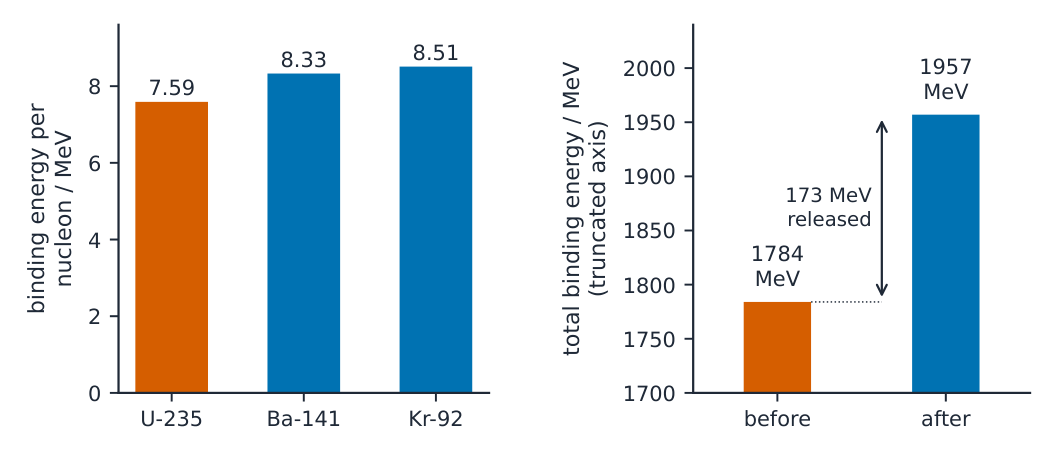
The fragments are nearer the peak of the binding energy curve than uranium, so they are more tightly bound. The energy released equals the increase in total binding energy.
Rounded per-nucleon values show the trend; total values are rounded from a mass-consistent calculation
From the displayed rounded per-nucleon inputs: $B_\mathrm{before}=235\times7.59=1783.65\ \text{MeV}$; the free incoming neutron has zero nuclear binding energy.
$B_\mathrm{after}=141\times8.33+92\times8.51=1957.45\ \text{MeV}$; free outgoing neutrons again contribute zero.
$Q=B_\mathrm{after}-B_\mathrm{before}=173.80\ \text{MeV}\approx174\ \text{MeV}$. Rounding the per-nucleon inputs explains the small difference from the more precise mass result, about 173 MeV. Do not truncate each intermediate product and claim exact agreement.
For a specified reaction, count only bound nucleons in each binding-energy total. Emitted free neutrons are included in mass accounting but do not receive the fragments' average binding energy per nucleon.
Energy from a kilogram of fuel
One kilogram of uranium-235 contains $\dfrac{1}{235 \times 1.661 \times 10^{-27}} = 2.56 \times 10^{24}$ nuclei. At 200 MeV ($3.2 \times 10^{-11}$ J) each, complete fission releases $8.2 \times 10^{13}$ J, about $2.7\times10^6$ times an assigned coal energy of $3.0\times10^7$ J per kilogram. This compares ideal complete fission of pure uranium-235 with that assigned chemical energy, not real fuel-pellet burnup or whole-plant efficiency.
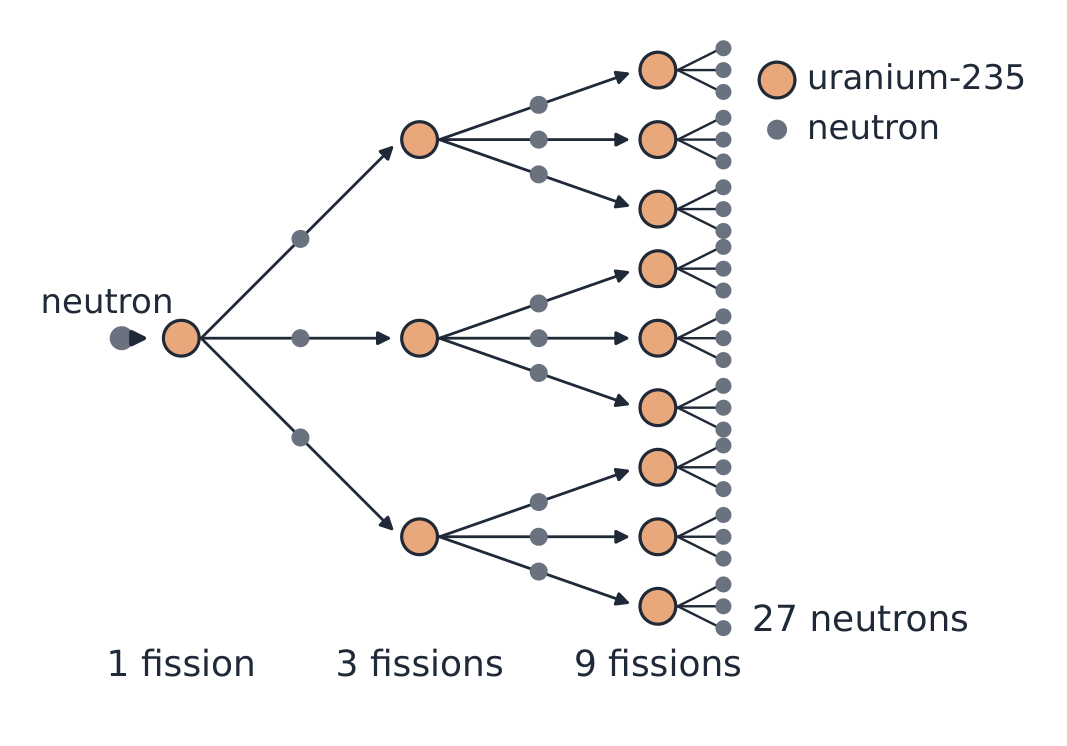
In the induced-fission chain model, a fission initiated by one neutron releases further neutrons. If these go on to cause more fissions, the reaction can keep itself going: a chain reaction 链式反应.
If every neutron caused a fission, the number of fissions would grow very quickly
If, on average, more than one neutron from each fission causes another fission, the expected fission rate grows. Growth alone is not a nuclear explosion: reactors can increase power in a controlled way, and the time response and feedback matter.
If, on average, exactly one does, the expected rate stays steady in this idealised generation model. This is the balance required at constant reactor power.
If fewer than one does, the reaction dies away.
Neutrons can be lost by escaping from the surface of the fuel or by being absorbed without causing fission. In a small piece of uranium too many escape. The critical mass 临界质量 is the minimum mass that can sustain a chain reaction for specified material and physical conditions. It is not a universal number attached only to an element; composition, geometry, surroundings and neutron losses affect the balance.
Natural uranium is mostly uranium-238 with roughly 0.7% uranium-235. Uranium-238 does not readily fission with thermal neutrons, although fast-neutron fission is possible and capture matters. Many light-water reactors use enriched uranium with a few percent uranium-235. Other designs can use natural uranium; neutron economy and reactor type matter.
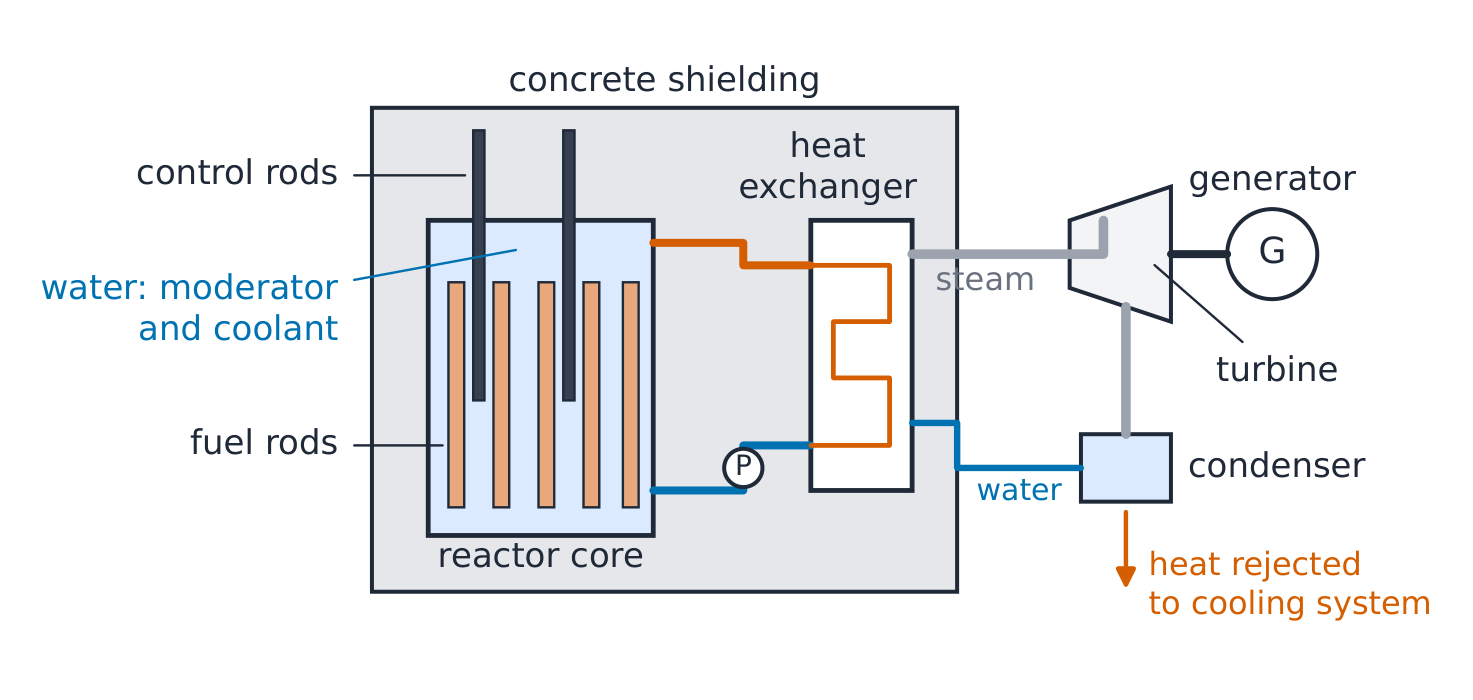
The energy chain: nuclear energy → kinetic energy of fragments → thermal energy of fuel and coolant → steam → kinetic energy of turbine → electrical energy from the generator.
Fission heats the coolant; the heat exchanger makes steam to turn the turbine
The moderator
Neutrons released in fission are fast (about 2 MeV). In a thermal reactor, uranium-235 has a much larger fission probability per target nucleus for slow neutrons than for typical fast fission neutrons. Around room temperature, thermal-neutron energies are of order 0.025 eV; the characteristic energy changes with moderator temperature. The moderator 慢化剂 slows the neutrons down.
Slowing a neutron collision by collision
Neutrons lose kinetic energy in elastic collisions with the nuclei of the moderator.
A neutron loses the most energy when it hits a nucleus of similar mass (think of a snooker ball hitting another snooker ball, rather than bouncing off a wall). So moderators contain light nuclei: water (hydrogen), heavy water or graphite (carbon).
Many collisions usually distribute energy to the moderator. Collision count depends on the material, scattering and initial/final energies, rather than one fixed count for all reactors.
The moderator must not absorb many neutrons itself.
The control rods
Control rods 控制棒 are made of a material such as boron or cadmium that absorbs neutrons strongly.
Control rods set the chain
Lowering them further into the core absorbs more neutrons, so fewer fissions occur and the power falls.
Raising them lets the rate rise.
They are adjusted so that, on average, exactly one neutron from each fission causes another. Shutdown systems insert neutron absorbers to suppress the self-sustaining chain; the insertion arrangement depends on the reactor. Decay heat remains, so cooling is still necessary. Moderation and absorption are distinct roles; a fast reactor does not use a moderator to thermalise its chain neutrons.
The heat exchanger
The coolant 冷却剂 carries thermal energy away from the core. In the pressurised-water reactor shown, high pressure keeps primary water liquid. A heat exchanger 热交换器 transfers heat through a separating wall to a secondary circuit, where water boils for the turbine. With intact barriers, bulk primary coolant and secondary water do not mix; the primary system may contain radioactive material.
This is one reactor design, not a universal circuit. The Department of Energy's reactor comparison distinguishes this from a boiling-water reactor, where steam is produced in the reactor vessel and goes to the turbine. The condenser returns steam to liquid water and transfers rejected heat to a cooling system; heat rejection is part of the energy balance, not an optional missing output.
Shielding
The core emits intense neutrons and gamma rays. A thick steel pressure vessel and a concrete shield 屏蔽层, several metres thick, attenuate radiation to reduce exposure. Shielding reduces radiation transmission; containment and fuel barriers limit escape of radioactive material. These are different functions, and no single wall guarantees every accident outcome. The building is also designed to contain radioactive material if there is an accident.
Worked example: fuel use
In an assigned idealised model, a station produces 1000 MW electrical at efficiency 33%. Take deposited energy per fission as 200 MeV, approximate each uranium-235 nucleus as 235 u, and assume steady operation.
This is uranium-235 fissioned, not total fuel loaded. Rejected thermal power is $1000/0.33-1000\approx2030$ MW. In a separate model with the same efficiency and coal energy $3.0\times10^7$ J per kilogram, required coal is about $8.7\times10^3$ tonnes per day.
Many primary fragments have too many neutrons for their size (heavy nuclei need a higher neutron–proton ratio than medium ones), so they are radioactive, mostly beta-minus and gamma emitters.
They have a wide range of half-lives, from seconds to millions of years.
Spent fuel is so radioactive that it is hot: it keeps producing thermal energy from decay after the reactor stops, and must be cooled.
Neutron capture followed by beta decays can convert some uranium-238 into plutonium-239 (half-life 24 000 years), which is radioactive, toxic, and can be used in nuclear weapons.
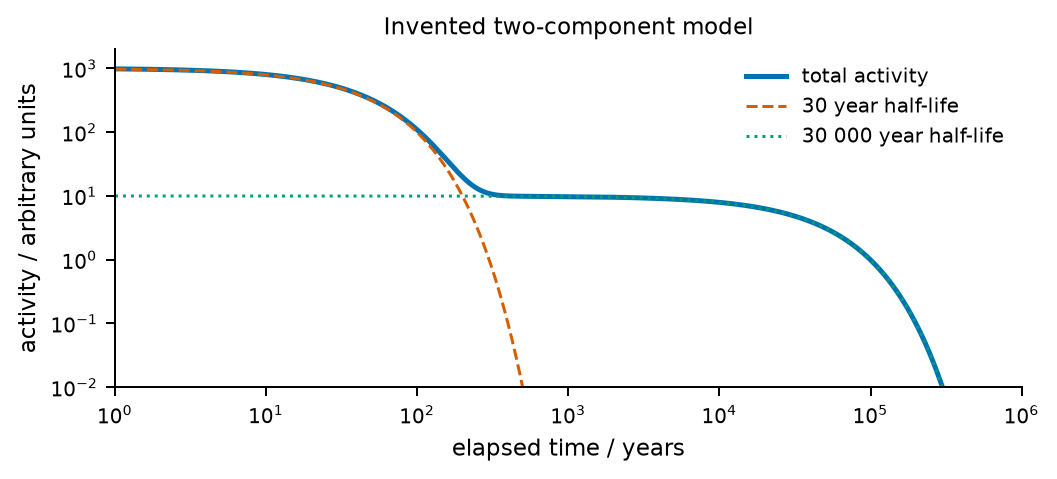
Mixture in arbitrary activity units, not a spent-fuel inventory, uranium-ore comparison or prediction of a safe disposal time
Managing nuclear waste
Nuclear waste 核废料 management considers activity, half-lives, heat generation and the physical/chemical form. Categories and acceptance rules are not determined by activity alone; ARPANSA's explanation illustrates this distinction.
Suitable low-level waste, such as some contaminated clothing and tools, may go to engineered near-surface facilities after conditioning. Not every used object belongs in that category.
Intermediate-level waste needs appropriate shielding and isolation; packages, depth and disposal routes depend on long-lived content and the waste acceptance criteria.
High-level waste, including spent fuel where declared waste, needs heat management and long-term isolation. Water pools initially remove decay heat and provide shielding. Later storage can use licensed dry casks; reprocessing is an alternative fuel-cycle route, not disposal and not elimination of all radioactive waste.
Some liquid high-level residues from reprocessing can be immobilised in glass, called vitrification. Intact spent-fuel assemblies need not be melted into glass. Geological disposal uses engineered packages and suitable rock to limit release and transport over long times.
The impact of long-term storage
Storage is monitored and can require continuing management. Geological disposal aims for long-term passive isolation using several barriers, rather than relying solely on containers remaining perfect or on future people actively operating a cooling pond forever.
A technical IAEA account describes geological disposal for high-activity and/or long-lived waste, including spent fuel. Site-specific groundwater, heat, material degradation and long-term geological change must be considered.
Security, records, safeguards, costs and community participation matter. No one generic activity curve establishes a universal time at which every spent fuel becomes safe or matches uranium ore; activity, heat and exposure risk are different quantities.
Fission and climate change
Fission is a debated part of the response to climate change.
Life-cycle emissions per kWh
For: almost no carbon dioxide is released while generating electricity; it can provide sustained output with a high fuel energy density. Mining, fuel preparation, construction and decommissioning still have environmental impacts, and cooling constraints or maintenance can limit output.
Against: long-lived radioactive waste; the risk of serious accidents (Chernobyl 1986, Fukushima 2011); high building costs and long construction times; links to nuclear weapons.
Distinguish between spontaneous fission and neutron-induced fission.
Complete the reaction ${}^{1}_{0}\text{n} + {}^{235}_{92}\text{U} \rightarrow {}^{140}_{54}\text{Xe} + {}^{94}_{38}\text{Sr} + x\,{}^{1}_{0}\text{n}$ by finding $x$, and check that charge is conserved.
For the reaction in question 2, the atomic masses are uranium-235 235.043930 u, xenon-140 139.921641 u and strontium-94 93.915361 u. Find the energy released in MeV and in J.
For the balanced reaction in question 2, use uranium-235 binding energy per nucleon 7.6 MeV and the fragments' mean 8.5 MeV. Estimate released energy, accounting for free neutrons.
Explain why the products of fission have less total mass than the original nucleus and neutron.
(a) Explain what is meant by a chain reaction and by critical mass. (b) State what must be true about the neutrons from each fission for a reactor to run at a steady power.
Explain the role of the moderator, and why light nuclei make good moderators.
Explain how the control rods control the power of a reactor, and what happens if they are raised.
(a) For the pressurised-water design shown, explain the heat exchanger and separate primary loop. Is that circuit universal for every reactor? (b) State the purpose of the shielding, and what it must absorb.
A power station has an electrical output of 600 MW and an efficiency of 32 %. Each fission releases 200 MeV. Find the mass of uranium-235 used in one year ($3.16 \times 10^7$ s). Treat 200 MeV as deposited energy, operation as steady, and each uranium-235 nucleus as 235 u. Distinguish this mass from total fuel loaded.
Explain why fission fragments are radioactive, and state the type of decay they usually undergo.
Describe how high-level nuclear waste is managed, and discuss two problems of storing it for a long time.
Why do many light-water reactors use enriched uranium, and why should this not be stated as a requirement for every reactor?
Discuss one advantage and one disadvantage of nuclear fission as a way of reducing carbon dioxide emissions.
Answers.
Spontaneous fission happens by itself, randomly, without any outside cause; neutron-induced fission happens when a nucleus absorbs a neutron and becomes unstable.
$B_\mathrm{before}=235\times7.6=1786$ MeV. The two fragments have $140+94=234$ bound nucleons, so $B_\mathrm{after}=234\times8.5=1989$ MeV; $Q=1989-1786=203$ MeV, about $2.0\times10^2$ MeV. Free neutrons have zero nuclear binding energy; the rounded assigned inputs give an estimate rather than the precise mass result.
The fragments are more tightly bound (higher binding energy per nucleon), so energy is released when they form; by $E = mc^2$ this energy corresponds to a decrease in mass.
(a) A chain reaction is one in which neutrons released by each fission go on to cause further fissions, so the reaction keeps itself going. Critical mass is the smallest mass of fuel in which this can be sustained, because in a smaller mass too many neutrons escape. The critical mass depends on specified composition and physical conditions, not the element alone. (b) On average, exactly one neutron from each fission must cause another fission.
It slows fast neutrons down by elastic collisions, so that they are much more likely to be absorbed by uranium-235 and cause fission. A neutron loses most energy in a collision with a nucleus of similar mass, so light nuclei such as hydrogen or carbon are used.
They absorb neutrons, so fewer neutrons are available to cause fission. Raising them absorbs fewer neutrons, so the rate of fission and the power increase. This can be a controlled increase, not necessarily an explosion. Shutdown does not remove existing radioactive products or their decay heat.
(a) In a pressurised-water reactor, primary coolant transfers heat through a wall to secondary water, producing turbine steam without normal bulk mixing. This limits transfer of primary radioactive material. A boiling-water reactor instead makes steam in the reactor vessel; the two-loop diagram is not universal. (b) To protect workers and the environment by absorbing the neutrons and gamma rays from the core.
Thermal power $= 600/0.32 = 1875\ \text{MW}$. Fissions per second $= (1.875 \times 10^9)/(3.2 \times 10^{-11}) = 5.9 \times 10^{19}$. Per year: $1.85 \times 10^{27}$ nuclei, mass $= 1.85 \times 10^{27} \times 235 \times 1.661 \times 10^{-27} = 7.2 \times 10^2\ \text{kg}$. This is the uranium-235 actually fissioned under the assigned model, not total fuel-assembly replacement mass.
They have too many neutrons for their size (a neutron–proton ratio too high for medium nuclei), so they are unstable; they usually decay by beta-minus emission, often with gamma rays.
Initially remove decay heat and provide shielding, commonly in water pools; later storage may use dry casks. Reprocessing recovers materials but leaves radioactive waste. Some residues can be vitrified; intact spent fuel need not be. Geological disposal aims at passive isolation. Long-term problems include heat and long-lived activity, groundwater transport/barrier degradation, security/safeguards, costs/records and site acceptance. A generic activity curve gives no universal safe-time threshold.
Natural uranium has only roughly 0.7% uranium-235. Many light-water reactors need a higher fissile fraction to offset neutron losses and sustain their intended chain. Other reactor designs can use natural uranium; moderation, absorption, leakage and fuel properties differ.
Low direct operational carbon emissions and sustained output are advantages; long-lived waste/decay heat, accident risk, cost/construction time and security concerns are disadvantages. This does not imply zero lifecycle impact or uninterrupted output.
23.8
考试技巧
English
Balance $A$, $Z$ and every neutron in the reaction.
Calculate $Q$ from precise rest masses or total binding energies.