This handout teaches B.1 Thermal energy transfers in full, for the course first assessed in 2025. There is no additional higher level content in B.1, so SL and HL students study the same material.
Prerequisites: energy stores, work and power from A.3; area and volume; powers of ten. Use $k_B = 1.38 \times 10^{-23}\ \text{J K}^{-1}$, $\sigma = 5.67 \times 10^{-8}\ \text{W m}^{-2}\ \text{K}^{-4}$ and $c_{\text{water}} = 4200\ \text{J kg}^{-1}\ \text{K}^{-1}$.
6.2
固体、液体和气体中的粒子
English
Why does a puddle disappear?
On a warm afternoon a puddle dries up long before it could ever boil. A metal bench in the sun feels much hotter than a wooden one at the same temperature, and a cup of tea cools faster with the lid off. All of these follow from one idea: matter is made of particles that are always moving, and energy moves between them. This unit builds that model and then uses it to measure energy transfers.
The molecular model
The molecular model 分子模型 explains the three states of matter by the arrangement, spacing and motion of the particles.
The three states differ in particle spacing, arrangement and motion
State
Arrangement and spacing
Motion
Forces between particles
solid
closely packed; crystalline solids are regular, amorphous solids lack long-range order
vibrate about fixed positions
strong; fixed shape and volume
liquid
irregular, still close together
vibrate and slide past each other
weaker; fixed volume, takes the container's shape
gas
random, widely spaced in a dilute gas; spacing depends on conditions
move fast in straight lines between collisions
almost none; fills any container
A dilute gas is readily compressed because of its large particle spacing. The gas-to-liquid volume ratio for the same mass depends on temperature, pressure and substance; a factor of order 1000 is an illustration at familiar pressures, not a fixed law.
Density
Density 密度 is mass per unit volume:
$$\rho = \frac{m}{V}$$
in kg m⁻³. A block of aluminium measuring 10 cm × 10 cm × 2.0 cm has mass 0.54 kg, so $\rho = 0.54 / (0.10 \times 0.10 \times 0.020) = 2700\ \text{kg m}^{-3}$. Water has density 1000 kg m⁻³ and air about 1.2 kg m⁻³: the large gap between them is the wide particle spacing in a gas. Convert to metres before calculating: $1\ \text{cm}^3 = 10^{-6}\ \text{m}^3$.
At standard atmospheric pressure, pure water melts near 0 °C and boils near 100 °C on the Celsius scale 摄氏温标. The Kelvin scale 开尔文温标 starts at absolute zero 绝对零度, the lowest possible temperature, where the particles have their minimum energy:
A thermometer measures temperature on a defined scale.
$$T/\text{K} = \theta/°\text{C} + 273.15$$
Use the rounded offset 273 in the numerical examples here: 27 °C is about 300 K and liquid nitrogen at −196 °C about 77 K. One kelvin is the same size as one degree Celsius, so a change in temperature is the same number on both scales: warming from 20 °C to 50 °C is a rise of 30 °C and of 30 K. Always use kelvin in an equation that contains $T$ itself rather than $\Delta T$.
Extrapolating the pressure–temperature line back to zero pressure gives absolute zero, about −273 °C
Temperature measures particle kinetic energy
In the classical ideal-gas model, kelvin temperature sets the average kinetic energy 平均动能 of translational motion per particle:
$$\overline{E}_k = \frac{3}{2}k_B T$$
where $k_B$ is the Boltzmann constant 玻尔兹曼常数. At 300 K, $\overline{E}_k = 1.5 \times 1.38 \times 10^{-23} \times 300 = 6.2 \times 10^{-21}\ \text{J}$. Doubling the kelvin temperature to 600 K doubles this mean translational kinetic energy; doubling a Celsius temperature does not. This relation does not include every possible rotational, vibrational or interaction-energy contribution in all materials.
Internal energy
The internal energy 内能 of a system is the total intermolecular potential energy, from the forces between the particles, plus the total random kinetic energy of the particles. In the classical ideal-gas model, temperature determines the average translational kinetic energy per particle; this is not a general equation for every contribution in every material. A bath of warm water has much more internal energy than a cup of boiling water, because it has so many more particles, even though its temperature is lower.
Internal energy is the molecules' random kinetic energy (the arrows) plus the potential energy of the forces between them (the springs)
The direction of thermal energy transfer
For spontaneous thermal exchange between two bodies in contact, the net transfer is from the body at the higher temperature to the body at the lower temperature, whatever their sizes or internal energies. At equal temperatures, opposing microscopic exchanges balance; the net thermal transfer is zero: the bodies are then in thermal equilibrium 热平衡. A small hot coin dropped into a large cold bath gives energy to the bath, even though the bath has more internal energy.
Heat flows from hot to cold until both reach the same temperature — thermal equilibrium
The specific heat capacity 比热容$c$ of a substance is the energy needed to raise the temperature of 1 kg of it by 1 K:
$$Q = mc\Delta T$$
in J kg⁻¹ K⁻¹. Water has a very large value, 4200 J kg⁻¹ K⁻¹; copper only 390 J kg⁻¹ K⁻¹. The same energy warms 1 kg of copper about 11 times more than 1 kg of water, which is why a metal pan heats up quickly while the water in it heats slowly.
Worked example: a kettle heats 1.5 kg of water from 20 °C to 100 °C.
With a 2.2 kW element and no losses, $t = Q/P = 504\,000 / 2200 = 230\ \text{s}$, nearly 4 minutes.
Measuring a specific heat capacity
In the lab: an electric heater of known power $P$ sits in an insulated metal block of mass $m$. Record the temperature every minute while the heater is on for a time $t$. Then $c = Pt/(m\Delta T)$, or $c = P / (m \times \text{gradient})$ from a temperature–time graph. Energy lost to the surroundings makes the measured $\Delta T$ too small, so the value of $c$ is too large. Reduce the error with insulation, good thermal contact (a drop of oil around the thermometer) and by starting a few degrees below room temperature.
Energy in from the joulemeter, temperature rise from the thermometer: $c = Pt/(m\,\Delta T)$
Mixing and the energy account
When a hot body and a cold body reach thermal equilibrium with no losses:
Energy lost equals energy gained
$$\text{energy lost by the hot body} = \text{energy gained by the cold body}$$
Worked example: 0.20 kg of copper ($c = 390$) at 100 °C is dropped into 0.30 kg of water at 20 °C. Let the final temperature be $T$.
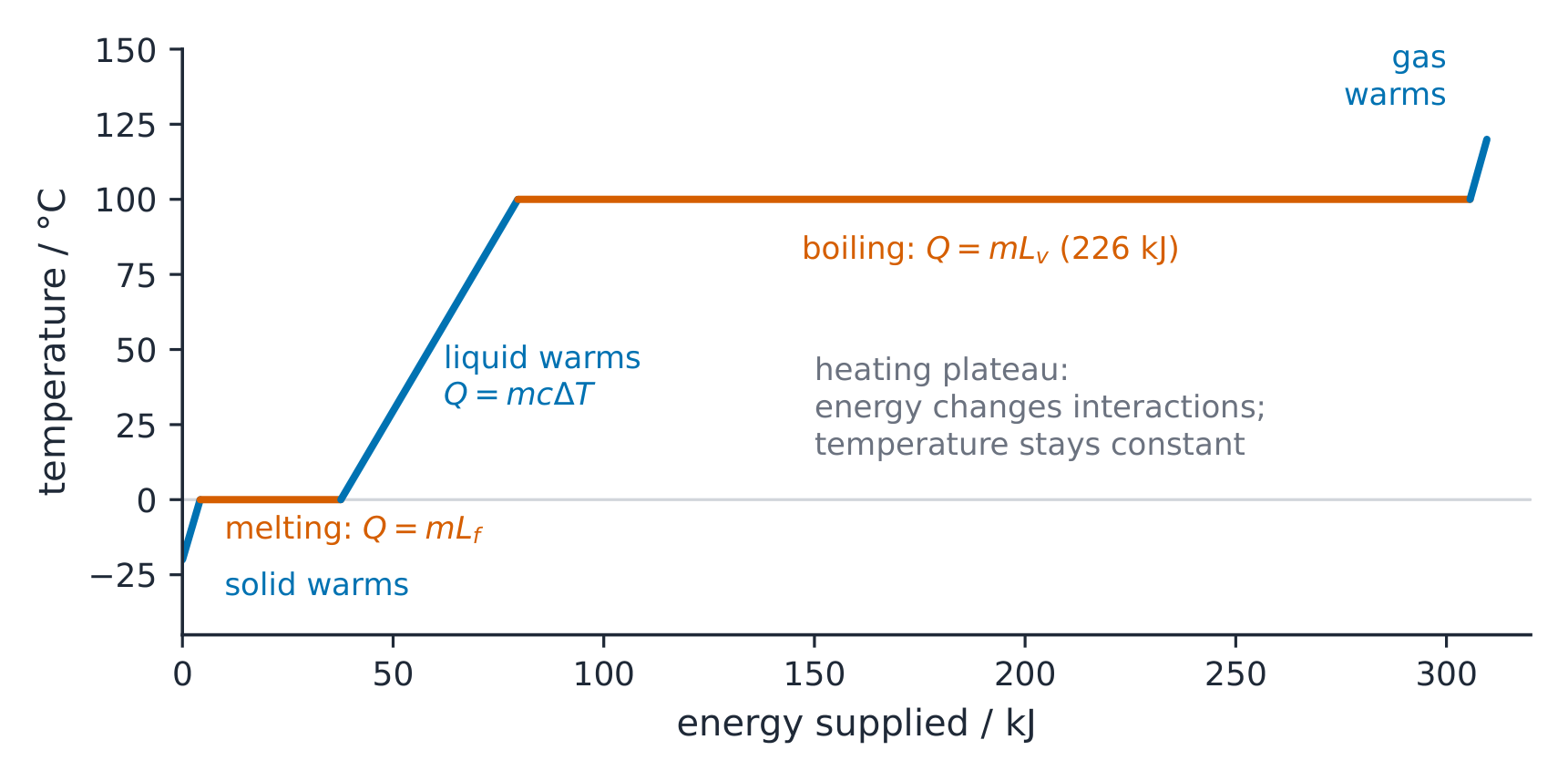
A phase change 相变 is a change of state: melting 熔化, freezing 凝固, boiling 沸腾, condensing 凝结 or evaporation. For a pure substance changing phase at fixed pressure, energy can be transferred while temperature stays constant. In the particle model, melting or vaporization raises interaction potential energy; freezing or condensation releases energy and lowers it. The modeled mean kinetic energy stays unchanged during the ideal plateau. Melting ice and boiling water change intermolecular interactions, not the covalent bonds inside each water molecule.
Each flat step is a phase change; boiling 0.10 kg of water takes more than five times the energy of heating it from 0 °C to 100 °C
Specific latent heat
The specific latent heat 比潜热$L$ is the energy transferred per kilogram for a stated phase change at constant temperature. With $L$ written as a positive magnitude:
Boiling water: at 100 °C the energy supplied changes liquid into steam instead of raising the temperature, and the energy per kilogram is the specific latent heat
$$Q = mL$$
in J kg⁻¹. This is energy absorbed for melting or vaporization and released for the reverse changes under the same conditions. Use the specific latent heat of fusion 熔化比潜热$L_f$ for melting or freezing and the specific latent heat of vaporization 汽化比潜热$L_v$ for boiling or condensing. For water, $L_f = 3.34 \times 10^5\ \text{J kg}^{-1}$ and $L_v = 2.26 \times 10^6\ \text{J kg}^{-1}$. $L_v$ is much larger because the particles must be pulled completely apart into a gas, not just loosened.
The heating curve above is an energy account for 0.10 kg of ice:
Stage
Equation
Energy / kJ
ice −20 °C → 0 °C
$0.10 \times 2100 \times 20$
4.2
melt at 0 °C
$0.10 \times 3.34 \times 10^5$
33.4
water 0 °C → 100 °C
$0.10 \times 4200 \times 100$
42
boil at 100 °C
$0.10 \times 2.26 \times 10^6$
226
At constant power the length of each plateau is proportional to $mL$, and the slope of each rising part is proportional to $1/(mc)$: the ice line is steeper than the water line because ice has the smaller $c$.
Ice in a drink
Worked example: 0.050 kg of ice at 0 °C is added to 0.25 kg of water at 30 °C. Find the final temperature $T$.
Energy to melt the ice: $0.050 \times 3.34 \times 10^5 = 16\,700\ \text{J}$.
The warm water loses $0.25 \times 4200 \times (30 - T)$; the melted ice then gains $0.050 \times 4200 \times T$.
Forgetting the melting step would give 25 °C, far too warm.
Evaporation and boiling
Evaporation 蒸发 happens at any temperature, only at the surface: particles with sufficient energy escape from the surface, tending to reduce the mean kinetic energy of those left. The liquid cools unless another transfer supplies the energy. This is why sweating cools you and why the puddle dries. Boiling occurs throughout the liquid, with vapour bubbles forming inside it. Its temperature depends on pressure and composition; for a pure substance at fixed pressure, the ideal boiling stage has constant temperature.
specific latent heat of fusion/spəˈsɪfɪk ˈleɪtənt hiːt ɒv ˈfjuːʒn/
熔化比潜热
róng huà bǐ qián rè
specific latent heat of vaporization
汽化比潜热
qì huà bǐ qián rè
evaporation/ɪˌvæpəˈreɪʃn/
蒸发
zhēng fā
6.6
传导
English
Particles passing on energy
The three mechanisms of thermal energy transfer are conduction, convection and thermal radiation. In conduction 热传导, particles at the hot end have more kinetic energy; they collide with their slower neighbours and pass energy along. Many metals conduct well because their free electrons move quickly through the whole lattice and carry energy with them. Dilute gases generally conduct less effectively than good metal conductors; microscopic collisions still transfer energy.
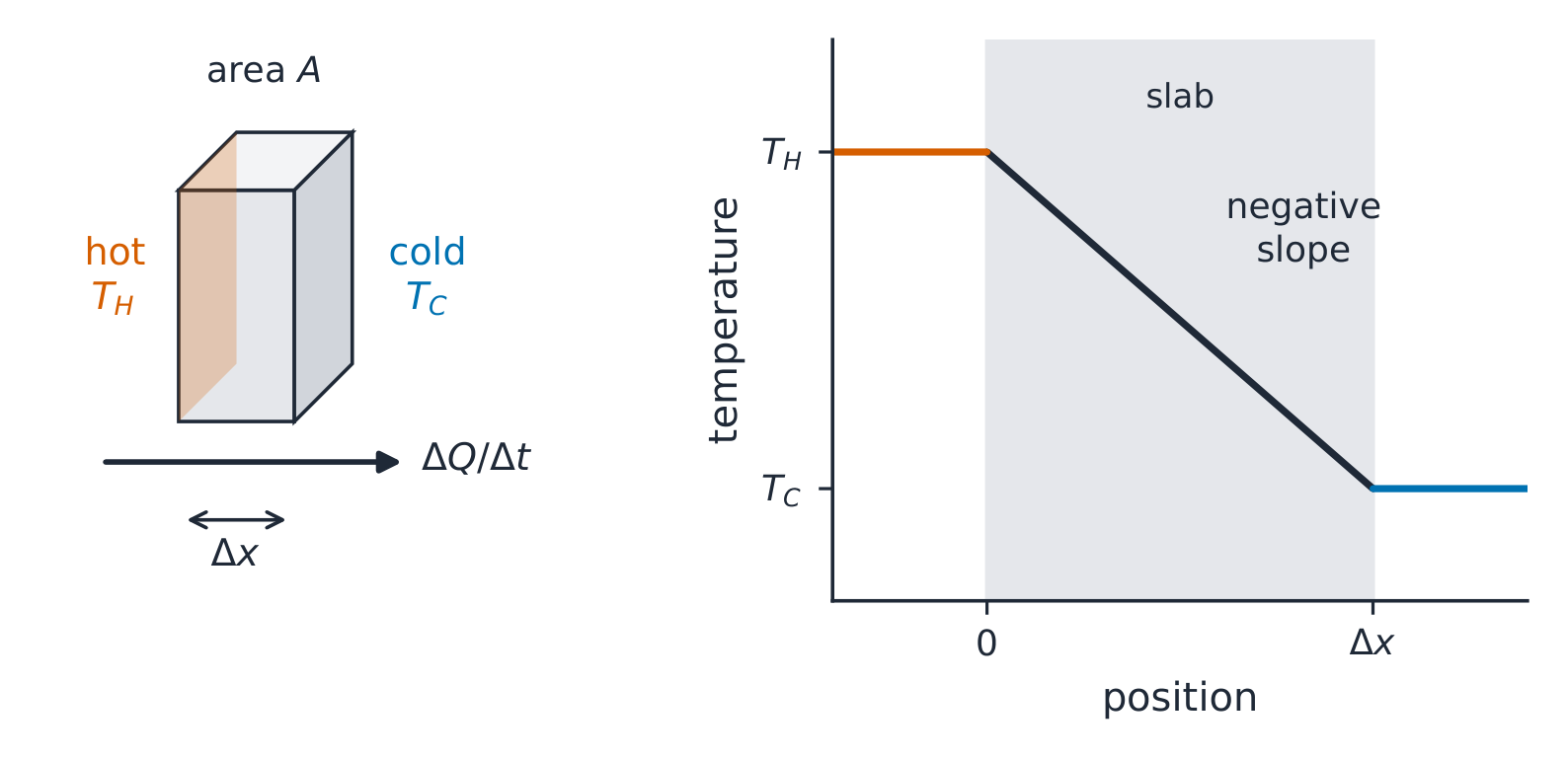
The rate of conduction depends on the material, the area and the temperature gradient across the slab
The rate of conduction
For a uniform slab at steady state, with constant conductivity, use the magnitude of the face-to-face temperature difference, $\Delta T=T_H-T_C>0$. The temperature gradient along the hot-to-cold direction is negative; this positive formula gives the power magnitude:
A 12 mm layer of still air with 15 K across it conducts only $0.025 \times 1.5 \times 15 / 0.012 = 47\ \text{W}$. Double glazing traps a layer of air for this reason.
Real windows lose much less than 6000 W because a layer of still air clings to each surface and takes most of the temperature difference.
Convection 对流 transfers energy by the bulk movement of a fluid, a liquid or a gas. In ordinary free convection under gravity, fluid near a heater warms, expands and becomes less dense, so buoyancy makes it rise; cooler fluid replaces it, forming a convection current 对流环流. A fan or pump can drive forced convection without relying on buoyant rise. A material remaining solid cannot form a bulk fluid circulation internally.
A low heater can establish room-air circulation. Some refrigerators use buoyant circulation; others use fans and may place the freezer below.
Sea breezes: by day the land warms faster than the sea, warm air rises over the land and cooler air flows in from the sea.
A lid reduces evaporation and some convective transfer from a drink; conduction and radiation can still remove energy.
A convection current: the sea breeze is its lower branch
Every body above absolute zero emits thermal radiation 热辐射, electromagnetic waves (mostly infrared at everyday temperatures) from its surface. Radiation needs no material medium and carries the main solar energy transfer across space to Earth. A black body 黑体 is an ideal surface that absorbs all radiation falling on it and is also the best possible emitter. Stars are close to black bodies.
The Stefan–Boltzmann law
The total power radiated by a black body is its luminosity 光度$L$:
$$L = \sigma A T^4$$
where $\sigma$ is the Stefan–Boltzmann constant 斯特藩玻尔兹曼常量, $A$ is the surface area and $T$ is the absolute temperature. Because of the fourth power, doubling the kelvin temperature multiplies the power by 16.
Worked example: the Sun has radius $6.96 \times 10^8\ \text{m}$ and surface temperature 5800 K.
A body also absorbs radiation from its surroundings. In a black-surface enclosure model, a 1.8 m² surface at 306 K emits about 890 W and absorbs about 750 W from 293 K surroundings, giving about 140 W net radiative loss. Emission does not stop at thermal equilibrium: absorption then balances it. These are approximate radiative terms, not a person’s total heat loss; real surfaces, clothing and geometry affect them.
The black-body spectrum and Wien's law
A black body emits a continuous spectrum with a peak. As the temperature rises the whole curve grows, and the peak moves to shorter wavelength. Wien's displacement law 维恩位移定律 links the peak wavelength to the temperature:
$$\lambda_{\max} T = 2.9 \times 10^{-3}\ \text{m K}$$
Hotter bodies emit more at every wavelength, and their peak moves to shorter wavelength
The Sun at 5800 K peaks at $2.9 \times 10^{-3} / 5800 = 5.0 \times 10^{-7}\ \text{m} = 500\ \text{nm}$, in the visible.
A filament lamp at 2900 K peaks at 1.0 μm, in the infrared, so most of its energy is not light.
The human body at 310 K peaks at 9.4 μm; thermal cameras detect this.
A thermal (infrared) camera maps temperature to colour: the hot fries glow bright orange, the cold drink stays dark
The colour of a star tells its temperature: red stars are cooler, blue-white stars are hotter.
The apparent brightness 视亮度$b$ of a star is the power received per unit area at the observer, in W m⁻². For isotropic emission, negligible intervening absorption and distance much larger than the source, luminosity spreads over a sphere of radius $d$:
$$b = \frac{L}{4\pi d^2}$$
This is an inverse-square law: twice as far away, a quarter as bright. At the Earth, $d = 1.5 \times 10^{11}\ \text{m}$, so the Sun's apparent brightness is $3.9 \times 10^{26} / (4\pi \times (1.5 \times 10^{11})^2) = 1.4 \times 10^3\ \text{W m}^{-2}$.
The same power spreads over a sphere of area $4\pi d^2$
Using brightness, colour and luminosity together
A star's luminosity is often given as a multiple of the Sun's, $L_\odot = 3.8 \times 10^{26}\ \text{W}$. Astronomers measure $b$ and $\lambda_{\max}$, then combine the laws:
Wien's law gives the surface temperature $T$.
If the distance is known, $L = 4\pi d^2 b$.
Then $L = \sigma 4\pi R^2 T^4$ gives the radius.
Worked example: a red star has $T = 3500\ \text{K}$ and $L = 1.0 \times 10^5 L_\odot$. Compare its radius with the Sun's ($T_\odot = 5800\ \text{K}$).
Convert (a) 25 °C to kelvin, (b) 4.0 K to degrees Celsius. A liquid warms from 15 °C to 60 °C: state the temperature rise in kelvin.
Explain, using the molecular model, why a gas is easy to compress but a liquid is not.
A gold ring has mass 7.7 g and volume 0.40 cm³. Find its density in kg m⁻³.
Find the average kinetic energy of the particles of a gas at 127 °C.
A 2.0 kW heater warms 0.80 kg of oil from 20 °C to 70 °C in 40 s. Find the specific heat capacity of the oil, and state whether heat loss makes your value too high or too low.
0.30 kg of water at 80 °C is mixed with 0.20 kg of water at 20 °C. Find the final temperature.
Find the energy needed to turn 0.25 kg of water at 100 °C into steam at 100 °C.
Explain why the temperature stays constant while a solid melts, even though energy is still being supplied.
A copper rod of length 0.50 m and cross-sectional area $1.0 \times 10^{-4}\ \text{m}^2$ has its ends at 100 °C and 20 °C. Find the rate of conduction ($k = 390\ \text{W m}^{-1}\ \text{K}^{-1}$).
Explain how a convection current forms above a radiator.
Model a hotplate as an ideal black body of radiating area 0.040 m² is at 500 K. Find the power it radiates. Find the factor by which this changes if it is heated to 1000 K.
A star has $\lambda_{\max} = 290\ \text{nm}$. Find its surface temperature and state its colour.
A star of luminosity $3.8 \times 10^{28}\ \text{W}$ has apparent brightness $2.0 \times 10^{-9}\ \text{W m}^{-2}$ at the Earth. Find its distance in metres.
Star X has twice the surface temperature of star Y and the same luminosity. Find the ratio of their radii $R_X / R_Y$.
Answers.
(a) 298 K. (b) −269 °C. A rise of 45 K.
Gas particles are far apart with mostly empty space between them, so pressing moves them closer. Liquid particles are already touching, so the volume barely changes.
$c = Pt / (m\Delta T) = 2000 \times 40 / (0.80 \times 50) = 2000\ \text{J kg}^{-1}\ \text{K}^{-1}$. Too high: some of the 80 kJ went to the surroundings, so the oil's real energy gain was smaller.
During an ideal pure-substance melting stage at fixed pressure, energy changes interparticle arrangements and raises interaction potential energy while temperature and modeled mean kinetic energy remain unchanged. For ice, this does not break the covalent bonds inside water molecules.
Air next to the radiator warms, expands and becomes less dense, so it rises. Cooler, denser air moves in to replace it, is warmed in turn, and a circulating current carries energy around the room.
$L = 5.67 \times 10^{-8} \times 0.040 \times 500^4 = 140\ \text{W}$. Doubling $T$ multiplies the power by $2^4 = 16$, to about 2300 W.
$L \propto R^2 T^4$, so $R^2 \propto 1/T^4$ at equal $L$: $R_X / R_Y = 1/2^2 = 1/4$.
6.11
考试技巧
English
Use kelvin for absolute temperature in gas-energy, radiation and Wien equations. Temperature changes have the same numerical value in K and °C.
In the classical ideal-gas model, temperature tracks mean translational kinetic energy per particle; internal energy includes total microscopic kinetic and interaction potential energies.
In mixing, balance all gains and losses, including each phase change and any significant container heat capacity.
A fixed-pressure pure-substance phase-change plateau has continuing input; a measured plateau can also reflect balanced input and losses.
Unaccounted heat losses make an experimentally inferred specific heat capacity too large.