This handout teaches E.2 Quantum physics in full, for the course first assessed in 2025. The whole unit is additional higher level (AHL); there is no SL counterpart.
Prerequisites: photons, $E = hf$ and energy levels from E.1; the electronvolt and potential difference from B.5 and D.2; momentum and conservation of momentum and energy from A.2 and A.3; single-slit diffraction from C.3. Use $h = 6.63 \times 10^{-34}\ \text{J s}$, $e = 1.60 \times 10^{-19}\ \text{C}$, $m_e = 9.11 \times 10^{-31}\ \text{kg}$ and $c = 3.00 \times 10^8\ \text{m s}^{-1}$.
21.2
AHL:光电效应
English
Why can a dim ultraviolet lamp do what a bright red lamp cannot?
Put a clean zinc plate on a negatively charged electroscope. Under ordinary single-photon conditions, suitable ultraviolet light can release electrons and discharge it, while bright red light cannot overcome the surface escape threshold. Brightness affects the rate when emission is allowed; it is not irrelevant. The example assumes a clean surface and negligible heating or other discharge mechanisms.
A photomultiplier tube: each photon striking its photocathode can free one electron, which the tube multiplies into a measurable pulseEnergy per photon decides emission
A vacuum photocell collects electrons emitted from a surface. Solar cells and many solid-state sensors instead excite carriers within a semiconductor; the Department of Energy's solar-cell explanation describes this internal process. Both involve light transferring energy to electrons, but they are not the same apparatus or escape-barrier model.
What happens
The photoelectric effect 光电效应 is the emission of electrons from a metal surface when electromagnetic radiation of high enough frequency falls on it. The emitted electrons are called photoelectrons 光电子.
A photocell: light releases electrons from the cathode, and the microammeter measures them
In the ordinary single-photon regime, the experiments show:
For each metal there is a threshold frequency 截止频率$f_0$. Below $f_0$, single-photon emission is absent below threshold. This statement does not cover arbitrarily strong fields or other emission processes.
Above $f_0$, there is no measurable long energy-accumulation delay, even with dim light; individual absorption/emission events remain probabilistic.
The maximum kinetic energy of the photoelectrons increases with the frequency of the light, but does not depend on its intensity.
At fixed frequency and surface efficiency, emitted-electron rate scales with intensity. Saturation current is proportional to this rate when essentially all emitted electrons are collected. Intensity itself is energy per unit area per unit time, not a photon count.
If light were only a wave, its energy would arrive continuously and spread evenly over the surface. An electron would absorb energy gradually until it had enough to escape.
Wave predictions against the evidence
The wave theory predicts
The experiments show
Light of any frequency releases electrons if it is bright enough.
Below the threshold frequency no electrons are released, however bright the light.
With dim light, an electron needs time to absorb enough energy, so there is a delay.
Emission starts immediately, with no measurable delay, even for very dim light.
Brighter light gives the electrons more energy, so $E_\text{max}$ increases with intensity.
$E_\text{max}$ does not depend on intensity.
Frequency has no special effect on the energy of the electrons.
$E_\text{max}$ increases linearly with frequency.
This classical continuous-energy accumulation account fails to explain these observations. Photon energy transfer explains them, while interference and diffraction still require a wave description.
21.4
AHL:爱因斯坦的解释
English
In 1905 Einstein proposed that light consists of photons, each with energy $E = hf$, and that:
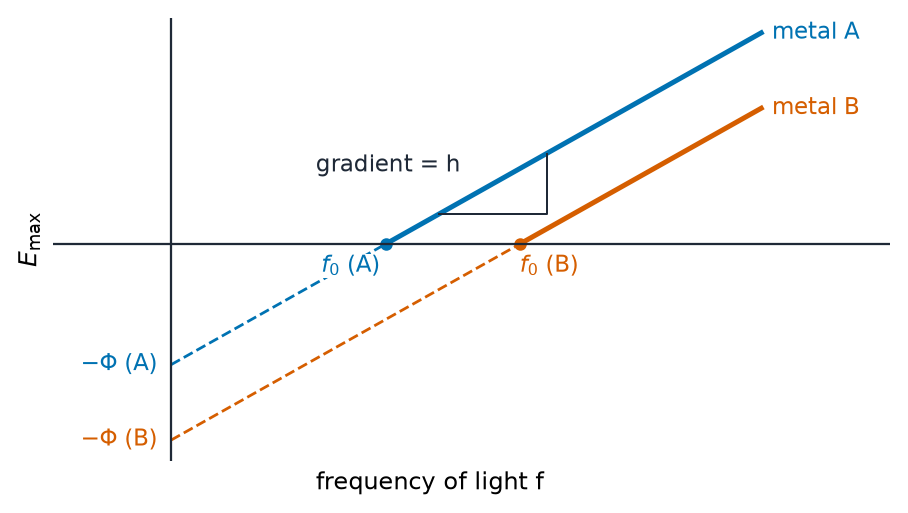
Two metals on one graph: parallel lines (the gradient is the Planck constant for both), each cutting the frequency axis at its own threshold and the energy axis at minus its own work function
one photon gives all its energy to one electron, at once;
the electron needs a minimum energy, the work function 逸出功$\Phi$ of the metal, to escape from the surface;
any energy left over becomes the kinetic energy of the electron.
For the electrons that escape most easily:
$$E_\text{max} = hf - \Phi$$
This explains every observation:
Threshold frequency. If $hf < \Phi$, a photon does not have enough energy to free an electron, in the elementary single-photon model. So this model requires $f \ge f_0$, where $hf_0 = \Phi$.
No delay. Absorption supplies a packet without a long accumulation period; not every incident photon is absorbed or releases a collected electron.
Intensity. At fixed frequency, brighter light means a greater photon arrival rate. With fixed emission efficiency and complete collection, saturation current increases. Individual photon energy stays fixed, so the ideal $E_\text{max}$ is unchanged.
Frequency. Each photon's energy $hf$ rises with frequency, so $E_\text{max}$ rises linearly with $f$.
Every metal gives a line of gradient h; the intercepts give f₀ and −Φ
On a graph of $E_\text{max}$ against $f$:
the gradient is $h$ when energy is in joules and frequency in hertz; with energy in eV the numerical gradient is $h/e$ in eV s;
the intercept on the frequency axis is the threshold frequency $f_0$;
the line extended back meets the energy axis at $-\Phi$.
Worked example
For this zinc-surface calculation, take the work function as 4.3 eV. Actual work function depends on surface condition.
Threshold frequency: $f_0 = \Phi/h = (4.3 \times 1.60 \times 10^{-19})/(6.63 \times 10^{-34}) = 1.0 \times 10^{15}\ \text{Hz}$, a wavelength of about 290 nm (ultraviolet).
Red light of 700 nm has photons of $hc/\lambda = 2.8 \times 10^{-19}\ \text{J} = 1.8\ \text{eV}$, less than 4.3 eV: no emission, however bright.
Ultraviolet of 200 nm has photons of 6.2 eV, so $E_\text{max} \approx 1.9\ \text{eV}$. Carrying the unrounded photon energy gives $E_\text{max} \approx 3.1 \times 10^{-19}\ \text{J}$, and the fastest electrons have $v = \sqrt{2E_\text{max}/m_e} = 8.2 \times 10^5\ \text{m s}^{-1}$.
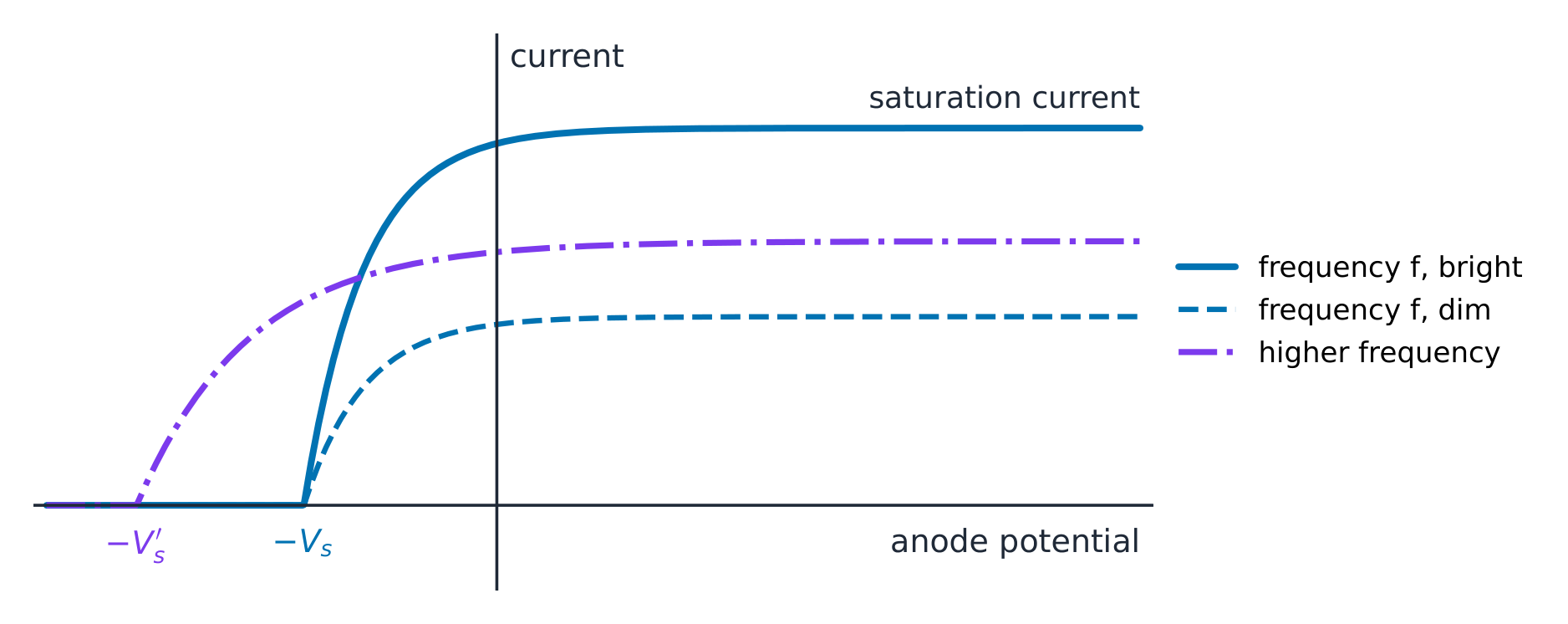
In the photocell circuit, the supply can be reversed so that the anode is negative. The electrons then slow down as they cross. The stopping potential 遏止电压$V_s$ is the smallest reverse potential difference that stops even the fastest electrons, so the current falls to zero:
$$eV_s = E_\text{max}$$
Intensity changes the current; frequency changes the stopping potential
Brighter light, same frequency: larger saturation current (more electrons per second), same stopping potential (same $E_\text{max}$).
Higher frequency: larger stopping potential.
Combining the equations gives $V_s = \dfrac{h}{e}f - \dfrac{\Phi}{e}$, so a graph of $V_s$ against $f$ has gradient $h/e$. This is the principle of Millikan's 1916 photoelectric determination; real measurements require attention to surface and voltage offsets.
Worked example: for ultraviolet of 200 nm on zinc, $E_\text{max} = 1.9\ \text{eV}$, so the stopping potential is 1.9 V.
In 1924 Louis de Broglie suggested that if light waves can behave as particles, then particles such as electrons might behave as waves. Every particle with momentum $p$ has a de Broglie wavelength 德布罗意波长:
Faster electrons, shorter waves
$$\lambda = \frac{h}{p}$$
For massive particles in the non-relativistic model, $p=mv$, giving $\lambda=h/(mv)$. High-energy electrons need relativistic momentum; the basic $h/p$ relation remains applicable.
A photon also has momentum, $p = h/\lambda$, although its rest mass is zero, with $p=E/c$ in vacuum.
For a non-relativistic electron accelerated from rest through a positive voltage magnitude $V$: $\tfrac{1}{2}mv^2 = eV$, so $p = \sqrt{2m_e eV}$ and $\lambda = \dfrac{h}{\sqrt{2m_e eV}}$.
Worked examples
An electron accelerated through 100 V: $p = \sqrt{2 \times 9.11 \times 10^{-31} \times 1.60 \times 10^{-19} \times 100} = 5.4 \times 10^{-24}\ \text{kg m s}^{-1}$, so $\lambda = 6.63 \times 10^{-34}/5.4 \times 10^{-24} = 1.2 \times 10^{-10}\ \text{m}$. This is about the spacing of atoms in a crystal, so a crystal can diffract these electrons.
A tennis ball of mass 0.058 kg at 50 m s⁻¹: $\lambda = 6.63 \times 10^{-34}/(0.058 \times 50) = 2.3 \times 10^{-34}\ \text{m}$. The wavelength is far too small for appreciable diffraction through an ordinary doorway; environmental decoherence adds a further practical limitation. This is not a fundamental absence of a wave description for macroscopic matter.
Diffraction is a property of waves, so particle diffraction is evidence for the wave nature of matter. Electron diffraction was first seen in 1927, by Davisson and Germer in the United States and by G. P. Thomson in Britain. Neutrons, atoms and even large molecules have since been diffracted.
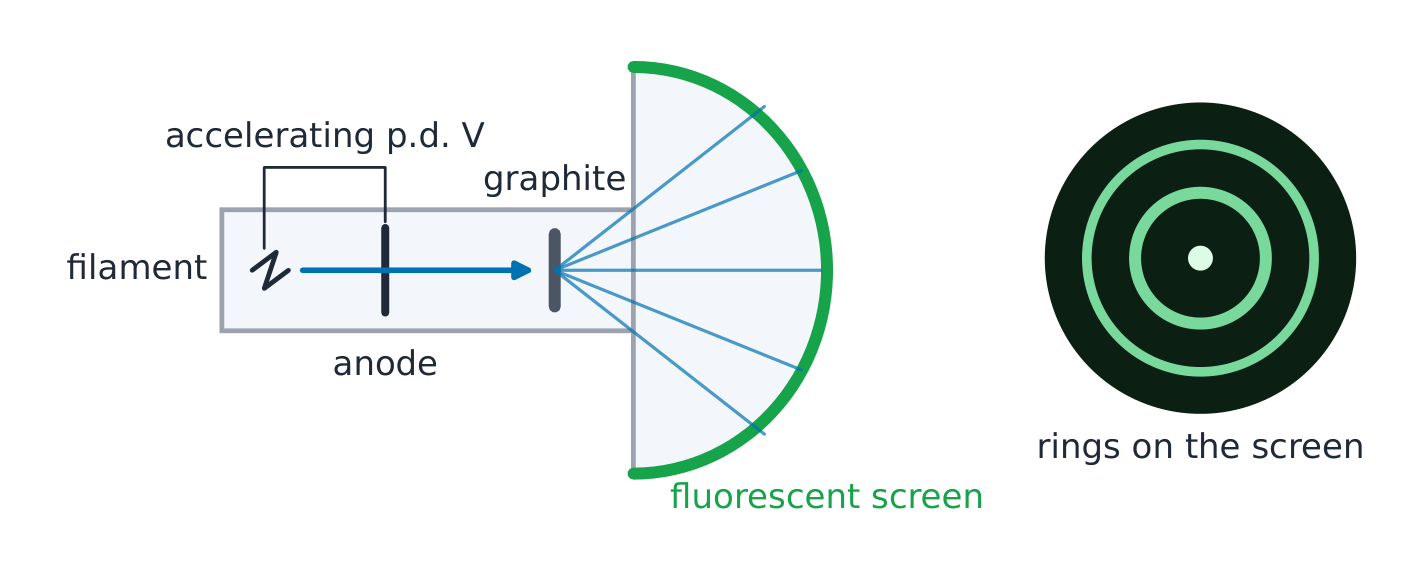
Electrons passing through graphite make rings, just as X-rays do
The electron diffraction tube:
Electrons are accelerated through a few thousand volts and pass through a very thin layer of graphite.
The screen shows bright rings, not just a spot. The rings arise from electron-wave scattering by regular atomic planes across many orientations in polycrystalline graphite. A suitably oriented single crystal can instead give spots.
When the accelerating voltage is increased, the electrons have more momentum, so a shorter wavelength, and the rings get smaller. This is exactly what $\lambda = h/p$ predicts.
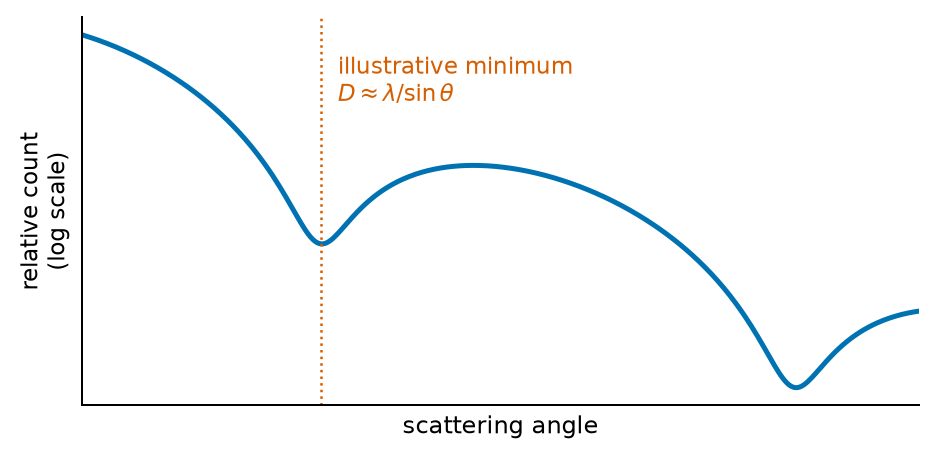
The position of a minimum
For a coherent beam through an ideal single slit of width $b$, the first-minimum condition is $b\sin\theta=\lambda$; for small angles, $\theta\approx\lambda/b$. A simplified nuclear-size estimate may be supplied in the analogous form
$$\sin\theta \approx \frac{\lambda}{b}$$
Use the stated geometry and angle convention. This nuclear-size analogy is approximate rather than an exact universal first-minimum law for every nuclear shape.
High-energy electrons scattered by nuclei show the same effect. Scattering can show diffraction minima related to nuclear size and charge distribution. The estimate $D\approx\lambda/\sin\theta$ uses a stated simplified model; detailed analysis uses momentum transfer and a nuclear form factor. High-energy probe momentum must be treated relativistically or supplied as a wavelength.
A scattering trend marks a first minimum for a stated approximate nuclear-size estimate
Worked example: electrons with a de Broglie wavelength of $3.0 \times 10^{-15}$ m are scattered by carbon nuclei, and the first minimum is at 35°. $D \approx \lambda/\sin\theta = 3.0 \times 10^{-15}/\sin 35° = 5.2 \times 10^{-15}\ \text{m}$, close to the value from $R = R_0A^{1/3}$ for carbon-12 ($2R = 5.5 \times 10^{-15}$ m). Electrons avoid the strong nuclear interaction of an alpha probe but still interact electromagnetically with the nuclear charge.
21.8
AHL:波粒二象性
English
Both light and matter show wave behaviour and particle behaviour. This is wave–particle duality 波粒二象性.
Wave behaviour
Particle behaviour
Light
Diffraction, interference, polarisation
Photoelectric effect, Compton scattering
Electrons
Electron diffraction
Deflection in fields, a charge and a mass, single dots on a screen
Which behaviour we see depends on the experiment. In an electron double-slit experiment with a very weak beam, each electron arrives at the screen as a single dot (a particle), but after many electrons the dots build up an interference pattern (a wave). Neither picture alone describes what an electron or a photon is.
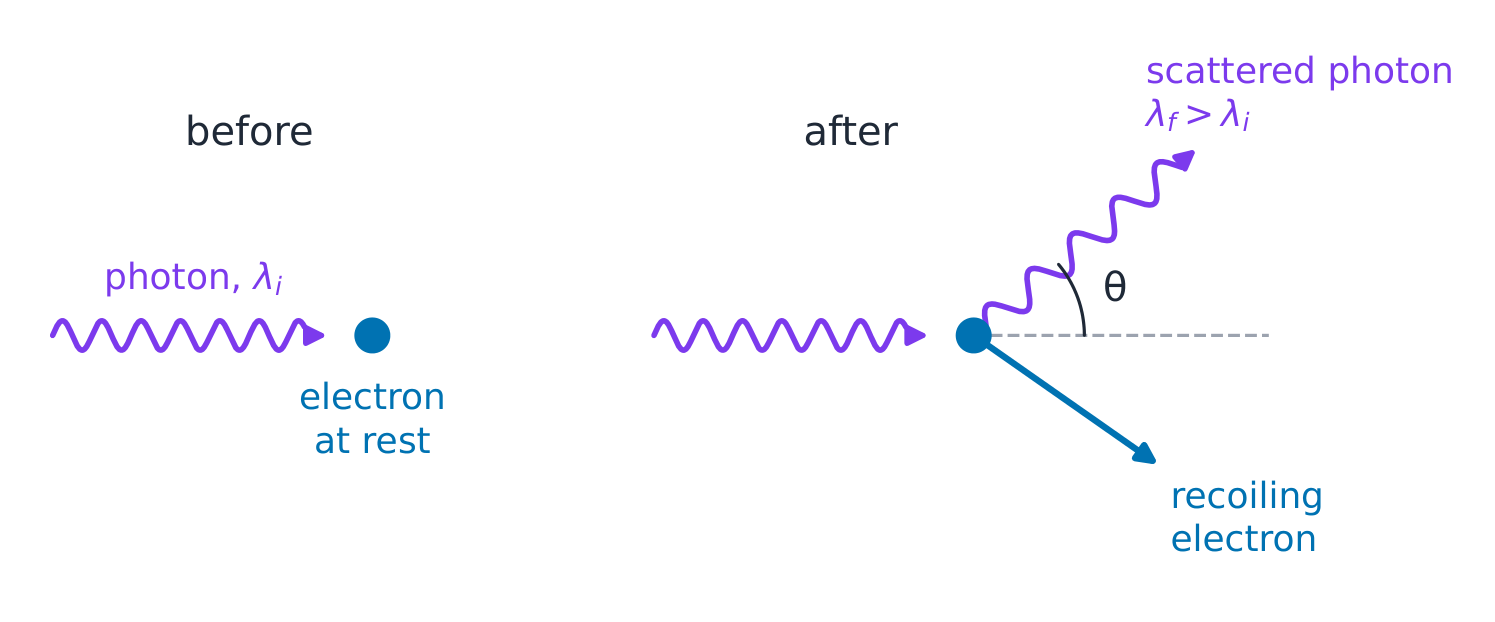
When X-rays are scattered by a material with loosely bound electrons, such as graphite, the scattered X-rays have a longer wavelength than the incident ones. This is Compton scattering 康普顿散射 (Arthur Compton, 1923).
A photon collides with an electron, gives it energy, and leaves with a longer wavelength
Compton explained it as a collision between a photon and an electron, conserving both energy and momentum. The photon gives some of its energy and momentum to the electron, which recoils; the scattered photon has less energy, so a lower frequency and a longer wavelength. For an initially resting free electron, or negligible binding effects, the wavelength increase depends on the photon scattering angle $\theta$:
Here $\theta$ is the photon deflection angle, not the electron recoil angle. The formula assumes an initially stationary electron and neglects binding effects.
At $\theta = 0$ there is no shift. The largest shift, $2h/m_ec = 4.85 \times 10^{-12}$ m, is when the photon bounces straight back ($\theta = 180°$).
The shift is the same for every incident wavelength, so its fractional effect is much greater for short wavelengths such as X-rays and gamma rays. For visible light it is about one part in $10^5$.
Δλ rises from 0 to 2h/mₑc as the photon turns from 0° to 180°
Worked example
X-rays of wavelength $7.10 \times 10^{-11}$ m are scattered through 90°.
Energy lost by the photon, which becomes electron recoil kinetic energy in the free-electron model: $\Delta E=hc(1/\lambda_i-1/\lambda_f)\approx9.26\times10^{-17}\ \text{J}$, about $9.3\times10^{-17}$ J or 580 eV. Keep the unrounded outgoing wavelength and photon energies until after subtraction: subtracting the displayed rounded energies $2.80\times10^{-15}$ J and $2.71\times10^{-15}$ J loses useful digits.
Why Compton scattering is strong evidence for photons
A wave theory predicts that the electrons would oscillate at the frequency of the incident wave and re-emit radiation at the same wavelength. The measured shift cannot be explained this way.
The shift is explained exactly by treating the photon as a particle with momentum $p = h/\lambda$ that collides with an electron like one ball hitting another. Unlike a ball, the photon does not slow down: it travels at $c$ between interactions in vacuum, and loses energy by changing its wavelength.
The photoelectric effect shows that light energy arrives in packets of $hf$. Compton scattering also shows that photons carry momentum, providing a quantitative momentum-transfer test in addition to photoelectric energy transfer. The quantum description must also explain wave interference and diffraction.
HL. Describe the photoelectric effect and state what is meant by the threshold frequency. State three observations of the photoelectric effect that cannot be explained by the wave theory of light, and explain how the photon model explains each.
HL. Assume a sodium-surface work function of 2.3 eV. Find its threshold frequency and wavelength.
HL. Light of wavelength 400 nm falls on sodium. Find (a) the maximum kinetic energy of the photoelectrons in eV, (b) the stopping potential, (c) the maximum speed of the photoelectrons.
HL. A graph of $E_\text{max}$ against frequency for a metal meets the frequency axis at $5.0 \times 10^{14}$ Hz. Find the work function in J and in eV, and state what the gradient of the graph represents.
HL. The intensity of the light on a photocell is doubled while its frequency stays the same. State and explain the effect on (a) the saturation current, (b) the stopping potential. Assume single-photon emission, unchanged surface efficiency and complete collection.
HL. Find the de Broglie wavelength of an electron accelerated from rest through 150 V.
HL. Explain why a tennis ball moving at 50 m s⁻¹ does not show diffraction when it passes through a doorway.
HL. An electron and a proton have the same kinetic energy. Find the ratio of their de Broglie wavelengths ($m_p = 1.67 \times 10^{-27}$ kg). Assume both particles are non-relativistic.
HL. Using the supplied approximate model $D\approx\lambda/\sin\theta$, estimate nuclear diameter for probe wavelength $3.0\times10^{-15}$ m and a first minimum at 30°. State why this is a model-dependent estimate. In an electron diffraction tube, the accelerating voltage is increased. State and explain what happens to the rings on the screen.
HL. Gamma rays of wavelength $5.0 \times 10^{-12}$ m are scattered through 60° by electrons. Find the wavelength of the scattered photons.
HL. Find the largest possible Compton shift, and explain why Compton scattering has a very small fractional shift in an ordinary demonstration for visible light of wavelength 500 nm.
HL. Find the momentum of a photon of wavelength 500 nm.
HL. Explain why Compton scattering is regarded as stronger evidence for the particle nature of light than the photoelectric effect.
HL. State what is meant by wave–particle duality, and give one piece of evidence for the wave nature and one for the particle nature of electrons.
Answers.
HL. Electrons are emitted from a metal surface when electromagnetic radiation falls on it. The threshold frequency is the minimum frequency of radiation that releases electrons from that metal ($hf_0 = \Phi$). Any three of: (i) no emission below $f_0$ however bright — one photon must have energy at least $\Phi$, within the elementary single-photon model; multiphoton processes are outside that regime; (ii) emission is immediate — the energy arrives in one packet; (iii) $E_\text{max}$ is independent of intensity — intensity changes the number of photons, not their energy; (iv) $E_\text{max}$ increases with frequency — each photon's energy $hf$ increases.
HL.$\Phi = hf_0 = 6.63 \times 10^{-34} \times 5.0 \times 10^{14} = 3.3 \times 10^{-19}\ \text{J} = 2.1\ \text{eV}$; the gradient is the Planck constant $h$.
HL. (a) Saturation current doubles under the stated assumptions: twice the fixed-frequency photon arrival rate gives twice the emitted and collected electron rate. (b) Stopping potential is unchanged because individual photon energy and maximum electron energy are unchanged.
HL. Assuming a mass of about 0.06 kg, $\lambda = h/mv \approx 2 \times 10^{-34}$ m. For an ordinary metre-wide doorway, the characteristic diffraction angle would be of order $10^{-34}$ rad and unresolvable in that setup. This is an observability limit, not a fundamental absence of matter waves.
HL.$\lambda = h/\sqrt{2mE_k}$, so $\lambda_e/\lambda_p = \sqrt{m_p/m_e} = \sqrt{1.67 \times 10^{-27}/9.11 \times 10^{-31}} = 43$: the electron's wavelength is 43 times longer.
HL.$D \approx \lambda/\sin\theta = 3.0 \times 10^{-15}/0.50 = 6.0 \times 10^{-15}\ \text{m}$. The coefficient and angle relation depend on the scattering geometry and charge distribution; this is not a universal exact nuclear formula. The rings become smaller. The electrons have more momentum, so their de Broglie wavelength is shorter, and they are diffracted through smaller angles.
HL. At 180°, $\Delta\lambda = 2h/m_ec = 4.85 \times 10^{-12}\ \text{m}$. For 500 nm light this is a fractional change of about $10^{-5}$, difficult to resolve in an ordinary visible-light demonstration, rather than fundamentally undetectable.
HL. The wave theory predicts scattered radiation of unchanged wavelength, but the measured shift is explained by the stated initially resting free-electron collision model in which the photon carries momentum $h/\lambda$ as well as energy, and both are conserved. The photoelectric effect shows that energy is transferred in packets; Compton scattering shows that photons also carry momentum, like particles.
HL. Light and matter can each behave as waves or as particles, depending on the experiment. Wave: electron diffraction by graphite (or by nuclei). Particle: electrons have a definite charge and mass, are deflected by fields, and arrive as single dots on a screen.
21.11
考试技巧
English
HL. In $E_\text{max} = hf - \Phi$, put both energies in joules, or both in eV; $E = hf$ gives joules.
HL. At fixed frequency and collection conditions, intensity controls photon rate; frequency controls individual photon energy.
HL. State the single-photon regime and the relevant surface work function.
HL. For an accelerated electron, find $p = \sqrt{2m_eeV}$ first, then $\lambda = h/p$.
HL. Use the stated diffraction geometry and a momentum model appropriate to the electron energy.
HL. Compton: the shift depends only on the angle, not on the wavelength; the scattered photon has a longer wavelength.