This handout teaches E.1 Structure of the atom in full, for the course first assessed in 2025. Sections marked AHL are for Higher Level only.
Prerequisites: electric force and Coulomb's law from D.2; electric potential energy (HL) from D.2; kinetic energy and energy conservation from A.3; the electromagnetic spectrum and $c = f\lambda$ from C.2. Use $k=8.99\times10^9\ \mathrm{N\,m^2/C^2}$, $e = 1.60 \times 10^{-19}\ \text{C}$, $h = 6.63 \times 10^{-34}\ \text{J s}$, $c = 3.00 \times 10^8\ \text{m s}^{-1}$ and $1\ \text{eV} = 1.60 \times 10^{-19}\ \text{J}$.
20.2
原子内部
English
How do you look inside something too small to see?
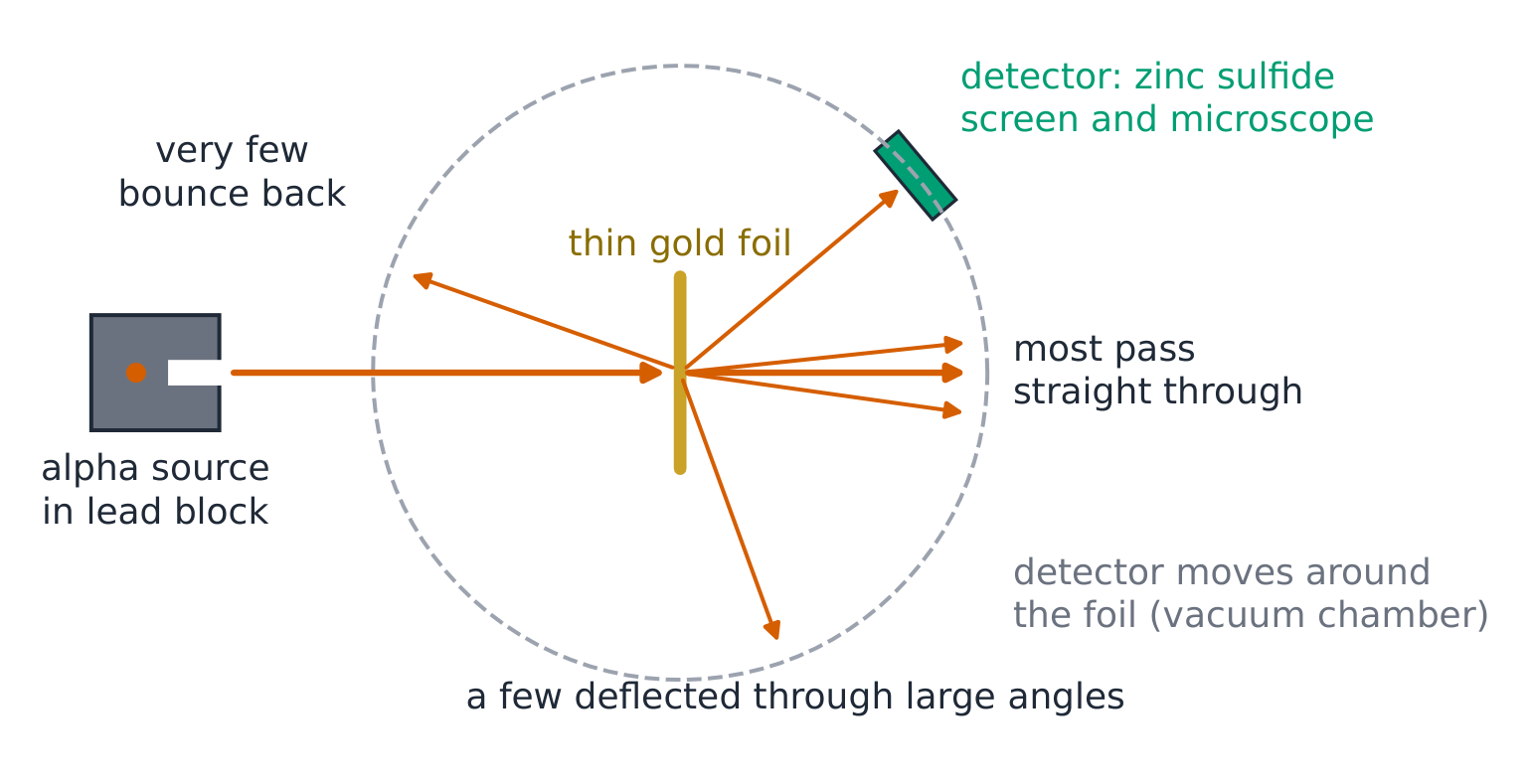
An atom is of order $10^{-10}$ m across, too small for ordinary visible light to resolve its internal structure. Geiger and Marsden studied alpha-particle scattering under Rutherford's supervision. Most probes passed through thin foil with little deflection, but a small fraction turned through large angles. This evidence led towards a small, massive nucleus 原子核 rather than positive charge and mass spread throughout the whole atom. In the positive-nucleus model a sufficiently close alpha particle is strongly repelled.
The 1909 Geiger–Marsden paper reports about 1 in 8000 reflected under specified conditions using a platinum reflector. It also studies gold foils and other materials. Do not transfer that fraction to every gold-foil arrangement: the rate depends on the foil, beam energy and geometry. The apparatus below is a simplified school model, not an exact reconstruction of every historical arrangement.
From the plum-pudding model to the nuclear model
Models of the atom changed as new evidence appeared:
Each model kept what still worked
Plum-pudding model 葡萄干布丁模型 (Thomson, 1904): the atom is a sphere of spread-out positive charge with electrons dotted through it. The positive charge and mass are spread over the whole atom, so its electric field is weak everywhere.
Nuclear model 核式模型 (Rutherford, 1911): almost all the mass and all the positive charge are in a tiny nucleus at the centre; the electrons move around it, and most of the atom is empty space.
Bohr model (Bohr, 1913): electrons can only have certain fixed energies, which explains line spectra.
Each model kept what the earlier one got right and changed what the new evidence contradicted.
Counting alpha particles at every angle around a thin gold foilAlpha-particle tracks in a cloud chamber, fanning out from an americium-241 source
The apparatus:
A narrow beam of alpha particles 阿尔法粒子 (helium nuclei, charge $+2e$) from a radioactive source.
A very thin gold foil 金箔, to reduce repeated large deflections and energy loss; most alpha particles do not pass close to any nucleus.
A small zinc sulfide screen that gives a tiny flash of light when an alpha particle hits it. The flashes were counted by eye through a microscope, at each angle in turn.
An evacuated 抽真空的 chamber, so the alpha particles are not stopped or scattered by air.
Results and what they show
Observation
Conclusion
Almost all alpha particles pass straight through or are deflected by very small angles.
Most of the atom is empty space.
A few are deflected through large angles.
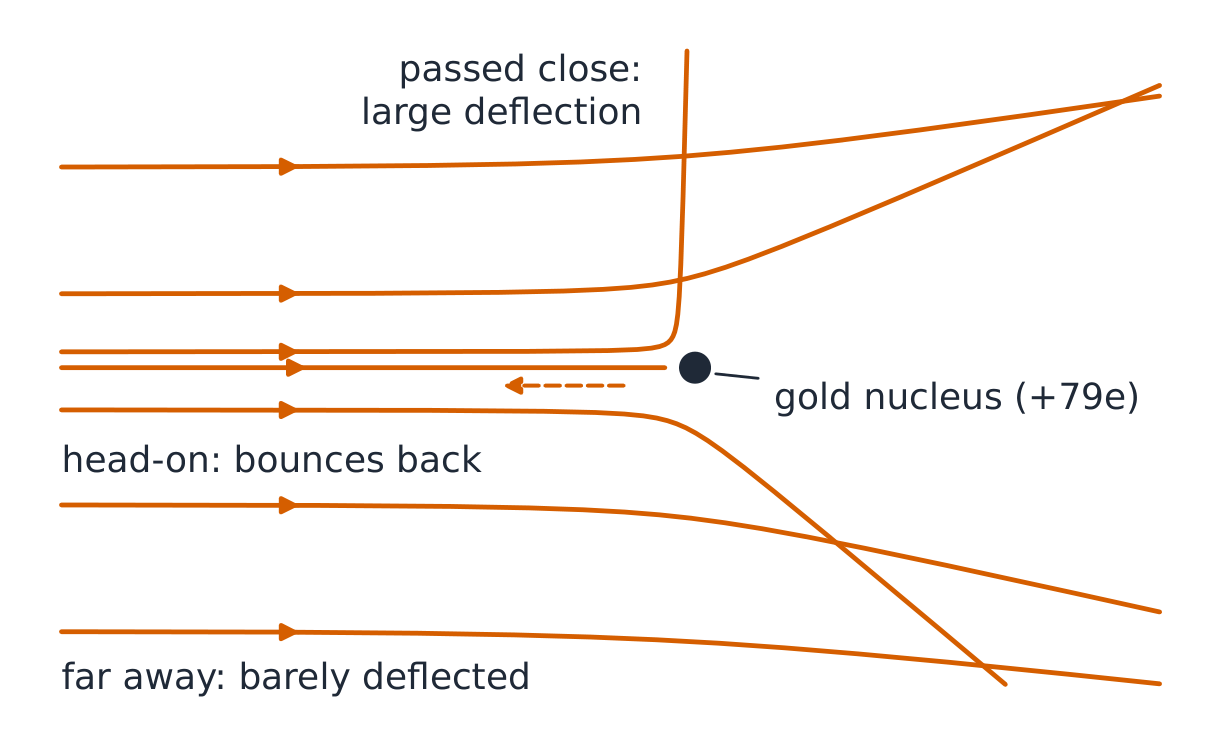
There is a very strong electric field in a small region: the positive charge is concentrated.
A very small fraction return through large angles (more than 90°).
The positive charge and most of the mass are in a tiny, massive nucleus that a fast alpha particle cannot push aside.
The plum-pudding model predicts only tiny deflections, because its spread-out positive charge gives a weak field everywhere. It cannot account for the observed frequency of very large deflections under these conditions.
The closer an alpha particle passes the nucleus, the larger its deflection
The alpha particles are repelled by the positive nucleus. The force is very large only very close to it, so only the few particles aimed almost straight at a nucleus are deflected strongly. Angular scattering data constrain the small scale of the central charge region. This experiment alone did not establish neutrons or quantised electron energy levels. Typical atomic and nuclear linear sizes differ by roughly four to five orders of magnitude, depending on the atom and the radius convention.
A nuclide 核素 (one particular type of nucleus) is written as
Reading nuclear notation
$${}^{A}_{Z}\text{X}$$
$A$ is the nucleon number 核子数 (mass number): the number of protons plus neutrons.
$Z$ is the proton number 质子数 (atomic number): the number of protons. It fixes which element it is.
X is the chemical symbol. The number of neutrons is $N = A - Z$.
Examples:
${}^{197}_{79}\text{Au}$: gold, 79 protons and $197 - 79 = 118$ neutrons. A neutral atom also has 79 electrons.
${}^{4}_{2}\text{He}$: an alpha particle, 2 protons and 2 neutrons.
${}^{12}_{6}\text{C}$ and ${}^{14}_{6}\text{C}$: both carbon, with 6 and 8 neutrons. Nuclei of the same element with different numbers of neutrons are isotopes 同位素.
You do not need to remember chemical symbols; they are given in questions.
When light from a source passes through a prism or diffraction grating, it spreads into a spectrum 光谱. There are three kinds:
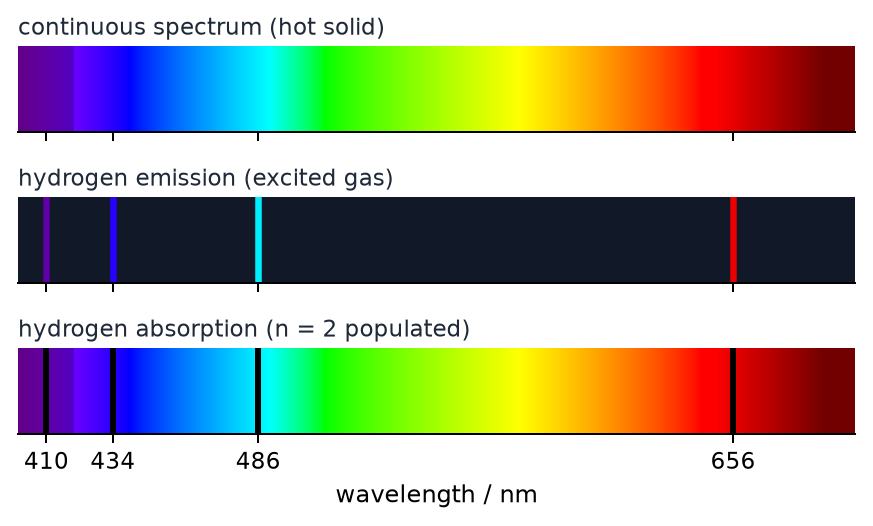
The same atomic transitions have matching emission and absorption wavelengths; lower-state populations determine which absorptions appear
A continuous spectrum 连续光谱 contains all wavelengths. It comes from a hot solid or dense gas, such as a lamp filament.
An emission spectrum 发射光谱 is a set of bright lines on a dark background. It comes from a hot, low-pressure gas, for example in a discharge tube.
An absorption spectrum 吸收光谱 is a continuous spectrum crossed by dark lines. It is seen when white light passes through a cooler gas.
For the same atomic transition, emission and absorption correspond to the same level separation and therefore matching wavelengths. Visible line strengths differ with excitation, ionisation, populations and line broadening; an emission line need not appear strongly in every absorption spectrum. In the pictured hydrogen model, the lower $n=2$ state must be populated for the visible absorptions shown. This is evidence that the electrons in an atom can only have certain discrete 分立的 energies, called energy levels 能级.
Light is emitted and absorbed in packets of energy called photons 光子. The energy of one photon is
$$E = hf = \frac{hc}{\lambda}$$
where $h$ is the Planck constant and $f$ the frequency.
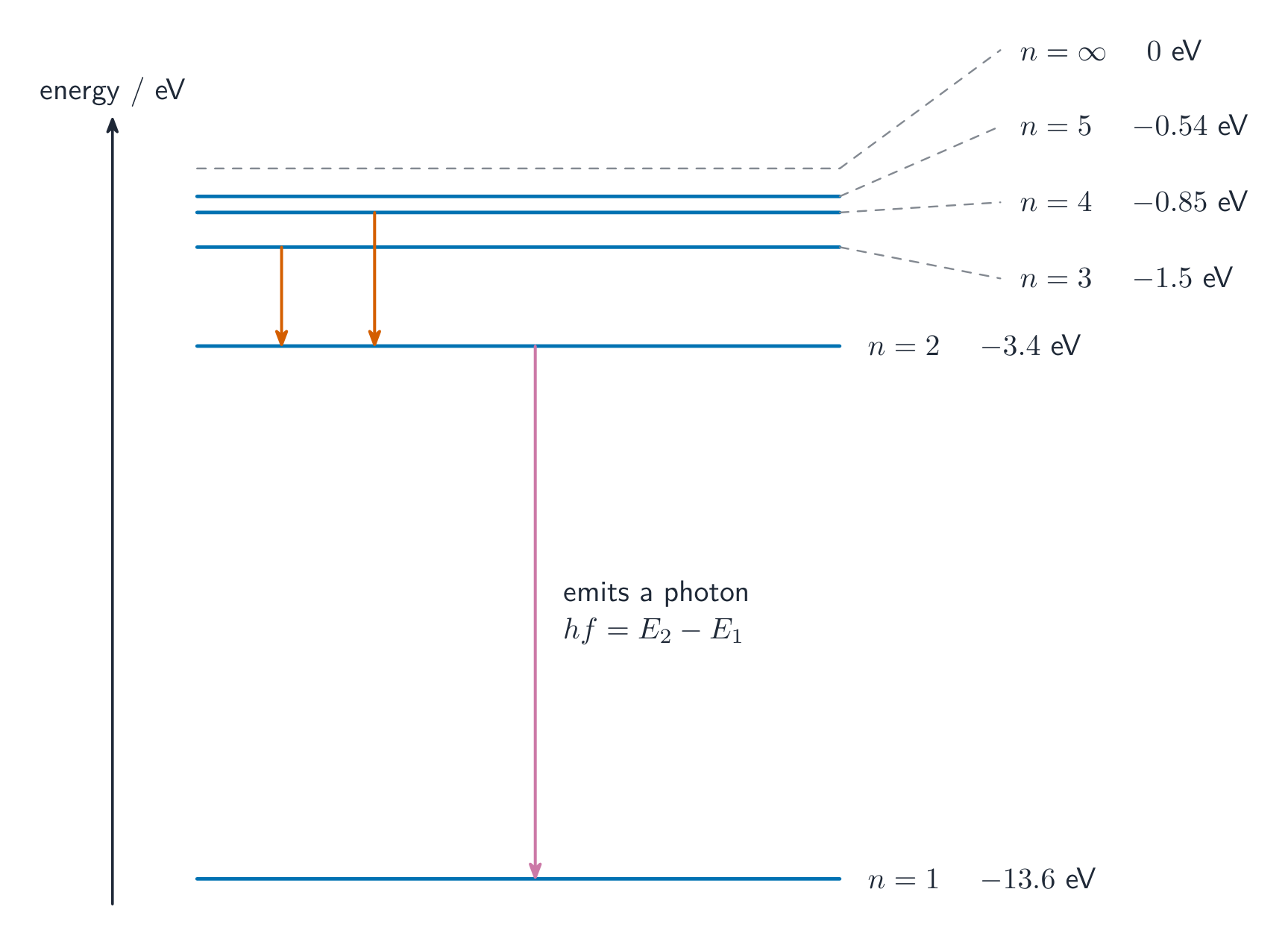
A downward transition emits one photon carrying exactly the energy difference
Emission. An electron drops from a higher level to a lower one and emits one photon. The photon's energy equals the difference between the levels: $hf = E_\text{upper} - E_\text{lower}$.
Absorption. An electron absorbs a photon and moves up to a higher level. For idealised bound-to-bound absorption the photon energy must match an allowed level gap and the lower state must be occupied. Above the ionisation threshold a photon can also free the electron, with surplus energy becoming kinetic energy (neglecting recoil); not every absorption is a bound-to-bound line.
Because the levels are fixed, only certain energy differences are possible, so only certain frequencies appear: a line spectrum 线状光谱.
The ground state 基态 is the lowest level. Energies are negative because 0 is defined as the electron just free of the atom. The energy needed to free an electron from the ground state is the ionisation energy 电离能: 13.6 eV for hydrogen.
Line darkness depends on optical depth, emission and instrumental resolution. Re-emission in different directions helps reduce the original beam at line wavelengths; absorption lines need not have identical depths or be perfectly black.
Worked examples
An electron in hydrogen falls from $-1.51\ \text{eV}$ to $-3.40\ \text{eV}$. $\Delta E = 1.89\ \text{eV} = 1.89 \times 1.60 \times 10^{-19} = 3.02 \times 10^{-19}\ \text{J}$. Then $f = E/h = 3.02 \times 10^{-19}/6.63 \times 10^{-34} = 4.56 \times 10^{14}\ \text{Hz}$ and $\lambda = c/f = 6.58 \times 10^{-7}\ \text{m}$: the red line near 656 nm.
The fall from $-3.40$ to $-13.6\ \text{eV}$ gives $\Delta E = 10.2\ \text{eV} = 1.63 \times 10^{-18}\ \text{J}$, so $\lambda = hc/E = 1.22 \times 10^{-7}\ \text{m}$, in the ultraviolet.
Across an ensemble with suitable populated levels, four levels can give up to six different downward transitions if all are allowed. One electron in level 4 emits at most three photons in a single descent through these four levels. The possible transitions are 4→3, 4→2, 4→1, 3→2, 3→1 and 2→1: six possible transitions, with distinct line energies only when their gaps differ.
探索
A photon carries the energy gap
Negative bound levels give positive photon energies; equal gaps share a spectral line.
Every element has its own set of energy levels, so its line spectrum is unique, like a fingerprint.
For a school comparison, use attributed reference spectra on a common wavelength scale and match several labelled lines. Use teacher-approved light sources and viewing equipment; never look directly at the Sun or another unsafe light source.
Each element's emission lines form its own pattern, so a spectrum identifies the elements in a hot gas or a star
Comparing the lines in the spectrum of a gas or a star with laboratory spectra shows which elements are present.
Comparing multiple solar lines with laboratory references identifies elements in the line-forming material. Helium was identified in solar spectra before it was identified in terrestrial samples; the conditions and spectrum type must be considered rather than treating every element as a strong dark line in every solar spectrum.
The same method finds elements in distant stars and gas clouds, and in a laboratory flame test. After line identification and calibration, shifts can give radial-motion information under an appropriate Doppler model (C.5); line strength alone is not a direct abundance measurement.
20.8
AHL:最近接近距离
English
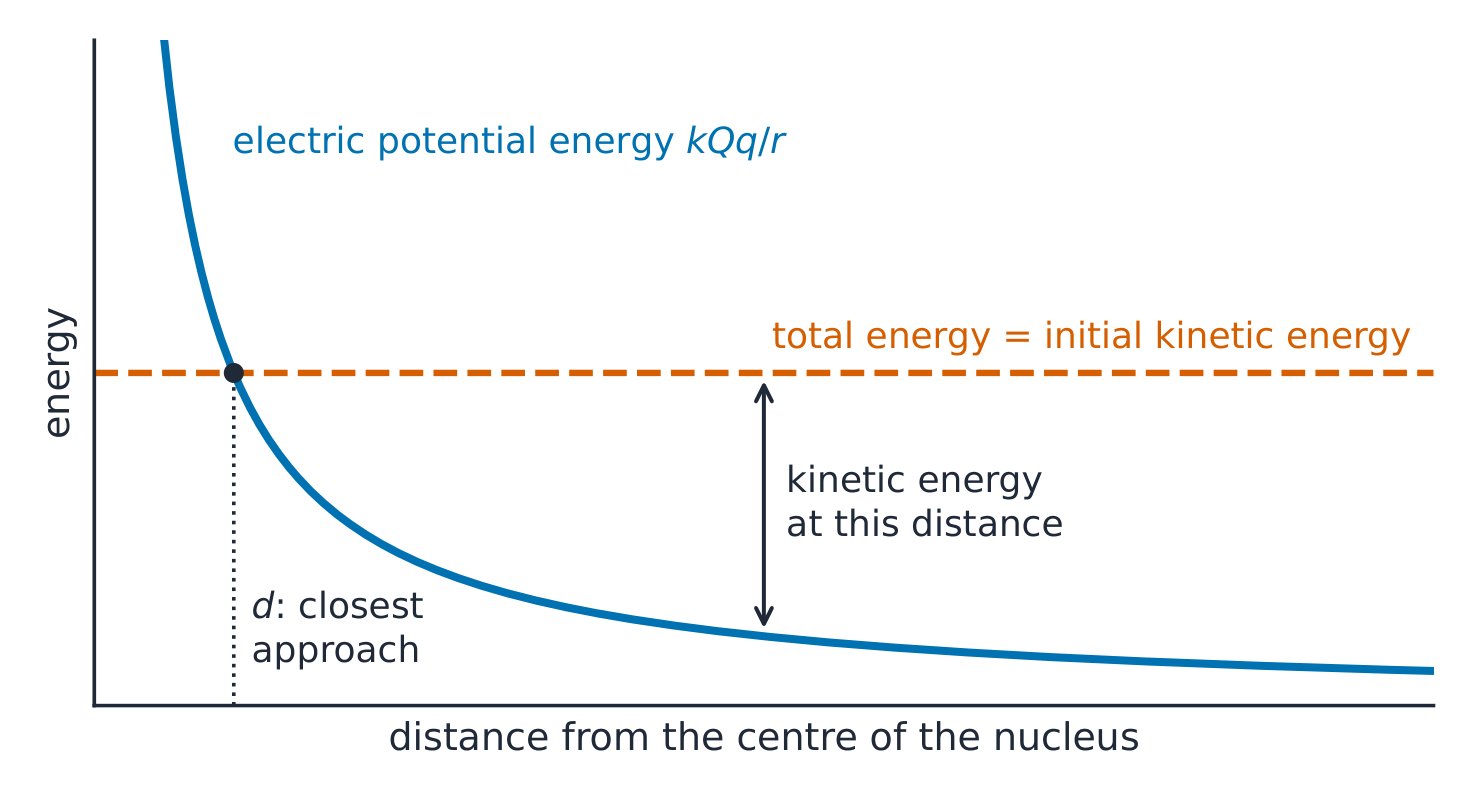
An alpha particle fired straight at a nucleus slows down as the repulsion grows. It stops at the distance of closest approach 最近距离$d$, then is pushed straight back. At that point all of its initial kinetic energy has become electric potential energy:
$$E_\text{k} = \frac{kQq}{d} \qquad\text{so}\qquad d = \frac{kQq}{E_\text{k}}$$
where $Q = Ze$ is the charge of the nucleus and $q = 2e$ that of the alpha particle. This approximation requires a target much heavier than the alpha particle so recoil is small, negligible initial potential energy, and a purely electric interaction outside nuclear range.
At closest approach, all the kinetic energy has become electric potential energy
Worked example
A 5.0 MeV alpha particle is fired head-on at a gold nucleus ($Z = 79$).
The alpha particle never touches the nucleus, so the radius of the gold nucleus must be less than$4.5 \times 10^{-14}$ m. The distance of closest approach gives an upper limit for the nuclear radius. A faster alpha particle, or a nucleus with a smaller charge, gives a smaller $d$.
distance of closest approach/ˈdɪstəns ɒv ˈkləʊsɪst əˈprəʊtʃ/
最近距离
zuì jìn jù lí
20.9
AHL:卢瑟福散射的偏差
English
Rutherford's scattering formula assumes that the only force on the alpha particle is the electric repulsion from a point charge. It is a useful model while the probe remains outside the nuclear charge distribution and other interactions are negligible.
Where the point-charge model stops working
At greater probe energies, deviations from the point-charge electric model can reveal finite nuclear charge extent and the short-range strong nuclear force 强核力. The change in angular counts need not always be downward; its form depends on energy, target and the scattering process.
Interpreting the onset requires a scattering model. A simple contact-scale estimate compares the centre-to-centre approach distance with the sum of target and alpha radii, rather than treating the alpha particle as a point touching a hard nuclear surface. The closest-approach energy equation applies only while its stated electric, head-on and stationary-target assumptions remain justified.
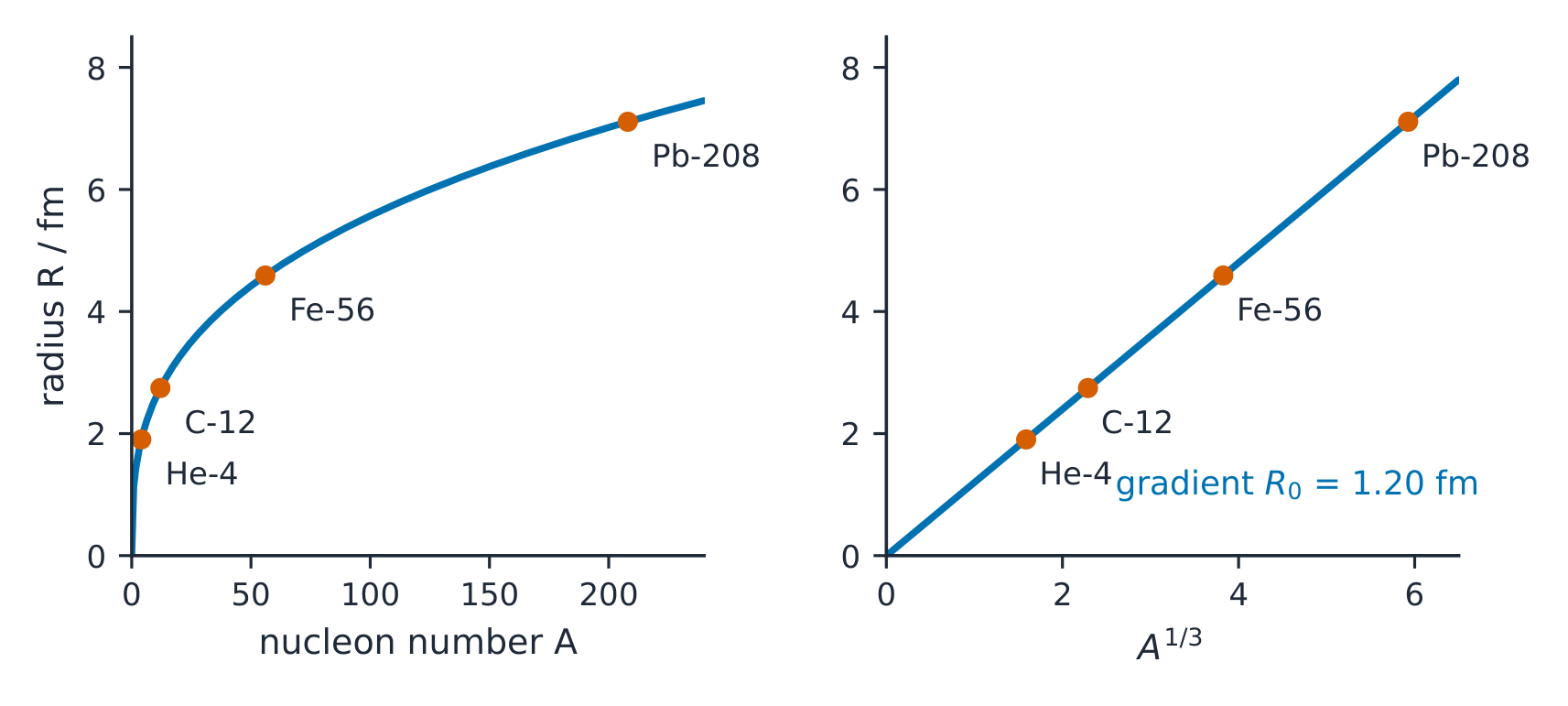
Scattering experiments (with alpha particles and, more accurately, with high-energy electrons) support an approximate nuclear-size trend with nucleon number:
$$R = R_0 A^{1/3}$$
where $R_0 = 1.20 \times 10^{-15}\ \text{m}$ (given in the data booklet). A length of $10^{-15}$ m is called a femtometre 飞米 (fm).
Plotting R against the cube root of A gives a straight line with gradient R₀
Gold-197: $R = 1.20 \times 10^{-15} \times 197^{1/3} = 1.20 \times 10^{-15} \times 5.82 = 7.0 \times 10^{-15}\ \text{m}$. This is less than the closest-approach distance of a 5.0 MeV alpha particle, as it must be.
A nucleus with 8 times as many nucleons has twice the radius, since $8^{1/3} = 2$.
Nuclear density
Each nucleon has a mass of about $m_u = 1.66 \times 10^{-27}$ kg (the atomic mass unit). The volume of a nucleus is $\tfrac{4}{3}\pi R^3 = \tfrac{4}{3}\pi R_0^3 A$. So
$A$ cancels, so the model predicts approximately common nuclear density. Light nuclei, binding-energy mass differences, distributions and nonspherical shapes limit this approximation. Nucleons are packed together like balls in a bag, each taking up about the same volume.
Nuclear matter is about $10^{14}$ times denser than water. A notional 5 cm³ sample at this density would have a mass of about $10^{12}$ kg; this is a dimensional illustration, not a claim that a stable isolated sample can be kept on a desk.
Since typical atomic and nuclear linear sizes differ by about four to five orders of magnitude, almost all of the volume of ordinary matter is empty space. Neutron stars are made of matter close to nuclear density.
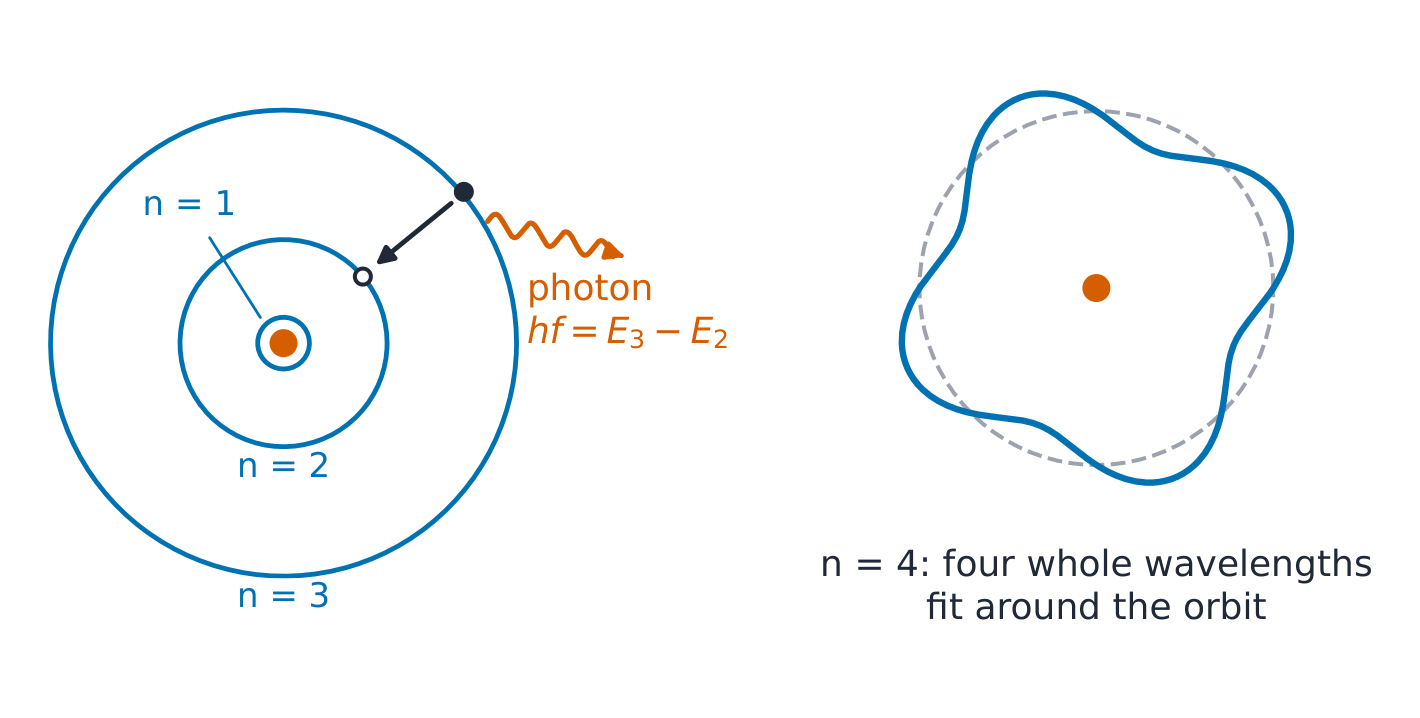
In 1913 Niels Bohr proposed a model of the hydrogen atom that explains its line spectrum. The electron moves in a circular orbit around the proton, held by the electric force, but:
only certain orbits are allowed, and in these orbits the electron does not radiate energy;
the electron emits or absorbs a photon only when it moves between allowed orbits, with $hf = \Delta E$.
Quantised angular momentum
Bohr's key condition is that the angular momentum 角动量$mvr$ of the electron can only be a whole-number multiple of $h/2\pi$:
$$mvr = \frac{nh}{2\pi}$$
where $n = 1, 2, 3, \dots$ is the principal quantum number 主量子数. Combining this condition with the electric force providing the centripetal force gives only certain allowed radii ($r_n = n^2 r_1$, with $r_1 = 5.3 \times 10^{-11}$ m) and therefore only certain energies. Quantised angular momentum leads to quantised orbits and quantised energy.
Allowed orbits: angular momentum is a whole number of h/2π
A later explanation (E.2): an electron behaves as a wave with wavelength $\lambda = h/mv$. In this historical standing-wave consistency picture, a whole number of wavelengths fits around the circumference: $2\pi r = n\lambda = nh/mv$, which is the same as $mvr = nh/2\pi$.
Worked example: in the ground state, $r = 5.3 \times 10^{-11}$ m, so the speed is $v = \dfrac{h}{2\pi m r} = \dfrac{6.63 \times 10^{-34}}{2\pi \times 9.11 \times 10^{-31} \times 5.3 \times 10^{-11}} = 2.2 \times 10^6\ \text{m s}^{-1}$.
The energy levels
The energy of the electron in orbit $n$ is
$$E = -\frac{13.6}{n^2}\ \text{eV}$$
$n$
1
2
3
4
$\infty$
$E$ / eV
$-13.6$
$-3.40$
$-1.51$
$-0.850$
0
Worked example: the photon emitted in the transition from $n = 3$ to $n = 2$ has energy $13.6\left(\tfrac{1}{4} - \tfrac{1}{9}\right) = 1.89\ \text{eV}$, the red line at 656 nm. The predicted wavelengths agree with the measured hydrogen spectrum, which was the great success of the model.
Limits of the Bohr model
This form gives hydrogen energies. The hydrogen-like extension to other one-electron ions requires a nuclear-charge factor $Z^2$; the $-13.6$ eV coefficient is not unchanged for every ion. It cannot explain why some lines are brighter than others, and it describes the electron as a particle in a definite orbit, which quantum physics shows is not correct. It is still used because it gives the right energy levels for hydrogen in a simple way.
principal quantum number/ˈprɪnsɪpl ˈkwɒntəm ˈnʌmbə/
主量子数
zhǔ liàng zǐ shù
20.12
练习
English
Describe the simplified alpha-scattering experiment, including why the foil is thin and the chamber evacuated. Explain why the historical “1 in 8000” fraction is not a universal gold-foil result.
State the main small-angle, large-angle and backward-scattering observations and the limited conclusions they support. Name one atomic property not established by scattering alone.
Explain why the spread-out positive charge in the plum-pudding model cannot explain the observed rate of very large deflections.
State proton, neutron and electron counts in neutral uranium-235 with $Z=92$.
Compare emission and absorption spectra. Explain why the same transition gives matching wavelengths, but not every emission line must be equally strong in absorption.
Find photon energy in eV for wavelength 434 nm. Use the constants in the prerequisites.
Levels are $-5.0$, $-2.0$ and $-.50$ eV. Find the three pair gaps and the highest photon frequency, assuming all three transitions are allowed.
Explain how a pattern of laboratory reference lines helps identify sodium in a solar spectrum, and why line strength alone does not directly give abundance.
In a counting example, iron-56 has $Z=26$ and charge $3+$. Find proton, neutron and electron counts; distinguish an isotope change from ionisation.
An atom starts at $-5.0$ eV with an allowed bound state at $-2.0$ eV. Explain the different outcomes of absorbing 3.0 eV and 6.0 eV photons, neglecting recoil.
Four distinct levels allow all six pair transitions, with different gaps. Compare the number of possible lines across a sample with the maximum photons from one electron descending from level 4 to level 1.
AHL. A 4.0 MeV alpha particle approaches gold ($Z=79$) head-on. Find the electric-model turning distance; predict changes for twice the energy and for half the target charge. Explain the radius bound and why high-energy scattering can deviate from the model.
AHL. Use $R_0=1.20$ fm to find aluminium-27 radius and the radius ratio for $A=216$ versus 27. Derive the approximate nuclear density using $m_u=1.66\times10^{-27}$ kg and explain its limitations.
AHL. State Bohr's angular-momentum condition. Use hydrogen $E_n=-13.6/n^2$ eV to find the $4\to2$ photon wavelength with the given constants. Given $r_2=4r_1$, derive $v_2/v_1$. State one limit of the model.
Answers.
A narrow alpha beam strikes thin foil; a movable scintillation detector counts scattered particles at angles. Thin foil reduces repeated strong encounters and energy loss; evacuation reduces air scattering. The 1909 reflected fraction refers to specified platinum-reflector conditions, not every gold foil, energy or detector geometry.
Mostly small deflections support a central concentration rather than uniform mass/charge throughout the atom. Rare large-angle returns require a small, strong-field, sufficiently massive centre. The nuclear model fits this evidence; scattering alone did not establish neutrons or discrete electron levels.
The diffuse positive charge gives much weaker forces for the probe than a concentrated centre and predicts far too few very large deflections under these conditions.
92 protons, $235-92=143$ neutrons and 92 electrons.
Emission has bright lines from excited atoms; absorption removes light from a background beam. For a particular level pair, matching gaps give matching photon energies and wavelengths. Different populations, temperature, ionisation and broadening change the line strengths and visible line lists.
$E=hc/\lambda=(6.63\times10^{-34})(3.00\times10^8)/(434\times10^{-9})=4.583\times10^{-19}$ J $=2.864$ eV, about 2.86 eV.
Gaps are 3.0, 1.5 and 4.5 eV. Highest frequency $=(4.5)(1.60\times10^{-19})/(6.63\times10^{-34})=1.086\times10^{15}$ Hz.
Several matched line positions, including the sodium pattern near 589 nm, support sodium in the line-forming material after calibration and shift checks. Strength also depends on excitation, ionisation, temperature and the radiation-transfer conditions.
26 protons, $56-26=30$ neutrons and $26-3=23$ electrons. Isotope change alters neutron number at fixed $Z$; ordinary ionisation alters electrons.
A 3.0 eV photon excites the atom to $-2.0$ eV. A 6.0 eV photon can ionise from the $-5.0$ eV state, leaving about 1.0 eV kinetic energy; continuum absorption is not restricted to another bound-level gap.
Six different pair gaps can give six lines across the ensemble. One electron emits at most three photons in a descent through four levels, and may emit only one for a direct transition. Cascade photon energies sum to the same total drop.
AHL.$K=6.40\times10^{-13}$ J; $d=k(79e)(2e)/K=5.68\times10^{-14}$ m. Doubling $K$ halves $d$; halving $Q$ at fixed $K$ also halves it. Agreement while the probe remains outside supplies an upper scale for nuclear extent, not its exact surface. Recoil, finite probe/target sizes and short-range nuclear interactions limit the electric point-charge model.
AHL.$R_{27}=1.20(27^{1/3})=3.60$ fm; ratio $=(216/27)^{1/3}=2$. $\rho=Am_u/[\tfrac43\pi R_0^3A]=3m_u/(4\pi R_0^3)=2.29\times10^{17}$ kg/m³. This is an approximate spherical-size/mass model, with light-nucleus, shape, distribution and binding-mass limitations.
AHL.$mvr=nh/(2\pi)$, with positive integer $n$. $\Delta E=13.6(1/4-1/16)=2.55$ eV $=4.08\times10^{-19}$ J; $\lambda=hc/\Delta E=4.875\times10^{-7}$ m, about 488 nm with these rounded constants (measured line near 486 nm). $v_2/v_1=(2/1)(r_1/r_2)=1/2$. Modern states are not definite classical orbits; hydrogen-like ions need the $Z^2$ factor and many-electron spectra need a fuller model.
20.13
考试技巧
English
Identify the evidence, initial state and model before using an equation.
Convert photon energy to joules before using $h$ in SI units; distinguish excitation, ionisation and a single cascade.
AHL. State head-on/recoil assumptions, use cube-root radius scaling, and keep hydrogen-specific Bohr constants within their scope.