This handout teaches D.3 Motion in electromagnetic fields in full, for the course first assessed in 2025. SL and HL students study the same material in D.3.
Prerequisites: projectile motion and circular motion from A.1 and A.2; kinetic energy from A.3; electric and magnetic fields from D.2. Use $e = 1.60 \times 10^{-19}$ C, electron mass $9.11 \times 10^{-31}$ kg, proton mass $1.67 \times 10^{-27}$ kg and $\mu_0 \approx 4\pi \times 10^{-7}\ \text{T m A}^{-1}$.
18.2
电场中的带电粒子
English
What makes the shapes of the northern lights?
Near the polar regions the night sky sometimes fills with moving curtains of light: the aurora. Solar-wind energy enters Earth's magnetosphere and energizes particles, mainly electrons. Earth's magnetic field guides their motion; collisions with the upper atmosphere excite atoms and molecules, which release light as they return to lower energy states. This is not simply a direct stream of solar electrons reaching the ground, nor does magnetic steering alone supply their kinetic energy. NOAA's aurora explanation distinguishes electron acceleration from magnetic guidance. In a laboratory, magnetic fields steer accelerated particles in a cyclotron and bend ion paths in a mass spectrometer.
An aurora: Earth's magnetic field guides energized electrons towards the polar regions, where collisions make the upper air glow
This unit is about how charged particles move in electric fields and in magnetic fields, and about the magnetic forces on wires that carry currents.
18.3
匀强电场中的运动
English
In a uniform electric field $E$ a charge $q$ feels a constant vector force $\mathbf F = q\mathbf E$, so it has a constant acceleration $\mathbf a = q\mathbf E/m$ when other forces are negligible. This is just like a mass in the Earth's uniform gravitational field.
Where the particles come from: a linear accelerator uses electric fields to drive charged particles fast enough to probe the nucleusBetween parallel plates the field is uniform, E = V/d
Moving along the field. A charge released from rest between parallel plates accelerates in a straight line: along the field for positive charge, against it for negative charge. If $V$ is the positive magnitude of the accelerating potential difference, the kinetic energy gained is
$$\tfrac{1}{2}mv^2 = |q|V$$
For a signed potential change instead, $\Delta K=-q\Delta V$ when the electric force alone supplies the work. These speed calculations use the non-relativistic model.
Worked example: a proton accelerated from rest through 500 V gains $1.60 \times 10^{-19} \times 500 = 8.0 \times 10^{-17}$ J (500 eV), so $v = \sqrt{2 \times 8.0 \times 10^{-17}/1.67 \times 10^{-27}} = 3.1 \times 10^5\ \text{m s}^{-1}$.
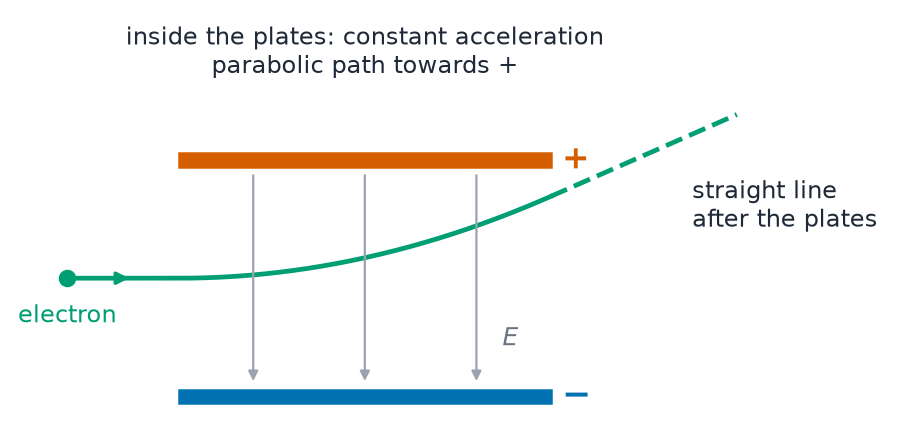
Entering at right angles to the field. A charge moving between the plates, parallel to them, keeps a constant velocity along the plates but accelerates across them. Its path is a parabola 抛物线, exactly like a ball thrown horizontally. After it leaves the ideal field region it moves along a straight tangent, if other forces are negligible. This model neglects fringe fields. A beam must also clear the plate: otherwise it strikes the plate before reaching the calculated exit.
In a uniform electric field the path is a parabola, like a projectile
Worked example: an electron enters the field ($E = 2.0 \times 10^4\ \text{V m}^{-1}$) between plates 5.0 cm long at $2.0 \times 10^7\ \text{m s}^{-1}$.
Time between the plates: $t = 0.050/(2.0 \times 10^7) = 2.5 \times 10^{-9}$ s.
A charge $q$ moving with speed $v$ through a magnetic field $B$ feels a force
$$F = |q|vB\sin\theta$$
where $\theta$ is the angle between the velocity and the field. The unit of $B$ is the tesla 特斯拉 (T).
The force is greatest when the charge moves at right angles to the field ($F = |q|vB$) and zero when it moves along the field.
A charge at rest feels no magnetic force at all.
The force is always at right angles to both the velocity and the field.
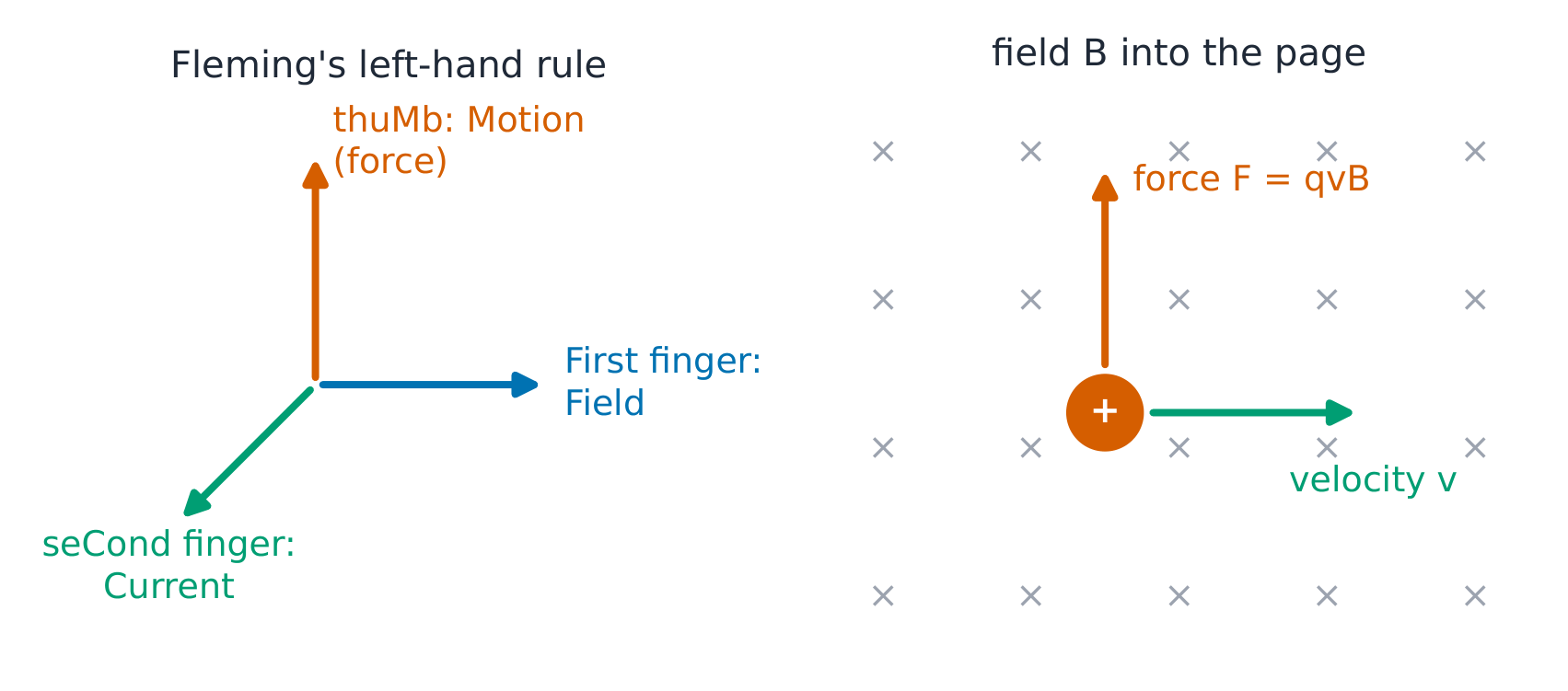
To find the direction, use Fleming's left-hand rule 弗莱明左手定则: hold the first finger, second finger and thumb of your left hand at right angles. Point the First finger along the Field and the seCond finger along the Current, that is the direction a positive charge moves. The thuMb gives the force (the Motion it causes). For a negative charge, such as an electron, the force is in the opposite direction.
The force is at right angles to both the velocity and the field
Worked example: a proton moving at $3.0 \times 10^6\ \text{m s}^{-1}$ at right angles to a 0.20 T field feels $F = 1.60 \times 10^{-19} \times 3.0 \times 10^6 \times 0.20 = 9.6 \times 10^{-14}$ N. At 30° to the field the force is half as big, $4.8 \times 10^{-14}$ N.
State charge sign, field directions and classical-model assumptions before calculating.
Use radius and perpendicular speed; convert units before squaring.
18.6
磁场中的圆周运动
English
Because the magnetic force is always at right angles to the velocity, the magnetic force alone changes the particle's direction but not its speed. It does no work, so the kinetic energy stays constant. A particle moving at right angles to a uniform field therefore moves in a circle, with the magnetic force providing the centripetal force:
A bubble chamber reveals the curved tracks of charged particles.
$$|q|vB = \frac{mv^2}{r} \quad\Rightarrow\quad r = \frac{mv}{|q|B}$$
The time for one orbit is
$$T = \frac{2\pi r}{v} = \frac{2\pi m}{|q|B}$$
in the non-relativistic uniform-field model. It does not depend on the speed: a faster particle moves on a bigger circle in the same time.
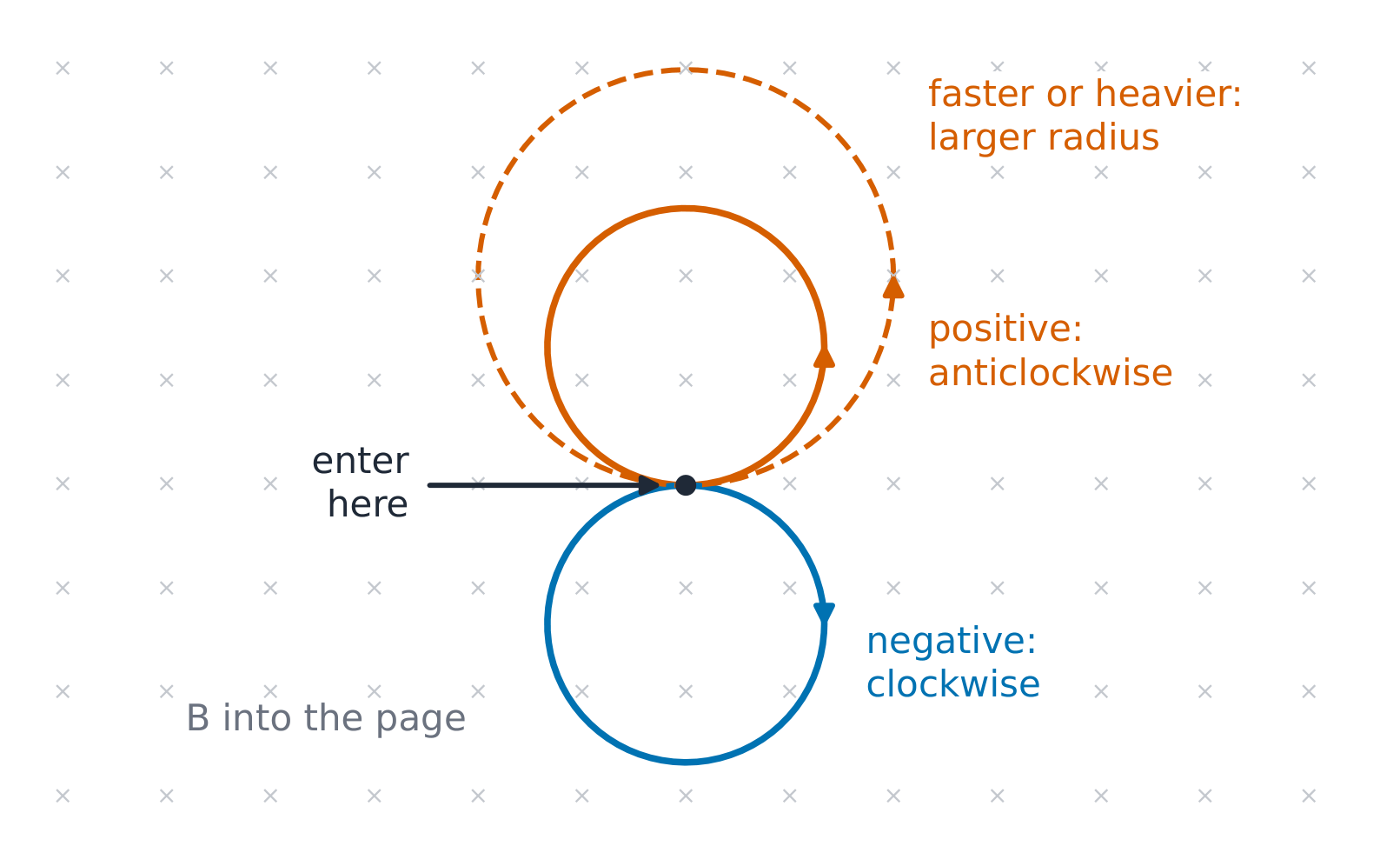
Opposite charges curve opposite ways; more momentum means a larger circle
Positive and negative particles curve in opposite directions.
At fixed other quantities, larger momentum gives a larger radius and larger charge magnitude or field gives a smaller one. Inferring mass from a spectrometer needs known speed and charge state; different masses alone do not guarantee different radii.
For oblique entry, $v_\parallel=v\cos\theta$ stays constant while $v_\perp=v\sin\theta$ produces circular motion with $r=mv_\perp/(|q|B)$. The result is a helix of pitch $|v_\parallel|T$. This describes a local uniform-field model; the real auroral field is nonuniform.
Worked example: the proton above ($3.0 \times 10^6\ \text{m s}^{-1}$, 0.20 T) moves on a circle of radius $r = 1.67 \times 10^{-27} \times 3.0 \times 10^6/(1.60 \times 10^{-19} \times 0.20) = 0.16$ m, with period $T = 2\pi \times 1.67 \times 10^{-27}/(1.60 \times 10^{-19} \times 0.20) = 3.3 \times 10^{-7}$ s.
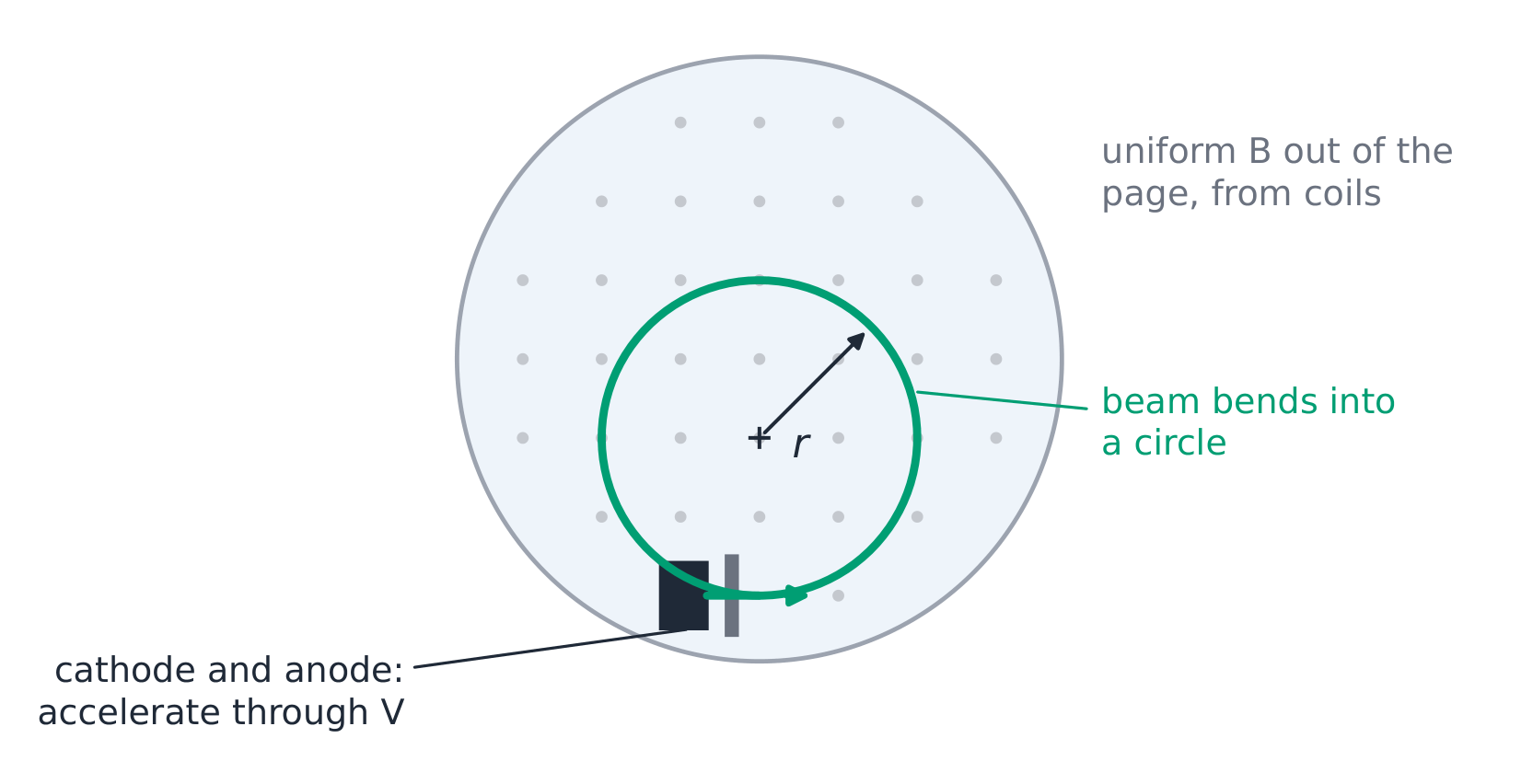
The path of a charged particle in a magnetic field lets us measure the magnitude of its charge-to-mass ratio 荷质比$|q|/m$. Electron $e/m$ below is positive; signed electron $q/m$ is negative. In a fine-beam tube, electrons are accelerated through a potential difference $V$ and then enter a uniform magnetic field made by a pair of coils. The tube holds a little gas, so the beam glows and the radius $r$ of its circle can be measured with a ruler.
Measure V, B and r to find the charge-to-mass ratio of the electron
From the energy gained, $\tfrac{1}{2}mv^2 = eV$, so $v = \sqrt{2eV/m}$. Putting this into $r = mv/eB$ and rearranging gives
$$\frac{e}{m} = \frac{2V}{B^2 r^2}$$
Worked example: with $V = 200$ V and $B = 1.0$ mT the beam radius is 4.8 cm. Then $e/m = 2 \times 200/((1.0 \times 10^{-3})^2 \times 0.048^2) = 1.7 \times 10^{11}\ \text{C kg}^{-1}$, close to the accepted magnitude $1.76 \times 10^{11}\ \text{C kg}^{-1}$. This assumes negligible initial kinetic energy and non-relativistic, perpendicular motion. Use radius, not diameter; check field calibration and viewing parallax. At fixed $B$, plotting $r^2$ against $V$ gives gradient $2/[(e/m)B^2]$, allowing several readings to test the model.
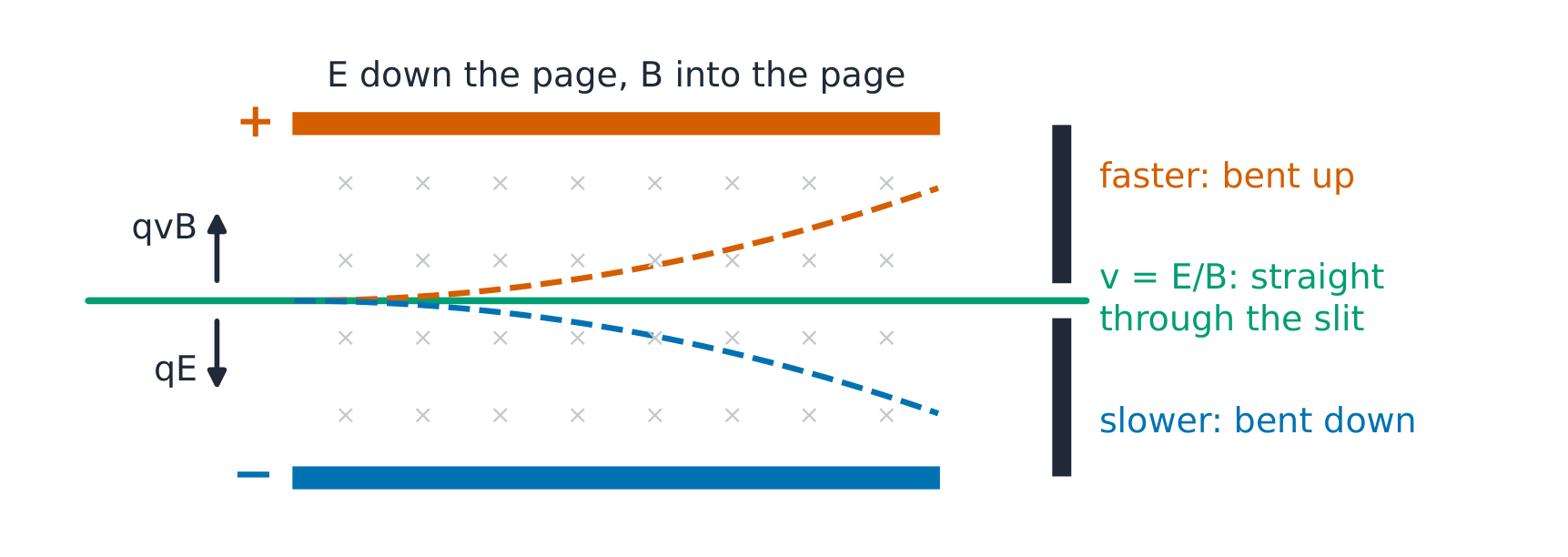
Suppose a uniform electric field and a uniform magnetic field are at right angles to each other and to a beam of charged particles. Electric and magnetic forces can oppose each other. Their magnitudes are $|q|E$ and $|q|vB$ for the perpendicular beam. They balance when
$$|q|E = |q|vB \quad\Rightarrow\quad v = \frac{E}{B}$$
Charged particles entering in the stated perpendicular direction pass undeflected at this speed, independent of their nonzero charge magnitude and mass. Neutral particles also pass straight because neither field acts on them. Slower charged particles initially deflect towards their electric force; faster ones initially deflect the other way. Both forces reverse for negative charge, so the balanced speed is unchanged, while the off-speed deflections reverse. This arrangement is called a velocity selector 速度选择器: a narrow exit slit passes a small range around the selected speed.
Only particles with v = E/B go straight through
Worked example: with $E = 3.0 \times 10^4\ \text{V m}^{-1}$ and $B = 0.010$ T, only particles with $v = 3.0 \times 10^4/0.010 = 3.0 \times 10^6\ \text{m s}^{-1}$ pass straight through.
A current is a flow of moving charges, so a wire carrying a current $I$ through a magnetic field also feels a force. For a straight length $L$ of wire actually within a uniform field, at angle $\theta$ to the field:
Fleming's left-hand rule: thumb = force, first finger = field, second finger = current
$$F = BIL\sin\theta$$
The direction comes from Fleming's left-hand rule, with the second finger along the conventional current. This is the motor effect 电动机效应, used in many electric motors and moving-coil loudspeakers. Energy for mechanical work comes from the electrical supply; this does not contradict zero magnetic work on a free charge.
Worked example: 5.0 cm of wire carrying 3.0 A at right angles to a 0.40 T field feels $F = 0.40 \times 3.0 \times 0.050 = 0.060$ N. At 30° to the field the force is 0.030 N; along the field it is zero.
Each current-carrying wire makes a magnetic field, and the other wire sits in that field. For two long parallel wires in vacuum (approximately air), a distance $r$ apart, the field from one wire at the other is $B_1=\mu_0 I_1/(2\pi r)$. Using $F/L=I_2B_1$ gives the force-per-length magnitude below. Ignore end effects and nearby return wires; use current magnitudes and centre-to-centre separation.
$$\frac{F}{L} = \frac{\mu_0 I_1 I_2}{2\pi r}$$
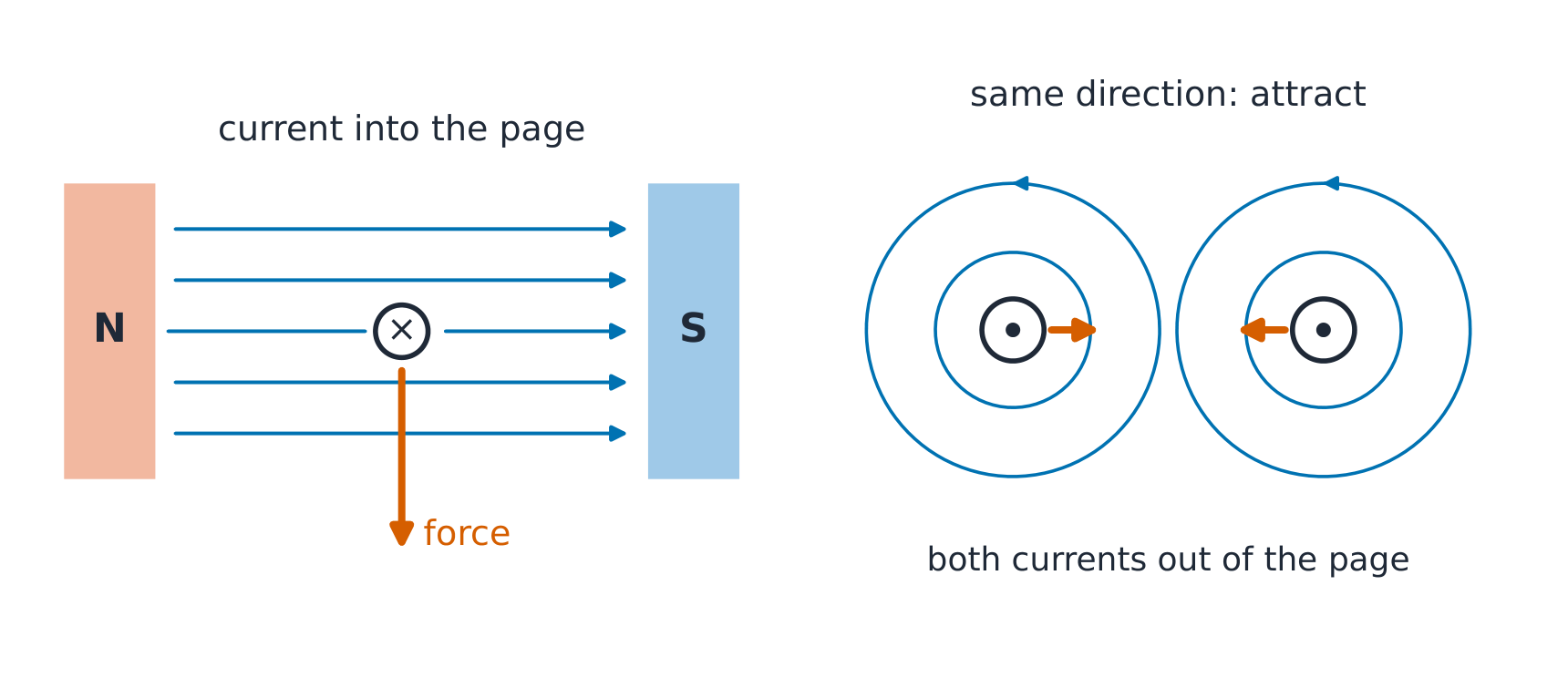
Currents in the same direction attract; currents in opposite directions repel. (This is the opposite of the rule for charges.)
The forces on the two wires are equal and opposite, as Newton's third law requires.
Find the direction by using the right-hand grip rule to find the field of one wire at the other, then Fleming's left-hand rule for the force.
The motor effect, and why parallel currents attract
Worked example: two long wires 5.0 cm apart each carry 10 A in the same direction. $F/L = 4\pi \times 10^{-7} \times 10 \times 10/(2\pi \times 0.050) = 4.0 \times 10^{-4}\ \text{N m}^{-1}$, attractive.
18.11
练习
English
A proton is accelerated from rest through 500 V. Find its kinetic energy and its speed.
An electron enters the uniform field between plates 5.0 cm long at $2.0 \times 10^7\ \text{m s}^{-1}$, moving parallel to the plates. The field is $2.0 \times 10^4\ \text{V m}^{-1}$. Find the time between the plates, its sideways deflection and its sideways velocity when it leaves.
Find the force on a proton moving at $3.0 \times 10^6\ \text{m s}^{-1}$ in a 0.20 T field when it moves (a) at right angles to the field, (b) at 30° to it, (c) along it.
Explain why a magnetic field cannot change the kinetic energy of a charged particle.
Find the radius and the period of the circular path of a proton moving at $3.0 \times 10^6\ \text{m s}^{-1}$ at right angles to a 0.20 T field.
The proton's speed is doubled. State what happens to the radius and to the period of its path.
In a fine-beam tube, electrons accelerated through 200 V move in a circle of radius 4.8 cm in a 1.0 mT field. Find the charge-to-mass ratio of the electron.
In a velocity selector $E = 3.0 \times 10^4\ \text{V m}^{-1}$ and $B = 0.010$ T. Find the speed of the particles that pass straight through, and state what happens to slower positive ions.
Find the force on 5.0 cm of wire carrying 3.0 A in a 0.40 T field when the wire is (a) at right angles to the field, (b) at 30° to it.
Two long parallel wires 5.0 cm apart each carry 10 A in the same direction. Find the force per metre between them and state whether it is attractive or repulsive.
A proton and an alpha particle (twice the charge magnitude, four times the mass) enter the same uniform field perpendicularly. Compare their radii (a) at the same speed and (b) at the same kinetic energy, in the classical model.
An electron moves due north through a magnetic field pointing vertically downwards. State the direction of the force on it.
A proton has perpendicular speed $3.0\times10^6$ m/s and parallel speed $1.0\times10^6$ m/s in a uniform 0.20 T field. Find helix radius and pitch. Explain which speed component determines each.
In a beam-tube measurement, percentage uncertainties in $V$, $B$ and $r$ are 1%, 2% and 3%. Estimate a conservative percentage uncertainty in $e/m$. Explain why measuring a diameter as though it were a radius changes the result by a factor of four.
$v = E/B = 3.0 \times 10^6\ \text{m s}^{-1}$. Slower ions feel a smaller magnetic force, so the electric force wins and they are bent in the direction of the electric field, missing the slit.
(a) $r=mv/(|q|B)$: at equal speed the alpha radius is $4/2=2$ times the proton's. (b) At equal $K$, $p=\sqrt{2mK}$ doubles, as does $|q|$, so the radii are equal.
For a positive charge the left-hand rule gives a force to the west; the electron is negative, so the force is to the east.
$r=mv_\perp/(eB)=0.1566$ m. $T=2\pi m/(eB)=3.28\times10^{-7}$ s; pitch $=|v_\parallel|T=0.328$ m. Perpendicular motion sets radius; parallel motion sets advance.
Conservative uncertainty $=1+2(2)+2(3)=11$%. Using diameter doubles $r$, quadruples the denominator, and makes inferred $e/m$ one quarter of its correct value.