跳到主要内容

D.2 · 电场与磁场

国际文凭组织 · IB Diploma · 物理 · HL · 知识点 17

本主题的视频课程 打开视频页面
4:18

电场与磁场

带负电的粒子受到的电场力方向与场强方向相反。场强方向是用正试探电荷定义的。

英语旁白 · 英中内嵌字幕

17.1

范围与先修条件

English

This handout teaches D.2 Electric and magnetic fields in full, for the course first assessed in 2025, but HL students must also study the sections marked AHL: electric potential energy, electric potential, potential gradient, work done in electric fields and equipotential surfaces.

Prerequisites: forces and Newton's laws from A.2; work and energy from A.3; current and potential difference from B.5; gravitational fields from D.1, which follow the same patterns. Use $e = 1.60 \times 10^{-19}$ C, $k = 8.99 \times 10^9\ \text{N m}^2\ \text{C}^{-2}$ and $\varepsilon_0 = 8.85 \times 10^{-12}\ \text{C}^2\ \text{N}^{-1}\ \text{m}^{-2}$.

17.2

电荷

English

Why do you sometimes get a shock from a car door?

On a dry day you slide out of a car seat, touch the metal door and feel a sharp snap. Sliding across the seat rubbed electrons from one surface onto the other, so your body gained an electric charge. When your finger came close to the metal, the charge jumped across the gap as a tiny spark. Lightning is the same thing on a huge scale. To understand it we need electric charge, the forces between charges, and the fields that carry those forces.

A lightning strike at night
Lightning is a giant spark driven by a huge electric field.

Two types of charge

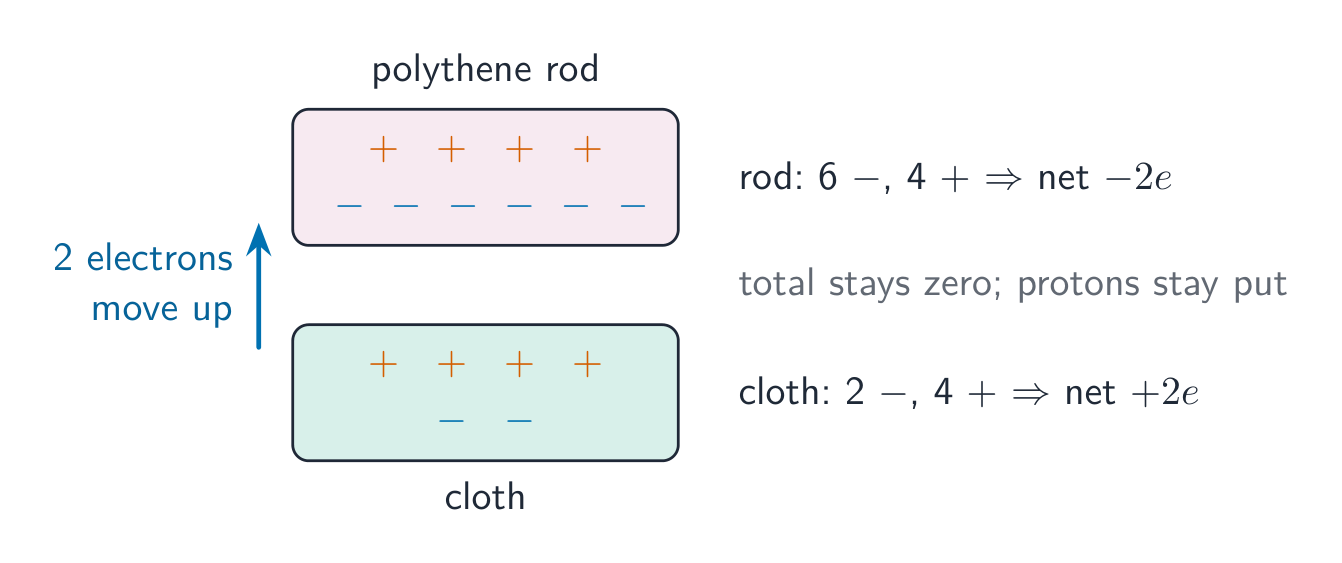
Electric charge 电荷 comes in two types, positive and negative. Protons carry a positive charge $+e$, electrons a negative charge $-e$, where $e = 1.60 \times 10^{-19}$ C is the elementary charge 元电荷.

A polythene rod and cloth: two electrons move from cloth to rod, leaving the rod at minus 2e and the cloth at plus 2e; protons stay put and total charge is zero
Rubbing moves electrons
  • Like charges repel; unlike charges attract.
  • A neutral object has equal amounts of positive and negative charge. It becomes charged when electrons are added (negative) or removed (positive). Protons stay in the nuclei.
  • Charge is conserved 电荷守恒: the total net charge of an isolated system stays the same. In these ordinary solid-body charging examples electrons transfer; nuclei remain in the solids.
词汇 训练
English 中文 拼音
electric charge/ɪˈlektrɪk tʃɑːdʒ/ 电荷 diàn hè
elementary charge/ˌelɪˈmentəri tʃɑːdʒ/ 元电荷 yuán diàn hè
charge is conserved 电荷守恒 diàn hè shǒu héng
17.3

通过摩擦、接触和感应起电

English

There are three ways to charge a body:

A Van de Graaff generator: a large polished metal dome on a clear column, with a moving rubber belt inside and a small discharge sphere on a stand beside it
A Van de Graaff generator stores a large static charge on its metal dome, making a strong electric field around it
  • Friction: rubbing two different insulators together transfers electrons from one to the other. A balloon rubbed on hair takes electrons and becomes negative; the hair is left with an equal positive charge.
  • Contact: touching a charged conductor to an uncharged one lets charge flow until they share it. Two identical, isolated metal spheres, with no nearby charged object, carrying $+6.0$ nC and $-2.0$ nC, touched and separated, each end up with $(6.0 - 2.0)/2 = +2.0$ nC.
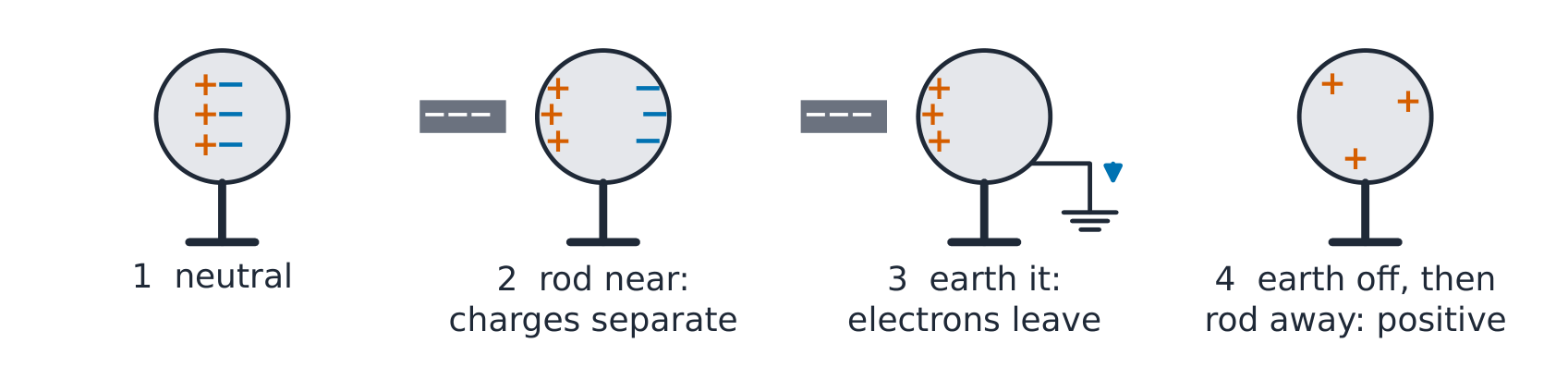
  • Electrostatic induction 静电感应: a charged object brought near a conductor, without touching it, pushes the conductor's free electrons to one side. If the conductor is then earthed 接地 (connected to the ground), electrons flow to or from the Earth, and the conductor is left with a charge opposite to the charged object.
Charging a metal sphere by induction in four steps: the neutral sphere; a negative rod brought near pushes the sphere's electrons to the far side; the far side is connected to earth and electrons flow away; the earth is removed and then the rod, leaving the sphere positive
Charging by induction: the sphere ends up with the opposite charge to the rod

The order of the last step matters: remove the earth connection before taking the rod away. Otherwise electrons flow back from the earth and the sphere is left neutral.

词汇 训练
English 中文 拼音
electrostatic induction 静电感应 jìng diàn gǎn yìng
earthed/ɜːθt/ 接地 jiē dì
17.4

密立根油滴实验

English

Is charge continuous, or does it come in lumps? Millikan's oil-drop work tested discrete charge; its final report appeared in 1913. In the simplified suspension model, a small charged oil drop is observed between horizontal plates. By adjusting the potential difference $V$ across the plates, separated by $d$, he could hold a drop still. For a stationary drop, neglecting air buoyancy, the upward electric-force magnitude balances weight:

$$|q|E = mg \quad\Rightarrow\quad |q| = \frac{mgd}{V}$$
Left: an oil drop held still between parallel plates, the upward electric force qE balancing the weight mg; right: the charges found on many drops all lie at whole-number multiples of 1.6 times ten to the minus nineteen coulombs
Charge-magnitude estimates cluster near multiples of e; plate polarity determines the suspended drop's sign

Measurements, with their uncertainties, supported charges in integer multiples of $e$, rather than arbitrary continuous values. This is evidence that charge is quantized 电荷量子化 for the isolated bodies studied here.

Worked example with values: a drop of mass $4.9 \times 10^{-15}$ kg is stationary between plates 1.0 cm apart with 1000 V across them, upper plate positive. Neglect buoyancy. The field is downward, so an upward electric force needs negative charge. $|q| = 4.9 \times 10^{-15} \times 9.81 \times 0.010/1000 \approx 4.8 \times 10^{-19}$ C; thus $q \approx -3e$, about three extra electrons.

词汇 训练
English 中文 拼音
charge is quantized 电荷量子化 diàn hè liàng zǐ huà
17.5

库仑定律

English

The force between two point charges $q_1$ and $q_2$ a distance $r$ apart is given by Coulomb's law 库仑定律:

Coulomb's law direction: two like charges (both positive) are pushed apart; a positive and a negative charge are pulled together
Like charges repel; opposite charges attract — the force is along the line joining them
$$F = \frac{k |q_1 q_2|}{r^2} \qquad k = \frac{1}{4\pi\varepsilon_0}$$
  • Like gravity, it is an inverse-square law. Unlike gravity, it can attract or repel.
  • An isolated spherically symmetric charge distribution acts as a point charge outside it. Nearby charges can redistribute charge on a conducting sphere, invalidating that simple external pattern.
  • $\varepsilon_0$ is the permittivity 电容率 of free space. An ideal homogeneous linear dielectric has $\varepsilon = \varepsilon_r\varepsilon_0$, reducing the point-charge force by $\varepsilon_r$. The approximate table values are for electrostatic conditions and depend on material and temperature; conducting liquids and dissolved ions require more than this simple model.
Medium Relative permittivity
vacuum 1 (exactly)
air 1.0006
paper about 3
glass about 5 to 10
water about 80

Worked examples:

  • $+3.0\ \mu$C and $-2.0\ \mu$C, 0.20 m apart in air: $F = 8.99 \times 10^9 \times 3.0 \times 10^{-6} \times 2.0 \times 10^{-6}/0.20^2 = 1.35$ N, attractive. In the ideal dielectric model with $\varepsilon_r=80$, the force is about 80 times smaller, 0.017 N. Salt solubility additionally depends on lattice, hydration and entropy changes; this force comparison alone does not predict it.
  • The electron and proton in a hydrogen atom, $5.3 \times 10^{-11}$ m apart: $F = 8.99 \times 10^9 \times (1.60 \times 10^{-19})^2/(5.3 \times 10^{-11})^2 = 8.2 \times 10^{-8}$ N.
词汇 训练
English 中文 拼音
Coulomb's law/ˈkuːlɒmz lɔː/ 库仑定律 kù lún dìng lǜ
permittivity/ˌpɜːmɪˈtɪvəti/ 电容率 diàn róng lǜ
17.6

电场强度

English

A charge creates an electric field 电场 around it. The electric field strength 电场强度 $E$ at a point is the force per unit charge on a small positive test charge placed there:

$$E = \frac{F}{q}$$

Its unit is N C⁻¹ (the same as V m⁻¹). The field is a vector, in the direction of the force on a positive charge. A negative charge feels a force in the opposite direction to the field.

For a point charge $Q$, combining with Coulomb's law gives $E = kQ/r^2$. For example, 0.10 m from a $+2.0$ nC charge, $E = 8.99 \times 10^9 \times 2.0 \times 10^{-9}/0.10^2 = 1.8 \times 10^3\ \text{N C}^{-1}$, pointing away from the charge.

词汇 训练
English 中文 拼音
electric field/ɪˈlektrɪk fiːld/ 电场 diàn chǎng
electric field strength/ɪˈlektrɪk fiːld streŋθ/ 电场强度 diàn chǎng qiáng dù
17.7

电场线

English

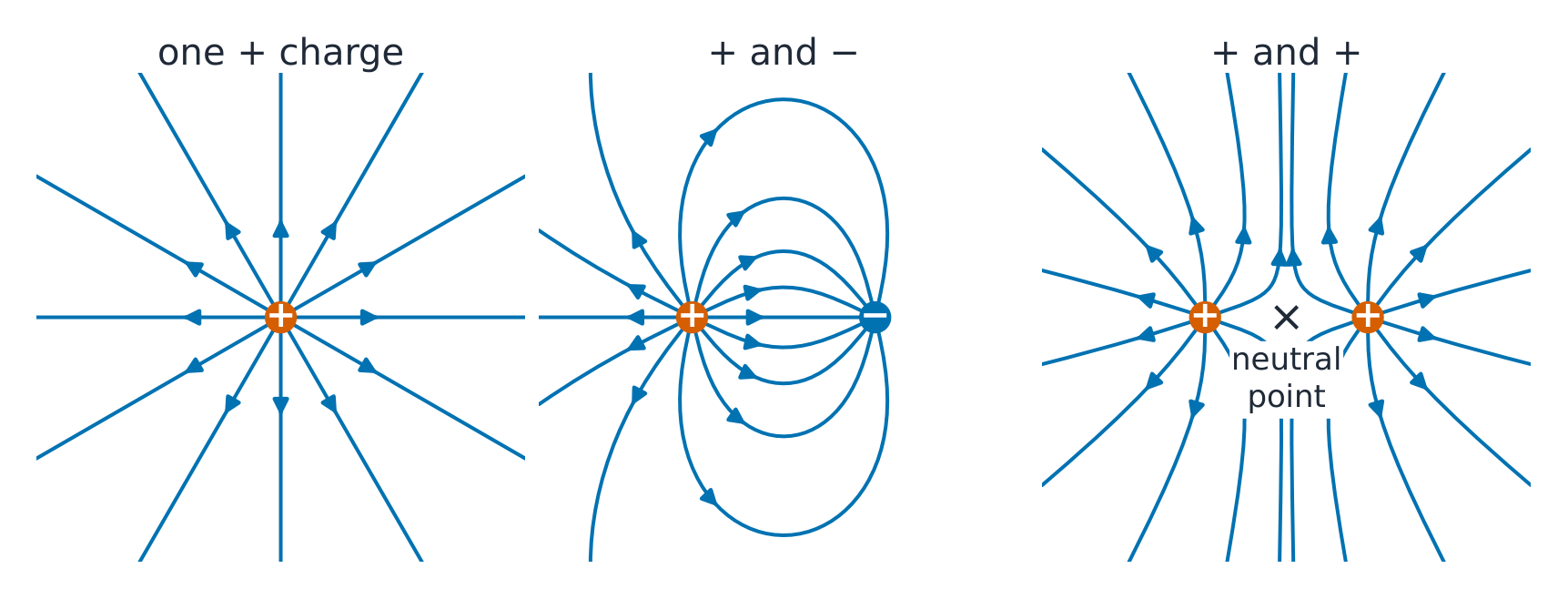
Electric field lines 电场线 show the direction of the force on a positive test charge.

  • They point away from positive charges and towards negative charges; lines may also extend to or from infinity. They do not cross where the field has a definite nonzero direction.
  • The density of the lines shows the field strength: where they are closer together, the field is stronger.
  • Around a single point charge the field is radial: outwards from a positive charge, inwards to a negative one.
  • Between like charges the lines push apart, and there is a neutral point where the field is zero.
Field lines for a single positive charge, radially outwards; for a positive and a negative charge, running from one to the other; and for two positive charges, pushed apart with a neutral point between them
Lines point away from positive charges and towards negative charges; some extend to infinity

Two more patterns to know:

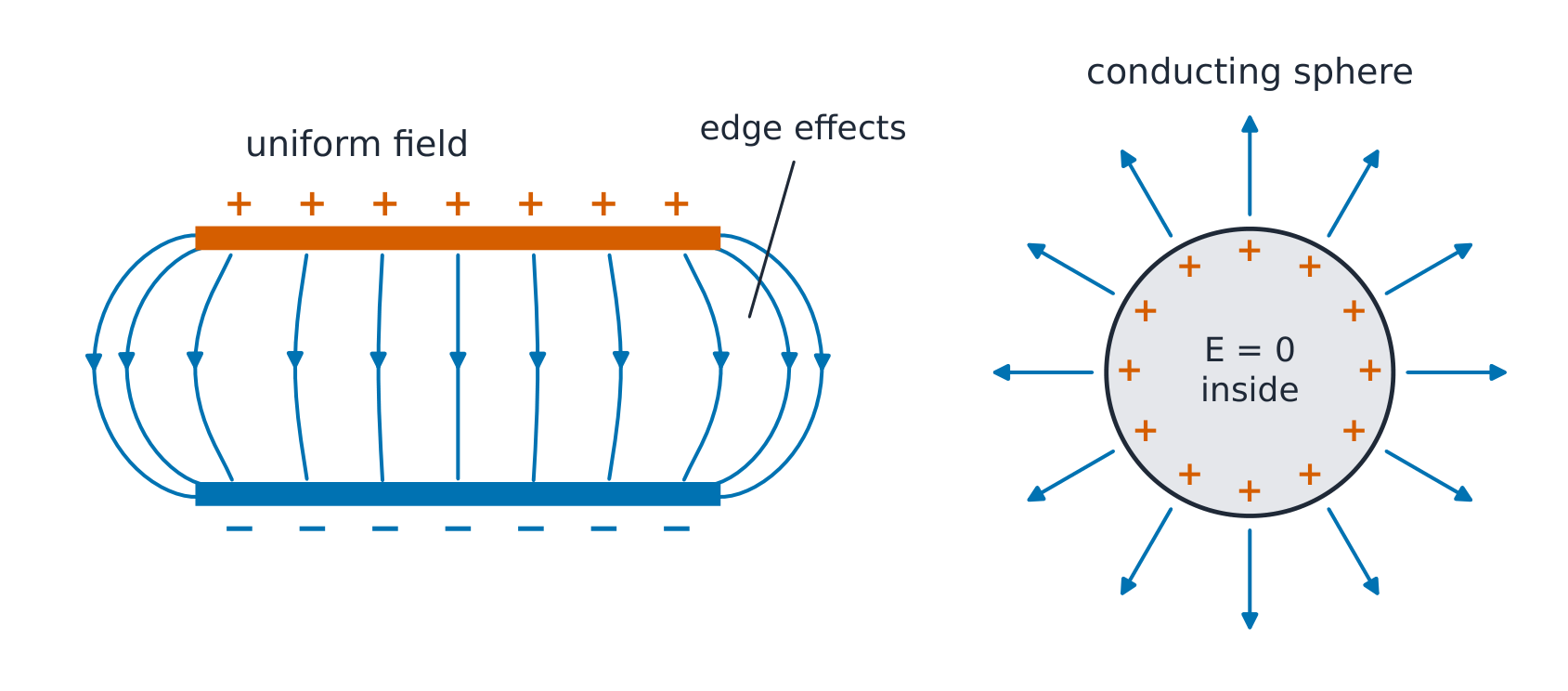
  • Parallel plates: between two oppositely charged plates the lines are straight, parallel and equally spaced. The field there is uniform. Near the ends of the plates the lines bulge outwards: these are the edge effects 边缘效应.
  • An isolated charged conducting sphere in electrostatic equilibrium: excess charge is on its surface and the exterior field is radial. The field inside conducting material is zero. A closed empty cavity also has zero field; a charge inside that cavity changes this conclusion about the cavity, not the conducting material.
Left: parallel straight field lines between oppositely charged plates, bulging outwards at the ends; right: radial field lines outside a charged conducting sphere, with zero field inside
A uniform field between plates; no field inside a charged conductor
词汇 训练
English 中文 拼音
electric field line 电场线 diàn chǎng xiàn
edge effect 边缘效应 biān yuán xiào yìng
17.8

平行板间的匀强电场

English

For ideal broad parallel plates, away from edges, let $V$ be the positive magnitude of the potential difference across gap $d$. The uniform field magnitude is:

$$E = \frac{V}{d}$$

Before calculating, sketch the plate polarities, field direction and charge sign; convert the gap to metres. In school, use a simulation or approved low-voltage model rather than exposed high-voltage equipment.

Worked example: 2.0 kV across plates 4.0 cm apart gives $E = 2000/0.040 = 5.0 \times 10^4\ \text{V m}^{-1}$. An electron between the plates feels $F = eE = 1.60 \times 10^{-19} \times 5.0 \times 10^4 = 8.0 \times 10^{-15}$ N, towards the positive plate, wherever it is between them.

探索

同一电场,正负电荷受力方向相反

120 V加在20 mm间距的极板上产生6000 V/m的电场。比较+2和−2 μC试探电荷:力的大小都是0.012 N,方向由电荷的正负决定。

17.9

磁感线

English

Magnets and electric currents create magnetic fields 磁场. Magnetic field lines 磁感线 show the direction a compass needle's north pole would point.

Iron filings around bar magnets
Iron filings trace the field lines around bar magnets.
  • Outside a magnet the lines go from the north pole to the south pole. They are closest together, so the field is strongest, at the poles.
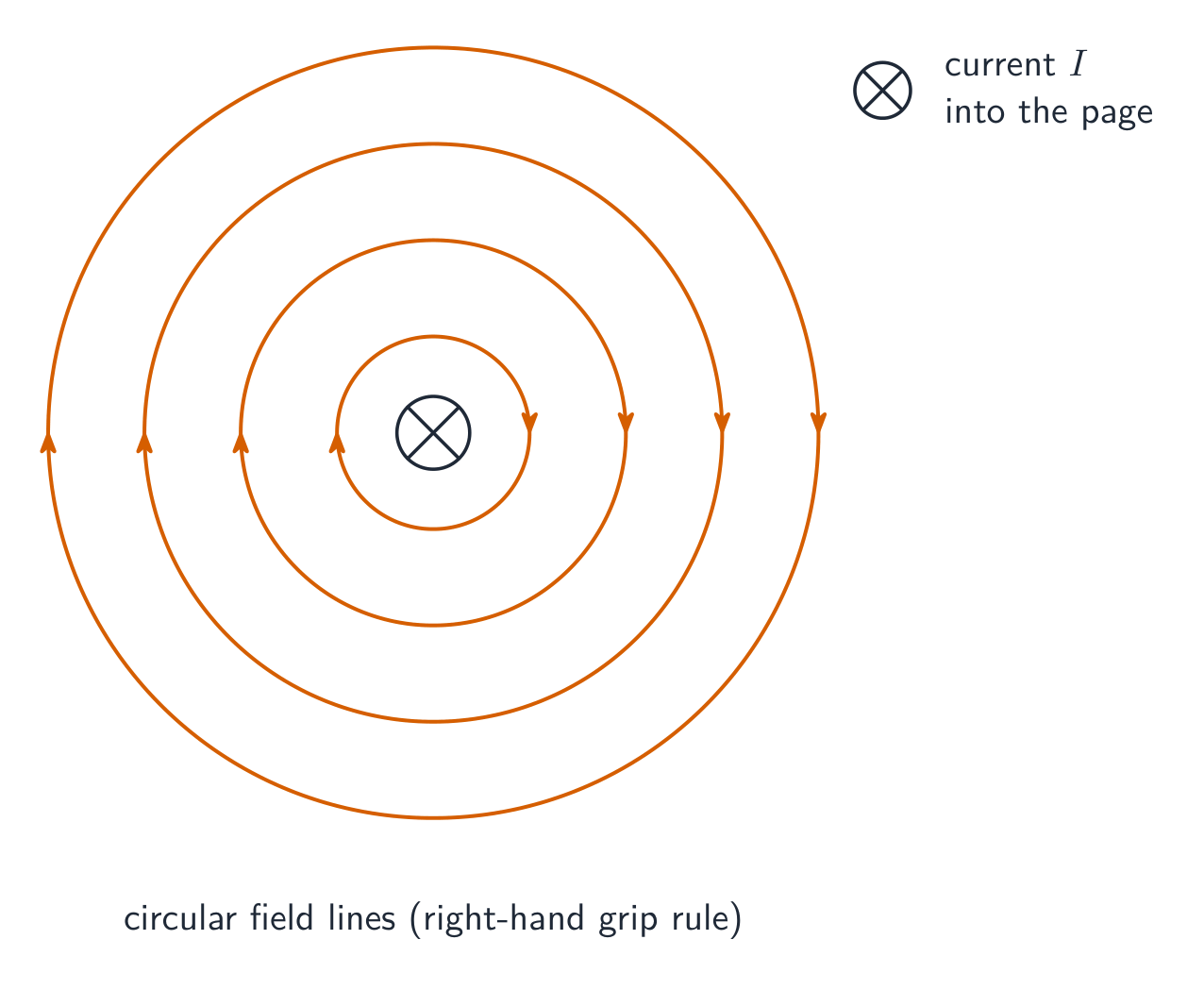
  • Around a long straight wire the lines are circles centred on the wire, closer together near the wire. Find their direction with the right-hand grip rule 右手螺旋定则: point your right thumb along the current; your fingers curl in the direction of the field.
  • Through a flat circular coil the lines pass straight through the middle and loop round each side.
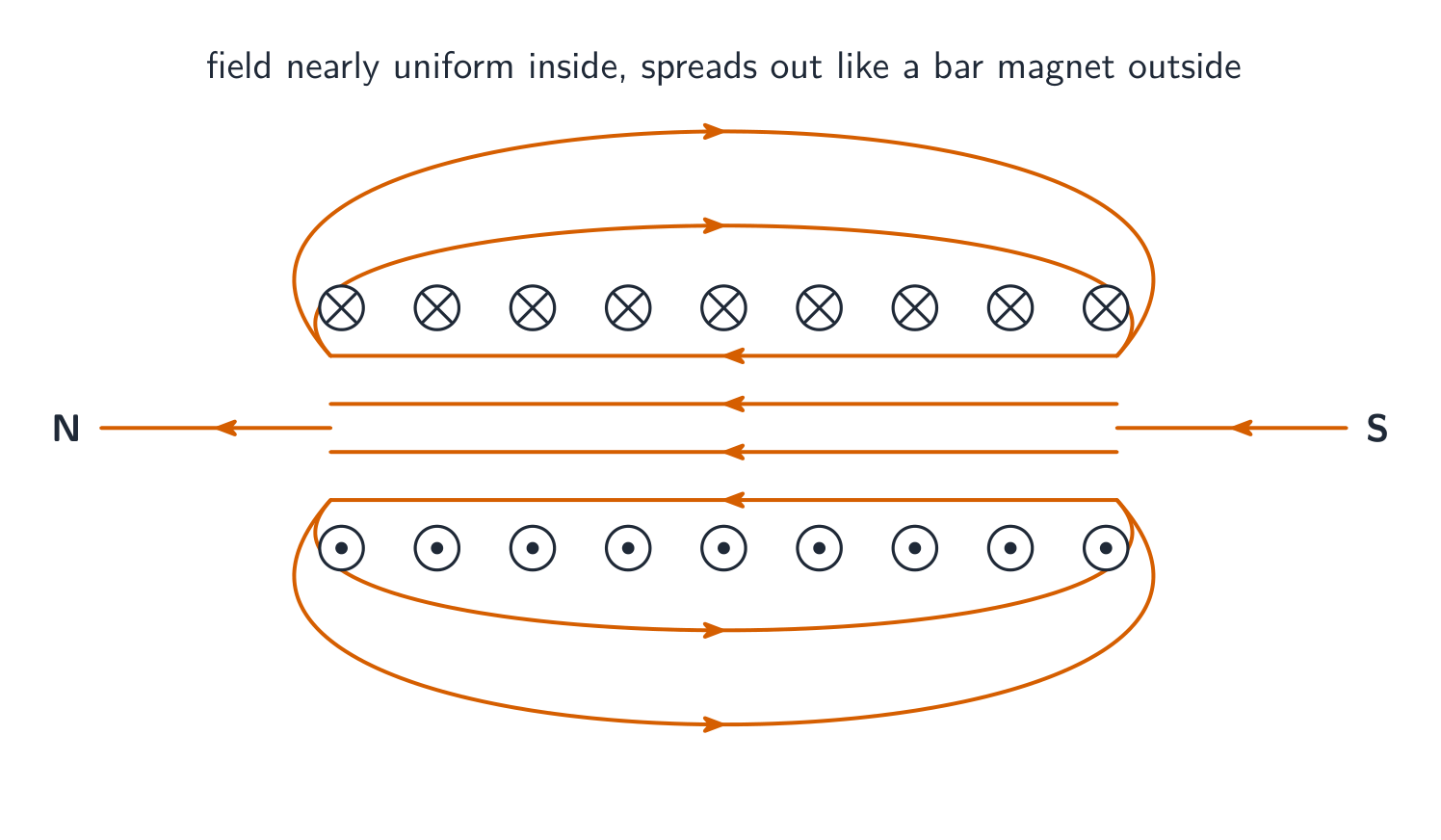
  • Inside a long solenoid 螺线管 (a coil of many turns, here with an air core) the field is strong and uniform: straight, parallel, equally spaced lines. Outside, the pattern is like a bar magnet's. Use the grip rule with the fingers along the current in the turns: the thumb then points to the north end.
Magnetic field lines of a bar magnet, from north to south outside; of a straight wire with current out of the page, anticlockwise circles; of a flat coil seen edge on, lines through the middle; and of a solenoid, uniform parallel lines inside
The four magnetic field patterns to know

In diagrams, a dot ⊙ means a current coming out of the page and a cross ⊗ means a current going into it. For a current out of the page, the field circles anticlockwise.

Magnetic field lines of a solenoid: uniform and parallel inside, spreading out at the ends like a bar magnet, with N and S ends marked
Field of a solenoid
Concentric circular magnetic field lines around a straight current-carrying wire, with the current going into the page
Field around a long straight wire
词汇 训练
English 中文 拼音
magnetic field/mæɡˈnetɪk fiːld/ 磁场 cí chǎng
magnetic field line 磁感线 cí gǎn xiàn
right-hand grip rule/raɪt hænd ɡrɪp ruːl/ 右手螺旋定则 yòu shǒu luó xuán dìng zé
solenoid/ˈsəʊlənɔɪd/ 螺线管 luó xiàn guǎn
17.10

AHL:电势能

English

The electric potential energy 电势能 $E_p$ of a system of charges is the external work to assemble the system slowly from infinite separation. For two point charges $r$ apart:

$$E_p = \frac{k q_1 q_2}{r}$$
  • Put in the signs of the charges. Like charges give a positive $E_p$: work must be done to push them together. Unlike charges give a negative $E_p$: they attract, so work is done by the field as they come together.
  • $E_p$ is zero when the charges are infinitely far apart.

Worked example: $+3.0\ \mu$C and $-2.0\ \mu$C, 0.20 m apart: $E_p = 8.99 \times 10^9 \times (3.0 \times 10^{-6}) \times (-2.0 \times 10^{-6})/0.20 = -0.27$ J. Separating them completely needs at least 0.27 J. For the hydrogen atom, $E_p = -4.3 \times 10^{-18}$ J.

Electric potential energy against separation: like charges give a positive curve falling towards zero (energy released if they fly apart); opposite charges give a negative curve rising towards zero — a bound well that needs energy supplied to separate them
Electric PE of two charges: positive for like charges, a negative well for opposite charges
词汇 训练
English 中文 拼音
electric potential energy/ɪˈlektrɪk pəˈtenʃl ˈenədʒi/ 电势能 diàn shì néng
17.11

AHL:电势

English

The electric potential 电势 $V_e$ at a point is the external work per unit charge to bring a small positive test charge slowly from infinity to that point. For a point charge $Q$:

Two 1/r curves of potential V against distance r from a point charge on one axis: a positive source charge gives a positive potential falling towards zero, a negative source charge gives a negative potential rising towards zero
The potential near a point charge varies as 1/r — positive for a positive charge, negative for a negative one
$$V_e = \frac{kQ}{r}$$
  • Its unit is the volt, V (J C⁻¹). Potential is zero at infinity.
  • It is positive near a positive charge and negative near a negative one.
  • Potential is a scalar 标量. The potential due to several charges is the simple sum of their potentials, with signs. Field strengths, being vectors, must be added with their directions.

Worked example: midway between $+4.0$ nC and $-2.0$ nC that are 0.20 m apart, each charge is 0.10 m away.

  • Potential: $V = 8.99 \times 10^9 \times (4.0 - 2.0) \times 10^{-9}/0.10 = 180$ V.
  • Field: both fields point towards the negative charge, so they add: $E = 3.6 \times 10^3 + 1.8 \times 10^3 = 5.4 \times 10^3\ \text{N C}^{-1}$.
词汇 训练
English 中文 拼音
electric potential/ɪˈlektrɪk pəˈtenʃl/ 电势 diàn shì
potential is a scalar 标量 biāo liàng
17.12

AHL:电势差与做功

English

The field strength is the negative of the potential gradient 电势梯度:

$$E_r = -\frac{dV_e}{dr} \qquad \overline{E_r}=-\frac{\Delta V_e}{\Delta r}$$

For outward radial coordinate r, the local component is the negative derivative; a finite difference gives its interval average. The field points towards lower potential. Between parallel plates the potential changes steadily, and $E = V/d$ is a special case.

Two graphs against distance for a uniform field: a) potential falling steadily from +V to zero with gradient minus V over d, b) the field strength constant at V over d
In a uniform field the potential falls steadily with distance, so the field strength $V/d$ is constant

The external work done for a slow move at unchanged kinetic energy is

$$W = q\,\Delta V_e$$

Worked examples:

  • 0.20 m from a $+2.0$ nC charge, $V = 90$ V; at 0.10 m, $V = 180$ V. Moving a $+1.0$ nC charge inwards needs $W = 1.0 \times 10^{-9} \times 90 = 9.0 \times 10^{-8}$ J.
  • In an ideal uniform field, two equipotentials 50 V apart have a perpendicular separation of 2.0 cm. The field magnitude is $E = 50/0.020 = 2.5 \times 10^3\ \text{V m}^{-1}$.

The electronvolt

For particles, work is often given in electronvolts 电子伏特 (eV). One electronvolt is the energy gained by an electron moving through a potential difference of 1 V: $1\ \text{eV} = 1.60 \times 10^{-19}$ J.

Worked example: an electron accelerated from rest through 2.0 kV gains 2.0 keV $= 2000 \times 1.60 \times 10^{-19} = 3.2 \times 10^{-16}$ J. Then $\tfrac{1}{2}mv^2 = 3.2 \times 10^{-16}$ gives $v = 2.7 \times 10^7\ \text{m s}^{-1}$.

词汇 训练
English 中文 拼音
potential gradient/pəˈtenʃl ˈɡreɪdɪənt/ 电势梯度 diàn shì tī dù
electronvolt/ɪˈlektrɒnvəʊlt/ 电子伏特 diàn zi fú tè
17.13

AHL:等势面

English

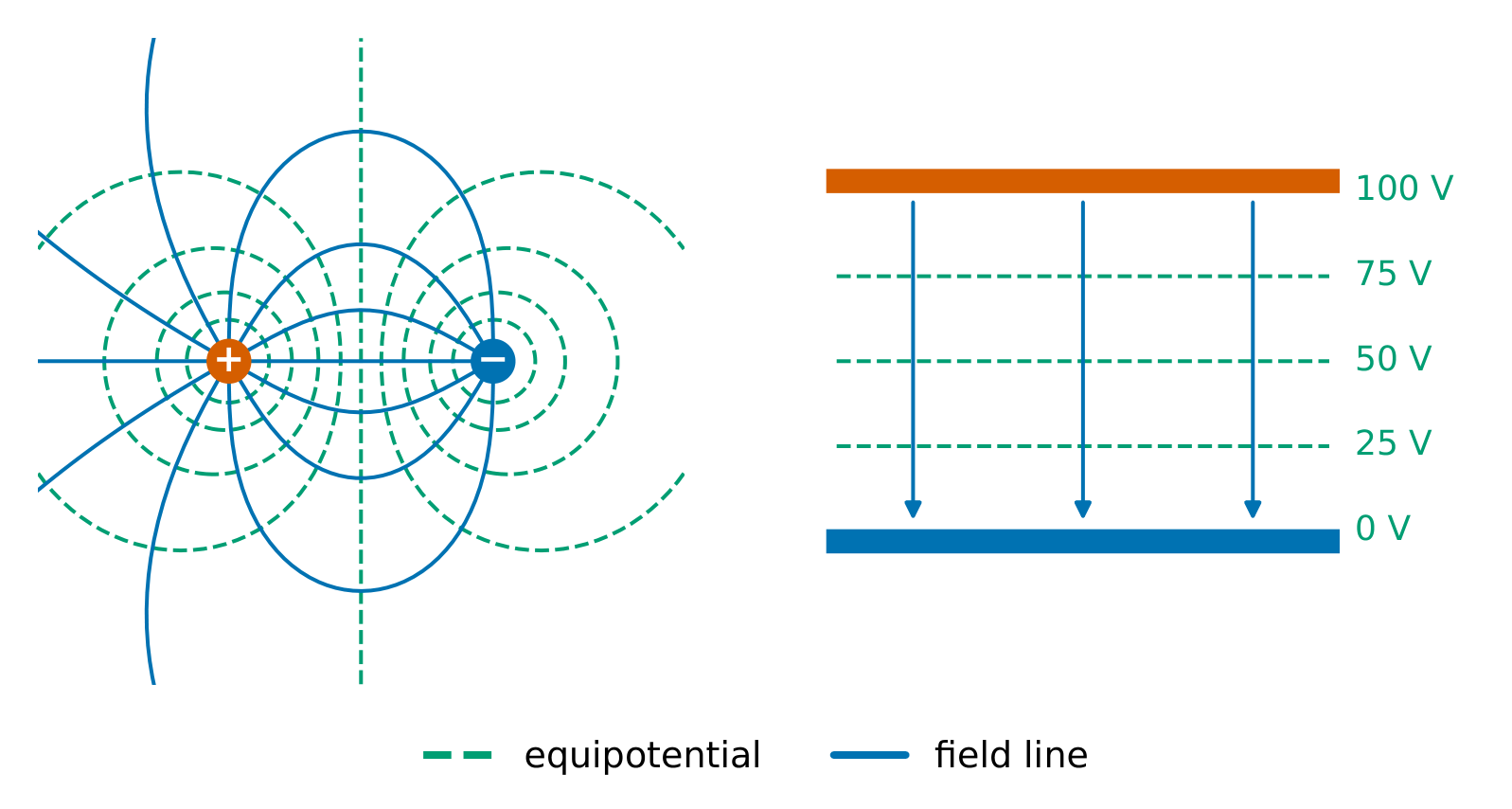
An equipotential surface 等势面 joins points at the same potential.

  • No work is done by the electric field along an equipotential because $\Delta V_e = 0$; another force may still change kinetic energy.
  • Field lines cross equipotentials at right angles. If the field had a part along the surface, moving along it would need work.
  • Drawn at equal steps of potential, equipotentials are closer together where the field is stronger.

Patterns to recognize:

  • Point charge: concentric spheres, further apart at larger distances.
  • Several point charges: add potentials as scalars with signs. Equipotential shapes depend on the whole arrangement and need not be closed; for an equal opposite pair the zero-potential surface includes the perpendicular bisector plane.
  • Parallel plates: flat planes parallel to the plates and equally spaced, because the field is uniform.
  • Isolated charged conducting sphere: the conducting material is equipotential; so is an empty cavity. With spherical symmetry the exterior equipotentials are concentric spheres.
Left: equipotentials and field lines for a positive and a negative charge, crossing at right angles; right: flat, equally spaced equipotentials at 0, 25, 50, 75 and 100 volts between parallel plates
Equipotentials always meet field lines at right angles

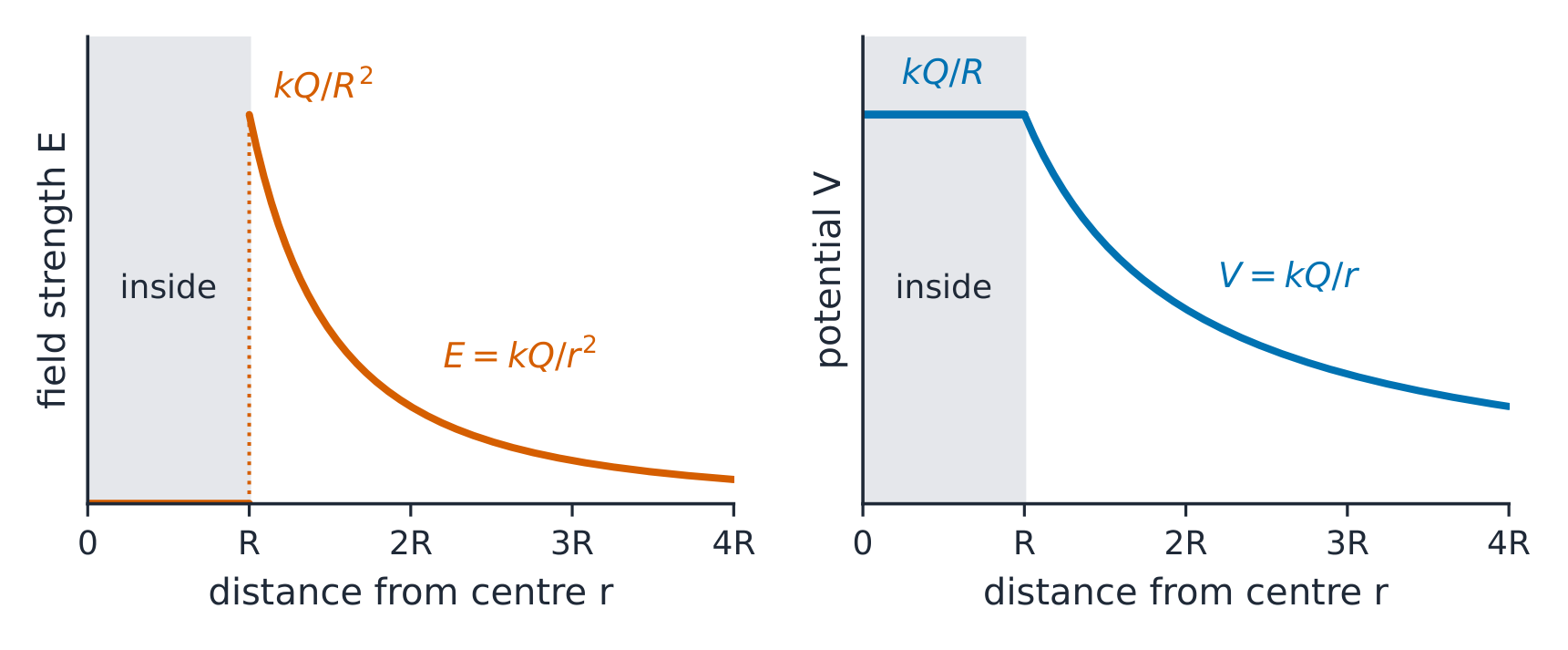
For an isolated conducting sphere in electrostatic equilibrium, with an empty cavity if hollow, the internal field is zero and potential is constant: it equals the surface value $kQ/R$ everywhere inside.

For a charged conducting sphere of radius R: field strength zero inside and falling as one over r squared outside; potential constant at kQ over R inside and falling as one over r outside
Inside a conductor: zero field, constant potential

Worked example: an isolated conducting sphere of radius 0.10 m carries $+5.0$ nC. Just outside its surface $V = 8.99 \times 10^9 \times 5.0 \times 10^{-9}/0.10 = 450$ V and $E = 4.5 \times 10^3\ \text{V m}^{-1}$. At its centre, $V = 450$ V and $E = 0$.

词汇 训练
English 中文 拼音
equipotential surface/ˌiːkwɪpəˈtenʃl ˈsɜːfɪs/ 等势面 děng shì miàn
17.14

练习

English
  1. A balloon rubbed on hair becomes negatively charged. Explain what happens to the charge, and why the hair is left positive.
  2. Two identical metal spheres carry $+6.0$ nC and $-2.0$ nC. They are touched together and separated. Find the charge on each.
  3. Describe how a negatively charged rod can be used to give an insulated metal sphere a positive charge.
  4. Find the force between $+3.0\ \mu$C and $-2.0\ \mu$C 0.20 m apart in air, and in water (relative permittivity 80).
  5. An oil drop of mass $4.9\times10^{-15}$ kg is stationary between plates 1.0 cm apart with 1000 V across them, upper plate positive. Neglect buoyancy and use g = 9.81 m/s². Find signed charge and the number of extra electrons.
  6. Find the electric field strength 0.10 m from a $+2.0$ nC point charge.
  7. 2.0 kV is applied across plates 4.0 cm apart. Find the field strength and the force on an electron between them.
  8. Sketch the field lines between a positive and a negative point charge, and between two oppositely charged parallel plates, including edge effects.
  9. A vertical wire carries a current upwards. State the direction of the magnetic field lines round it, seen from above.
  10. Sketch the magnetic field of a solenoid and state how it compares with that of a bar magnet.
  11. A particle with charge $-3.2\times10^{-19}$ C is in a uniform field of magnitude $5.0\times10^4$ N/C directed right. Find its force magnitude and direction, and its charge in units of e.
  12. HL. Point charges $+4.0$ nC and $-2.0$ nC are 0.20 m apart in vacuum. Find their interaction potential energy, external work for slow separation to infinity, and midpoint potential and field direction/magnitude.
  13. HL. An electron is released from rest just beside the negative plate of two broad plates 4.0 cm apart with 2.0 kV across them. It crosses the full gap to the positive plate; neglect other forces and edge effects. Find field magnitude, which plate it accelerates towards, kinetic-energy gain in eV and J, and non-relativistic final speed. Use electron mass $9.11\times10^{-31}$ kg.
  14. HL. An isolated conducting sphere of radius 0.10 m carries $+5.0$ nC. Find V and E at its centre, just outside the surface and at r = 0.20 m. Explain why electrostatic field lines meet a regular equipotential at right angles.

Answers.

  1. Rubbing transfers electrons from the hair to the balloon. Charge is conserved, so the hair loses exactly as much negative charge as the balloon gains and is left positive.
  2. Total charge $+4.0$ nC is shared equally: $+2.0$ nC each.
  3. Bring the rod near (not touching): electrons are pushed to the far side. Earth the far side: electrons flow to earth. Remove the earth connection, then the rod: the sphere is left positive.
  4. Air: $F = 8.99 \times 10^9 \times 6.0 \times 10^{-12}/0.040 = 1.35$ N, attractive. Water: $1.35/80 = 0.017$ N.
  5. $|q|=mgd/V\approx4.8\times10^{-19}$ C. The field is downward but electric force upward, so $q\approx-4.8\times10^{-19}$ C, about three extra electrons.
  6. $E = 8.99 \times 10^9 \times 2.0 \times 10^{-9}/0.10^2 = 1.8 \times 10^3\ \text{N C}^{-1}$, away from the charge.
  7. $E = 2000/0.040 = 5.0 \times 10^4\ \text{V m}^{-1}$; $F = 1.60 \times 10^{-19} \times 5.0 \times 10^4 = 8.0 \times 10^{-15}$ N, towards the positive plate.
  8. Lines start on the positive charge and curve round to end on the negative charge. Between plates: straight, parallel, equally spaced lines from + to −, bulging outwards at the ends.
  9. Anticlockwise circles centred on the wire (right-hand grip rule).
  10. Inside: straight, parallel, equally spaced lines (uniform field). Outside: the same pattern as a bar magnet, with a north pole at one end.
  11. $|F|=|q|E=1.6\times10^{-14}$ N, left because the charge is negative; $q/e=-2$.
  12. HL. $U=kq_1q_2/r=-3.60\times10^{-7}$ J, so slow external separation work is $+3.60\times10^{-7}$ J. Midpoint $V=k(4.0-2.0)\times10^{-9}/0.10\approx180$ V. Field contributions point from positive towards negative and add: $E=k(6.0\times10^{-9})/0.10^2\approx5.4\times10^3$ N/C.
  13. HL. $E=2000/0.040=5.0\times10^4$ N/C. The electron accelerates towards the positive plate; $\Delta K=2000$ eV $=3.2\times10^{-16}$ J. $v=\sqrt{2\Delta K/m}\approx2.65\times10^7$ m/s, about 0.089c; this is the non-relativistic estimate.
  14. HL. Centre: V ≈ 450 V and E = 0. Just outside R: V ≈ 450 V and E ≈ 4500 N/C outward. At 0.20 m: V ≈ 225 V and E ≈ 1120 N/C outward. Potential is continuous at the surface while field has a jump. A tangential field would do nonzero electric work along equal potential, so at nonzero field the direction is normal.
17.15

考试技巧

English
  • Field direction is the force direction on a positive charge; the force on an electron is opposite.
  • Field lines never cross; their density shows the field strength.
  • In electrostatic equilibrium the field in conducting material is zero; specify an empty cavity when extending that statement to a hollow interior.
  • Use the right-hand grip rule for straight wires and solenoids, and draw ⊙ and ⊗ for currents out of and into the page.

更多 国际文凭组织 · IB Diploma · 物理 · HL 知识点

登录或创建账户

IGCSE, A-Level & AP