English
This handout covers D2.1: cell division, mitosis, meiosis and variation. Sections marked AHL are for Higher Level only.
Prerequisites: DNA replication, chromosomes and the distinction between a gene and an allele.
 3:51
细胞分裂与核分裂
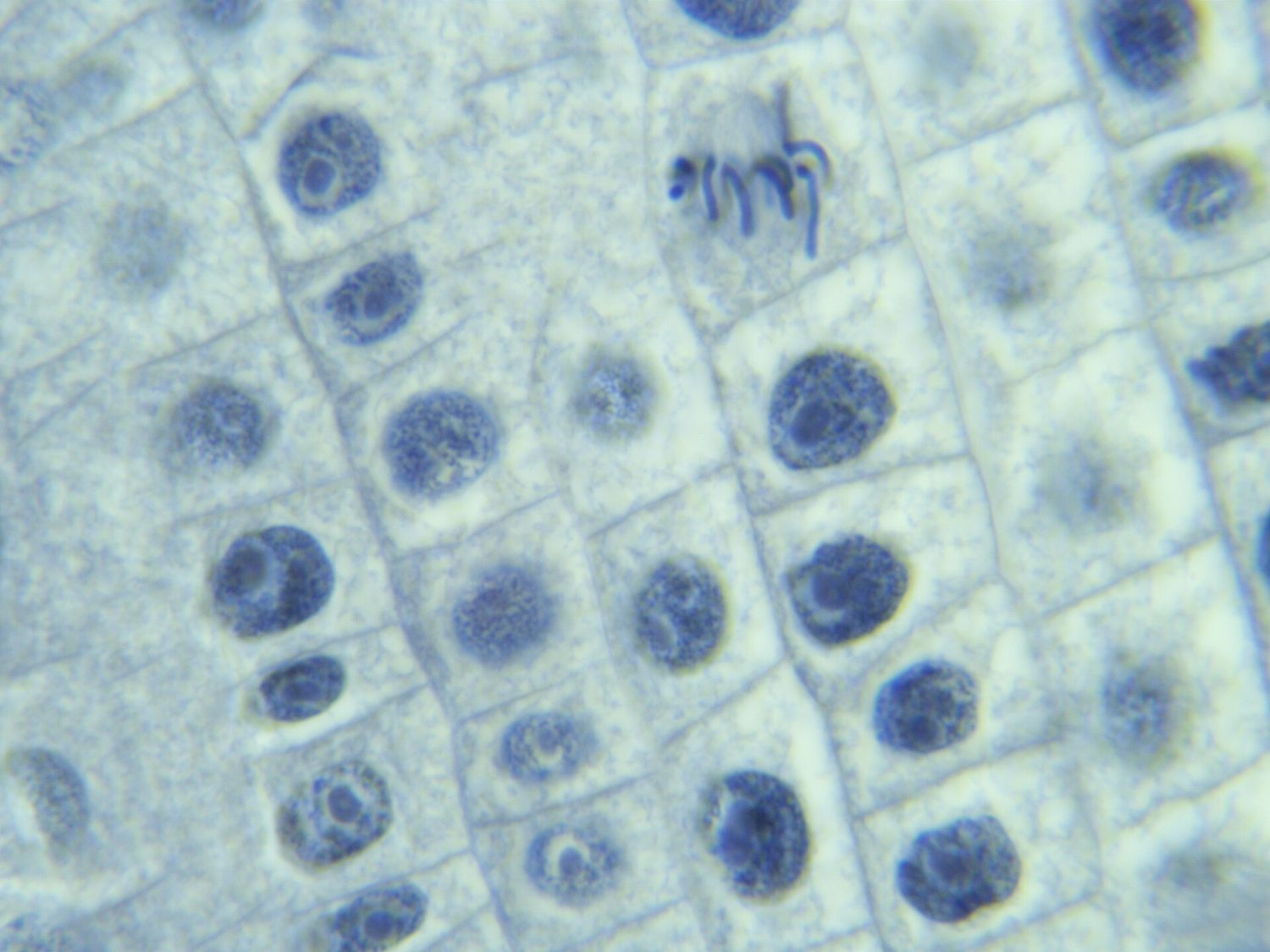
根尖图像中包含处于有丝分裂不同阶段的细胞。快照可估算正在分裂的细胞比例,但无法对单个观察到的细胞进行计时……
英语旁白 · 英中内嵌字幕
This handout covers D2.1: cell division, mitosis, meiosis and variation. Sections marked AHL are for Higher Level only.
Prerequisites: DNA replication, chromosomes and the distinction between a gene and an allele.
A growing root needs more cells; damaged skin needs replacement cells; a sexually reproducing organism needs cells with half its usual chromosome number. These problems all involve division, but they do not require the same nuclear outcome.
In living organisms, new cells arise by division of existing cells. A parent cell divides to produce daughter cells. Unicellular organisms can reproduce in this way, while multicellular organisms also use division to build and maintain tissues. A cell does not normally assemble a whole new living daughter cell from non-living material outside itself.
In a nucleated eukaryotic cell, nuclear division distributes genetic material before the cytoplasm is fully separated. Without suitable nuclear division, one product could lack a nucleus or receive an incomplete chromosome set. Mitosis maintains chromosome number in daughter nuclei; meiosis reduces it and generates new combinations of inherited information.
Nuclear division and cytokinesis are distinct. One separates nuclei and chromosomes; the other separates the cytoplasm into cells. They usually work together, but their timing can overlap. Nuclear division without cytokinesis can produce a cell containing more than one nucleus.
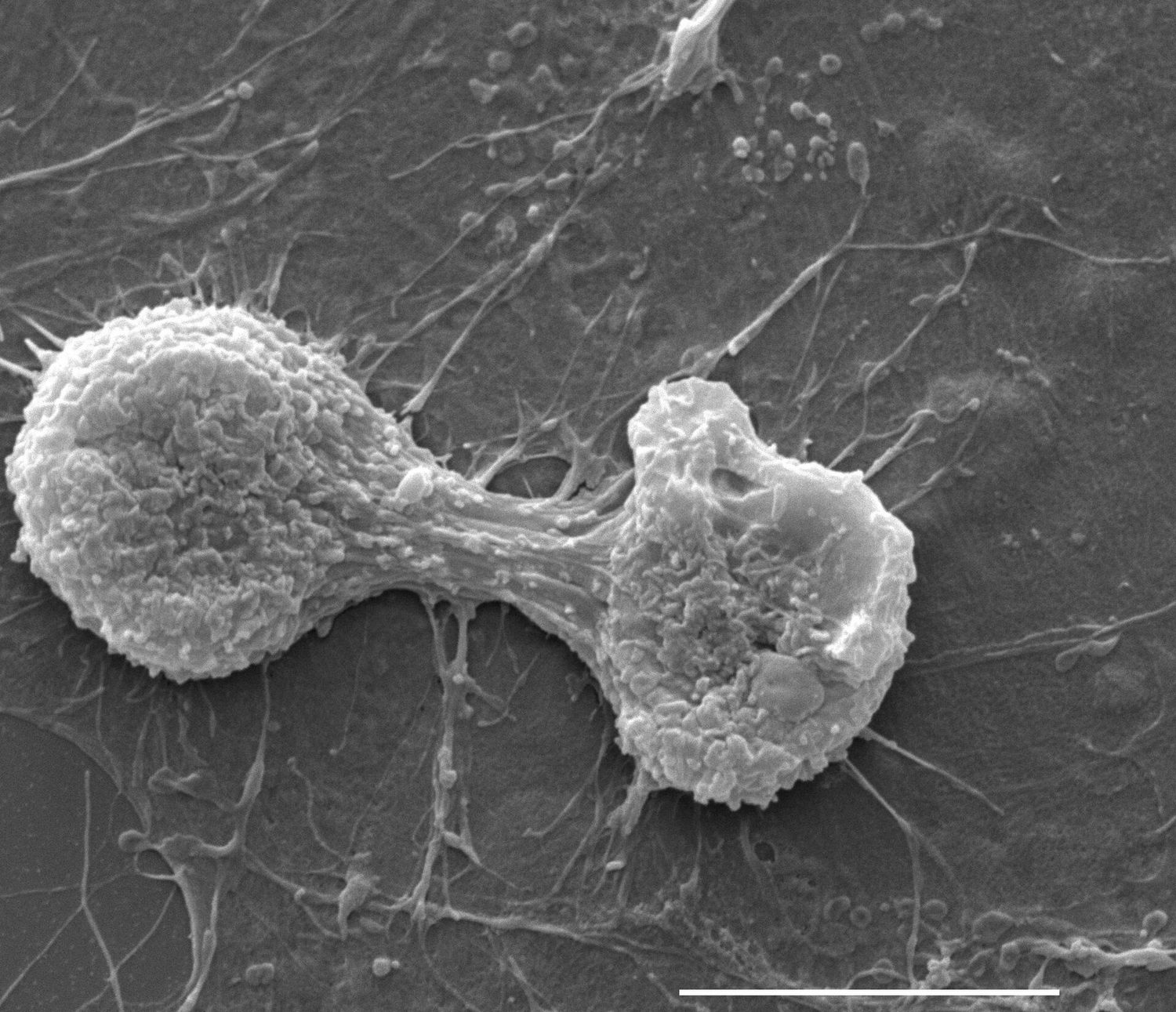
In animal cells, a contractile ring containing actin and myosin tightens beneath the cell membrane. A cleavage furrow deepens and the membrane is pinched into two daughter cells. A rigid wall would prevent this same inward-pinching mechanism in plant cells.
In a dividing plant cell, vesicles gather near the centre and contribute membranes and wall materials to a growing cell plate. It expands outward and connects with the existing cell boundary, separating the daughter cytoplasms and building a new wall between them. Do not describe a plant cell as forming an animal-style cleavage furrow through its rigid wall.
The shares of cytoplasm are often similar but need not be equal. During human oogenesis, unequal division retains most cytoplasm in the developing egg, while polar bodies receive much smaller amounts. This helps retain resources in the cell that can support early development. It does not mean each nucleus should receive an arbitrary chromosome number.
In budding yeast, a smaller bud receives a daughter nucleus and cytoplasm before separating. The products differ in size. Both daughters must also receive at least one mitochondrion and other organelles required for their continued life. Mitochondria, and chloroplasts where present, grow and divide from existing organelles; daughter cells cannot replace their inheritance merely by receiving nuclear DNA.
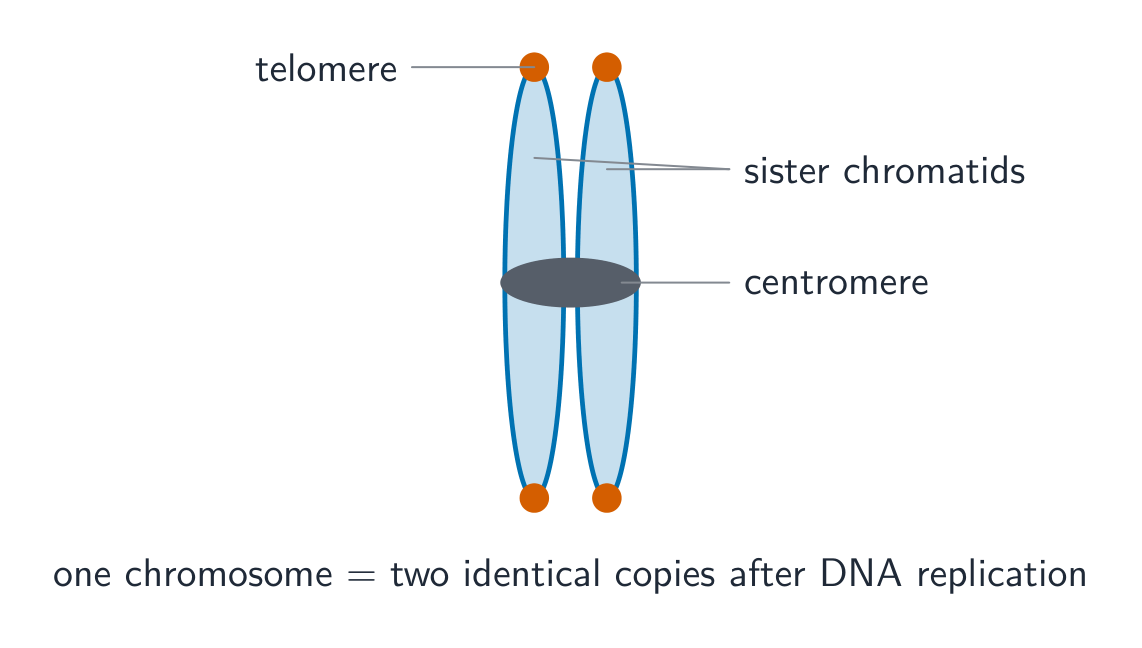
A chromatid 染色单体 is one of the DNA-containing copies of a replicated chromosome before the copies separate. Each sister chromatid contains a long DNA molecule associated with proteins. Sister chromatids are joined until their separation; homologous chromosomes are the corresponding maternal and paternal members of a pair, not the two sisters of one chromosome.
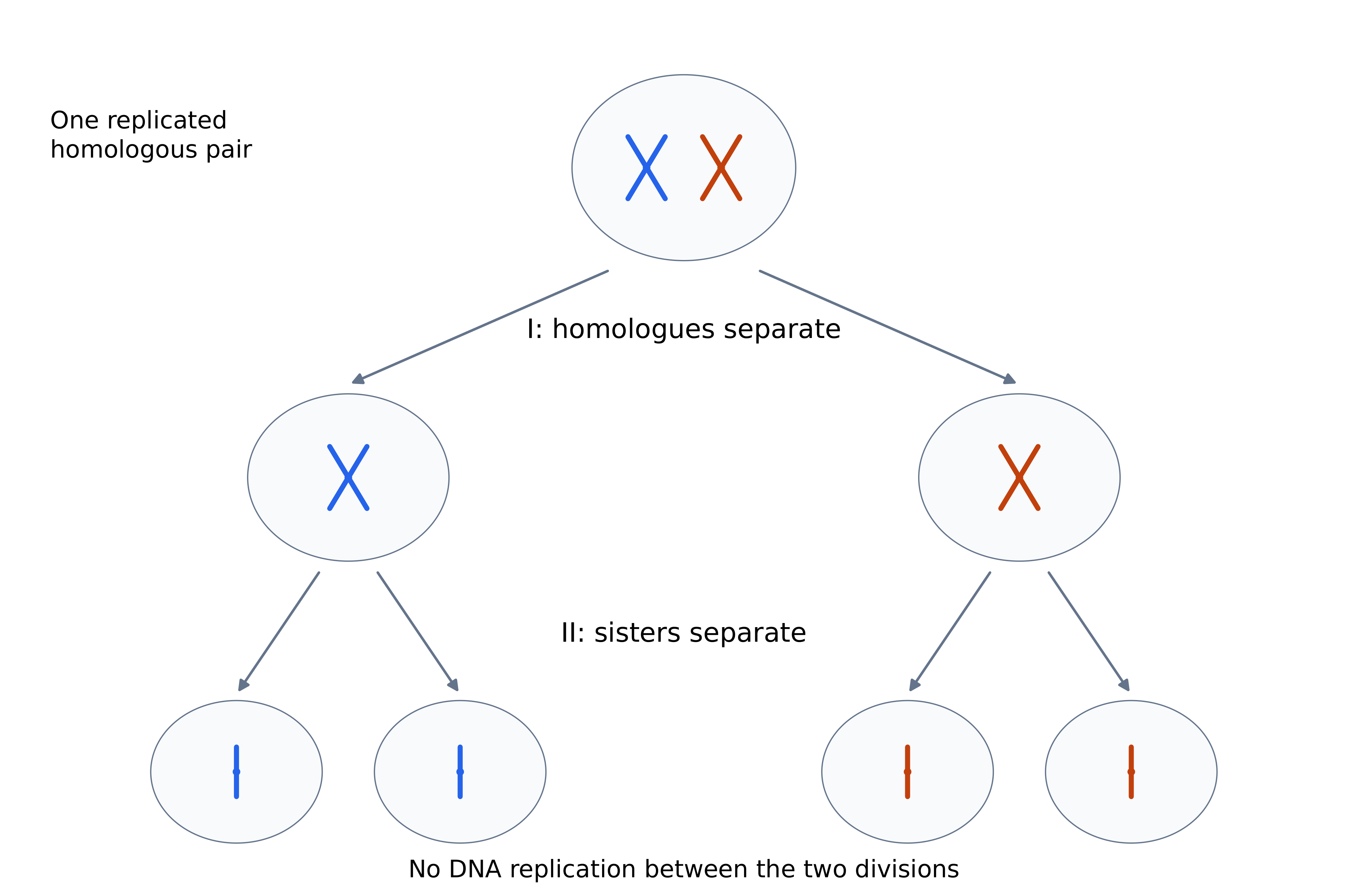
DNA replication precedes mitosis and also precedes meiosis I. One round of replication makes sister chromatids. There is no second DNA-replication round between meiosis I and meiosis II. Without the preceding replication, the usual segregation processes could not distribute the expected copies to both sets of products.
Use the stated counting convention. A replicated chromosome with two attached sister chromatids counts as one chromosome. When its sisters separate, each becomes a daughter chromosome. The chromosome count briefly doubles within the still-undivided anaphase cell, but each future daughter nucleus receives the original number.
For a species with $2n=4$, the following table distinguishes chromosome sets from DNA amount. Here C means the DNA amount in one unreplicated haploid set; it is not a count of chromosomes.
| Stage, with boundary specified | Chromosomes | DNA amount |
|---|---|---|
| One diploid cell before replication | 4 | 2C |
| Same cell after replication, sisters attached | 4 | 4C |
| Each daughter after mitosis | 4 | 2C |
| Each product after meiosis I | 2, still duplicated | 2C |
| Each product after meiosis II | 2, unduplicated | 1C |
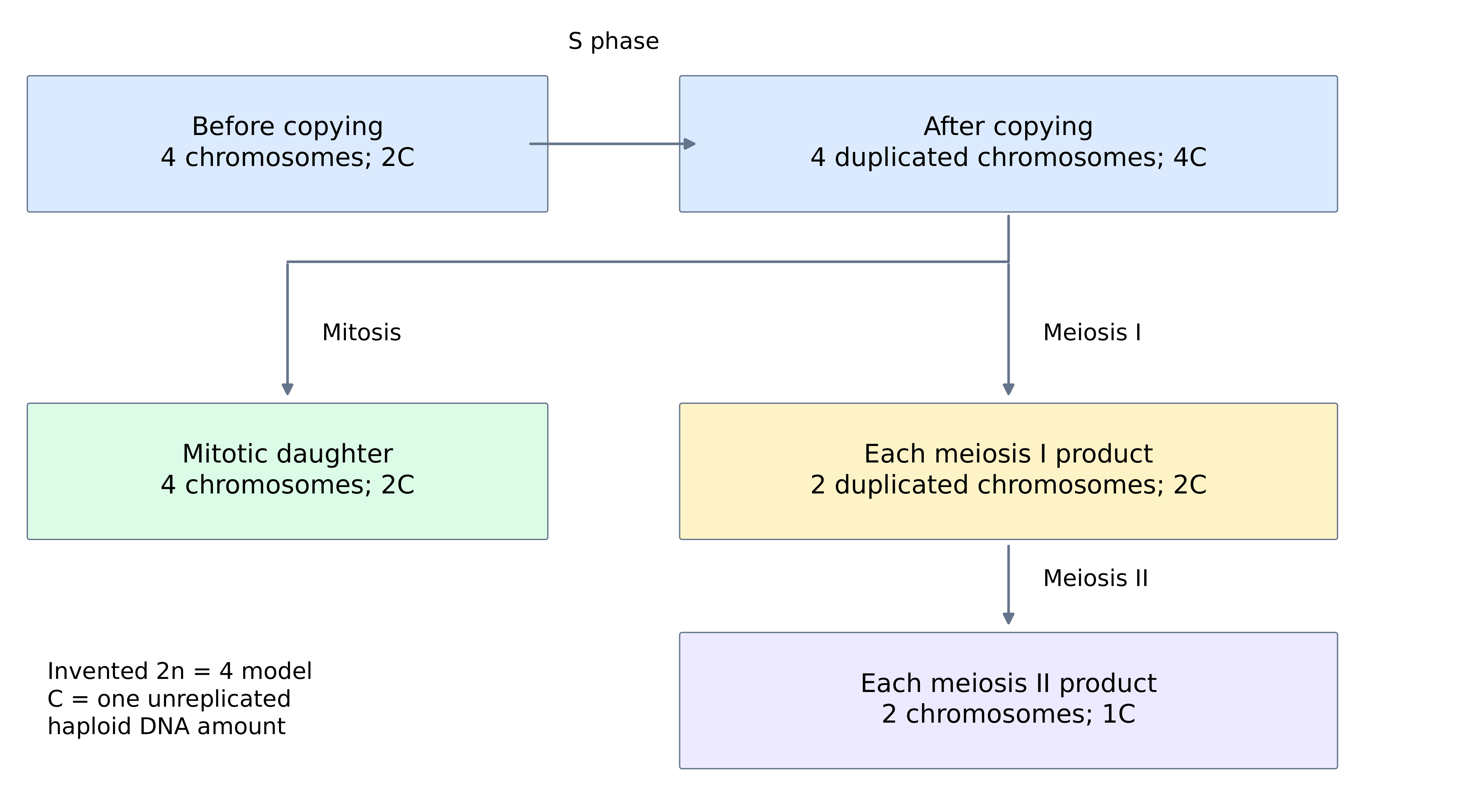
A four-chromosome metaphase cell contains eight chromatids and eight DNA molecules. An anaphase cell before cytokinesis contains eight daughter chromosomes in total, four moving towards each pole. Saying only “there are eight chromosomes” without naming the cell boundary can therefore mislead.
| English | 中文 | 拼音 |
|---|---|---|
| chromatid/ˈkrəʊmətɪd/ | 染色单体 | rǎn sè dān tǐ |
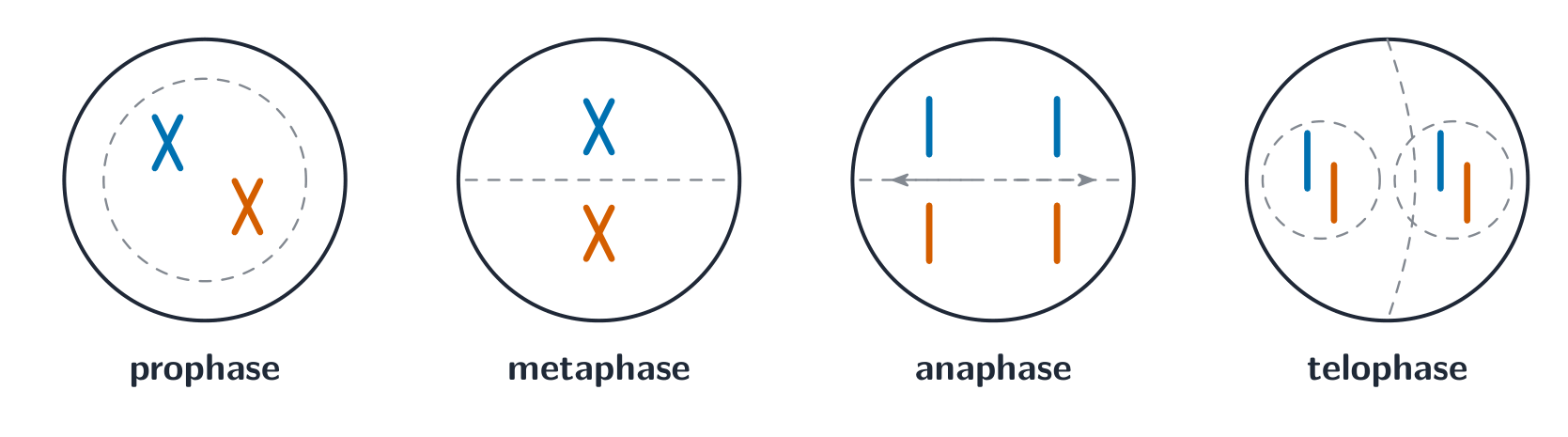
During condensation, DNA wrapped around histone proteins is further coiled and packaged into compact, visible chromosomes. Condensation changes arrangement, not the number of DNA copies. A replicated chromosome drawn as an X is not two homologous chromosomes: it represents two attached sister chromatids.
Microtubules form the spindle and attach at chromosome-associated structures. Together with motor proteins and changes in microtubule length, they move chromosomes and help distribute them. Chromosomes do not swim independently to the poles, and the cell does not sort them by reading a printed X shape.
| Phase | Evidence and mechanism |
|---|---|
| Prophase | Chromosomes condense; spindle develops; nuclear-envelope breakdown allows spindle access |
| Metaphase | Duplicated chromosomes align at the equatorial region with sisters connected towards opposite poles |
| Anaphase | Sister chromatids separate; daughter chromosomes move towards opposite poles |
| Telophase | Chromosomes reach poles, nuclear envelopes form and chromosomes become less condensed |
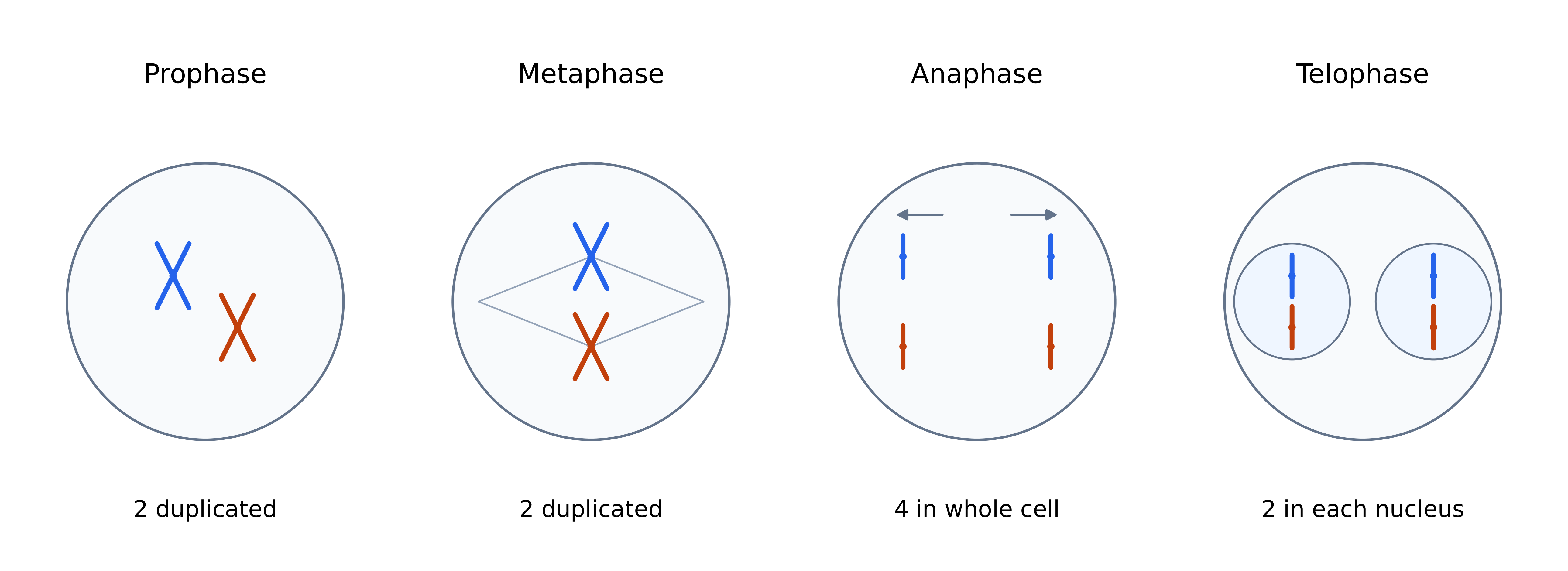
For the normal model, mitosis gives two daughter nuclei with the same chromosome number and equivalent genetic information as the parent before replication. New mutation or segregation errors are possible; “identical” describes the normal distribution model, not a guarantee that every real division is error-free.
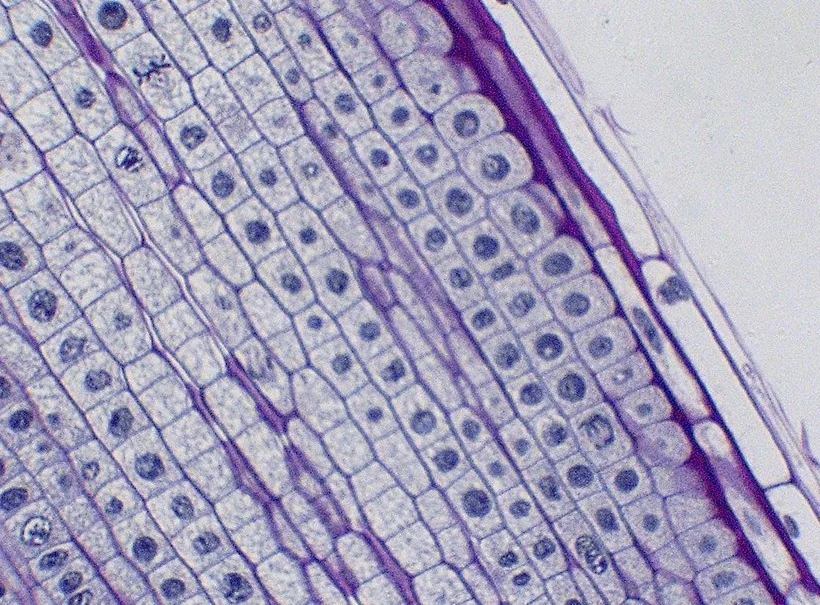
When identifying a phase in a diagram or micrograph, use chromosome arrangement. A central line of condensed duplicated chromosomes supports metaphase. Two groups of separating chromosomes support anaphase. Two forming nuclei support telophase. A round cell alone is not enough evidence. Interphase cells usually show less distinct chromosome outlines; interphase is not one of the four mitotic phases.
In a practical, use a prepared root-tip slide under a microscope or a supplied micrograph. Locate a region containing dividing cells, then examine several clearly bounded cells at higher magnification. Record a labelled sketch or image for each identified phase, with the chromosome arrangement used as evidence. Keep uncertain cells separate rather than assigning a phase from staining intensity alone.
Diploid means two chromosome sets; haploid means one. Meiosis is needed in a sexual life cycle because fertilization joins two haploid contributions. Without reduction somewhere in that cycle, chromosome-set number would double with each generation of fertilization.
After replication, homologous chromosomes pair during meiosis I. Each bivalent contains two homologues and four chromatids. At metaphase I, the bivalents align. Homologues separate in anaphase I while their sister chromatids remain attached. Each product receives one member of each homologous pair, so it is haploid even though each chromosome is still duplicated.
In meiosis II, duplicated chromosomes align and sister chromatids separate, broadly resembling mitotic segregation. No intervening DNA replication is needed. The complete process produces four haploid nuclei from one diploid nucleus. Cytoplasmic division may be unequal, as in oogenesis; four nuclei do not always mean four equal functional gametes.
For the $2n=4$ model, replication gives four duplicated chromosomes. Meiosis I gives two products, each with two duplicated chromosomes. Meiosis II gives four products, each with two unduplicated chromosomes. A cell after meiosis I has half as many chromosome sets, not half a set of incomplete genes.
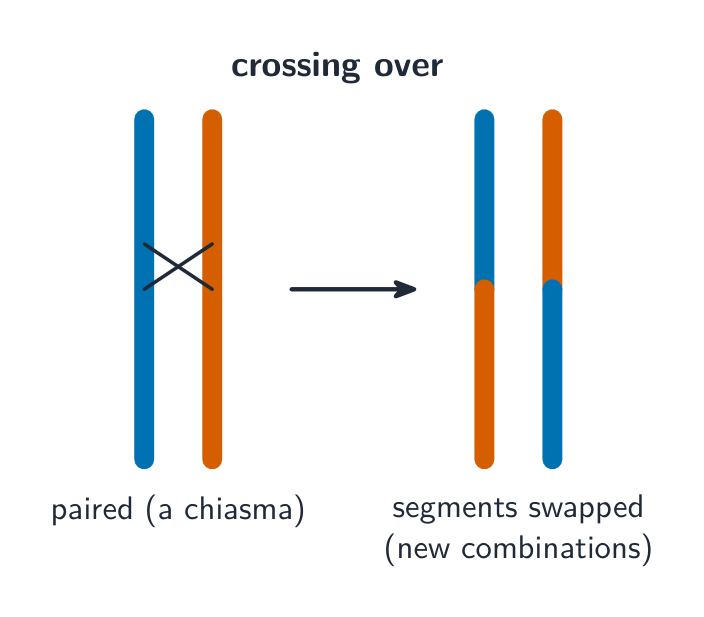
During prophase I, non-sister chromatids of paired homologues can exchange corresponding DNA regions. Crossing over creates chromatids carrying new combinations of alleles. The exchange is between homologues at corresponding regions; it is not a random transfer of unrelated chromosome pieces. Sister chromatids alone do not account for the usual reshuffling of maternal and paternal alleles.
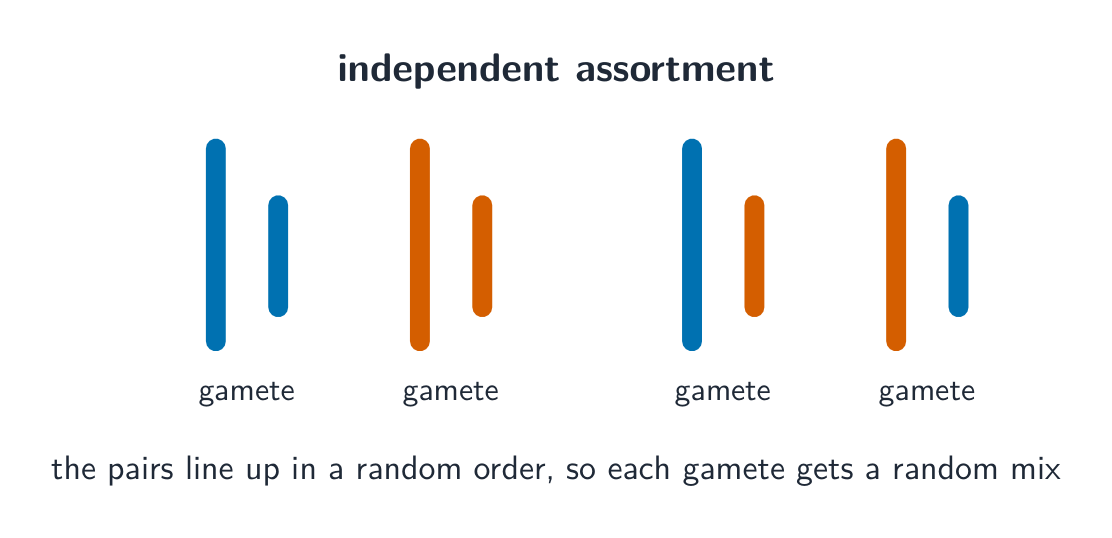
At metaphase I, each bivalent can orient in either direction relative to the poles. Different bivalents orient independently in the simple model. Thus a product can receive different combinations of maternal and paternal homologues. This is random orientation followed by segregation, not a claim that each gamete must contain exactly half maternal and half paternal chromosomes.
Ignoring crossing over, $n$ independently orienting homologous pairs allow $2^n$ whole-chromosome combinations across possible meiotic products. For $n=3$, this is $2^3=8$. One meiosis still produces only four nuclei; eight possible types across many divisions does not mean eight products from one division. Crossing over adds further combinations within chromosomes.
Mutation creates new alleles, while these meiotic mechanisms rearrange existing ones. Fertilization adds another source of combination when two gametes join. Distinguish the origin of sequence variation from the redistribution of variants during sexual reproduction.
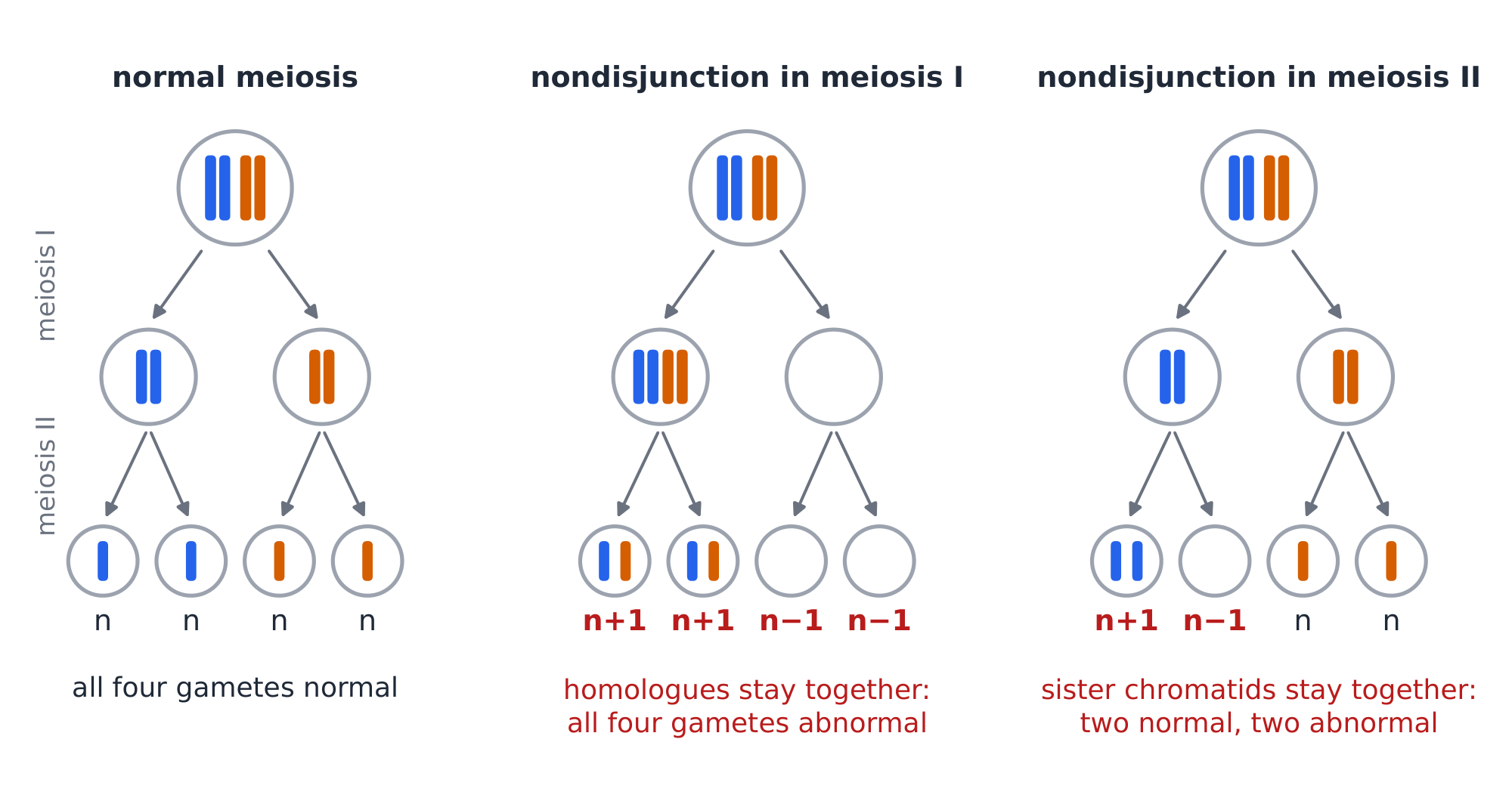
Non-disjunction is failure of chromosomes to separate normally. In meiosis I, both members of a homologous pair may pass to one pole. In meiosis II, sisters may fail to separate. The resulting gametes can contain an extra chromosome or lack one. These errors are changes in chromosome distribution, not automatically a change in one DNA base.
A human gamete containing two copies of chromosome 21 can join a normal gamete containing one. In the usual full-trisomy model, the zygote then has three copies of chromosome 21 and 47 chromosomes in total. Extra chromosome 21 material causes Down syndrome. Other forms involve chromosome rearrangements or mosaicism, so not every case is described completely by the simple 47-chromosome model. NIH explanation of chromosome 21 and non-disjunction.
A simple model of non-disjunction of one pair at meiosis I, followed by normal meiosis II, gives two products with an extra chromosome and two lacking it. If meiosis I is normal but one of its two products has non-disjunction at meiosis II, the four products include two with the usual number, one with an extra and one lacking a chromosome. These are specified segregation models, not probabilities that every human meiosis follows these errors.
The mitotic index 有丝分裂指数 is the fraction of scored cells undergoing mitosis. Count all four mitotic phases in the numerator and all scored cells, including interphase, in the denominator. State whether the result is a fraction or a percentage.
In a field, 160 cells are interphase, 20 prophase, 8 metaphase, 7 anaphase and 5 telophase. Total cells $=200$; mitotic cells $=20+8+7+5=40$. The index is $40/200=0.20$, or 20%. A second field with 18 mitotic cells out of 120 gives $18/120=0.15$, or 15%. Compare equivalent sampling methods and tissue regions before attributing the difference to a treatment.
Choose fields before seeing which looks most active. Use a clear rule for boundary cells and ambiguous or damaged cells; record exclusions. Include several representative fields and biological replicates. Large nuclei, dark staining or a cell wall alone do not identify mitosis; chromosome arrangement matters.
A snapshot gives a population fraction, not the directly observed duration of one cell's division. If a representative asynchronous population has a steady cycle and comparable survival, a rough phase-time estimate can use its fraction of cells. If 20% are mitotic and the known cycle lasts 15 hours, estimated mitotic duration is $0.20\times15=3$ hours under those assumptions. Synchronized cells, selective cell loss, non-cycling cells or a drug that arrests mitosis can break the model. A high index can reflect slow exit from mitosis rather than fast production of daughter cells.
200个已计数细胞中有25个正在分裂,指数为25/200 = 0.125 = 12.5%。改变分裂与非分裂细胞数,并区分瞬时样本比例与时间的直接测量。
| English | 中文 | 拼音 |
|---|---|---|
| mitotic index/maɪˈtɒtɪk ˈɪndeks/ | 有丝分裂指数 | yǒu sī fēn liè zhǐ shù |
Cell proliferation increases cell number through repeated cell cycles. In plant meristems, division supplies new cells for growth; those cells can later expand and differentiate. Early animal embryos also undergo rapid divisions. Initial cleavage can partition existing cytoplasm into more, smaller cells without a matching increase in total embryo mass.
In skin, dividing cell lineages replace cells lost through routine wear. Following a wound, proliferation helps supply cells for repair alongside migration and other tissue processes. Growth of an individual cell and an increase in cell number are distinct: cell enlargement alone is not proliferation, and a larger tissue does not automatically prove a higher instantaneous division rate.
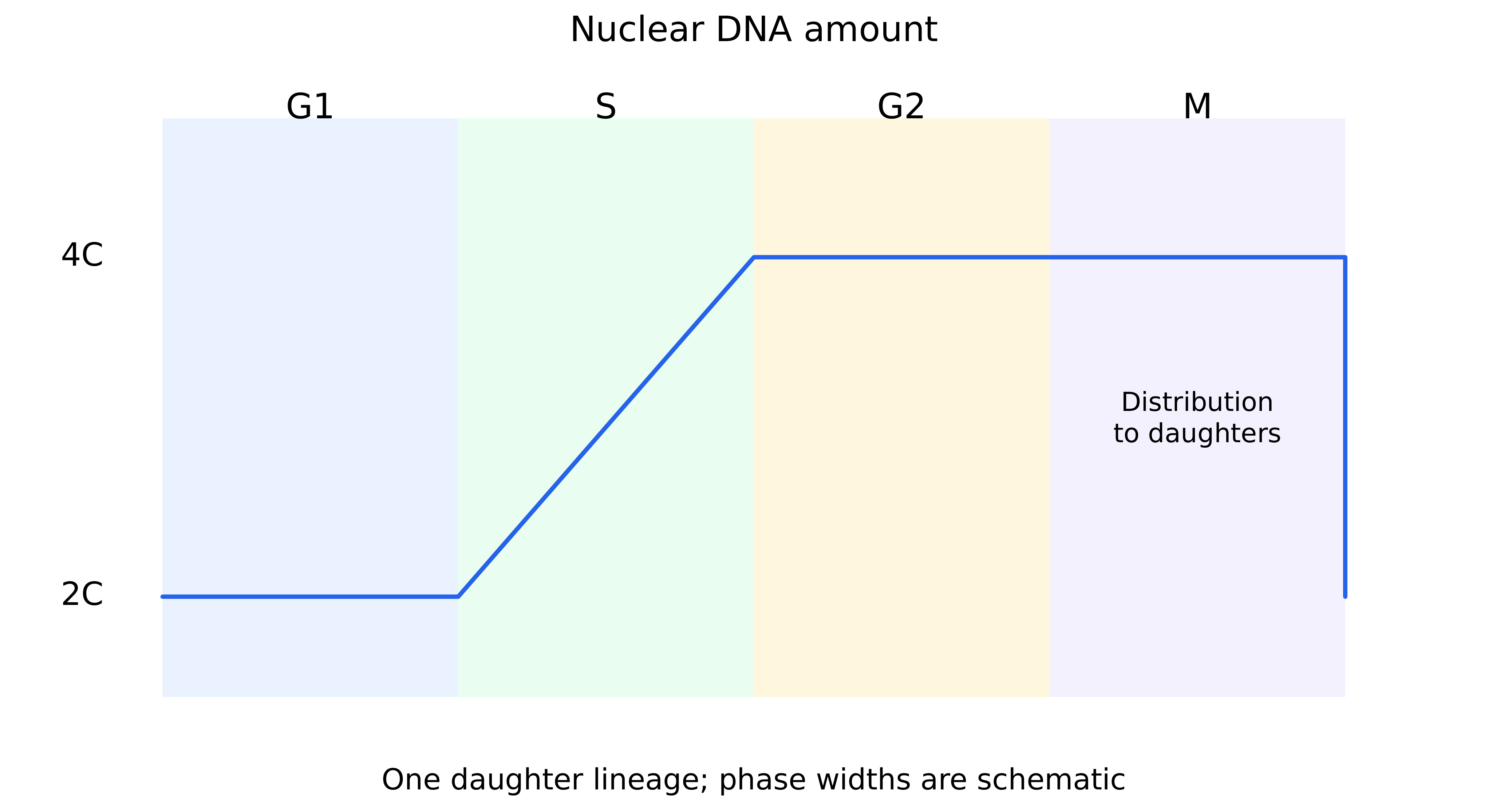
The cycle proceeds through G1, S and G2, then mitosis and cytokinesis. G1, S and G2 form interphase. Cells grow and synthesize components during interphase; it is not a resting gap in which nothing happens. DNA is replicated during S, while proteins and other components are made as needed across interphase. Mitochondria and chloroplasts increase through growth and division of existing organelles.
For example, a cycling cell has 6 pg of nuclear DNA in G1. It reaches 12 pg after S and remains at that amount through G2 until the copies are distributed. Each normal daughter receives 6 pg. The whole parent cell at anaphase still contains 12 pg; it does not lose half its DNA just because the chromosomes have begun to move.
Cyclin concentrations rise and fall during the cycle. Passing a checkpoint requires an appropriate cyclin-dependent control system, including a threshold level of a relevant cyclin. A checkpoint can prevent progression when conditions are unsuitable. This is regulated molecular control, not an organism deciding consciously to divide. Different cyclins act at different stages; memorizing specific cyclin names is not needed here.
A cell may pause because of DNA damage or another problem. Similarly, not every cell in a tissue is continuously cycling; some differentiate or leave the proliferating population.
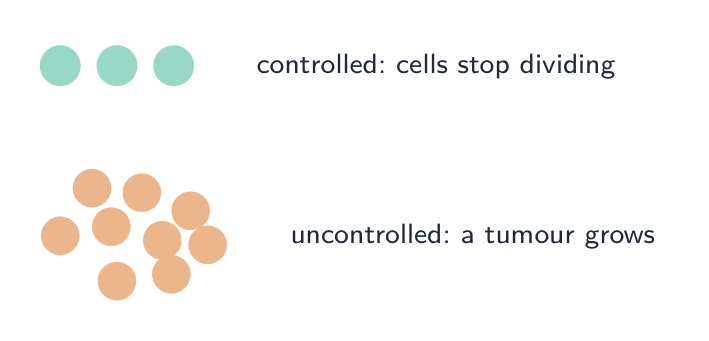
Proto-oncogenes normally participate in controlled growth and division. Some mutations convert them to oncogenes with excessive or inappropriate growth-promoting activity. Tumour suppressor genes normally help limit proliferation or support protective controls; loss of their function can remove a restraint. These are different routes to loss of control, not a rule that every mutation turns every gene into an oncogene.
Accumulated changes can produce a tumour, an abnormal mass of cells. Tumours differ in growth rate and capacity to invade neighbouring tissue or spread. A benign tumour remains localized and does not invade or metastasize in the way a malignant tumour can, though its location or size can still cause harm. Malignant tumours are cancerous and can invade surrounding tissue.
Metastasis is spread of cancer cells to another location, where a secondary tumour can form. The primary tumour is the original site. A secondary tumour derived from the primary retains that cancer's origin; it is not simply an unrelated new cancer of the tissue in which it settles. Fast growth alone does not establish metastasis, and a low measured division fraction does not prove a tumour benign.
Name the boundary and distinguish chromosome count from DNA amount. Identify phases by chromosome arrangement: mitosis separates sisters, meiosis I homologues, meiosis II sisters. Explain variation through non-sister crossing over and independent bivalent orientation.
State the denominator and sampling rules. Phase times need a valid population model.
出了什么问题?只有网站团队能看到这些信息。