Why can a tiny infectious particle use a much larger cell to make thousands of copies, and why can yesterday's effective immune response become less effective against a changed virus?
This is the HL-only A2.3 unit; there is no SL counterpart. It covers viral structure and diversity, host dependence, the lytic and lysogenic cycles of bacteriophage lambda, possible multiple origins, and rapid evolution using influenza and HIV. It also uses infection rates to practise fair comparisons. Prerequisites: DNA/RNA, gene expression, membranes and natural selection.
5.2
AHL:病毒并非小型细菌细胞
English
A virus contains a nucleic-acid genome protected by a protein capsid. A complete particle outside a host cell is a virion. Unlike a cell, it has no cytoplasm containing ribosomes and a complete metabolic system. It does not grow into a larger cell and divide by binary fission. New particles are assembled from components made during infection.
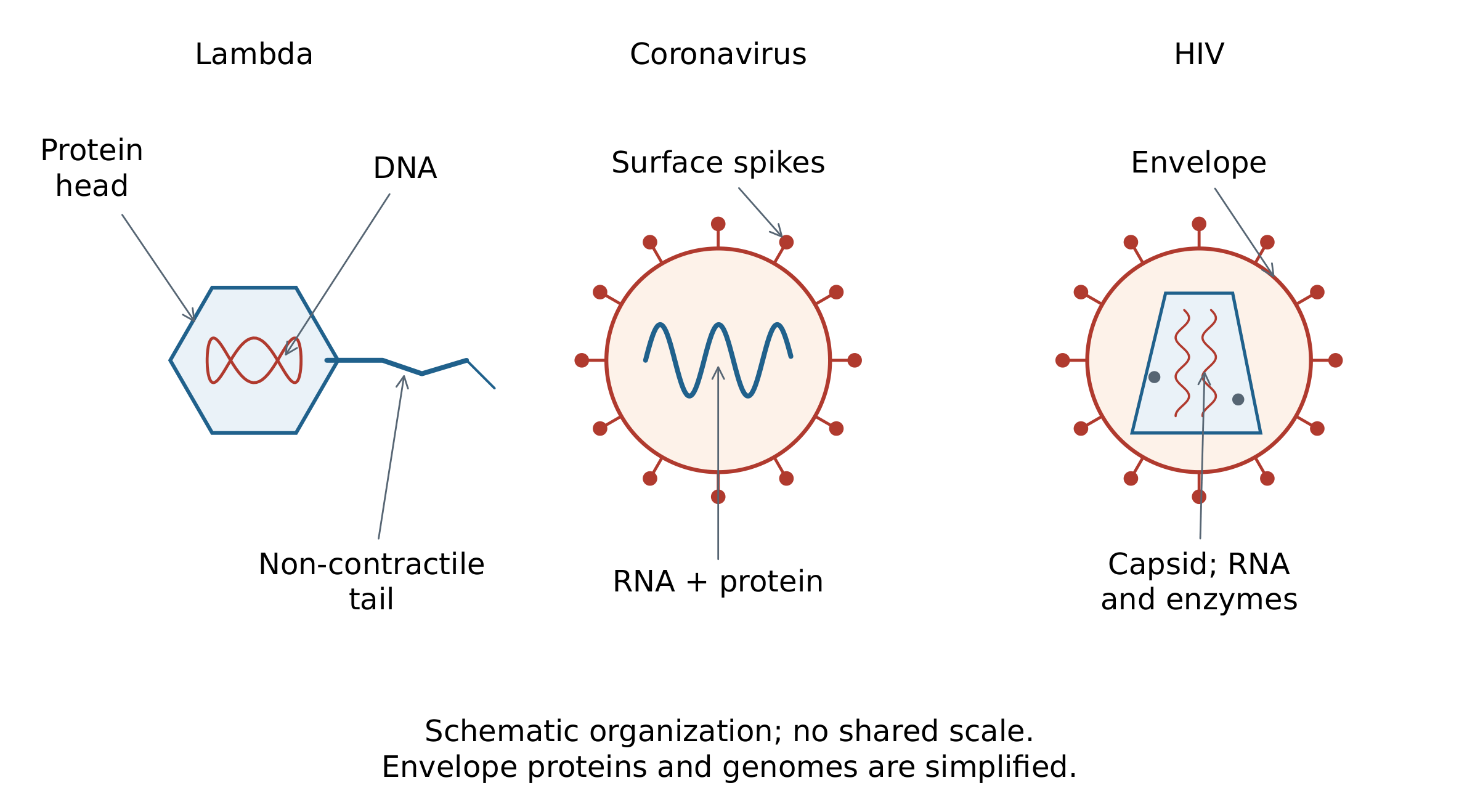
A generalised virus: nucleic acid inside a protein capsid, with a lipid envelope in some virusesThe rounded head contains the viral genome within a protein capsid; the tail delivers the genome into a bacterium. The scale bar represents 100 nm, not the length of the whole particle.
The genome is DNA or RNA, depending on the virus, and can be single- or double-stranded. "All viruses contain DNA" is therefore wrong. A virus can make different nucleic-acid forms during its replication cycle; distinguish the genome packaged in the particle from intermediate molecules inside an infected cell.
Some viruses have a lipid envelope acquired from host membranes during formation. Viral proteins inserted into the envelope help recognize and enter suitable host cells. The envelope is not a bacterial cell wall, and it does not supply a cell's cytoplasm or autonomous metabolism. Other viruses have no envelope. Capsid structure, genome type and entry mechanism vary widely, so one spherical diagram cannot represent every virus.
Viruses carry relatively few enzymes compared with cells; some carry enzymes essential for the first steps of infection. HIV, for example, carries reverse transcriptase. Having an enzyme does not make a virus independent: it still needs host resources and ribosomes to synthesize its proteins.
A pathogen 病原体 is an agent that causes disease. Not every virus infects humans, and an infection does not necessarily cause immediate visible illness. Bacteriophages infect bacteria. The word "virus" describes a kind of infectious agent, while "pathogen" describes a disease-causing role.
Susceptible animal cells; host range depends on the coronavirus
Susceptible human cells, especially certain immune cells
Packaged genome
Double-stranded DNA
Single-stranded RNA
Two copies of single-stranded RNA
Main structural model
Protein head and long non-contractile tail
Envelope with surface spike proteins and an internal RNA–protein complex
Envelope with surface proteins and a capsid containing RNA and enzymes
Envelope
Absent
Present
Present
Important replication feature
Can follow lytic or lysogenic pathways
Uses RNA copying during replication
Reverse transcription produces DNA that can integrate into host DNA
HIV particles budding from a human lymphocyte (electron micrograph): the virus leaves wrapped in host membraneCompare organization rather than colour. Lambda's tail is not the contractile syringe drawn for some other phages.
Binding depends on interactions between viral surface components and suitable host receptors. A virus that cannot attach to, enter or use a cell may fail to reproduce there. Host range is therefore a biological relationship, not a virus choosing a preferred victim. Receptor binding alone may be insufficient if later steps cannot occur.
Worked example: a particle on a printed image
A micrograph shows a 9.0 mm particle whose actual diameter is 90 nm. Convert both lengths to nanometres:
The ratio is dimensionless. At this scale an ordinary light microscope would not resolve the particle's internal capsid and genome. A large printed image is not evidence that the original instrument resolved every drawn feature. For an electron micrograph, do not infer natural colours from added colour coding.
5.4
AHL:宿主依赖性与组装
English
During infection the viral genome directs production of viral components using an infected cell. The host supplies amino acids and other building materials, energy, and ribosomes for translation. Different viruses use different combinations of viral and host enzymes for copying and expressing their genomes.
Attachment, entry, uncoating, replication, assembly, release — every antiviral target and every vaccine antigen sits on this cycle
A useful chain of reasoning is genome → expression of viral proteins → genome copying → assembly → release. This is a functional outline, not one universal sequence of identical molecular steps. RNA genomes do not all enter the same pathway as DNA genomes. HIV uses reverse transcriptase to make DNA from RNA; this is the reverse of ordinary DNA-to-RNA transcription.
Some particles are released by cell lysis, others by budding or related membrane processes. Budding can supply a lipid envelope containing viral proteins. Do not use the lambda lytic model to claim that every virus always bursts its host cell immediately. An infected cell may continue functioning for a time while producing particles or carrying viral genetic material.
Antibiotics target bacterial structures or processes, such as cell-wall synthesis or bacterial ribosomes. Viruses do not have these targets as independent cellular systems. Antiviral approaches instead target stages of viral replication or entry. This distinction explains a treatment principle; it does not mean that every antibiotic works against every bacterium or every antiviral works against every virus.
Bacterial antibiotic resistance also evolves through heritable variation and selection. An antibiotic inhibits susceptible bacteria more strongly, so resistant variants can leave more descendants; an individual bacterium does not choose to become resistant because it needs to survive.
An antigen 抗原 is a structure recognized by a specific immune response; viral surface proteins can be antigens. Vaccination exposes the immune system to antigens so that memory cells can support a faster, stronger secondary response on later exposure to the same antigen. This is different from an immediate cure for an established infection. Changes to antigens can affect recognition, connecting immune memory to viral evolution.
Bacteriophage lambda is a temperate phage: following infection it can enter either a lytic pathway or a lysogenic state. In the lytic pathway, distinguish the particle outside the cell from the viral genome and components inside it.
Attachment: the tail region binds suitable receptors on the bacterial surface.
Entry: phage DNA enters the bacterium. The whole head and tail are not injected as a ready-made new cell.
Biosynthesis: phage genes are expressed; viral DNA is copied and phage proteins are made using host resources.
Assembly: genomes are packaged into new heads and tails are attached to form progeny particles.
Lysis and release: phage-directed processes disrupt the bacterial envelope, releasing progeny able to infect other susceptible bacteria.
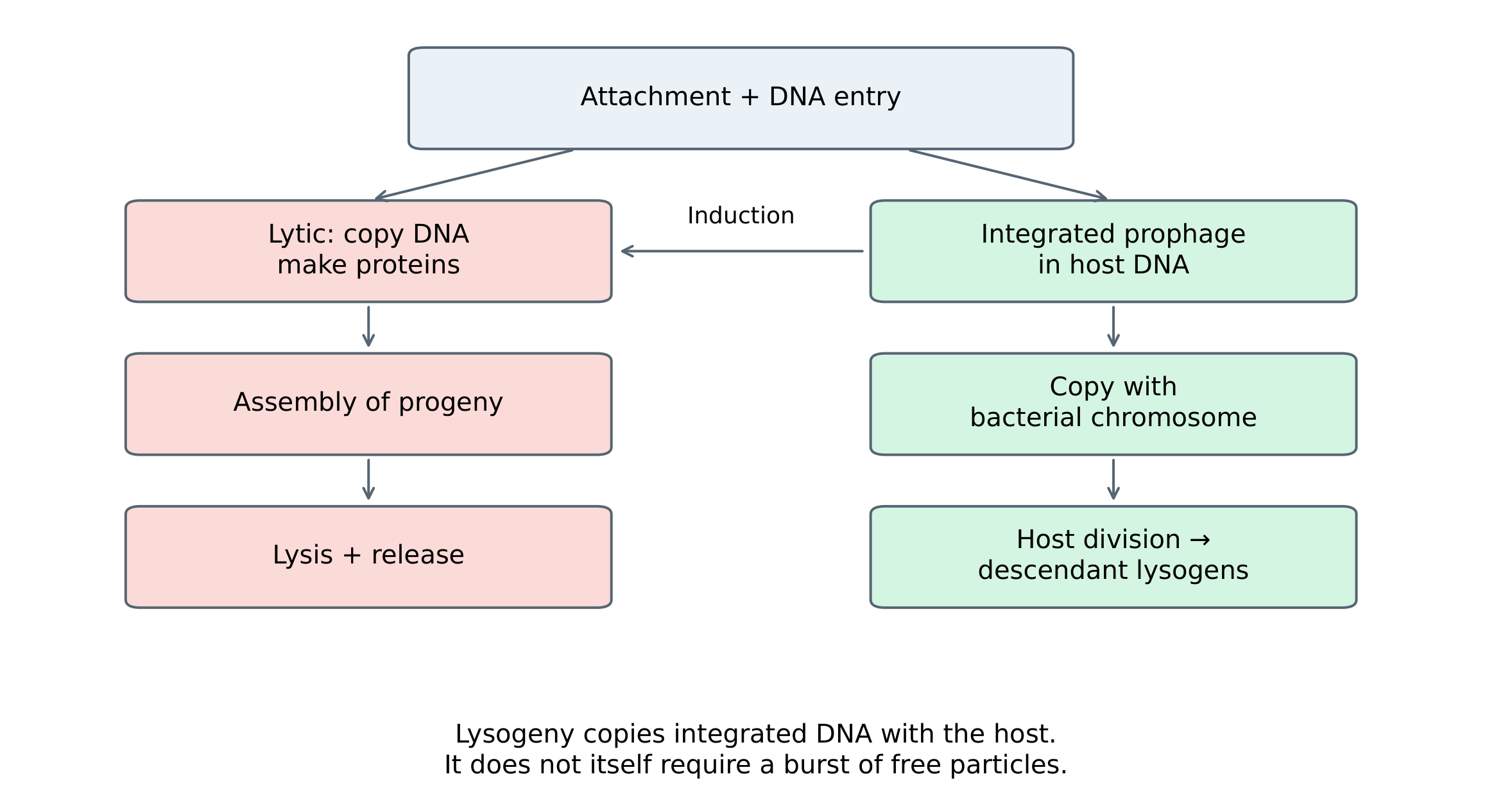
Follow the DNA in the two pathways. Integration and host-cell division are different from immediate particle assembly.
The infecting particle is not enlarged until it splits. The host cell manufactures components that assemble into many new particles. "Replication" can refer to genome copying; explain whether a question asks about DNA replication, particle production or increase in infected cells.
Worked example: estimate burst size under stated conditions
In a single-cycle model, 80 infected bacterial cells lyse and release 4,800 newly produced infectious particles. Residual input particles have been removed and no second infection cycle occurs.
$$\text{mean burst size}=\frac{4800}{80}=60\text{ infectious particles per infected cell}.$$
This is an average under the model, not a fixed property of all viruses or even every infected cell. A plaque-based count measures infectious units under the assay conditions; it need not equal the number of all physical particles, some of which may be non-infectious. Do not mix a whole-culture titre with a count per infected cell.
5.6
AHL:溶原性维持一种不同的状态
English
In lambda lysogeny, viral DNA integrates into the bacterial chromosome as a prophage. The bacterium carrying it is a lysogen. Viral regulation suppresses immediate production of a lytic burst. As the bacterium copies its chromosome and divides, the integrated phage DNA is copied and passed to descendant cells.
Lysogeny and induction in lambda: the prophage is copied with the bacterial chromosome until a switch sends it lytic
The prophage is not a fully assembled particle hiding inside the nucleus: bacteria have no membrane-bound nucleus, and the integrated material is DNA. The term "dormant" should not suggest that the bacterial cell stops growing or that every viral gene must be silent.
Under suitable induction conditions, such as particular DNA-damage responses, lambda can leave the integrated state and enter the lytic pathway. Excision, renewed viral gene expression, genome copying, assembly and release then occur. Induction is a regulated switch, not the phage deciding to become aggressive. Not all viruses integrate their genomes, and HIV integration should not be labelled the lambda lysogenic cycle without explaining the differences.
Worked example: follow a prophage through divisions
Begin with one lysogen containing one integrated prophage. In a simplified model there is no induction, loss or cell death. Four rounds of binary division give $2^4=16$ descendant cells carrying the prophage. This does not imply that 16 free virus particles have been released: the counted objects are bacteria containing integrated viral DNA.
5.7
AHL:病毒可能具有多个起源的原因
English
Viruses differ greatly in genomes, replication systems, capsid organization and host relationships. These differences are consistent with several origins rather than requiring one simple ancestral virus from which every viral feature descended unchanged. Proposed routes include genetic elements escaping cells and cellular parasites losing functions as dependence increased. Ancient exchanges of genes can complicate the history.
Several proposed routes are consistent with the diversity of viruses
The shared genetic code connects viral gene expression to cellular translation systems. It does not mean that all viruses share identical genes or genomes. Similar needs can also favour similar solutions: genome protection and transfer between hosts are useful to unrelated obligate parasites.
Convergent evolution produces similar functional features independently. A protective protein shell is therefore not, by itself, proof that all viruses descend from one recent common viral ancestor. Compare sequences, replication mechanisms and structural evidence across several groups. State an explanation as a hypothesis with evidence and limits, not a directly witnessed origin story.
5.8
AHL:快速进化需要变异和选择
English
Evolution is a change in inherited characteristics of populations across generations. In some viruses, rapid copying, large populations and relatively error-prone genome copying generate many variants over short times. Mutations are not produced because a virus knows which change it needs. Many mutations are harmful or neutral; only some improve reproduction in a particular environment.
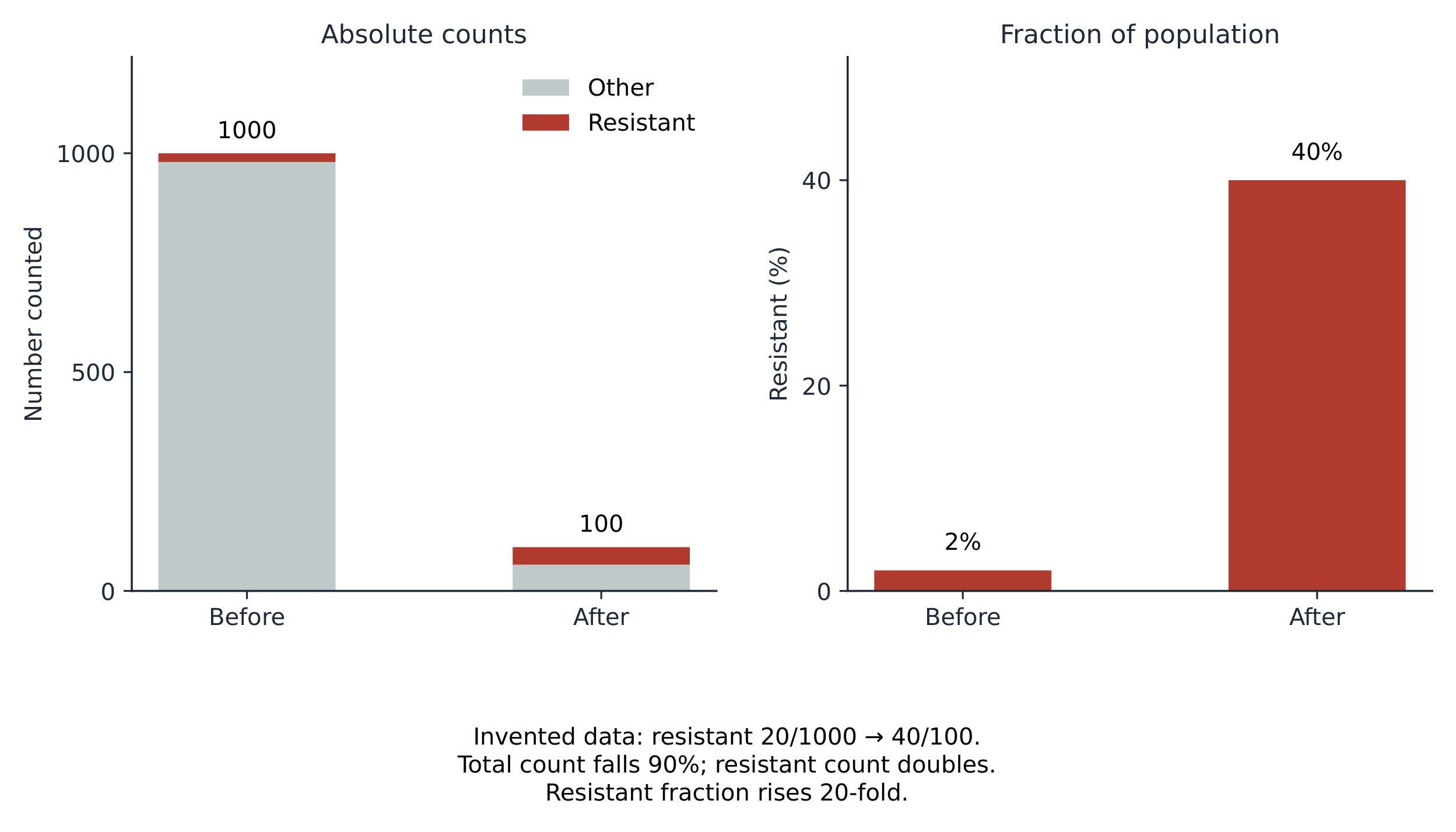
Selection by a drug: the resistant variant was already present and becomes common because it keeps reproducing
Selection acts when variants differ in reproductive success. An immune response may reduce the success of one surface-antigen variant more than another. A drug can inhibit susceptible variants more effectively than resistant variants. A resistant variant can then form a larger fraction of the population. Conditions determine the advantage; resistance can carry costs when the selective pressure is absent.
Do not turn this into "all RNA viruses evolve equally fast". Copying accuracy, proofreading, population bottlenecks, genome structure and selection differ. A measured mutation rate is also not automatically the same as a long-term evolutionary substitution rate.
Influenza: drift and shift are different mechanisms
Small genetic changes can alter influenza surface antigens, including haemagglutinin and neuraminidase. Accumulation of such changes is antigenic drift. Changes can reduce recognition by antibodies produced after an earlier infection or vaccination, without making the immune system entirely useless against every variant.
Drift is gradual; shift is a reshuffle
Influenza has a segmented RNA genome. If different influenza viruses infect the same cell, progeny can receive a new combination of genome segments: reassortment. In influenza A, a major antigenic change can produce antigenic shift. Shift is not simply one more small mutation, and not every reassortment causes a pandemic. Transmission ability and population immunity also matter. Seasonal influenza change creates a continuing need for surveillance and assessment of vaccine strain matching.
HIV: copying errors and selection complicate control
HIV copies its RNA genome through a DNA intermediate using reverse transcriptase, which lacks the proofreading accuracy of many cellular DNA-copying systems. Frequent replication and genetic variation provide material for selection. Variants can differ in susceptibility to immune responses or antiretroviral drugs; recombination can also contribute to variation.
Drug exposure does not deliberately instruct HIV to produce a useful resistance mutation. Where susceptible variants are inhibited more strongly, variants already able to reproduce under those conditions can become more common. Combination antiretroviral therapy targets multiple aspects of replication, helping suppress reproduction and limiting opportunities for resistance. Latent integrated viral DNA is another reason why suppressing replication is different from removing every viral genome.
5.9
AHL:在得出结论前需解读计数数据
English
Resistance rises from 2% to 40% while total count falls. Frequency, absolute number and total population answer different questions.
In this example, the resistant fraction rises twentyfold, but resistant count rises only twofold. The total population falls from 1,000 to 100, a 90% reduction. Calling this simply "the virus increased" would hide three different quantities. The pattern is consistent with differential success, but counts alone do not identify the resistance gene or prove that no other process affected the sample.
For infection comparisons, keep population size and observation period consistent. In group A, 18 cases among 900 people over one month give $18/900\times1000=20$ cases per 1,000 people. Group B has 10 cases among 250 over the same month: $40$ per 1,000. B has fewer cases but a higher proportion. Equal denominators improve comparison; they do not remove differences in exposure, testing, age or immunity. Distinguish existing cases at one time from new cases during an interval.
Use published datasets or simulations for school analysis, not collection of unknown pathogens. A model of differential reproduction is enough to investigate the logic of selection without handling infectious material.
探索
Fewer cases can still mean a higher case proportion
Compare the lesson's 18 cases among 900 people with 10 among 250. Standardize both denominators to 1,000, then double A's case count and population together to see why its proportion stays unchanged.
5.10
练习
English
Identify the objects counted and distinguish observations from explanations.
Describe the minimum structural model of a virus and explain why it is not a bacterial cell. Distinguish a genome from a capsid and a virion from an infected cell.
Compare lambda, coronavirus and HIV for packaged genome, envelope and overall organization. Explain why a lambda diagram should not automatically have a contractile tail.
Name three resources a virus obtains from a host cell. Explain why HIV carrying reverse transcriptase does not make it an autonomous living cell.
Put attachment, assembly, entry, biosynthesis and lysis into the order of a lambda lytic infection. State what enters the bacterium and what is made inside it.
Explain integration, a prophage, a lysogen and induction. In a no-loss/no-induction model, how many prophage-carrying cells descend from one lysogen after five rounds of division? How many free particles must this imply?
A single-cycle investigation finds 6,300 newly produced infectious particles from 90 infected cells. Input particles were removed. Calculate mean burst size and give two reasons why this number is not a universal physical-particle count per cell.
A virus image is 12 mm long and actual length is 120 nm. Calculate magnification. Explain why digital enlargement does not establish better resolution.
Explain how viral diversity and convergent evolution are relevant to possible multiple origins. Why is a protein capsid alone insufficient to establish one common origin?
Distinguish influenza antigenic drift from shift. Explain the role of genome segments and why a major change does not automatically prove pandemic spread.
In the selection figure, calculate the resistant percentage before and after, its fold increase, the change in resistant count, and the percentage fall in total count. Explain the selection interpretation without saying the drug teaches the virus to mutate.
Explain two reasons HIV can evolve rapidly and two biological difficulties for controlling it. Distinguish suppression of replication from removal of every integrated genome.
Calculate cases per 1,000 for 12 cases among 600 people and 8 among 500 over the same month. Which group has the higher proportion, and why would different testing practices limit the comparison?
Explain why an antibiotic aimed at bacterial cell-wall synthesis does not directly stop viral replication. Distinguish vaccination-induced immune memory from an immediate cure for an established infection.
Worked answers
A nucleic-acid genome is protected by a protein capsid; some viruses also have envelopes and enzymes. The genome carries information; the capsid protects/packages it. A virion is a complete particle, not a cell with cytoplasm, ribosomes and autonomous metabolism. An infected cell is the host system used to produce new viral components.
Lambda: double-stranded DNA in a protein head with a long non-contractile tail, no envelope. Coronavirus: single-stranded RNA with associated protein, inside an envelope bearing spikes. HIV: two RNA genome copies plus enzymes inside a capsid and envelope. Contractile tails occur in some other phages; they are not the lambda model.
Host ribosomes translate proteins; host building materials supply components; host energy supports synthesis. Reverse transcriptase catalyses RNA-to-DNA copying but cannot supply the entire protein-synthesis and metabolic system.
Attachment → entry → biosynthesis → assembly → lysis/release. Lambda DNA enters; the whole particle is not injected as a cell. DNA and proteins are produced, then assembled into progeny particles.
Viral DNA integrates into bacterial DNA as a prophage; its bacterial carrier is a lysogen. Induction switches towards the lytic pathway. $2^5=32$ descendant cells carry the prophage under the assumptions. This implies no necessary release of free particles; the model can have zero release throughout.
$6300/90=70$ infectious particles per infected cell on average. Cells can differ in output, and infectious units need not include all physical particles. Assay conditions and viral/host identity also affect the estimate; residual input or a second cycle would invalidate the simple calculation.
$12\,\mathrm{mm}=12\times10^6\,\mathrm{nm}$, so $M=12\times10^6/120=100\,000$. Enlarging the displayed image cannot reconstruct details not resolved in the original recording.
Different genomes, structures and replication systems are consistent with several origins; similarities can also arise because obligate parasites face similar functional demands. One protective shell is not enough: compare independent sequence and mechanistic evidence. Proposed origins remain historical explanations evaluated with evidence.
Drift involves smaller accumulated genetic changes affecting antigens. Shift is a major antigenic change in influenza A, often linked to reassortment of segments when different viruses co-infect a cell.
Before $20/1000=2\%$; after $40/100=40\%$. Resistant fraction rises $40/2=20$ times; resistant count doubles from 20 to 40. Total count falls $(1000-100)/1000=90\%$. Differential inhibition favours variants able to reproduce under the conditions; useful mutations are not directed by need.
Error-prone reverse transcription and frequent replication generate variation; selection can favour resistant or immune-escape variants. Variation and long-lived integrated genomes complicate control. Combination therapy suppresses replication through multiple targets; low replication does not establish that every integrated viral genome has been removed.
$12/600\times1000=20$ and $8/500\times1000=16$ per 1,000. The first proportion is higher. Different testing can change how many infections are detected, so the difference need not reflect transmission alone.
Viruses have no bacterial peptidoglycan cell-wall synthesis to target and use host cellular machinery. Vaccination can establish antigen-specific memory that supports a later response; it is not an instant cure after infection. A bacterial co-infection would be a separate question about treatment targets.
5.11
考试技巧
English
Follow the genetic material: particle genome, copied genome, integrated prophage and released particle are different objects.
State lambda's two pathways precisely. Host-cell division during lysogeny is different from immediate assembly and lysis.
Explain rapid evolution through inherited variation and differential reproductive success, without intention or need-directed mutation.
Keep counts, fractions, rates and observation periods separate. A higher resistant fraction can coexist with fewer total particles.