A plant closes its stomata during a dry afternoon. Over many generations, a plant population becomes more likely to inherit a thick leaf cuticle. Both changes may reduce water loss, but only the second necessarily describes evolutionary change. We need to identify what changed, which organisms were compared, and whether the difference is inherited.
This unit covers A4.1: evolution, molecular evidence, artificial selection, homologous and analogous structures, speciation, reproductive isolation and differential selection. SL understandings plus allopatric and sympatric speciation, adaptive radiation, hybrid barriers and plant polyploidy (marked AHL). Prerequisites: inheritance, meiosis, variation and species concepts. Named studies are identified separately.
8.2
进化在代际间改变种群
English
Evolution is change in the heritable characteristics of a population across generations. An individual's growth, learning or temporary physiological adjustment does not by itself show that its population has evolved. An inherited allele can become more or less common; a population can change even while each individual keeps the same alleles throughout its life.
The peppered moth shows natural selection: the dark form hides on dark, sooty bark, while the pale speckled form hides on pale lichen — birds eat whichever stands out
An adaptation 适应 is a heritable feature associated with improved survival or reproduction in particular conditions. A thick cuticle can reduce water loss; reduced stomatal opening can conserve water but also limit carbon dioxide entry for photosynthesis. There is no universally best leaf: a benefit under dry conditions may carry a cost elsewhere.
Acclimatization 适应过程 is an individual's adjustment to changed conditions during its lifetime. A useful response is not automatically a newly evolved inherited feature. To investigate inheritance, compare offspring under controlled common conditions, use appropriate genetic evidence and consider environmental effects. A functional story alone is a hypothesis to test.
Natural selection can explain adaptive population change when individuals vary, relevant variation is heritable, and variants differ in reproductive success in an environment. Variation is not created because an organism knows what it needs. Mutation supplies new variants; inheritance passes variants on; selection changes their relative representation. Not every evolutionary change is adaptive: chance and other population processes also matter.
Worked example: count the next generation
In a model, a starting population has 100 individuals of inherited form A and 100 of inherited form B. In one environment, the next generation contains 300 A and 100 B offspring. Assume forms are faithfully inherited, generations do not overlap, and there is no migration or mutation in this simple example.
Initially, the frequency of A is $100/(100+100)=0.50$.
Among the offspring, it is $300/(300+100)=0.75$.
The increase is 25 percentage points, or a 50% relative increase in frequency: $(0.75-0.50)/0.50\times100=50\%$.
The model illustrates differential reproductive success changing an inherited population characteristic. It does not mean B deliberately turned into A. In a real study, test the inheritance and alternative causes before attributing every frequency change to selection.
All cellular organisms use DNA as inherited information and RNA in gene expression. Similarities in homologous DNA, RNA and protein sequences provide powerful evidence of common ancestry. Shared complex sequence patterns are more informative than noticing that both samples contain the same four DNA bases.
Counting differences in an alignment: 6 of 40 sites differ, so the sequences are 15% different over this region
Use corresponding genes or regions and align equivalent positions. A shared sequence difference can support a particular relationship when compared with other organisms. Different genes, many sites and other evidence can test whether the same branching pattern is supported. The shared genetic code also connects living systems, while allowing known variations rather than requiring every detail to be identical.
Suppose two aligned sequences have 6 differences among 40 sites. Their observed percentage difference is $6/40\times100=15\%$, so 85% of these aligned positions match. This describes the chosen alignment, not a universal percentage of the whole genomes. Neither “15% different” nor one matching gene automatically provides a divergence date. Rates, repeated changes, sampling and gene histories affect interpretation.
A molecular tree is a hypothesis inferred from evidence. Modern species at its tips share ancestors; one modern species need not be the direct ancestor of another. Agreement among independent sequence datasets and anatomical evidence is stronger than repeatedly analysing the same short region.
8.4
人工选择证明可遗传的变化
English
Artificial selection occurs when people choose which organisms reproduce based on desired inherited traits. If breeders repeatedly select parents with a heritable characteristic, its frequency or average expression can change in subsequent generations. Dog breeds differ greatly in body form but share ancestry; crop varieties can also differ markedly from their wild relatives and from one another.
Dairy cattle: generations of selective breeding for milk yieldSelective breeding: choosing only the best to breed each generation makes the wanted feature more and more common
The important explanation is selection of breeding individuals, inheritance and cumulative population change. Breeders do not simply train a parent's body into a new shape and transmit that acquired shape to every offspring. If a trait is strongly affected by environment, compare offspring under consistent conditions and repeat the selection across generations.
Artificial selection shows that populations can change relatively quickly when selection is strong and variation is available. It supports the possibility of evolutionary change, but it is not a complete recreation of every past event. Natural selection has no breeder choosing a goal: environmental conditions influence which inherited variants leave more offspring.
8.5
同源结构共享遗传蓝图
English
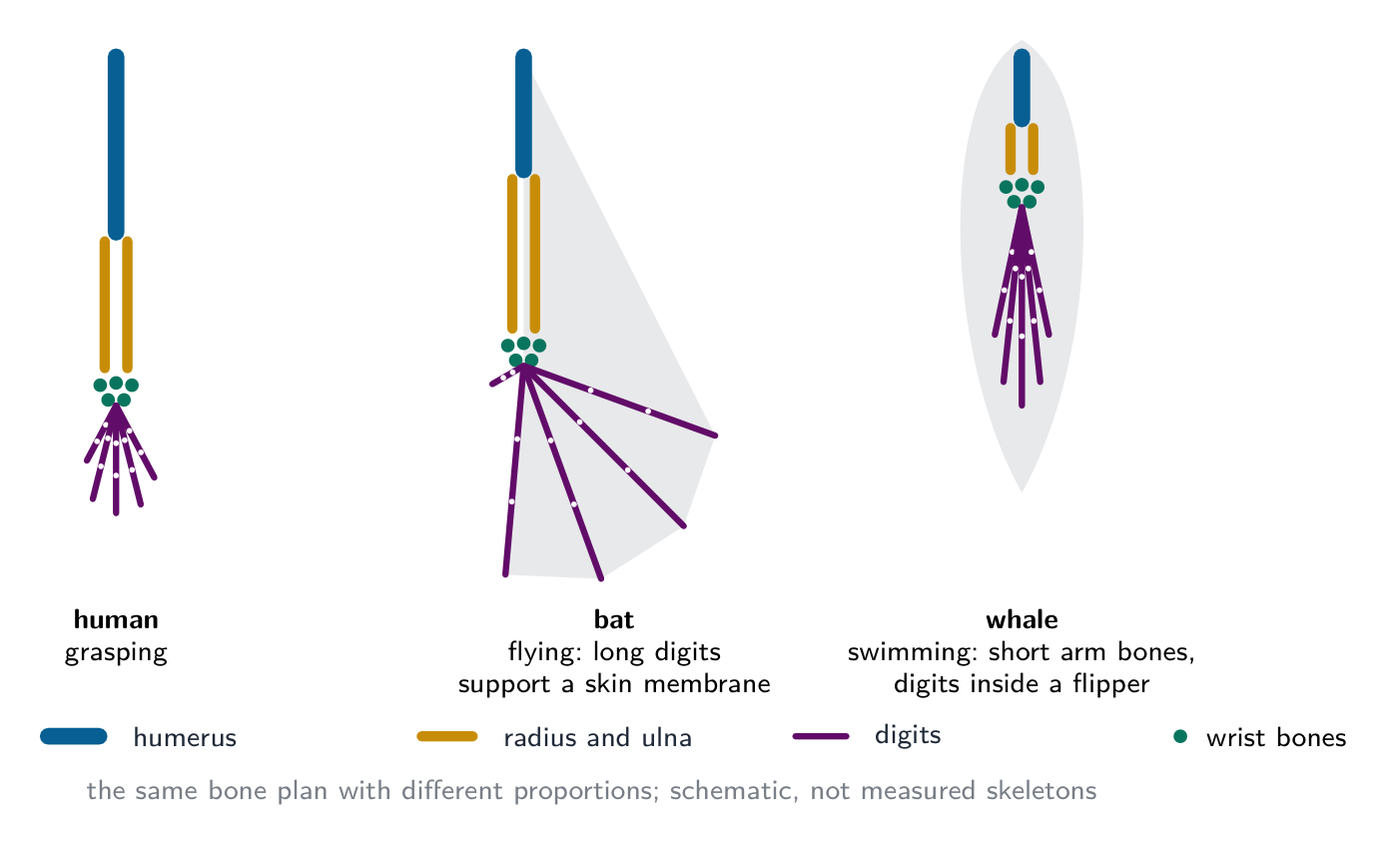
Homologous structures derive from the corresponding structure in a common ancestor, even when their functions differ. The pentadactyl limb illustrates this: an ancestral five-digit forelimb plan has been modified for functions such as grasping, running, swimming and flying.
Archaeopteryx fossil: feathers plus reptilian features — evidence of common ancestry
In a typical tetrapod forelimb comparison, identify one upper-arm bone (humerus), two forearm bones (radius and ulna), wrist bones and a hand region with digits. Their relative positions and developmental relationships matter more than identical lengths. Some descendants reduce, lose, elongate or fuse parts; not every modern limb must display five equally obvious fingers.
These teaching models show a shared structural plan, not measured skeletons of named species. Changes in proportions can support different functions.
A flipper and a human arm need not perform the same task to be homologous. Their corresponding bones are evidence of common ancestry with modification. The inference is stronger when it agrees with developmental and molecular evidence. Do not conclude that one living animal's arm gradually turned into another living species' flipper; both lineages descend from ancestral populations.
8.6
相似特征通过趋同进化产生
English
Analogous features have similar functions but different evolutionary origins as those functional features. Bird wings and insect wings both support flight, but an insect wing is not a modified bony vertebrate forelimb. Similar selection pressures can favour independently evolved ways of solving a similar problem. This is convergent evolution.
Wings as flight surfaces are analogous in all three; the bird and bat forelimb bones are homologous
Distinguish the comparison being made. Bird and bat forelimb bones are homologous as tetrapod forelimbs, while powered flight and the wing surfaces evolved separately in their lineages. A bird's flight surface uses feathers; a bat's uses a skin membrane supported largely by elongated digits. A label such as “homologous” must refer to a specified structure and level of comparison.
Convergence explains why organisms that live similarly can look alike without being each other's closest relatives. Use several independent features and molecular comparisons to test relationships.
8.7
物种形成分裂现有谱系
English
Speciation produces two or more species from pre-existing lineages. A population can change substantially over time without splitting; that is evolution, but not necessarily speciation. A new species does not normally appear as an unrelated organism from nowhere. Speciation increases species number, while extinction decreases it; both processes affect biodiversity.
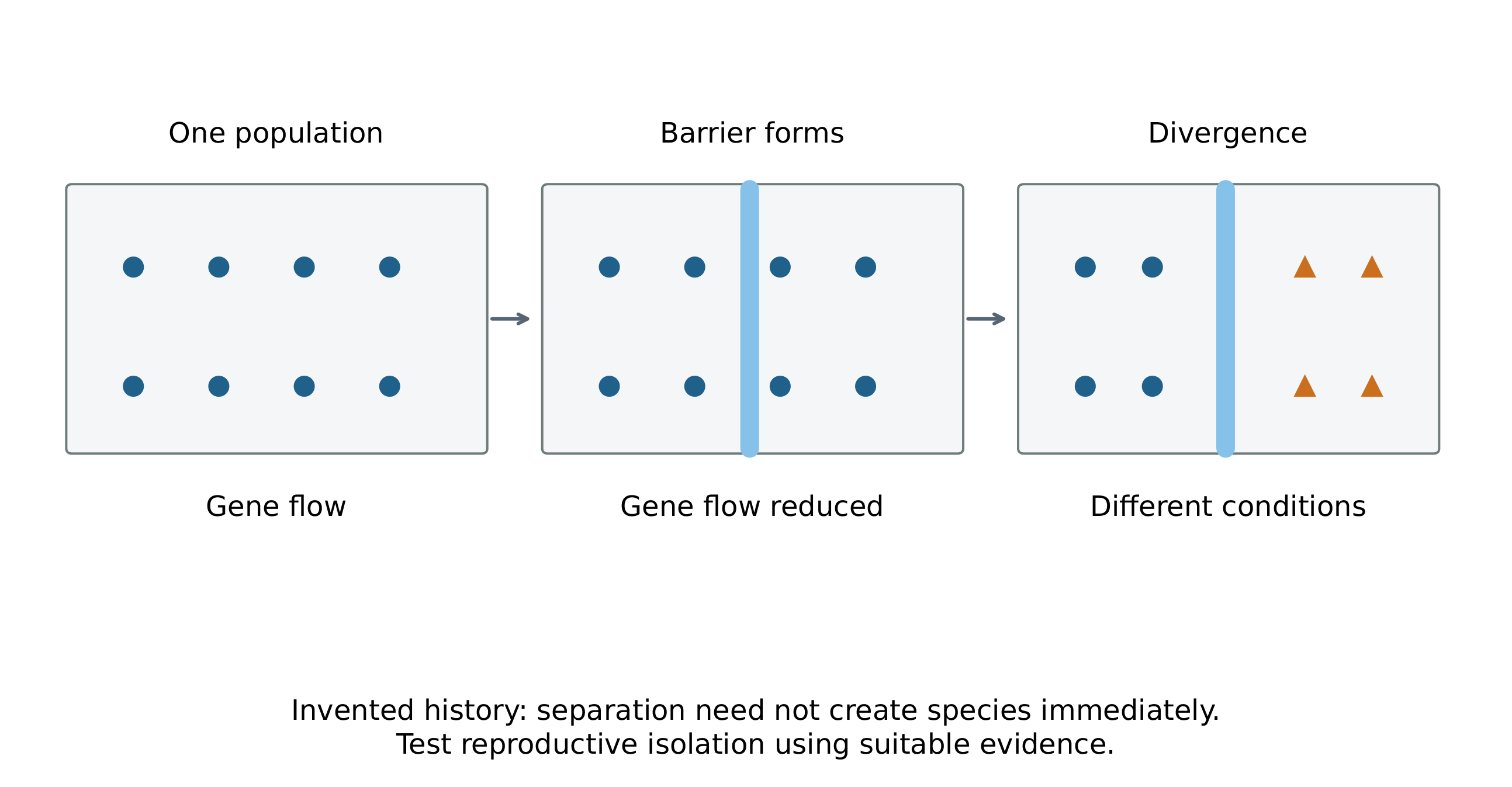
In the biological species framework, reproductive isolation limits gene flow between populations. A geographical barrier may reduce contact. Differences in mating signals, breeding time or compatibility can also reduce successful reproduction. A river separating populations is a possible cause of isolation, not by itself proof that two species already exist.
When gene flow is reduced, populations can diverge through mutation, selection and other population processes. Different environments can impose differential selection: inherited variants favoured in one population may be less successful in the other. Over generations, differences affecting mate recognition or hybrid fertility may strengthen reproductive isolation.
Geographical separation reduces opportunities for gene flow. Different appearance alone does not prove complete reproductive isolation.
A real example: chimpanzees and bonobos
Common chimpanzees (Pan troglodytes) and bonobos (Pan paniscus) share ancestral populations. The Congo River separates much of their present ranges and is an important geographical barrier to gene flow. Separation allowed populations experiencing different ecological and social conditions to diverge. This illustrates geographical isolation and the opportunity for differential selection, rather than one modern species deliberately changing into the other.
A bonobo: bonobos and chimpanzees split when the Congo River separated their populationsThe Congo River separates much of the ranges of common chimpanzees and bonobos (schematic)
Keep the historical claim proportionate to the evidence. Genomic research also supports episodes of ancient gene flow after their main divergence. A river need not have been perfectly impermeable throughout history, and their evolutionary history is not explained by one observation of today's ranges. Molecular data, geography and trait comparisons contribute different kinds of evidence. The research institute's account of the genome study explains this added complexity.
8.8
通过公平比较验证适应性解释
English
To investigate water-loss differences, normalize measurements by leaf area and observation time, then control other influences. In observations, sample A loses 12 g from $0.20\,\mathrm{m^2}$ over 2 h; sample B loses 8 g from the same area over the same time. Define the area-time-normalized rate $R$:
Thus $R_A=12/(0.20\times2)=30\,\mathrm{g}/(\mathrm{m^2\,h})$ and $R_B=8/(0.20\times2)=20\,\mathrm{g}/(\mathrm{m^2\,h})$. B's measured rate is one-third lower under these conditions, a reduction of about 33.3% relative to A.
This does not by itself prove that B's leaves are an inherited drought adaptation. Control humidity, temperature, airflow, light, leaf age and water supply; use repeated measurements and independent plants. Compare relatedness and growth conditions, and test inheritance if the claim is evolutionary. Lower water loss may also carry a photosynthetic cost. Observe permitted local plants without removing protected species. An observational environmental gradient can suggest hypotheses, but correlated conditions limit causal conclusions.
Allopatric speciation begins with geographical separation that reduces gene flow. Both populations then evolve; different selection pressures and chance processes can contribute to divergence. A barrier need not create immediate reproductive incompatibility. If populations meet again, successful mating and the viability and fertility of offspring help test whether reproductive isolation has developed.
Allopatric and sympatric speciation
Sympatric speciation occurs without geographical separation of the diverging populations. Gene flow must still be reduced by another mechanism, such as mating preferences, different breeding times or, in plants, a change in chromosome-set number. Merely living in one area does not mean all individuals exchange genes freely.
The two routes share divergence and reproductive isolation but differ in the role of geography. Behavioural isolation involves differences such as courtship signals; temporal isolation involves different reproductive periods. A strong explanation identifies the mechanism, how it limits gene flow, and how divergence can persist. “They look different” is insufficient for either route.
8.10
AHL:适应辐射使生物占据不同的生态位
English
Adaptive radiation is diversification from a common ancestral lineage into multiple species associated with different ecological roles. New habitats or underused resources can create ecological opportunities. Divergent selection can favour different ways of feeding, moving or using habitat, while reproductive isolation allows differences to persist.
Adaptive radiation in an island bird lineage: one ancestor, three feeding niches
For example, a colonizing bird lineage encounters large hard seeds, small seeds and insects in different parts of an island group. Inherited variation in feeding structures and behaviour can influence access to these resources. Over many generations, divergence and isolation can produce several related species with different niches.
Do not claim that individuals choose to evolve new beaks, that every colonization causes radiation, or that competition disappears completely. Resource partitioning can reduce overlap and permit coexistence, but species can still compete for other limiting resources. Demonstrate common ancestry, divergence, ecological differences and species boundaries rather than treating a list of differently shaped animals as sufficient evidence.
8.11
AHL:受精前和受精后的屏障
English
Some mechanisms reduce hybrid formation before fertilization. Different courtship signals may prevent mating; different flowering seasons may prevent pollen transfer between plant populations. These are barriers to the mixing of alleles even when organisms occupy overlapping areas.
Reproductive barriers act before fertilization or after it
Other barriers act after fertilization. A hybrid may have reduced viability, or it may survive but have low fertility. A mule, the usual hybrid of a female horse and a male donkey, is generally sterile. Its existence therefore does not establish continuing free gene flow between the parental species. Chromosome differences can disrupt pairing and segregation in meiosis, so producing an adult hybrid is different from producing fertile gametes.
Such barriers need not be absolute in every organism. Some related species hybridize occasionally, and gene flow may be limited rather than zero. Evaluate the frequency, direction and reproductive success of crosses instead of treating one hybrid as an automatic disproof of every species boundary.
8.12
AHL:植物中的杂交与多倍体
English
Polyploidy means having more than two complete chromosome sets. Hybridization combines genetic contributions from different species. Together they can produce a new reproductively isolated plant lineage much more abruptly than gradual divergence of separated populations.
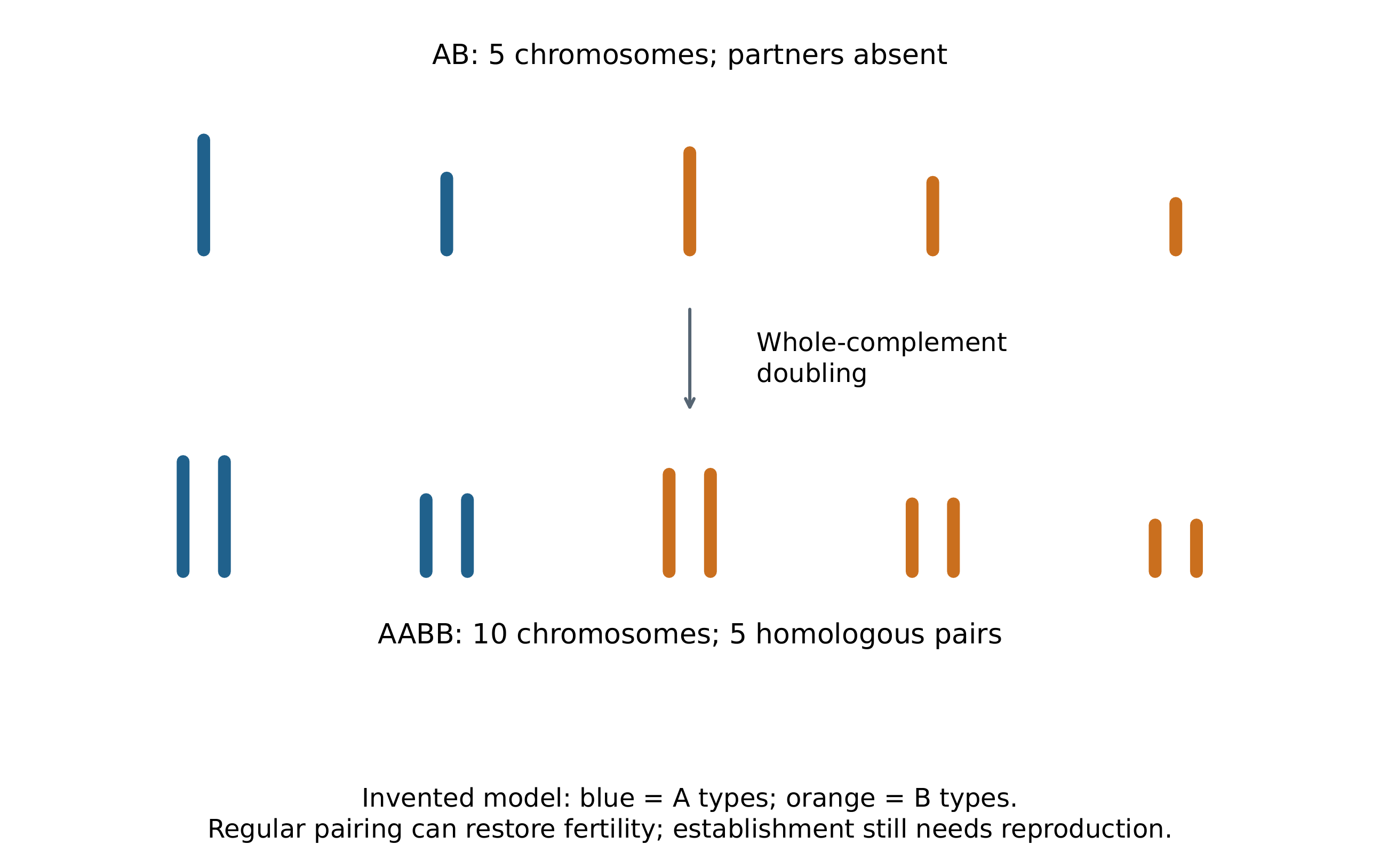
In a model, parent species A has two copies of an A set containing two chromosomes: $2n_A=4$. Parent B has two copies of a B set containing three chromosomes: $2n_B=6$. Their normal gametes contain two and three chromosomes respectively. Fusion gives an AB hybrid with five chromosomes. If A and B chromosomes cannot pair effectively as homologues, meiosis is irregular and fertility is low.
If all chromosomes in this hybrid are doubled, the new plant has AABB: ten chromosomes, with a homologous partner for each of the five chromosome types. Regular pairing can allow viable AB gametes with five chromosomes. Compatible doubled plants, or a self-compatible plant, can reproduce while crosses with the original diploid parents may produce unbalanced complements. This can establish reproductive isolation. Doubling creates chromosome partners; it is not merely ordinary DNA replication followed by an ordinary mitosis.
Pairing and establishment are model conditions, not a guarantee that every hybrid becomes a new species.*
The knotweed/smartweed genus Persicaria supplies real evidence for this process. A 2008 molecular study supported multiple allopolyploid origins, using different nuclear gene copies to identify contributions from different parental lineages. For P. punctata, the evidence supported P. hydropiper and a lineage related to P. hirsuta or P. setacea as contributors. The uncertainty between potential contributors is part of the inference. Our five-to-ten chromosome model is not that study's measured chromosome dataset. See the primary study.
8.13
练习
English
State what the evidence supports and what remains untested.
Define evolution and adaptation. Distinguish a plant's afternoon stomatal response from a population-level inherited change, and explain one cost of reduced stomatal opening.
A model starts with 80 inherited form A and 120 form B individuals. The next generation contains 240 A and 160 B. Find A's initial and later frequencies, the change in percentage points and its relative percentage increase. State two model assumptions needed for a selection interpretation.
Two homologous sequences differ at 9 of 60 aligned sites. Calculate percentage difference and percentage matching positions. Explain why the results are neither a whole-genome identity claim nor a divergence date.
Explain how selective breeding can produce heritable population change, and why it is evidence relevant to evolution. Distinguish selection from a breeder transmitting an acquired body change directly.
Describe the shared pentadactyl forelimb plan. Explain how different functions can accompany homology and why a modern flipper need not be the ancestor of a modern arm.
Compare bird and insect wings as analogous flight structures. Explain why bird and bat forelimb bones can nevertheless be homologous while their flight surfaces differ.
A population's average inherited body size changes for many generations but it remains one interbreeding group. Is this evolution, speciation, both or neither? Explain. Distinguish the effects of speciation and extinction on species number.
Explain how geographical isolation and differential selection can lead to speciation. Why are a river and different appearance insufficient proof of complete reproductive isolation?
Use the chimpanzee–bonobo example to connect geography and divergence. Why should the explanation allow for evidence of ancient episodes of gene flow?
Two plant samples each have leaf area $0.25\,\mathrm{m^2}$ and are measured for 4 h. A loses 15 g; B loses 10 g. Calculate both normalized rates and B's percentage reduction relative to A. Give three controls, one replication requirement and a reason this alone does not prove inherited adaptation.
Design a stronger test of the claim that a leaf trait is an inherited adaptation to dry conditions. Include evidence of inheritance, reproductive benefit and a possible trade-off; explain why a correlation along a habitat gradient is insufficient alone.
AHL Compare allopatric and sympatric speciation, giving a mechanism limiting gene flow in each. Explain how adaptive radiation involves more than different-looking descendants and why niche differences need not eliminate all competition.
AHL Distinguish a courtship barrier, a seasonal breeding barrier and hybrid sterility. Use a mule to explain why producing a surviving hybrid is different from maintaining fertile gene flow.
AHL In the A/B plant model, state parental diploid counts, gamete counts, AB hybrid count, AABB count and the number of paired chromosome types after doubling. Explain restored pairing, possible isolation from parents, and why the Persicaria study supports rather than directly observes every inferred historical event.
Worked answers
Evolution is population change in heritable characteristics across generations. An adaptation is an inherited feature improving survival or reproduction in particular conditions. Afternoon closure is an individual response, not by itself inherited population change. Reduced carbon dioxide uptake can limit photosynthesis even while closure saves water.
Initially $f_A=80/200=0.40$; later $f_A=240/400=0.60$. Increase: 20 percentage points; relative increase $(0.60-0.40)/0.40\times100=50\%$. Assume relevant forms are inherited and the counts represent successive generations without confounding migration or mutation; reproductive success differs under the model. In real data, test these assumptions and alternative causes.
Difference $9/60\times100=15\%$; matching positions $51/60\times100=85\%$. These apply to this homologous alignment. Other genome regions can differ, and a date needs a rate/calibration model with appropriate assumptions.
Breeders choose parents with a desired heritable trait; offspring inherit relevant variants, and repeated selection changes their representation. Differences among breeds and varieties show population change is possible on observable timescales. Training or changing a parent's body does not itself establish inheritance of that acquired change.
One humerus, radius and ulna, wrist bones and a hand region with a five-digit ancestral plan. Corresponding positions can be retained while proportions and functions change, with later reductions or losses possible. Modern arms and flippers descend from ancestral structures in different lineages; neither living endpoint must be the other's ancestor.
Bird and insect flight structures have different origins: a bony feather-bearing forelimb versus an insect wing without that vertebrate bone plan. Similar flight function evolved independently. Bird and bat forelimbs retain homologous bones; feathers and a bat's digit-supported skin membrane provide different flight surfaces.
Evolution, because inherited population characteristics change; not necessarily speciation, because no lineage split is established. Speciation adds species through splitting; extinction removes species. A change in trait average alone supplies no new-species count.
A barrier reduces gene flow; different selection pressures, mutation and other processes permit divergence; reproductive barriers may accumulate. A river may separate still-compatible populations. Different appearance can reflect environment or within-species variation. Test mating patterns and offspring viability/fertility in suitable evidence, rather than forcing risky or unnecessary crosses.
The Congo River is a major barrier separating much of the present ranges of P. troglodytes and P. paniscus. Reduced gene flow allowed divergence under different conditions. Genomic evidence of later ancient mixing means the barrier was not perfectly impermeable throughout history. Both modern species share ancestors; one is not simply the other's ancestor.
$R_A=15/(0.25\times4)=15$ and $R_B=10/(0.25\times4)=10\,\mathrm{g}/(\mathrm{m^2\,h})$. Reduction $(15-10)/15\times100\approx33.3\%$. Control, for example, temperature, humidity and airflow; also consider light, age and water supply. Use several independent plants and repeat measurements. Conditions or plasticity can explain differences; inheritance and reproductive benefit remain untested.
Compare related plants or offspring under common controlled growth conditions to investigate inheritance, supported where appropriate by genetic evidence. Test replicated dry and wetter conditions, measuring survival or reproductive output as well as the leaf trait and water loss. Look for a photosynthetic or growth cost. Habitat gradients confound temperature, soil, ancestry and other factors, so correlation alone cannot establish the mechanism or inheritance.
AHL Allopatric: geography reduces gene flow; sympatric: separation arises without a geographic barrier, for example through breeding-time differences or plant chromosome-set changes. Both need persistent divergence and reproductive isolation. Radiation combines common ancestry, multiple species and ecological diversification. Niche partitioning can reduce resource overlap without eliminating competition for every resource.
AHL Courtship differences can prevent mating; different breeding seasons can prevent reproductive contact. Both reduce fertilization between groups. Sterility acts after a hybrid is formed: a mule can survive but is generally unable to produce offspring. Reduced meiotic pairing/segregation success limits onward allele mixing; occasional hybrid formation does not demonstrate unrestricted fertile gene flow.
AHL A: four chromosomes, gametes two; B: six, gametes three. AB: five; AABB: ten, with five paired types. Doubling supplies homologous partners and can permit five-chromosome AB gametes. Reproduction among compatible doubled plants can maintain a lineage isolated from parental complements. Establishment and fertility are conditions, not automatic. Different Persicaria gene copies support contributions from different ancestral lineages, with uncertainty about some contributors; the historical crosses were inferred, not directly watched.
8.14
考试技巧
English
Identify the population, generations and evidence of inheritance. Explain a benefit and a cost in a stated environment. Distinguish homology of a structure from similarity of function. For speciation, explain reduced gene flow and reproductive isolation; geographical separation or a changed average alone is insufficient. State the denominator in frequency and rate calculations.
References: IB Biology guide, A4.1. Named genomic and plant studies are linked in their teaching sections.