This handout covers all eleven D2.2 objectives: gene expression, transcription control, mRNA degradation, differentiation and epigenetic inheritance. D2.2 is Higher Level only; there is no SL counterpart.
Prerequisites: DNA, transcription and translation, mutations, cell division and the distinction between genotype and phenotype.
33.2
基因表达连接遗传信息与表型
English
A liver cell and a nerve cell can contain essentially the same genome but have different shapes, proteins and functions. The difference need not come from deleting every unused gene. Cells use different parts of their inherited information and regulate how much product they make.
The same genotype gives different phenotypes in different environments: hydrangea flower colour depends on soil pH
Gene expression is the process through which information in a gene contributes to a functional product and hence to phenotype. For a protein-coding gene, the common sequence is transcription into RNA, translation into a polypeptide, then protein function. An enzyme can alter the rate of a metabolic reaction; a structural protein can affect a cell's shape. Some genes make functional RNAs instead of polypeptides.
Do not treat the arrows as conversion of DNA material into protein. The DNA template is normally retained. Expression can change while the DNA base sequence stays the same, although a mutation in a regulatory or coding region can also affect expression or function.
More transcript does not necessarily mean proportionally more active protein. Translation efficiency, mRNA lifetime, protein degradation, processing and availability of interacting molecules can intervene. Measure the level relevant to the claim: RNA abundance, protein abundance, enzyme activity and a whole-cell phenotype are distinct outcomes.
33.3
基因组、转录组和蛋白质组描述不同的集合
English
The genome is the cell's complete genetic information. The transcriptome is the set of RNA transcripts present under specified conditions. The proteome is the set of proteins present. RNA and protein sets and their amounts can change with cell type, developmental stage and environment.
Most differentiated nucleated cells in an individual share essentially the same genome, yet no cell expresses every gene at the same time. A muscle cell requires a different expression pattern from a pancreatic beta cell. These are useful comparisons of specialization; mature red blood cells lacking nuclei are not a suitable example of two nucleated cells retaining identical nuclear genomes.
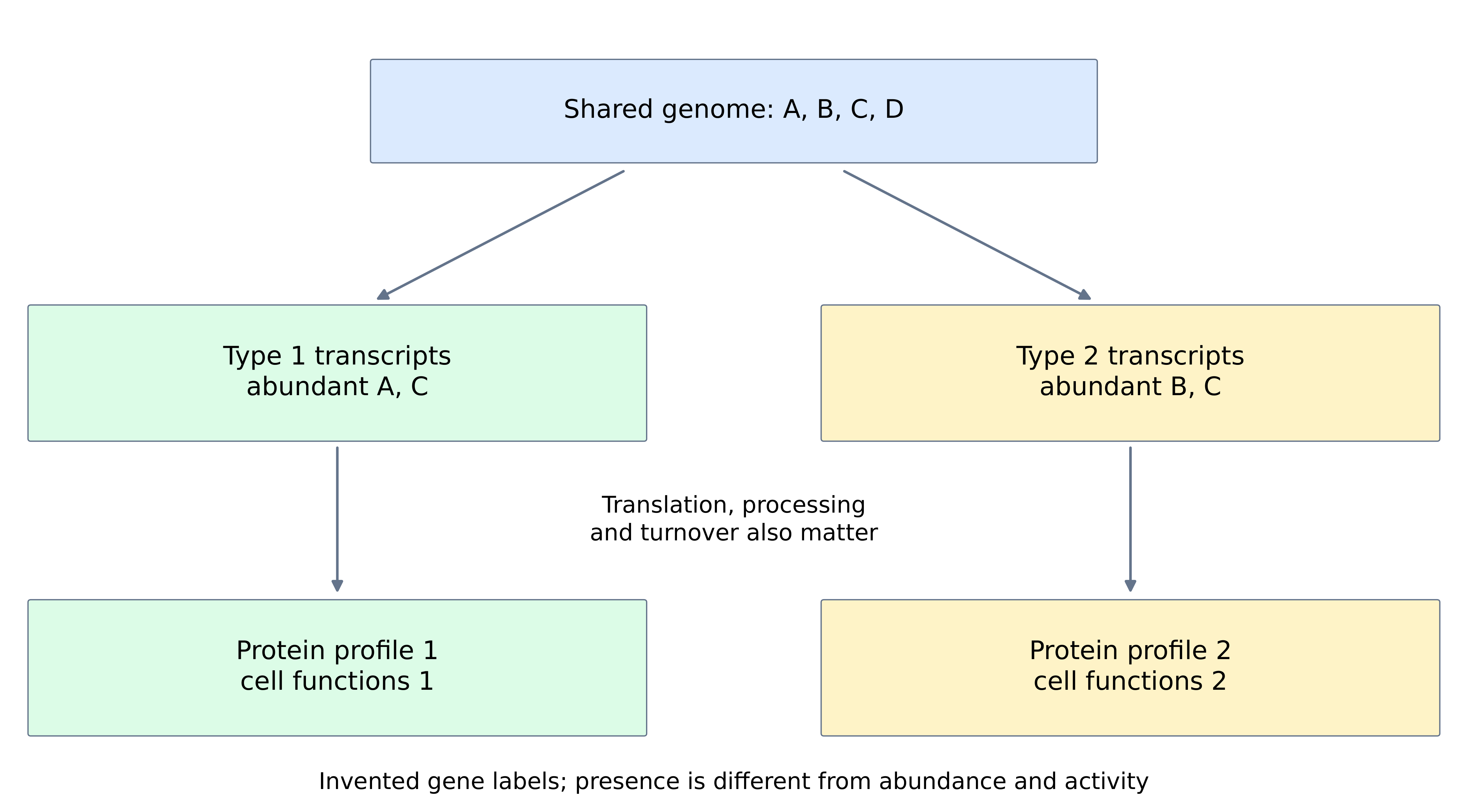
The gene labels A–D are placeholders, not real gene names. A gene can remain present when its transcript is absent or below detection.
Suppose two cell types both contain genes A, B, C and D. Type 1 has abundant transcripts A and C; type 2 has abundant B and C. Shared DNA does not require shared transcript abundance. Nor does the presence of transcript C establish that both cells contain equal amounts of active protein C.
Cell differentiation develops patterns of specialization through selective expression. Epigenesis describes the development of these patterns in a multicellular organism. A stable expression pattern can help a daughter cell retain its tissue identity through subsequent divisions, without changing its genotype at the relevant DNA sequence.
33.4
DNA结合蛋白调控转录过程
English
A transcription factor 转录因子 is a protein that influences transcription through interactions with particular DNA sequences and other components of the transcription machinery. The sequence matters: binding depends on molecular recognition, not an organism consciously choosing a useful gene.
Proteins bound at the promoter and at distant enhancers decide whether a gene is transcribed
A promoter is a DNA region associated with initiation of transcription. Suitable transcription factors and RNA polymerase machinery must assemble appropriately for transcription to begin. An enhancer is a regulatory DNA sequence where bound proteins can increase transcription of a target gene. An enhancer may be far from the promoter in the linear DNA sequence; folding can bring the interacting components closer in space.
Several factors can act together. A cell may express a gene only when the required combination is available, and regulatory proteins can also reduce transcription. A binding event alone does not prove a gene is fully active. Chromatin accessibility, other regulatory partners and the cell's conditions matter.
The promoter and enhancer are DNA, whereas a transcription factor is protein. Promoters and enhancers act directly as regulatory DNA. A transcription factor is made by translating the mRNA that encodes it. A promoter mutation can alter factor binding; changing the concentration of a factor can also alter expression without any mutation in the target gene.
A hormone can change the transcriptional context
Cortisol is a steroid hormone. In a responsive cell it can bind an intracellular glucocorticoid receptor. The activated receptor can interact with specific regulatory DNA regions and other proteins to change transcription of target genes. The response depends on which regulatory sites and partners are accessible in that cell. This illustrates hormone-dependent gene regulation; it does not mean cortisol increases transcription of every gene.
Distinguish this slower change in gene products from a signal that simply changes the activity of an enzyme already present. Both can occur in cell signalling, but they answer different mechanistic questions. For the transcriptional pathway, ask about receptor availability, target-gene RNA and subsequent product or function.
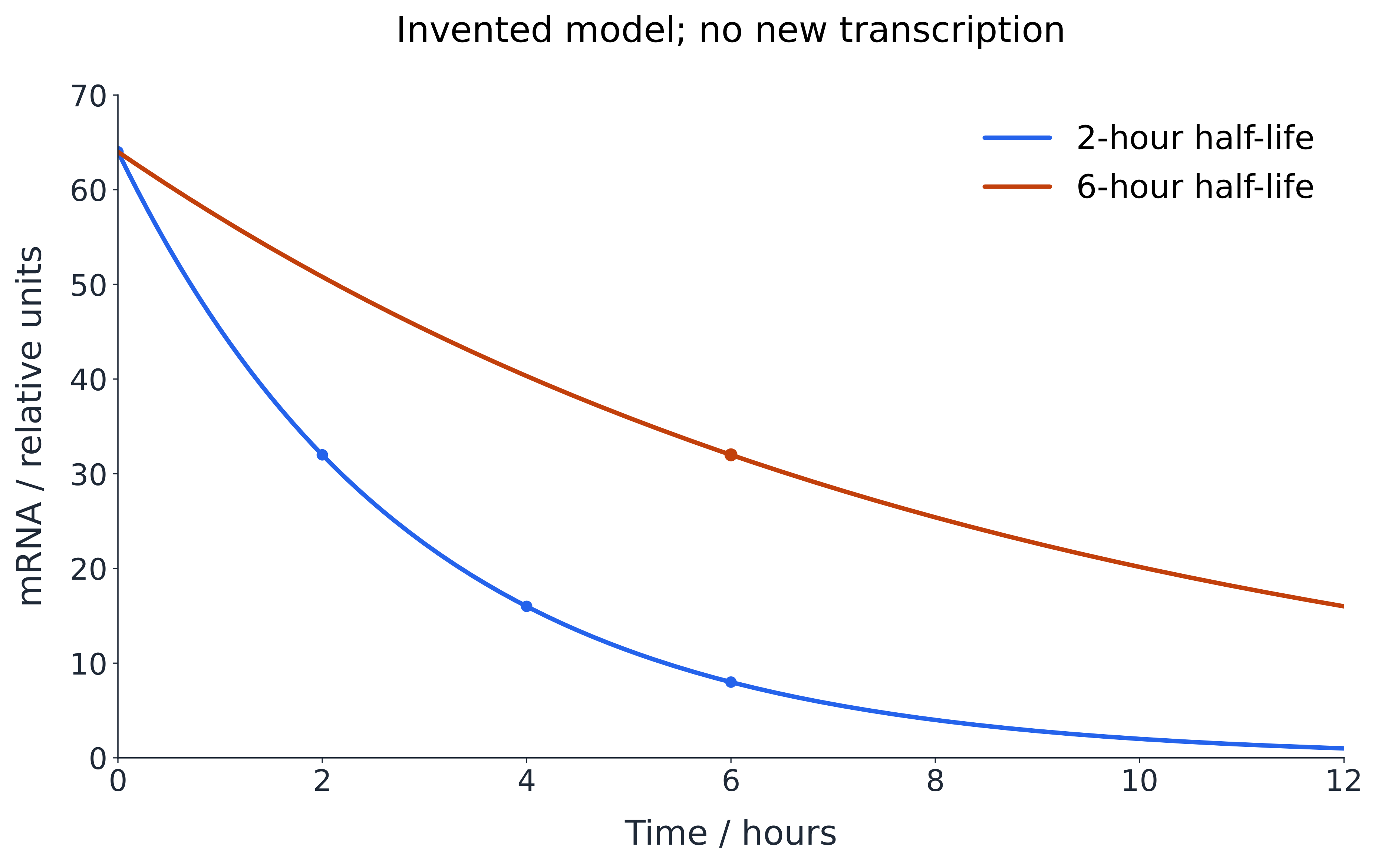
An mRNA molecule can be translated repeatedly while it remains intact and available. Nucleases eventually break it down. Human mRNA lifetimes vary greatly, from minutes to days. Shorter persistence can let a cell change its protein-production pattern quickly; a longer-lived message can support translation for longer without being transcribed again each time.
Abundance reflects production as well as removal. A higher measured mRNA amount could mean more transcription, slower degradation or both. Measuring RNA at one time point cannot distinguish these possibilities by itself. A suitable time course after stopping new transcription can help estimate message persistence, although the intervention's other effects must also be considered.
This model uses constant half-lives of two and six hours. It isolates degradation; real messages and experimental conditions need not follow a single constant half-life.
For a message starting at 64 relative units, a two-hour half-life gives 32 after two hours, 16 after four and 8 after six. With a six-hour half-life, 32 remain after six hours. The difference does not require different starting DNA or different initial RNA abundance.
Protein already made can persist after its mRNA disappears. Conversely, an abundant message can yield little active product if translation is inhibited or the protein is rapidly removed. Match the time scale and measured molecule before explaining a phenotype.
33.6
表观遗传标记在不改变碱基序列的情况下改变基因表达
English
An epigenetic modification 表观遗传修饰 can affect expression without changing the underlying DNA base sequence. DNA methylation and histone modification are examples. A methyl group attached to cytosine does not substitute thymine or another base for that cytosine; the base sequence is preserved.
A calico cat's patches: in each skin patch a different X chromosome has been switched offIn the promoter model, methyl tags on cytosine repress transcription; the base sequence does not change
In the promoter model used here, cytosine methylation represses transcription of the downstream gene. It can help maintain a less active state. Do not generalize this to every methyl group anywhere in a genome: position and molecular context matter.
DNA is packaged around histone proteins in nucleosomes. Histones can also carry methyl groups on particular amino acids. Histone methylation can be associated with repression or activation depending on the residue and modification pattern. The rule “all methylation switches every gene off” is therefore wrong. Specific histone sites and enzyme names are not needed for this unit.
These tags influence how genetic information is used. They do not erase the distinction between genotype and phenotype: two cells can differ in epigenetic state and gene expression while retaining the same nucleotide sequence. A sequence mutation and an epigenetic change are different explanations requiring different evidence.
Epigenetic inheritance means that an expression state can pass to daughter cells, or sometimes to offspring, without a change in DNA sequence. Persistence or restoration of DNA methylation and histone states through cell division can help retain a pattern of differentiation.
This does not mean every tag persists indefinitely or every environmentally induced change reaches future generations. Many epigenetic states are reset during germ-cell and early embryonic development. Most tags are removed, while certain parent-of-origin marks can escape particular resetting stages or be maintained through them. Imprints are also erased and established afresh in the developing germ line according to the sex of the individual making the gametes.
Marks are copied through mitosis but largely reset between generations; imprints follow the parent of origin.
Genomic imprinting produces parent-of-origin effects: the activity of an allele can depend on whether it came from the mother or father. Both copies can be present in DNA even when their expression differs. Imprinting does not mean an offspring has only one parent's entire genome.
Reciprocal lion–tiger hybrids illustrate why parent of origin matters
A liger has a lion father and tiger mother; a tigon has a tiger father and lion mother. Ligers commonly show greater growth than tigons. These reciprocal crosses involve the same two parent species but reverse which species supplies the maternal and paternal contributions.
Ligers (lion father, tiger mother) grow much larger than tigons from the reverse cross: the same genes, expressed differently by parent of originReciprocal crosses: the same two species, with parent of origin reversed, give offspring that grow differently
The course uses these growth differences to illustrate an imprinting model. Parent-specific expression of growth-regulating genes and differences in retained epigenetic marks can contribute to different growth regulation in reciprocal hybrids. Tags are not all removed and converted into identical expression states at fertilization.
Treat the model with appropriate limits. Maternal environment, species-specific regulation and other genetic interactions can also contribute. The key reasoning is that similar species contributions do not guarantee identical expression when parent of origin is reversed.
33.8
环境暴露可能改变甲基化模式
English
Environmental conditions can change gene expression directly through signalling and can also alter epigenetic states. Air pollution provides an example of changes in DNA methylation. A pollution-related methylation difference is a chemical-tag difference, not automatically a change in the DNA base sequence.
Genetically identical agouti viable yellow mice: methylation of one gene, influenced by the mother's diet, shifts coat colour and body massMethylation adds chemical tags to DNA without changing its base sequence
A 2021 controlled crossover study by Cardenas and colleagues compared diesel exhaust with clean air in 13 volunteers and measured DNA methylation in bronchial epithelial cells. It found methylation differences at particular sites and regions after exposure. This supports an effect on the measured epigenome under those study conditions. It does not establish that every site changes, that every tag persists for life, or that the observed changes are inherited by offspring. Researchers' study summary at the US EPA.
To investigate a proposed regulatory effect, measure the relevant methylation, transcript and functional outcome, with comparable tissue and controls. An association between exposure and a tag is not by itself proof of the entire causal chain from tag to disease. Cell composition, prior exposure, timing and other covariates can affect comparisons.
33.9
同卵双胞胎有助于区分共享DNA与不同表达
English
Monozygotic twins develop from one zygote and share essentially the same inherited DNA sequence. This makes paired comparisons useful when investigating environmental influences on expression. It does not eliminate every possible difference: later mutations, developmental conditions, cell composition and chance processes can also matter.
Identical twins share about 100% of their DNA, fraternal twins about 50%: comparing them separates shared genes from different experience
In a 2005 study, Fraga and colleagues examined 40 monozygotic twin pairs. Fourteen pairs, 35%, differed significantly in the global DNA-methylation and histone-acetylation measures examined. Differences were associated with age; the researchers also compared expression in selected younger and older pairs. These results support epigenetic divergence without requiring different inherited genomes. Original study.
The study did not randomly assign lifelong environments. It therefore cannot prove that one specific lifestyle caused every observed difference. Internal epigenetic drift can also contribute. Nor does 35% mean “35% of all human genes differ” or that the remaining pairs were identical at every possible site.
A stronger design for a particular exposure compares the same tissue, checks cell composition, records exposure and relevant covariates, uses adequate pairs and follows changes over time. A within-pair difference reduces some genetic confounding but is not a complete causal explanation by itself.
33.10
细菌终产物可调控其自身合成的基因
English
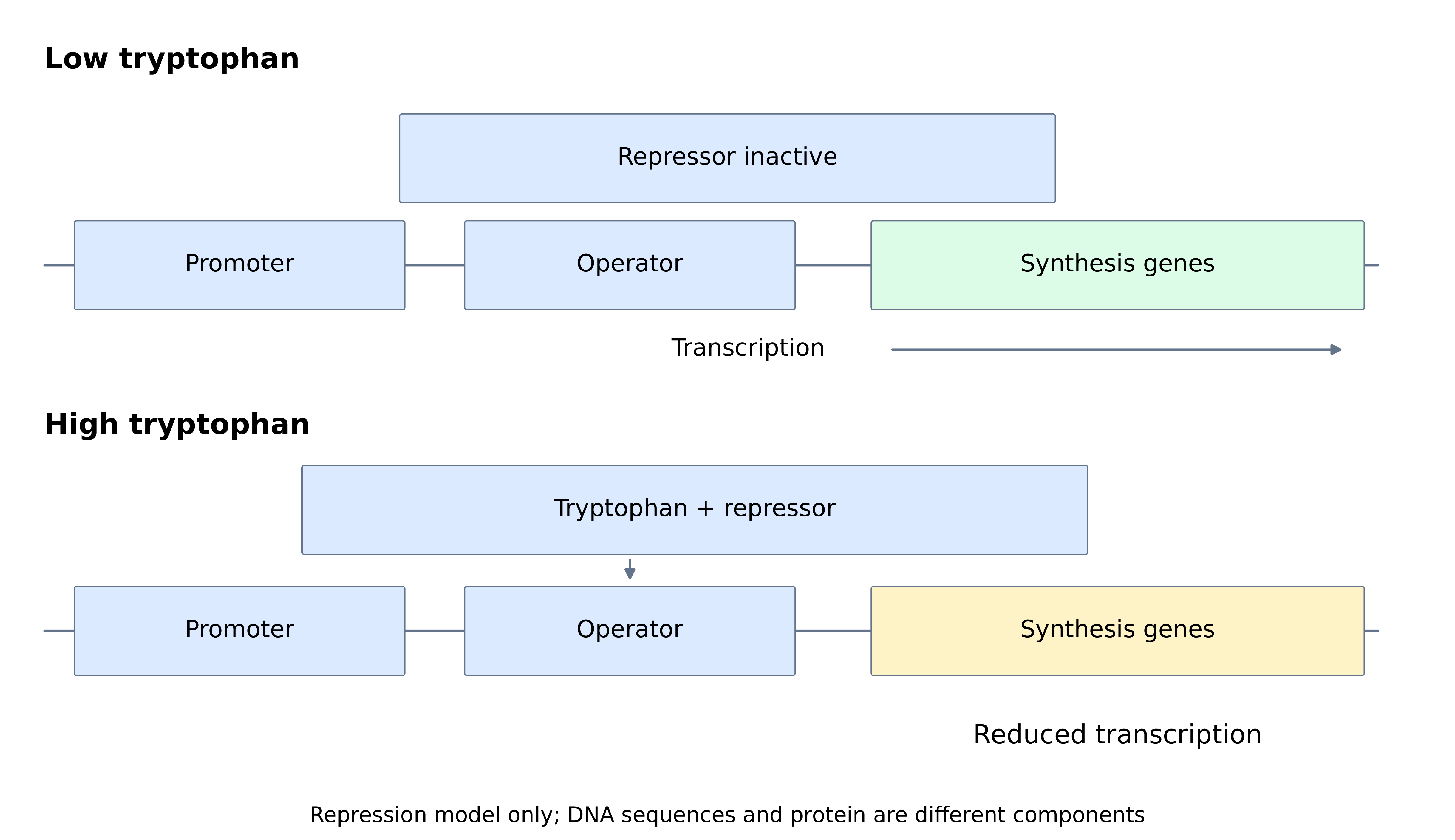
Tryptophan is an amino acid. In the simplified trp-operon repression model, its abundance influences transcription of genes encoding enzymes for tryptophan synthesis.
When tryptophan is scarce, the repressor is inactive in the relevant binding state and does not bind the operator effectively. Transcription of the biosynthetic genes can proceed. When tryptophan is plentiful, it acts as a corepressor: binding changes the repressor so it can bind the operator and reduce transcription. The end product therefore helps limit production of enzymes that make more of it.
The diagram isolates repressor control. It is not a complete map of every regulatory mechanism affecting the real operon.
The operator and promoter are DNA sequences; the repressor is protein; tryptophan is the small molecule that changes its binding behaviour. Tryptophan does not itself become a DNA-bound transcription factor. The response changes transcription of the target biosynthetic genes, not every gene in the bacterial genome.
This is negative feedback in gene expression. It differs from direct inhibition of an enzyme already present, which can change pathway activity faster without first changing transcript supply. Both kinds of control can help regulate metabolism.
33.11
计算倍数变化前比较表达量测量值
English
Fold change is a ratio of comparable treatment and control quantities. If normalized transcript abundance is 12 in treatment and 3 in control, fold change is $12/3=4$. This is a fourfold level, not a 4% increase. Relative increase is $(12-3)/3\times100=300\%$.
Normalise before comparing: double the raw signal can still be a fold change of 1
Normalization matters. Suppose target/reference measurements are 60/20 in a control and 120/40 in a treatment. Both normalized ratios equal 3, so normalized fold change is $3/3=1$, despite twice as much raw target signal. Equal normalized values do not imply equal absolute cell counts in the original samples.
Report biological replication and variation. A single treatment/control ratio does not establish statistical significance. A transcript increase alone does not prove direct transcription-factor binding or proportional enzyme activity; use appropriate perturbation and downstream measurements to test those claims.
探索
A fourfold mRNA change does not specify the protein change
Reproduce the lesson's 12/3 = 4 transcript fold change. Compare added fictional protein readings of 6 and 6, then vary the independent measurements to distinguish mRNA abundance, total protein abundance and unmeasured protein activity.
33.12
练习
English
Explain how two differentiated nucleated cells can retain essentially the same genome but differ in transcriptome, proteome and phenotype.
Trace how information in a protein-coding gene can affect a metabolic phenotype. Why does more RNA not guarantee proportionally more active enzyme?
Distinguish promoter, enhancer and transcription factor. How can an enhancer distant in linear DNA influence transcription?
Explain one hormone-dependent route from cortisol to altered gene expression. Distinguish this from changing the activity of an existing enzyme.
An mRNA sample starts at 80 relative units and has a ten-minute half-life with no new transcription. Calculate the amount after 30 minutes. Why need protein abundance not fall in the same proportion?
Distinguish promoter cytosine methylation from a base substitution. Why is “all histone methylation represses transcription” incorrect?
Explain how epigenetic inheritance can preserve a cell's differentiated state. Why does this not prove every acquired tag passes to grandchildren?
Identify the parents of a liger and a tigon. Outline the parent-of-origin explanation for their growth differences and a limitation on inferring a specific mechanism from size alone.
Describe what the named diesel-exposure study measured. Give one supported conclusion and two claims its findings do not establish.
In the twin study, calculate the percentage represented by 14 of 40 pairs. Why does this result not establish that a particular lifestyle caused every difference? Give two useful design controls.
Explain the low- and high-tryptophan states of the simplified trp repression model, naming DNA, protein and small-molecule components.
Normalized transcript abundances are 20 in treatment and 4 in control. Calculate fold change and percentage increase. What additional evidence would help test a claim of greater functional enzyme output?
Raw target/reference values are 45/15 in a control and 90/30 in a treatment. Calculate each normalized value and normalized fold change. Explain why the raw target ratio alone would mislead.
33.13
例题答案
English
Cells can retain the same genes while selectively expressing different subsets and amounts. Different transcript sets, translation, processing and degradation yield different protein sets and functions. The genome describes genetic information, the transcriptome RNA present, and the proteome proteins present under stated conditions.
Transcription makes RNA, translation makes a polypeptide, and a functional enzyme changes reaction activity, potentially affecting phenotype. RNA lifetime, translation efficiency, protein processing/degradation and other required molecules intervene; measure RNA, protein and activity separately.
Promoter and enhancer are regulatory DNA; a transcription factor is protein. Promoter-associated machinery supports initiation; enhancer-bound proteins can influence it through spatial interactions as DNA folds. Regulatory partners and accessible chromatin affect the outcome.
Cortisol can bind an intracellular glucocorticoid receptor; activated receptor interactions with regulatory DNA and partners alter target transcription. The cell's receptor and regulatory context matter. Direct enzyme activation changes an existing protein's activity without necessarily changing RNA or making new protein.
Thirty minutes is three half-lives: $80\rightarrow40\rightarrow20\rightarrow10$ units. A stable existing protein can persist after message degradation; new translation and protein removal have their own time scales.
A methyl tag on promoter cytosine leaves the nucleotide sequence intact; substitution changes a base. Promoter methylation represses transcription in this model. Histone methylation can activate or repress depending on the modified site and context.
Persistent or restored tags can maintain expression patterns through daughter-cell divisions without sequence change. Germ-cell and early embryo reprogramming removes many tags; inheritance of a particular acquired state across generations requires evidence, not an assumption from mitotic persistence.
Liger: lion father, tiger mother. Tigon: tiger father, lion mother. Retained parent-of-origin marks can produce different regulation of growth-related genes in reciprocal crosses. Size alone identifies neither a specific tag nor a complete single-gene cause; maternal and other regulatory/genetic effects may contribute.
It compared diesel and clean-air exposure in a controlled crossover design and measured bronchial-cell DNA methylation. Differences at specific sites support an exposure effect on the measured epigenome. They do not establish universal changes at all sites, lifelong persistence, disease causation through those tags or inheritance by offspring.
$14/40\times100=35\%$ of the studied pairs for the measures used. Age and environment were not randomly assigned; internal drift and other differences can contribute. Compare the same tissue/cell composition, record exposure and covariates, and use replicated or longitudinal measurements. Shared inherited DNA reduces some confounding but proves no specific lifestyle mechanism.
Low tryptophan: inactive repressor does not effectively bind operator, permitting transcription. High tryptophan: the small molecule acts as corepressor, allowing the repressor protein to bind the DNA operator and reduce transcription of biosynthetic genes. Promoter/operator are DNA; repressor is protein; tryptophan is neither.
Fold change $=20/4=5$; relative increase $=(20-4)/4\times100=400\%$. Use biological replicates and variation, protein abundance and enzyme-activity measurements with appropriate controls; transcript amount alone does not establish proportional function or significance.
Control $45/15=3$; treatment $90/30=3$; normalized fold change $=3/3=1$. Raw target signal doubles, but the reference also doubles. These measurements show unchanged normalized target abundance, not necessarily equal absolute RNA or cell counts in the original samples.
33.14
考试技巧
English
Name the measured molecule and the regulatory stage. Separate DNA sequence, epigenetic state, RNA, protein and function. Distinguish mitotic persistence from inheritance across generations, and association from a tested causal mechanism. For numerical comparisons, normalize first, state the ratio's direction and distinguish fold level from percentage increase.