This handout covers D1.3: molecular changes in genes, their causes, inheritance and role in variation. Sections marked AHL are for Higher Level only.
Prerequisites: complementary DNA bases, gene expression, mRNA codons and the distinction between body cells and gametes.
31.2
DNA 序列发生改变可能产生多种不同的后果
English
Two cells can have different DNA sequences yet make the same amino-acid sequence. Another single-base change can introduce an early stop. The size of a DNA change alone therefore does not tell us the size of its effect.
A mutation 突变 is a change in the DNA base sequence. Once copied, a sequence change can pass to descendant cells. DNA damage is not automatically a lasting mutation: repair may restore the original sequence before it becomes established. A change in gene activity without a change in DNA sequence is also a different process.
Deliberately changing a chosen DNA sequence is gene editing 基因编辑. Both spontaneous mutations and targeted changes must be understood through their actual sequence and biological context. The Higher Level sections examine how targeted editing can test gene function.
A gene mutation changes sequence within a gene; larger chromosome changes can involve many genes. Always identify the scale in the question. Here the main molecular changes are base substitutions, insertions and deletions. A change may affect a protein-coding region, RNA processing or a sequence controlling expression.
A substitution 替换 replaces one base with another. DNA still contains the same number of bases, so a simple substitution inside a coding region does not by itself shift subsequent codon boundaries. However, the new triplet may have a different meaning.
A blood smear in sickle-cell disease: one base substitution in the haemoglobin gene changes one amino acid, and the red cells deform into sickles
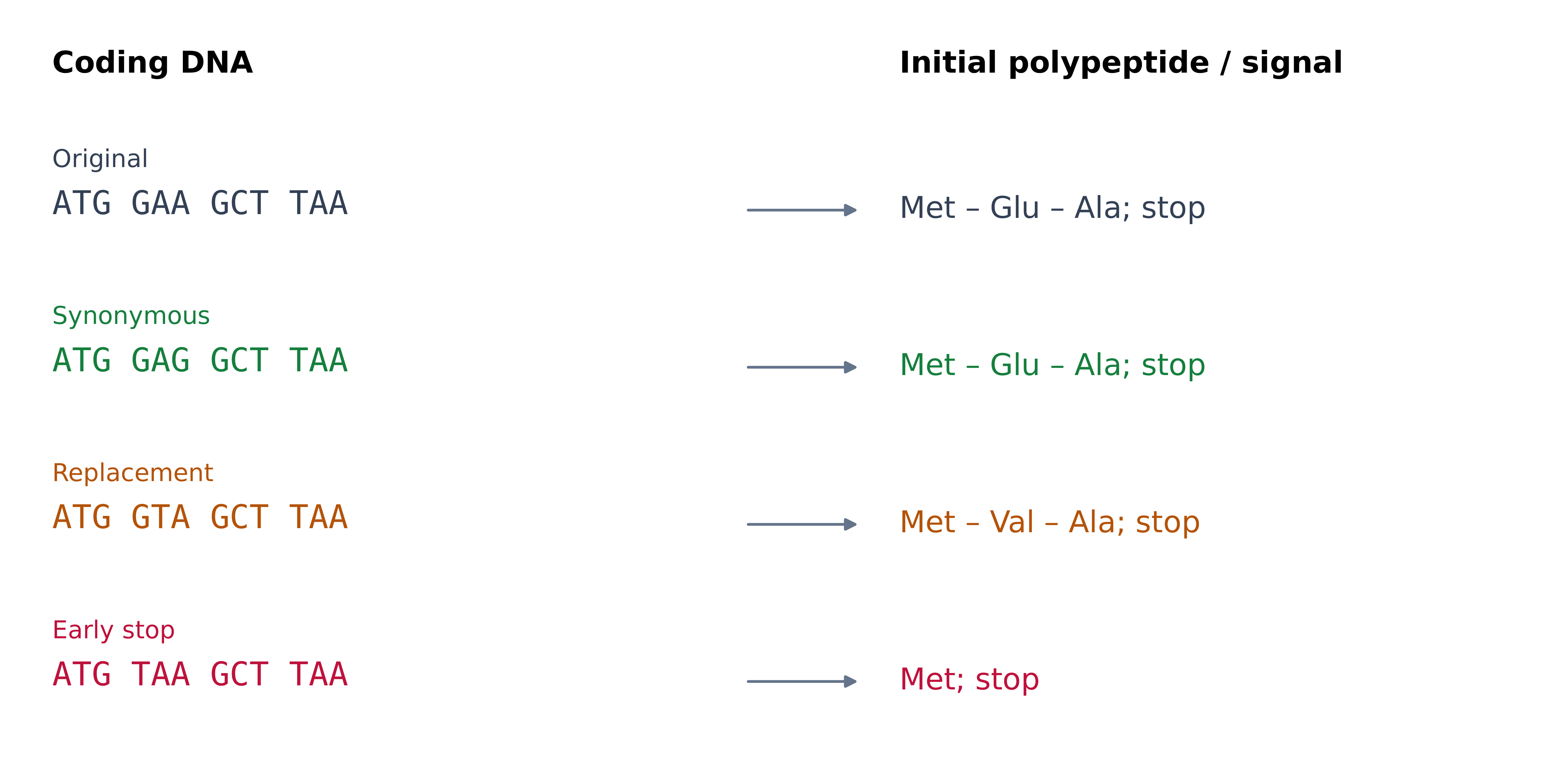
For the following example, the coding DNA strand is written in the same direction as its mRNA; replace T with U to obtain the RNA. The original coding DNA is ATG GAA GCT TAA. Its mRNA is AUG GAA GCU UAA, specifying Met–Glu–Ala, followed by a stop. The stop specifies no amino acid.
Coding DNA change
Corresponding mRNA
Consequence in this example
GAA becomes GAG
GAA becomes GAG
Both specify Glu: synonymous
GAA becomes GTA
GAA becomes GUA
Glu becomes Val: amino-acid replacement
GAA becomes TAA
GAA becomes UAA
A stop replaces Glu: early termination
Each row begins in the same stated frame. DNA changes are interpreted through mRNA codons; the stop is not an amino acid.
The genetic code is degenerate: several codons can specify one amino acid. A synonymous change leaves that amino acid unchanged. This is narrower than proving that every aspect of gene expression and cell function is unaffected. Sequence context can also influence processing or expression.
An amino-acid replacement may alter charge, bonding, folding, a binding site or stability. Its effect depends on the residue and its role. Some replacements have little detectable effect; others have large effects. An early stop often shortens the translated chain, but the observed amount of product may also be affected by RNA quality-control mechanisms. Do not assume every altered gene produces an abundant shortened protein.
A single-nucleotide polymorphism, or SNP, is variation at one nucleotide position among individuals. Such variation can arise through base substitution mutations. An observed base difference is not automatically disease-causing. Population variation, molecular consequence and effect on a person's traits are separate questions.
The reading frame 阅读框 is the grouping of successive bases into codons from a defined starting position. An insertion adds bases; a deletion removes them. Within a translated region, a change whose length is not a multiple of three shifts the grouping downstream of the change.
Substitution, deletion, and insertion mutationsA substitution changes one triplet; a deletion or insertion shifts every later triplet (a frameshift)
Delete base 4, the first G after AUG, from the mRNA sequence AUGGAAGCUUAA. The sequence becomes AUGAAGCUUAA. Regrouping from the same start gives AUG AAG CUU AA: Met–Lys–Leu and an incomplete final group. The original stop is no longer a complete stop codon in this displayed frame. More downstream sequence is needed to predict where translation ends.
This is not evidence that every later amino acid must differ or that translation stops immediately. Chance agreement and degeneracy can preserve some residues. The frame changes at the edited position; the actual new codons determine the consequences.
Deleting the complete GAA codon instead gives AUG GCU UAA: Met–Ala, then stop. The downstream frame is preserved and one amino acid is lost. A three-base deletion that crosses a codon boundary can also change the newly joined codon. Preserving the downstream frame does not guarantee normal protein function. A large insertion or deletion can disrupt a whole functional domain, including a binding or catalytic region, even when its length is a multiple of three.
Change inside a coding region
Downstream frame
What still needs checking?
Add 1 base
Shifted
New codons and location of a stop
Remove 2 bases
Shifted
New sequence and product
Remove 3 bases
Preserved downstream
Missing residue(s), joined codon and function
Add 6 bases
Preserved downstream
Added sequence, junctions and function
Mutations outside translated sequence can also matter. A promoter change can alter transcription; a change at a splice-related sequence can alter which RNA sequence is retained. A non-coding change is therefore not automatically harmless, and it need not act by directly replacing an amino acid in a codon.
探索
Keep the bases in order, then regroup the codons
Compare the reference's AUG CCU GGA UAA with a base-5 substitution to CAU and a base-4 deletion. Track original base positions through regrouping, compare one- and three-base deletions, and test a silent substitution or early stop without assuming a full peptide length beyond the shown fragment.
DNA replication and repair are accurate but not perfect. An incorrectly incorporated base or an error during repair can establish a new sequence. A spontaneous mutation does not require a known external mutagen.
Sunscreen on skin in normal light (left) and ultraviolet light (right): it absorbs the UV that can damage DNA in skin cellsDamage is not yet a mutation: it may be repaired, kill the cell or be copied into a lasting change
A mutagen increases the frequency of mutations under stated conditions. Examples include some chemicals and radiation. Ultraviolet radiation can damage neighbouring pyrimidine bases; ionizing radiation can damage DNA directly or through reactive products. Some chemicals alter bases or interfere with normal copying. For example, metabolic products of benzo[a]pyrene, found in tobacco smoke, can bind to DNA and interfere with accurate copying or repair. Damage may be repaired, cause cell death or become a lasting sequence change.
In a fair comparison, control the starting population, growth conditions, exposure measurement, number of generations and detection method. A larger fraction of mutant colonies after treatment is evidence to investigate. It is not automatically a measured mutation rate: survival, selection and multiplication of an early mutant can change that fraction.
For example, a sample contains 24 resistant colonies among 12,000 viable colonies. The observed resistant fraction is $24/12000=0.002$, or $0.20\%$. This counts a phenotype in the final sample. It does not tell us that 0.20% of DNA-copying events produced resistance.
31.6
突变相对于生物体的需要是随机的
English
A new mutation is not normally directed to the exact useful base because an organism needs a particular adaptation. Changes can occur in many genome regions, including changes with no benefit. However, random with respect to need does not mean every position, base change or environment has the same mutation probability. Sequence hotspots, copying processes, repair and exposure can produce biases.
Consider bacteria exposed to an antibiotic. Resistant variants may already exist before exposure. The antibiotic removes susceptible competitors and resistant lineages become more common. This is selection acting on variation. Observing more resistant cells after exposure does not by itself show that the antibiotic instructed susceptible cells to make the needed mutation.
Independent cultures started before selection can produce very different resistant counts if mutations arise at different times: an early event leaves many descendants, a late event few. Such a pattern is consistent with pre-existing mutation and clonal growth. Interpretation still requires suitable controls, repeated cultures and a model accounting for growth and survival.
Very uneven counts across independent cultures fit mutations that arose at random times before the antibiotic.
Mutation creates new alleles. Recombination and sexual reproduction can rearrange existing alleles into new combinations. Both contribute to variation, but shuffling existing alleles is different from the origin of a new sequence variant.
31.7
细胞谱系决定某种变化能否遗传
English
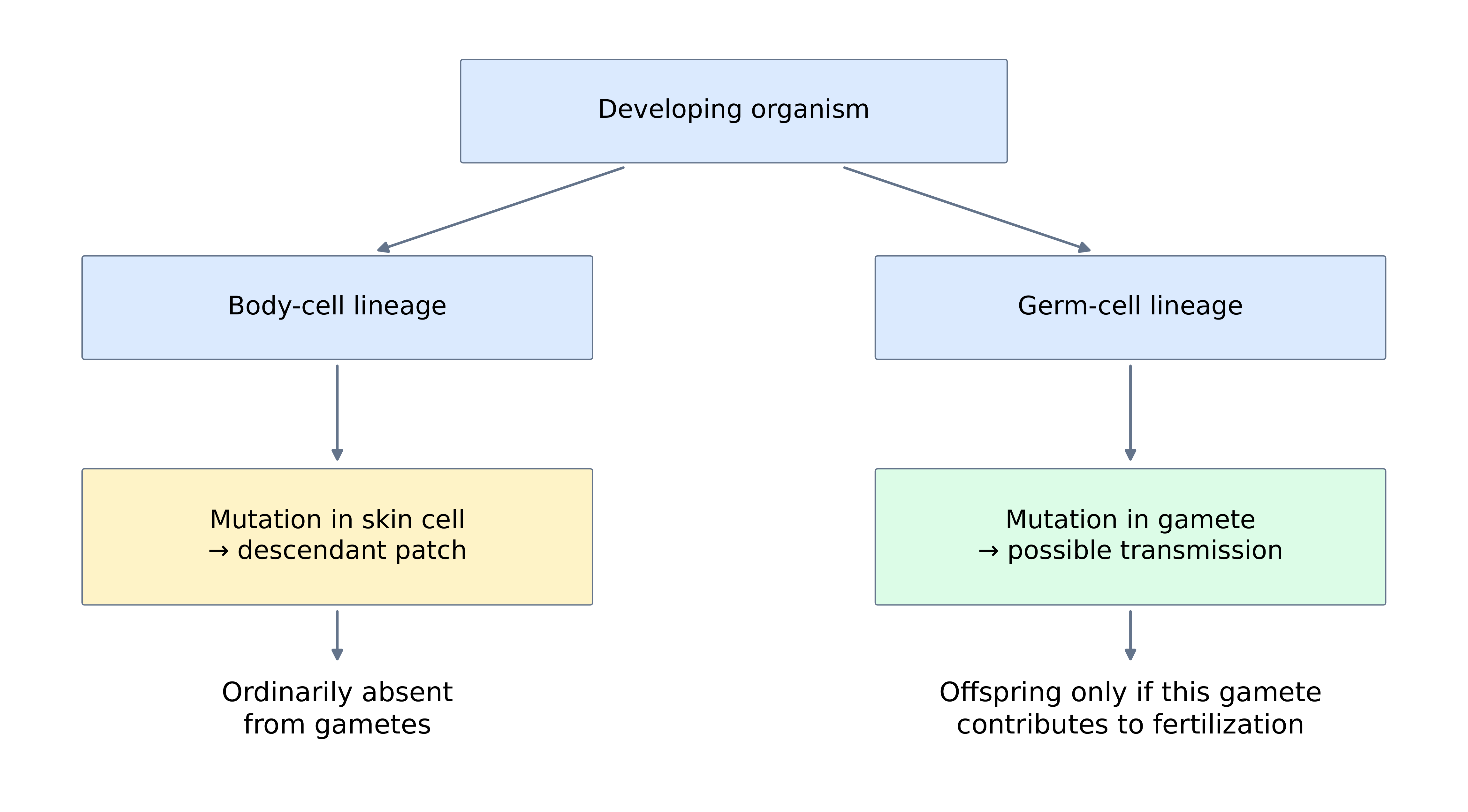
A somatic mutation occurs in a body-cell lineage. It can pass through mitosis to a patch of descendant cells, producing genetic mosaicism. In ordinary sexual reproduction, a mutation confined to skin cells does not enter the gametes and is not inherited by offspring.
A mutation in a germ-cell lineage can reach a gamete. It can then enter an offspring if that gamete contributes to fertilization. Not every germline mutation is transmitted: many gametes do not contribute, and survival and development also matter. A change inherited at fertilization can be present throughout many descendant tissues; a later embryonic change may be present only in some lineages.
Arrows show cell ancestry. A somatic change can spread within the body without entering an offspring; transmission through a gamete is conditional on fertilization.
Some somatic mutations affect control of cell division, DNA repair or cell survival. Descendant cells may gain a growth advantage, contributing to cancer development. One mutation is not automatically sufficient to cause cancer: several changes and tissue conditions can matter. A mutation affecting a protein unrelated to growth is not automatically a cancer mutation either.
Keep inheritance and effect separate. A harmful mutation can be somatic or germline. A germline mutation can be neutral. The word inherited does not mean beneficial, and a mutation arising during one person's life is not necessarily somatic if it occurs in a germ-cell lineage.
31.8
变异为进化提供材料,其效应取决于情境
English
Many mutations have no detectable effect on reproductive success in a particular environment; many that affect important functions are harmful. A small proportion can provide an advantage in a given context. No fixed percentage applies to every gene, organism and environment.
A change affecting an enzyme may be harmful when its normal substrate is essential, yet useful under another condition. A variant allowing growth during antibiotic exposure may also carry a cost without the antibiotic. Benefit describes a relationship between a variant and its conditions, not a permanent label on the DNA change.
The same variant is a cost in one environment and an advantage in another: benefit depends on context.
For mutation to contribute to evolution through sexual generations, it must enter the inherited variation of a population. Natural selection can then change allele frequencies when variants differ in reproductive success. Neutral variants can also change frequency through genetic drift. Mutation is essential over evolutionary time because it is the ultimate source of new alleles; that does not mean an individual needs a damaging mutation to stay healthy.
Evaluate a genetic-test claim
A commercial report identifying a variant is not, by itself, a diagnosis or a guarantee about a future trait. Ask which variants were tested, whether the association is supported in an appropriate population, how large the effect is, and what environmental or other genetic influences remain. A negative result for a small panel does not exclude every relevant variant.
Use absolute quantities when possible. In a comparison, a risk rises from 2 in 1,000 to 4 in 1,000. It doubles, but the absolute increase is 2 in 1,000, or 0.2 percentage points. Neither description means every carrier develops the condition. Expert interpretation matters because sequence detection, statistical association and individual prediction are different levels of evidence.
31.9
AHL:基因敲除用于检验功能贡献
English
A gene knockout makes a gene inoperative so that its contribution can be investigated. Compare organisms or cells with a functional gene against otherwise comparable knockout material. Knockout libraries allow many genes to be studied systematically in a model organism.
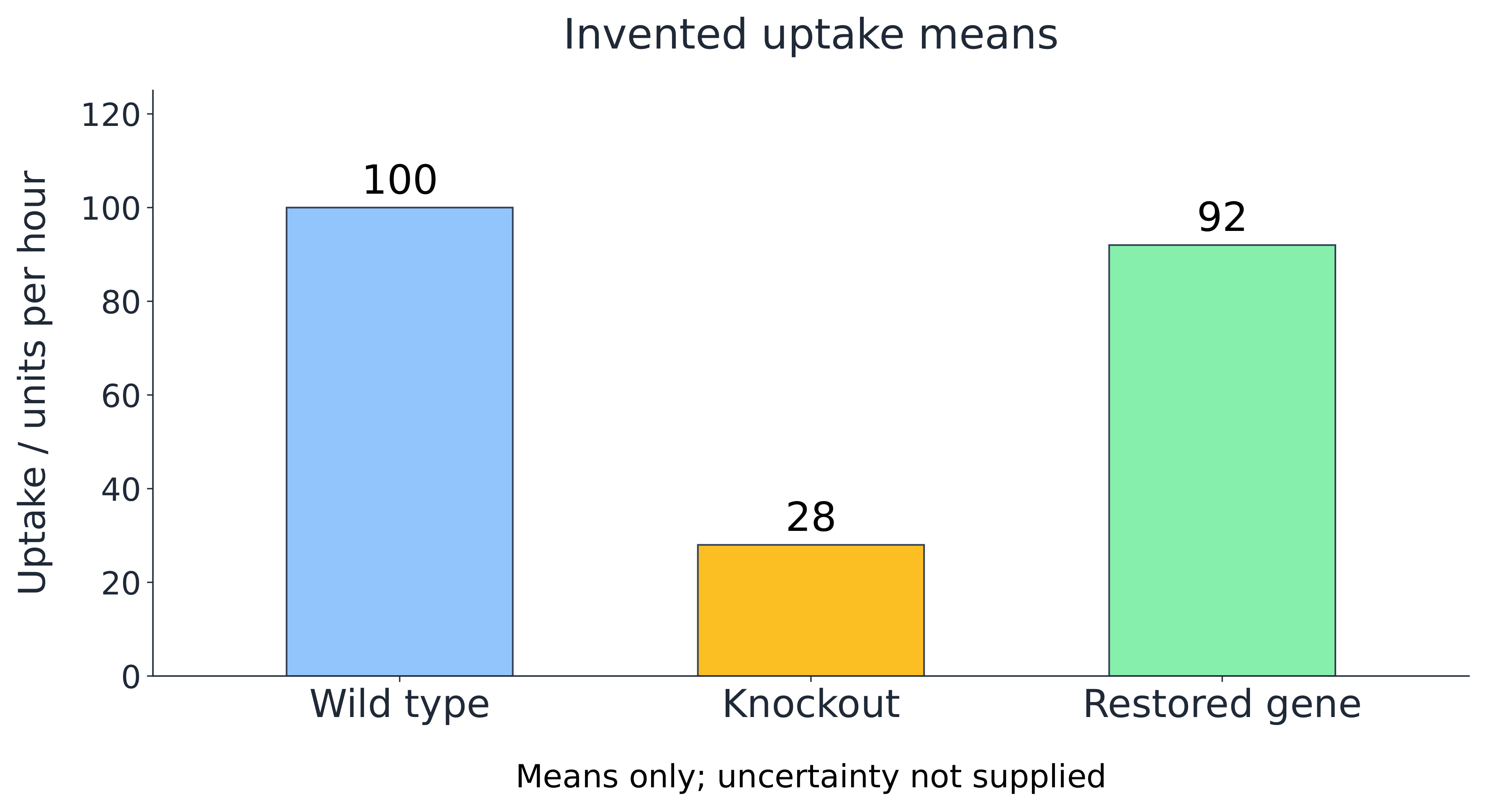
Suppose a gene may contribute to uptake of a nutrient. An experiment measures mean uptake in matched conditions: wild type 100 units per hour, knockout 28, and knockout with a restored functional copy 92. The reduction is $100-28=72$ units per hour, or 72% of wild type. Restoration towards the original value supports a contribution of the gene to the process.
Bars show group means, not uncertainty intervals. Replicate counts and variation would be needed to assess precision and statistical support.
The experiment does not yet show that the gene's protein binds the nutrient directly. It might regulate another gene, build a membrane structure or supply energy. A rescue strengthens causal interpretation, but controls for background differences and unintended changes remain necessary. Use independent lines, matched environments and measurements of the proposed mechanism.
No visible phenotype does not prove that a gene has no function. Another gene may compensate, the function may appear only under another condition, or the measured outcome may miss the relevant process. Distinguish a complete knockout from a partial reduction in expression.
31.10
AHL:CRISPR-Cas9系统关联靶向、切割与细胞修复
English
In a simplified CRISPR-Cas9 model, guide RNA helps recognize a complementary DNA target next to an appropriate short recognition sequence, the PAM. Cas9 cuts the DNA strands. Cellular repair determines the resulting sequence: a cut is not itself a guarantee of the intended final edit.
The Cas9 protein with its guide RNA bound to target DNA: the guide finds the matching sequence and Cas9 cuts both strands thereCRISPR-Cas9 targets and cuts; the cell's repair makes the edit, and every outcome still needs checking
Repair can create small insertions or deletions that disrupt a coding frame. Other editing outcomes can involve a specified sequence change under suitable conditions. Not every cut disables a gene, and a non-coding target can change expression without deleting a protein-coding sequence. The target, actual repaired sequence and measured function must all be checked.
A useful evaluation asks whether the intended site changed, whether all relevant cells or alleles changed, whether other similar sites were affected, and whether the biological result persisted. A successful molecular edit and a useful clinical outcome are related but separate endpoints.
A published example and its limits
In a 2024 single-group study of exagamglogene autotemcel for severe sickle-cell disease, patients' blood stem cells were edited outside the body and returned after conditioning. Editing targeted an erythroid-specific enhancer of BCL11A, reducing repression of fetal haemoglobin; it did not directly repair the sickle-cell HBB substitution. Of 44 treated patients, 30 had sufficient follow-up for the primary endpoint: 29/30, approximately 97%, were free of severe vaso-occlusive crises for at least 12 consecutive months. This is a defined observed benefit, not proof of lifelong cure or zero risk. Frangoul and colleagues, 2024.
The denominator must match the outcome being discussed. Patients without enough follow-up are not automatically treatment failures or successes. A study without a randomized comparison group also requires care when judging causes and comparing treatments. Long-term follow-up and adverse-event assessment remain important.
Ethics needs a named application and affected people
Editing a person's somatic cells and editing a germline that may affect future generations raise different issues. Consider expected benefit, uncertain harm, consent, fair access, effects on future offspring and the distinction between treating illness and selecting preferred traits. Animal research also requires attention to welfare and alternatives.
A useful argument states who may benefit, who bears risk and what evidence or safeguards would change the judgement. Countries can regulate uses differently, creating challenges for international standards. International cooperation seeks to harmonize regulation while addressing these ethical differences. Do not assume that technical possibility gives permission for every application, or that the same rules apply everywhere.
31.11
AHL:保守序列可指示功能约束
English
A conserved sequence remains similar across compared species or lineages. One explanation is purifying selection: variants disrupting an important function leave fewer descendants, so functional sequence is retained. Conservation can help identify regions worth investigating, including regulatory DNA as well as coding DNA.
However, conservation is not proof that mutations never occurred there. Another hypothesis is a lower local mutation rate. Closely related species can also share sequences simply because little time has passed. Compare equivalent sequences, divergence times and nearby or suitably matched neutral regions. Then test function rather than relying on similarity alone.
In an eight-position alignment, ACGTACGT and ACGTTCGT match at seven positions. Identity is $7/8\times100=87.5\%$, with no gaps included in this model. A difference at one position does not identify the trait it affects. Conversely, 100% identity in a short sample does not show that change is impossible.
Percentage identity counts matching aligned positions; it does not say what the one difference does.
Coding DNA can change while amino-acid sequence is conserved because of degeneracy. Specify whether conservation is measured in DNA or protein. Evidence from a knockout, altered expression or a biochemical test can complement comparative sequence evidence.
31.12
练习
English
Distinguish a lasting mutation from repaired DNA damage and from a change in transcription activity.
For coding DNA ATG GAA GCT TAA, give the mRNA and initial amino-acid sequence, including the meaning of the final triplet.
Compare changes of the second coding-DNA triplet from GAA to GAG, GTA and TAA. Which shifts the downstream frame?
Delete coding base 4 from the corresponding mRNA AUGGAAGCUUAA. Regroup it and explain what can and cannot be concluded about the final peptide.
Explain the difference between a complete-codon deletion and a two-base deletion within a translated region. Is either guaranteed harmless?
A promoter change leaves the coding DNA unchanged but lowers protein abundance. Explain a plausible mechanism and one useful measurement.
An exposure experiment finds 36 resistant colonies among 18,000 viable colonies. Calculate the observed fraction as a decimal and percentage. Why is this not automatically a mutation rate?
Explain why increased resistance after antibiotic exposure does not show mutations occurred because bacteria needed them. Does random mean equal probability at all bases?
Compare a mutation restricted to skin cells with a mutation entering a gamete. State the condition needed for transmission to an offspring and one possible consequence within a body-cell lineage.
Explain how mutation, recombination, selection and drift make different contributions to population variation. Why can the same variant have different effects on fitness in different conditions?
A report changes estimated risk from 3 in 1,000 to 6 in 1,000. Give the relative change and absolute change in percentage points. Explain why a positive or negative panel test is not a complete prediction.
AHL: Uptake means are 80 for wild type, 20 for knockout and 74 for restored gene, in units per hour. Calculate the knockout reduction as a percentage of wild type. Give a supported conclusion, a control and a limit on the inferred mechanism.
AHL: Explain guide recognition, Cas9 cutting and repair as distinct stages. Why does a cut not prove a precise, safe, successful edit? Distinguish somatic and potentially inherited uses when evaluating ethics.
AHL: Two ungapped DNA sequences, AACCGGTTAA and AACCGATTAA, differ at one position. Calculate identity and evaluate the claim that a highly conserved sequence proves mutations never occur there. Name evidence that could separate functional constraint from a low mutation rate.
31.13
例题答案
English
A lasting mutation changes the established DNA sequence. Repair may remove damage and restore the original sequence, leaving no lasting mutation. Transcription can increase or decrease without a DNA-sequence change.
mRNA AUG GAA GCU UAA; Met–Glu–Ala, then stop. UAA is a termination signal and adds no amino acid: four codons here produce three residues before processing.
GAG gives mRNA GAG, still Glu; GTA gives GUA, Val; TAA gives UAA, an early stop. None changes sequence length or shifts the downstream frame by itself.
Removing base 4 gives AUGAAGCUUAA, grouped AUG AAG CUU AA: Met–Lys–Leu and two remaining bases. The frame changes after AUG and no complete stop is displayed. Further downstream sequence is required to predict the full product or termination position.
A complete-codon deletion removes one amino acid while preserving the downstream frame. A two-base deletion shifts subsequent grouping. Either can affect function; the location, new sequence and biological role determine the outcome.
The promoter change could reduce transcription initiation, lowering mRNA supply and therefore protein production. Measure transcript abundance as well as protein, with appropriate controls; protein breakdown and other regulation can also affect abundance.
$36/18000=0.002=0.20\%$. This is a final resistant fraction. Differential survival, generations and expansion of early mutants can affect it; it is not a count of new sequence changes per copying event.
Selection can enrich resistant variants that arose before exposure. A useful mutation need not arise in response to need. Random with respect to need does not require equal rates at all genome positions or identical probabilities for all base changes.
A skin-cell mutation can pass to descendant skin cells but ordinarily not to gametes. An offspring can inherit a mutation if the affected gamete contributes to fertilization. Somatic changes may produce mosaic patches or contribute to cancer through altered growth control; a single mutation need not cause cancer.
Mutation creates new alleles; recombination shuffles existing alleles. Selection changes frequencies through differences in reproductive success; drift changes frequencies through chance sampling. Environmental conditions can change the benefits and costs of a variant, so its effect on fitness is context-dependent.
Risk doubles, a 100% relative increase. It rises from 0.3% to 0.6%, an absolute increase of 0.3 percentage points. A tested variant may alter probability without determining outcome; an untested variant, other genes or the environment may matter. A negative limited panel does not exclude every relevant change.
AHL: Reduction $=80-20=60$; $60/80\times100=75\%$. Knockout reduces uptake and restoration towards 80 supports a contribution of the gene. Use matched genetic background and conditions, independent lines and replication. The gene might act indirectly; these means alone neither prove direct nutrient binding nor establish statistical significance.
AHL: Guide pairing and PAM recognition help locate the target; Cas9 cuts DNA; cellular repair generates the final sequence. Unintended repair, incomplete editing, off-target effects or loss of function at an important site can limit success. Verify sequence and biological outcome. Somatic treatment primarily affects the treated person; germline changes may affect future descendants, adding consent and inheritance concerns alongside benefit, risk and access.
AHL: Nine matches out of ten give $90\%$ identity. Conservation can reflect purifying selection, a lower mutation rate or limited divergence time; it does not prove mutation is impossible. Compare suitably matched neutral regions and lineages, and experimentally test the conserved region's function. Distinguish DNA conservation from protein conservation.
31.14
考试技巧
English
Name the altered molecule and region before predicting an effect. A non-coding change can affect expression or processing.
Translate mRNA codons in the specified frame. Give the new sequence before claiming a frameshift, stop or residue change.
Separate a new mutation, its inheritance and its frequency after selection. A final mutant fraction is not automatically a mutation rate.
AHL: Separate targeting, cutting, repaired sequence and functional outcome. Explain what a knockout or conserved sequence supports and which alternatives remain.