Two cells can contain the same gene but produce different amounts of its protein. Even when both make a polypeptide, only one may process it into an active product. To explain the difference, follow the information from DNA to RNA, then follow the amino acids through synthesis and maturation.
This handout covers D1.2: transcription, stable templates and gene expression; mRNA, ribosomes and tRNA; the genetic code, elongation and mutation effects. Sections marked AHL are for Higher Level only.
Prerequisites: DNA and RNA structure, complementary bases, amino acids, enzymes and peptide bonds. Unless identified as a named biological example, sequences, lengths and numerical data below are original, teaching examples.
30.2
蛋白质合成将基因与多肽连接起来
English
Protein synthesis 蛋白质合成 uses a base sequence to specify the order of amino acids in a polypeptide. Two processes must be distinguished. Transcription 转录 makes RNA using a DNA template. Translation 翻译 uses an mRNA sequence at a ribosome to assemble amino acids into a polypeptide. DNA does not become protein, and RNA bases are not converted into amino acids.
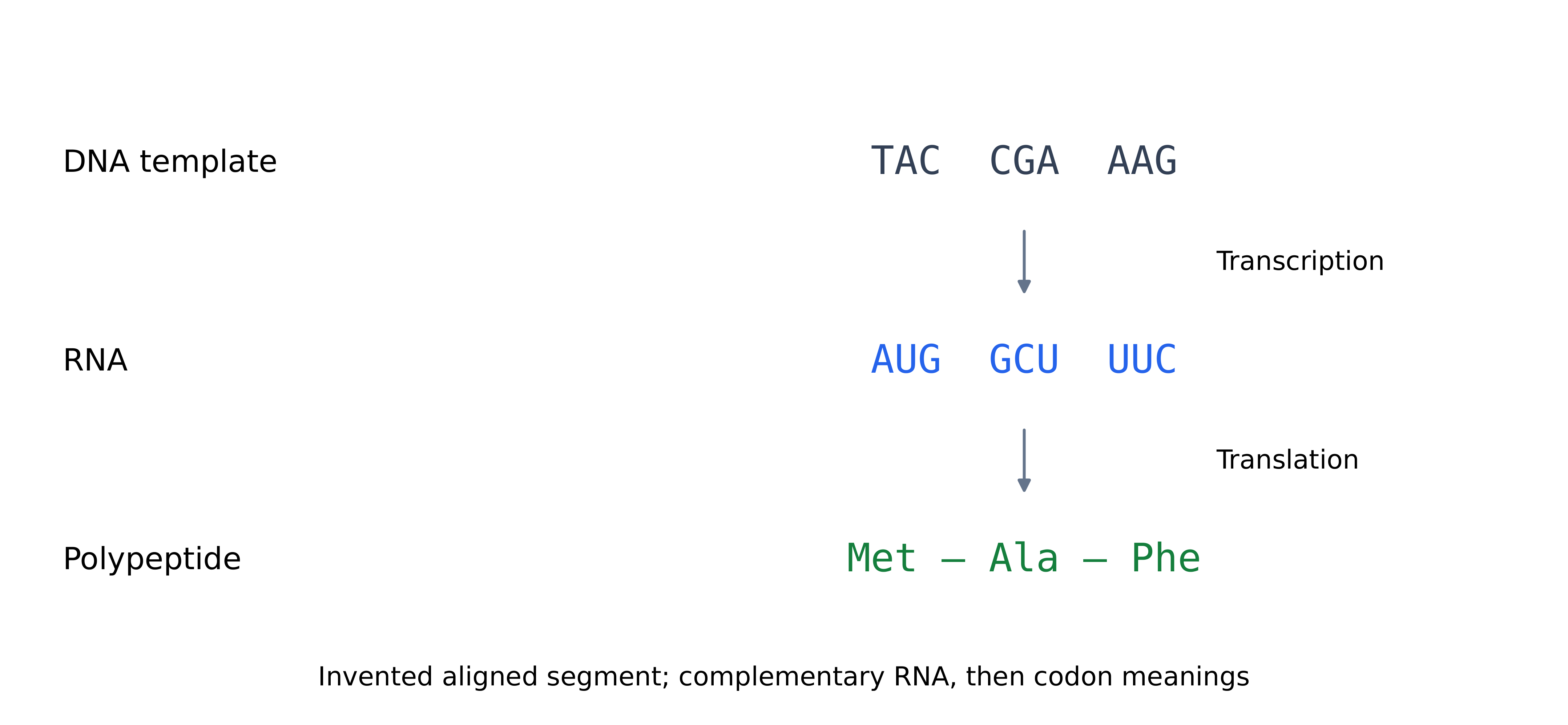
Transcription copies DNA into mRNA in the nucleus; translation at the ribosome builds the polypeptide
For a protein-coding gene, transcription supplies an RNA copy of relevant information; translation interprets the coding region of that message. Other genes produce functional RNAs, such as rRNA or tRNA, rather than polypeptides. A polypeptide is a chain of amino acids; a functional protein may require folding, processing or assembly of several chains.
In eukaryotes, nuclear genes are transcribed in the nucleus and their mRNAs can be translated by cytoplasmic ribosomes, including ribosomes attached to rough endoplasmic reticulum. Prokaryotes have no nucleus, so do not draw a nuclear membrane around bacterial transcription. The two-stage information relationship remains useful in both cases.
RNA polymerase exposes a short region of DNA and uses one strand as the template for the particular transcript. Complementary RNA nucleotides pair with exposed DNA bases. DNA A pairs with RNA U, DNA T with RNA A, DNA C with RNA G and DNA G with RNA C. RNA polymerase catalyses covalent joining of RNA nucleotides into the new RNA backbone.
Hydrogen bonding helps select complementary bases across template and product. It is different from the covalent bonds joining adjacent nucleotides within the RNA. The RNA separates as transcription proceeds, and DNA strands can pair again. The whole chromosome need not remain permanently open.
For an aligned DNA template segment T–A–C–C–G–A–A–A–G, the complementary RNA segment is A–U–G–G–C–U–U–U–C. When this is part of the stated reading frame, its codons are AUG, GCU and UUC. Do not copy the template unchanged, substitute T into the RNA, or read DNA template triplets directly from an mRNA codon table.
The segment is aligned for pairing. RNA bases are copied from the template relationship; amino acids are selected through the genetic code. The arrows represent information use, not conversion of DNA material into protein.
A reusable template is not consumed by transcription
Transcribing a sequence does not normally change the DNA base sequence. The nucleotides in the RNA come from the cell's available RNA-nucleotide supply; they are not pieces cut out of the DNA template. A gene can therefore be transcribed repeatedly while retaining its information.
Long-lived non-dividing somatic cells still need to maintain their DNA sequences. They can continue making RNA and proteins without duplicating the whole genome for cell division. “This cell does not divide” does not mean “this cell never expresses genes”. Equally, template stability is not a guarantee that DNA damage or mutation can never occur.
30.4
调控转录有助于开启和关闭基因表达
English
Cells do not use every gene at the same time. Whether a protein-coding gene is transcribed affects whether its mRNA is available for translation. A cell making more of one mRNA can often make more of the associated product, although later stages also influence protein abundance.
Same genome, different genes switched on
A pancreas beta cell and a nerve cell can share most of their genome while expressing different sets of genes. Different gene activity helps cells perform different functions; it does not require every specialized cell to possess a completely different set of protein-coding genes.
Imagine two otherwise comparable cells. Both retain an intact gene, but only cell A has a detectable transcript and product under the measured conditions. This is consistent with different gene expression, not proof that B lacks the gene. Check DNA presence, RNA detection and protein detection separately. The absence of a signal can also reflect a method's sensitivity or the sampling time.
30.5
核糖体和tRNA将密码子与氨基酸连接起来
English
Messenger RNA, mRNA, carries the sequence used during translation. The small ribosomal subunit binds the mRNA and helps position it for reading. The large subunit participates in the machinery that links amino acids. Two tRNAs involved in peptide-chain transfer can be bound at the same time; a ribosome does not have to release the growing chain into solution after each amino acid.
A bacterial 70S ribosome built from its molecular structure: the large and small subunits clamp the mRNA between them
A codon 密码子 is a group of three mRNA bases read together in a specified reading frame. A tRNA has an anticodon that pairs with a complementary codon and carries a particular amino acid when charged. The anticodon is RNA, so it also uses U rather than T. Correct matching of amino acid to tRNA is essential: the ribosome reads the pairing relationship, not a printed name tag on the amino acid.
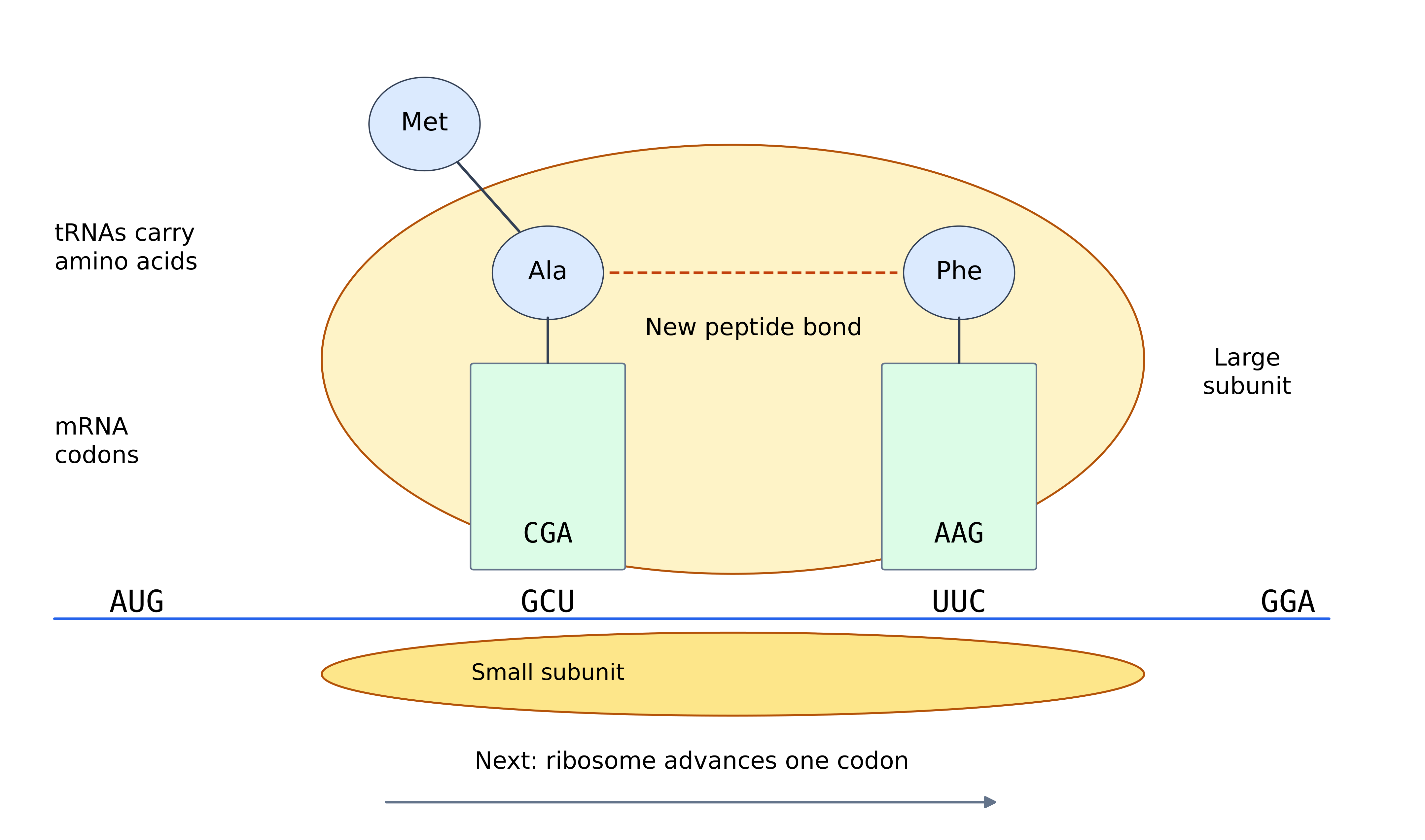
For an mRNA codon GCU, an aligned anticodon is CGA. For UUC it is AAG. These are aligned complements; direction labels are developed in the Higher Level section. The tRNA's amino-acid attachment site is separate from its anticodon. A codon does not directly attach to a free amino acid without the adaptor relationship.
The growing Met–Ala chain is attached to one tRNA; the next tRNA brings Phe. Chain transfer forms the Ala–Phe peptide bond. The diagram shows a stage in elongation, not a whole ribosome at molecular scale.
There are four kinds of RNA base. A one-base code gives only $4^1=4$ different signals; a two-base code gives $4^2=16$. A triplet code gives $4^3=64$, enough combinations to specify twenty standard amino acids and termination signals. “Three” refers to three bases in one codon, not three codons per amino acid.
Only a triplet code gives enough combinations: 4³ = 64 is more than the 21 signals needed.
The genetic code is degenerate: several different codons can specify the same amino acid. For example, GCU and GCC both specify alanine. This does not mean that one codon has an arbitrary choice of amino acids in the standard code. Keep several-codons-to-one-amino-acid distinct from one-codon-to-several-amino-acids.
The code is nearly universal: most organisms use the same codon meanings, reflecting shared evolutionary history. Important exceptions exist, for example in some mitochondrial codes. “Universal” in this course describes the broad shared system, not a claim that no organism or organelle ever differs.
A stop codon 终止密码子 ends translation and specifies no amino acid. In the standard code the stop signals are UAA, UAG and UGA. AUG specifies methionine and commonly serves as the start signal in the appropriate initiation context. Not every AUG anywhere in an mRNA automatically begins an independent protein.
Use the mRNA table with the correct strand and frame
The following excerpt contains the codons needed in this handout's examples. Read codons as mRNA, not anticodons. Use a complete supplied table when a question contains other codons. The NCBI genetic-code tables identify the standard code and documented alternatives; their DNA-style T corresponds to U in mRNA.
Transcription copies the gene into mRNA in the nucleus; translation at a ribosome matches each codon with a tRNA anticodon and joins the amino acids.
mRNA codon or codons
Amino acid or signal
AUG
Methionine, Met
GCU, GCC, GCA, GCG
Alanine, Ala
UUU, UUC
Phenylalanine, Phe
GGU, GGC, GGA, GGG
Glycine, Gly
GAA, GAG
Glutamic acid, Glu
GUU, GUC, GUA, GUG
Valine, Val
UAU, UAC
Tyrosine, Tyr
CUU
Leucine, Leu; other Leu codons omitted
UCG
Serine, Ser; other Ser codons omitted
GAU, GAC
Aspartic acid, Asp
UAA, UAG, UGA
Stop; no amino acid
For the coding sequence AUG GCU UUC GGA UAA, begin at the stated start and group successive triplets. The product is Met–Ala–Phe–Gly, then translation stops. There are five codons but four amino acids. UAA does not add an amino acid named “stop”.
Count only the translated coding region
Suppose a coding region contains 63 nucleotides, including its single terminal stop codon, with no untranslated sequence or introns in the stated count. The number of codons is $63/3=21$. One is stop, so the initial polypeptide contains $21-1=20$ amino acids. A linear chain of twenty amino acids has nineteen peptide bonds before any processing.
From nucleotides to amino acids
The model can be written as $L=B/3-1$, where $B$ is the coding-region nucleotide count including the terminal stop and $L$ the initial amino-acid count. It cannot be applied to an entire gene or full mRNA without checking the included regions. Nor does it necessarily give the length of a mature protein after processing. A 90-nucleotide coding region under the same conditions gives $90/3-1=29$ amino acids.
探索
Count the triplets, then remove the terminal stop
Reproduce the reference's 63-base coding segment: 21 codons including one terminal stop encode 20 amino acids. Compare the 90-base and 45-base examples, and distinguish a stated coding length that includes the stop from one that excludes it.
An incoming charged tRNA pairs its anticodon with the next mRNA codon. The growing polypeptide is initially attached to another tRNA. A peptide bond forms between the chain's terminal amino-acid residue and the incoming amino acid, transferring the chain onto the incoming tRNA.
Each codon is matched by a tRNA anticodon; the chain passes from the P-site tRNA to the amino acid in the A site
The ribosome then advances by one codon relative to the mRNA. The tRNA now carrying the chain occupies the position used for the next transfer; the uncharged tRNA can leave and be recharged. Repetition extends the chain in the codon-specified order. The mRNA is not consumed one codon at a time or permanently turned into the polypeptide.
For the sequence Met–Ala–Phe–Gly, forming the four-residue chain requires three peptide bonds. Adding another amino acid increases both the residue count and the number of peptide bonds by one. The precise initiation and binding-site sequence is treated in the Higher Level sections; the shared explanation focuses on how elongation links base order to amino-acid order.
30.8
突变可通过改变密码子来改变蛋白质
English
A base substitution replaces one base. Because the code is degenerate, some substitutions leave the amino-acid sequence unchanged: GCU to GCC still specifies alanine. Other substitutions change an amino acid, such as UUC to UAC, changing phenylalanine to tyrosine. A substitution that creates a premature stop can shorten the product. The effect depends on the sequence and position; “one base change always destroys the protein” is false.
Substitution, deletion, and insertion mutationsA silent substitution keeps the amino acid; a single-base deletion shifts the reading frame
A real example is the sickle-cell variant of human beta-globin. The coding-DNA triplet GAG changes to GTG, corresponding to mRNA GAG changing to GUG and a glutamic-acid-to-valine substitution. It is commonly numbered position 6 in the mature beta chain. The altered side-chain properties favour association of deoxygenated haemoglobin S molecules into polymers, which can distort red cells. This connects a sequence change with protein behaviour rather than treating “mutation” as a complete explanation. See the NIH description of the molecular change.
An insertion or deletion not divisible by three shifts the grouping of downstream bases within a coding region. In the sequence AUG GCU UUC GGA UAA, deleting base 4 gives AUG CUU UCG GAU AA when regrouped from the same start. The displayed complete codons specify Met–Leu–Ser–Asp; two bases remain at the end of this displayed segment. No stop appears among those four complete codons, so the eventual full product cannot be inferred without downstream sequence.
The reading frame changes, but do not claim every downstream amino acid must differ or that a premature stop must occur immediately. Degeneracy and the particular sequence matter. Removing three bases can remove one amino acid without a sustained frame shift, depending on where the deletion lies; a deletion crossing a codon boundary can also alter the codon at its junction.
30.9
AHL:转录和翻译具有确定的方向
English
RNA polymerase follows a DNA template 3′ to 5′ and extends the RNA 5′ to 3′ by adding nucleotides at its growing 3′ end. The coding DNA strand has the same sequence as the corresponding RNA when both are written 5′ to 3′, except DNA has T where RNA has U. “Coding strand” and “template strand” are not interchangeable names.
Template, coding strand and mRNA: the RNA matches the coding strand, with U for T
For example, template $3'\text{-TAC CGA AAG-}5'$ specifies RNA $5'\text{-AUG GCU UUC-}3'$. The corresponding coding DNA is $5'\text{-ATG GCT TTC-}3'$. If instead the template is supplied 5′ to 3′, construct its complementary RNA antiparallel, then reverse the written RNA to report it 5′ to 3′. Copying unchanged letters with new end labels is incorrect.
During translation the ribosome reads the mRNA 5′ to 3′. This is movement along the message; polypeptides do not have 5′ and 3′ sugar ends. Amino-acid addition extends a chain at its carboxyl end, giving amino-to-carboxyl synthesis. Sequence orientation and the chosen start establish which triplets are read.
30.10
AHL:启动子和非编码DNA具有不同功能
English
Transcription begins at an appropriate initiation region associated with a promoter. Proteins including transcription factors recognize specific DNA sequences and help recruit or position transcription machinery. Their binding can affect whether transcription begins. The promoter is not an amino-acid sequence and does not need to be translated to perform its role.
Regulatory sequences, promoter and introns are non-coding DNA with different roles
Non-coding DNA means DNA that does not specify a polypeptide sequence. It does not mean all such DNA is useless or never transcribed. Regulatory sequences can control gene activity; introns are transcribed into primary RNA but removed during processing; telomeres help protect chromosome ends. Genes for rRNA and tRNA produce functional RNA products that are not translated into polypeptides.
Also distinguish a non-coding DNA region from the “non-coding” or template strand of a protein-coding gene. That strand name describes its relationship to the RNA sequence, not a claim that the whole strand has no biological information. Some retained exonic sequence is untranslated, so “exon” is not a universal synonym for “amino-acid-coding segment”.
30.11
AHL:RNA加工生成成熟的真核mRNA
English
A primary transcript of a typical eukaryotic protein-coding gene includes exons and introns. Splicing removes intron sequences and joins the retained exon sequences. The result is a continuous mature RNA sequence; introns are not translated and then removed from the finished polypeptide by splicing.
Introns are removed and exons joined to make mature mRNA
A modified 5′ cap and a 3′ polyA tail contribute to stability and other aspects of mRNA handling. The tail is added during processing; it is not simply a long DNA-encoded run copied from the gene in this model. These modifications do not mean that every nucleotide in mature mRNA becomes an amino acid: untranslated regions remain, and the cap and tail are not part of the translated coding region.
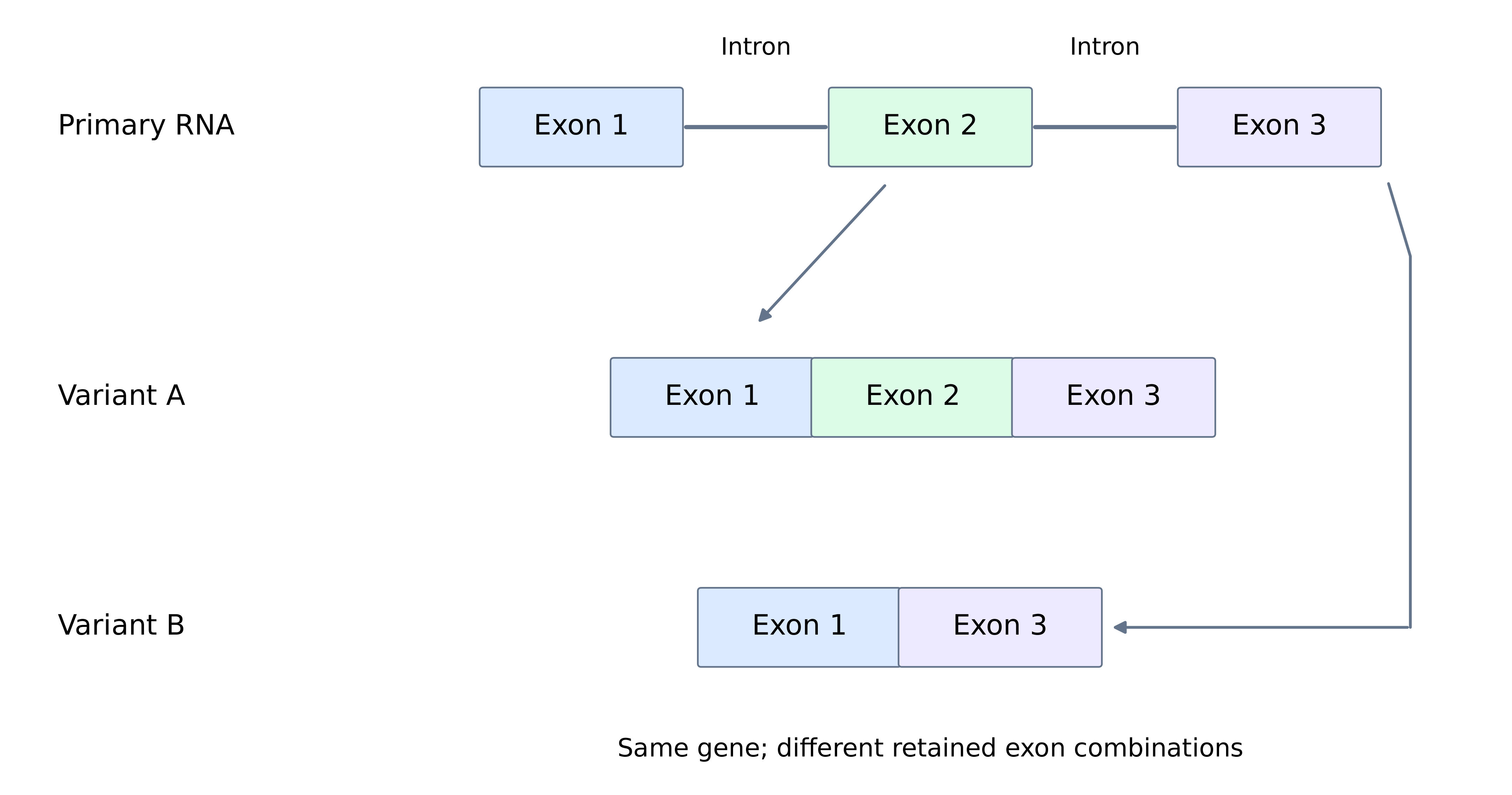
Alternative splicing joins different combinations of exons from the same gene, allowing different polypeptide variants. Exons retain an appropriate order rather than being shuffled at random. Whether an alternative produces a functional product depends on its sequence, reading frame and regulation; do not infer $2^n$ functional proteins merely from counting exons.
This exon-skipping model assumes frame-compatible coding sequences. Exons 1 and 3 are retained in both variants. Introns and the skipped exon are absent from the second mature message; the gene's DNA is unchanged.
In a model, exons have 120, 90 and 180 coding nucleotides and the two introns contain 210 and 150. The primary transcript segment contains $120+90+180+210+150=750$ nucleotides. Retaining all three exons leaves 390 coding nucleotides; skipping the middle exon leaves 300. If each retained sequence begins at the same start, remains in frame and includes one terminal stop, their products contain $390/3-1=129$ and $300/3-1=99$ amino acids. Caps, tails and untranslated sequences are excluded from these stated counts.
30.12
AHL:真核起始确立阅读框与结合位点
English
In the simplified cap-dependent model, the small ribosomal subunit associates with the 5′ end of the mRNA and an initiator tRNA, then scans to an appropriate start codon. The initiator tRNA pairs with that start, establishing the reading frame. The large subunit joins to complete the ribosome, and an incoming tRNA can occupy the next codon position. This is an ordered assembly, not two arbitrary tRNAs choosing any adjacent triplets.
The ribosome has A, P and E tRNA-binding sites. During elongation the A site receives the incoming charged tRNA; the P site holds the tRNA carrying the chain before transfer. Peptide-bond formation transfers the chain onto the A-site amino acid. Movement by one codon shifts that chain-carrying tRNA into P and the uncharged tRNA toward E, from which it exits.
The initiator tRNA is positioned in P at initiation; do not apply “every tRNA first enters A” to it. Two tRNAs can participate simultaneously in chain transfer even though three binding-site names are used to describe the cycle. A stop codon is recognized by termination machinery, not by a tRNA carrying an amino acid called stop.
30.13
AHL:加工使许多多肽具备功能
English
A newly translated chain may need folding, cleavage, chemical modification or assembly with other chains before it functions. Examples of modification include addition of carbohydrate groups or phosphate groups where appropriate. These are regulated processes; not every protein receives every possible modification.
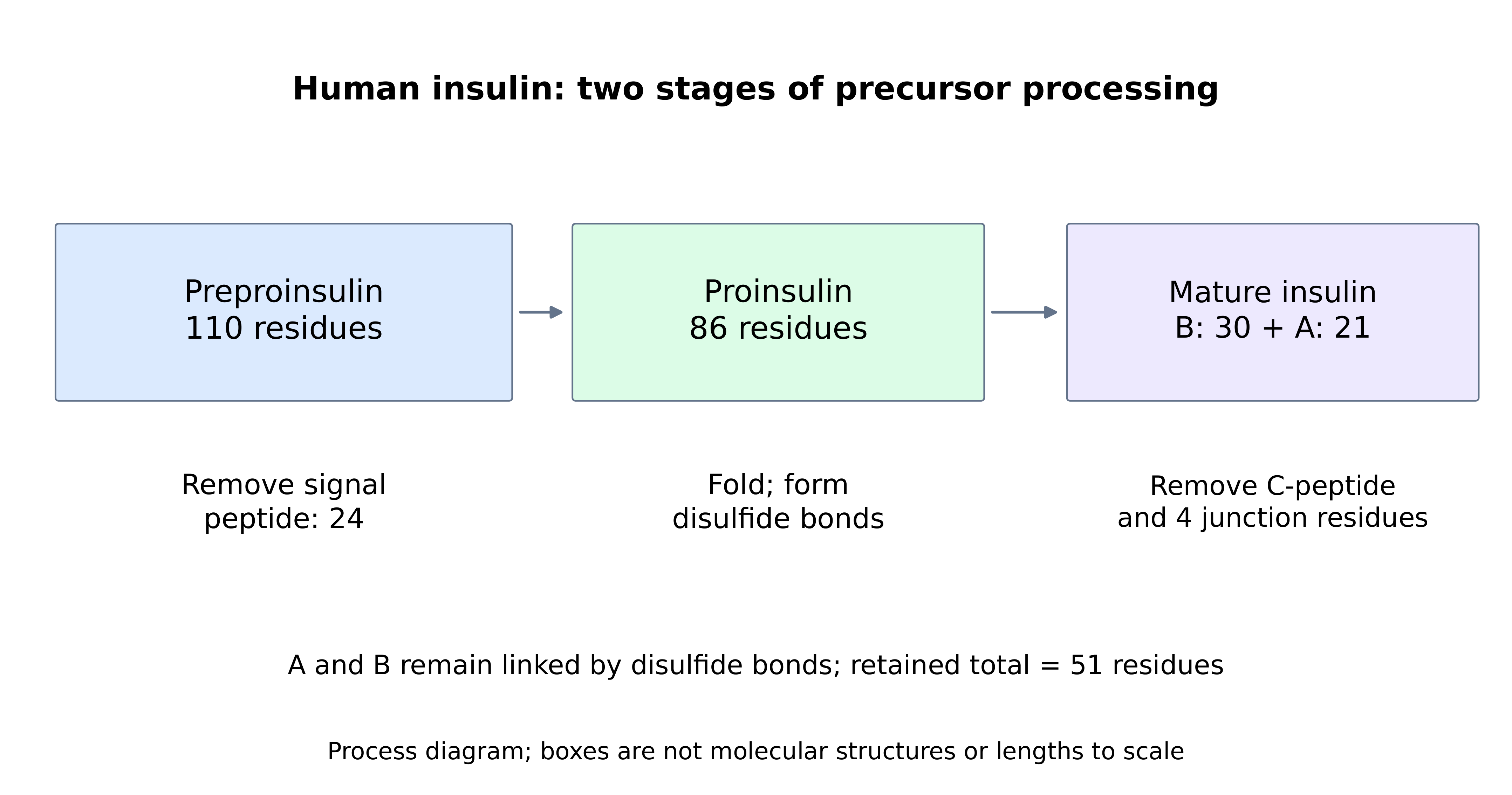
Human insulin illustrates two stages of precursor processing. Preproinsulin includes a signal peptide that directs entry into the secretory pathway. Removal of the signal peptide during entry into the endoplasmic reticulum yields proinsulin. Proinsulin folds and forms disulfide bonds; later processing removes the connecting C-peptide and adjacent basic residues, leaving the A and B chains joined by disulfide bonds.
Human precursor lengths are biological values: 110 residues in preproinsulin, 86 in proinsulin and 51 in mature insulin. The boxes show processing steps, not molecular structures or lengths to scale.
Human preproinsulin has 110 amino-acid residues; removing the 24-residue signal gives proinsulin with 86. Mature insulin retains 30 residues in B and 21 in A, a total of 51. The removed 35 residues comprise the 31-residue C-peptide plus four basic junction residues; calling all 35 “the C-peptide” would be inaccurate. The PDBe structural account describes the precursor and folding stages; the Reactome processing pathway distinguishes protease cleavage and additional residue removal.
RNA splicing and insulin processing therefore operate on different substrates. Splicing changes an RNA transcript's retained sequence. Proteolytic processing cuts a polypeptide precursor. Neither process rewrites the underlying DNA gene into a shorter gene each time a product is made.
30.14
AHL:蛋白酶体支持蛋白质周转及氨基酸回收
English
A functional proteome requires both protein synthesis and protein breakdown. Damaged, misfolded or no-longer-needed proteins can be targeted for degradation. Proteasomes break appropriate proteins into smaller peptides; further breakdown can release amino acids for reuse in new synthesis. Other degradation pathways also exist, so do not assign all cellular protein breakdown exclusively to proteasomes.
Protein turnover: proteasomes recycle amino acids, not the old protein's function
Recycling recovers building blocks, not the original protein's function unchanged. The cell still needs an mRNA sequence, ribosomes and energy to construct new polypeptides in the required order. Proteasomes degrade proteins; they do not splice introns out of RNA or proofread DNA templates.
For a cellular pool, synthesis of 120 protein molecules per hour and degradation of 80 gives a net increase of 40 per hour, assuming no other gains or losses. A constant pool could instead have synthesis and degradation both at 200 per hour. Constant abundance therefore does not demonstrate that its molecules never change.
30.15
练习
English
Distinguish replication, transcription and translation by template, product and role. Explain why a non-dividing somatic cell can still need a stable DNA template and active protein synthesis.
Write the complementary RNA aligned with DNA template T–A–C–C–C–G–A–A–A. Explain the roles of RNA polymerase, hydrogen bonds and covalent bonds, and why the template is reusable.
Two cells have an intact gene but only one has detectable transcript and protein. Explain how transcription can regulate expression and why the observation does not establish gene absence in the other cell.
Explain the separate roles of mRNA, tRNA and the ribosomal subunits. For codons GCU and UUC write aligned anticodons and identify the carried amino acids using the table.
Show why a triplet code has enough combinations for twenty amino acids. Explain degeneracy, near universality and stop signals without claiming that one standard codon can arbitrarily specify several amino acids.
Translate AUG GCC UAC GAG UGA using the table, stating the number of codons and amino acids. Explain why using anticodons in the table would give the wrong interpretation.
A coding region has 156 nucleotides including one terminal stop and no other included sequence. Calculate codons, initial polypeptide length and peptide bonds in that single chain. Explain why a whole gene's length cannot normally be used in the same calculation.
Explain an elongation step from incoming charged tRNA to peptide-bond formation and ribosome movement. For an existing six-residue chain, state the effect of adding one amino acid on residue and peptide-bond counts.
Classify the changes GCU to GCC, UUC to UAC and UAU to UAA. Relate the sickle-cell coding-DNA change GAG to GTG to its RNA codon and amino-acid consequence. Explain why a substitution need not destroy a protein.
Delete base 4 of AUG GCU UUC GGA UAA, regroup from the original start and use the excerpt to interpret the complete codons shown. Explain what additional information is needed to know the full product and why “every later amino acid must change” is too strong.
Compare removal of three consecutive coding bases with removal of one. Explain the effect on frame, why the junction can matter, and why the actual sequence and position are needed before predicting function.
AHL: A template is supplied as $5'\text{-AGC CAT-}3'$. Report the corresponding RNA 5′ to 3′ and its coding DNA in that direction. Explain polymerase and ribosome direction, promoter/transcription-factor roles, and why introns, telomeres and rRNA/tRNA genes are not all useless DNA.
AHL: A primary transcript contains coding exons of 150, 120 and 210 nucleotides and introns of 180 and 240. Calculate the primary length and the coding lengths/products with all exons or with the middle exon skipped. Assume frame compatibility, one terminal stop and no other included sequence. Explain cap/tail roles and A/P/E-site events during initiation and one elongation cycle.
AHL: Human preproinsulin contains 110 residues, its signal peptide 24, and mature insulin B/A chains 30/21. Calculate proinsulin length, total subsequent removal and the residues removed in addition to a 31-residue C-peptide. Distinguish RNA splicing from these steps. Explain how proteasomes support recycling, and calculate pool change if synthesis is 150 and degradation 110 molecules per hour.
30.16
例题答案
English
Replication uses DNA to make DNA copies for genetic continuity; transcription uses DNA to make RNA; translation uses mRNA to specify a polypeptide at ribosomes. A non-dividing cell still maintains DNA instructions and can repeatedly express genes to replace proteins and support its functions without copying the whole genome for division.
A–U–G–G–G–C–U–U–U. Complementary RNA nucleotides pair with DNA bases through hydrogen bonding; RNA polymerase catalyses the new RNA's covalent backbone. DNA is not consumed or normally changed in base sequence by the copying event, so it can be reused.
Different transcription activity can produce different mRNA availability despite a shared gene. Protein amount also depends on later stages. Check DNA directly and consider timing and detection sensitivity; a missing transcript/protein signal does not by itself prove a gene deletion.
mRNA supplies ordered codons. A charged tRNA carries an amino acid and has a matching anticodon; the attachment and anticodon sites differ. The small ribosomal subunit binds/positions mRNA; the large subunit supports peptide bonding. Aligned anticodons are CGA for GCU, carrying Ala, and AAG for UUC, carrying Phe. Two tRNAs can take part together in chain transfer.
Four bases give 4, 16 and 64 combinations for one-, two- and three-base signals respectively. Sixty-four can represent twenty standard amino acids plus stop signals. Degeneracy means several codons can specify the same amino acid; near universality means broad sharing with known exceptions. UAA/UAG/UGA specify termination, not an added amino acid.
Met–Ala–Tyr–Glu, then stop. Five codons specify four residues. The table keys are mRNA codons; a complementary tRNA anticodon is a different sequence, not the sequence to look up as the message.
Codons $=156/3=52$; residues $=52-1=51$; peptide bonds $=51-1=50$ in the stated initial single chain. Whole genes can contain regulatory, untranslated and intron regions; full mRNA also includes untranslated sequence. Later protein processing may change chain length or number.
An incoming charged tRNA pairs with the next codon while another tRNA carries the chain. Peptide bonding transfers the chain to the incoming amino acid; movement by one codon repositions the tRNAs and permits exit/recharging. Six residues with five peptide bonds become seven residues with six peptide bonds. The mRNA is reused, not consumed as amino-acid material.
GCU to GCC is synonymous for Ala; UUC to UAC changes Phe to Tyr; UAU to UAA creates a stop. Sickle-cell coding DNA GTG yields mRNA GUG and Val instead of the Glu specified by GAG. Effects depend on sequence, position, side-chain properties and protein structure; a base substitution may leave the amino-acid sequence unchanged or have varied functional effects.
Deleting G at base 4 gives AUG CUU UCG GAU AA. Complete codons specify Met–Leu–Ser–Asp; AA is incomplete and no full stop is shown. More downstream sequence is needed for the full product. Grouping changes, but degeneracy or chance agreement can preserve some amino acids.
A one-base deletion shifts downstream grouping; three bases preserve the downstream frame. A boundary-crossing deletion can also change the joined codon. Function depends on sequence, position and affected residues; preserving a frame does not guarantee function.
AHL: Pair antiparallel to obtain RNA $3'\text{-UCG GUA-}5'$, then reverse: $5'\text{-AUG GCU-}3'$. Coding DNA is $5'\text{-ATG GCT-}3'$. RNA polymerase reads template 3′ to 5′ and builds RNA 5′ to 3′; a ribosome reads mRNA 5′ to 3′. Promoter-bound factors help regulate initiation. Introns can be transcribed then removed, telomeres protect chromosome ends, and rRNA/tRNA genes provide functional RNAs without polypeptide coding.
AHL: Primary length $=150+120+210+180+240=900$ nucleotides. All exons give 480 coding nucleotides and $480/3-1=159$ residues; skipping exon 2 gives 360 and $360/3-1=119$, forty fewer. Cap and polyA tail support stability/handling and are excluded from these counts. During cap-dependent initiation, the small subunit with initiator tRNA scans to the start; the initiator occupies P, then the large subunit joins. Charged tRNA enters A; peptide bonding transfers the chain from P to A; one-codon movement shifts the chain-carrying tRNA to P and uncharged tRNA toward E for exit.
AHL: Proinsulin $=110-24=86$ residues; mature insulin $=30+21=51$. Subsequent removal $=86-51=35$, including $35-31=4$ basic junction residues as well as C-peptide. Signal removal and later cleavage/folding process a protein precursor; splicing removes/joins RNA regions. Proteasomal breakdown and subsequent peptide breakdown can recover amino acids for new, sequence-directed synthesis. Pool increase $=150-110=40$ molecules per hour under the stated closed balance. Equal synthesis and breakdown could maintain a constant abundance despite continual turnover.
30.17
考试技巧
English
Identify the molecule before using a code table. Pair DNA with RNA correctly and read the message in the stated frame; a stop adds no amino acid.
Give a mechanism: template pairing and polymerase action for transcription; tRNA matching, peptide transfer and one-codon movement for elongation.
Check whether a length includes untranslated sequence or a terminal stop. A shifted frame does not prove that every later amino acid differs.
AHL: Keep strand direction, promoter control, RNA splicing/cap/tail, translation initiation, protein cleavage and proteasomal recycling as distinct steps.