跳到主要内容

任务十二—十五 · Family, learning history, school and work

HSK 2 · 知识点 5

本主题的视频课程 打开视频页面
3:31

HSK 2 · 家庭、学习经历、学校与工作

家庭成员清单。清晰指派人物、时间与活动;将持续时间与日期区分开;并标记当前正在发生的事。“经常”常,“有时候”有时。“正在…”

英文讲解与普通话例句 · 字幕与原声同步

点击任意汉字可查看拼音和释义。
English

Describe your family and explain why people do things. to have / there is有yǒu introduces family members, because因为yīn wèi……so / therefore所以suǒ yǐ…… links a reason and a result, then / just就jiù and only then / not until才cái show that something happened earlier or later than expected, and to / for / give给gěi means to, for or give.

5.1

一目了然

English
  • 1. to have / there is有yǒu / because因为yīn wèi……so / therefore所以suǒ yǐ…… – have / because … so …: I / me我wǒto have / there is有yǒu一个yí gèolder sister姐姐jiě jiě。
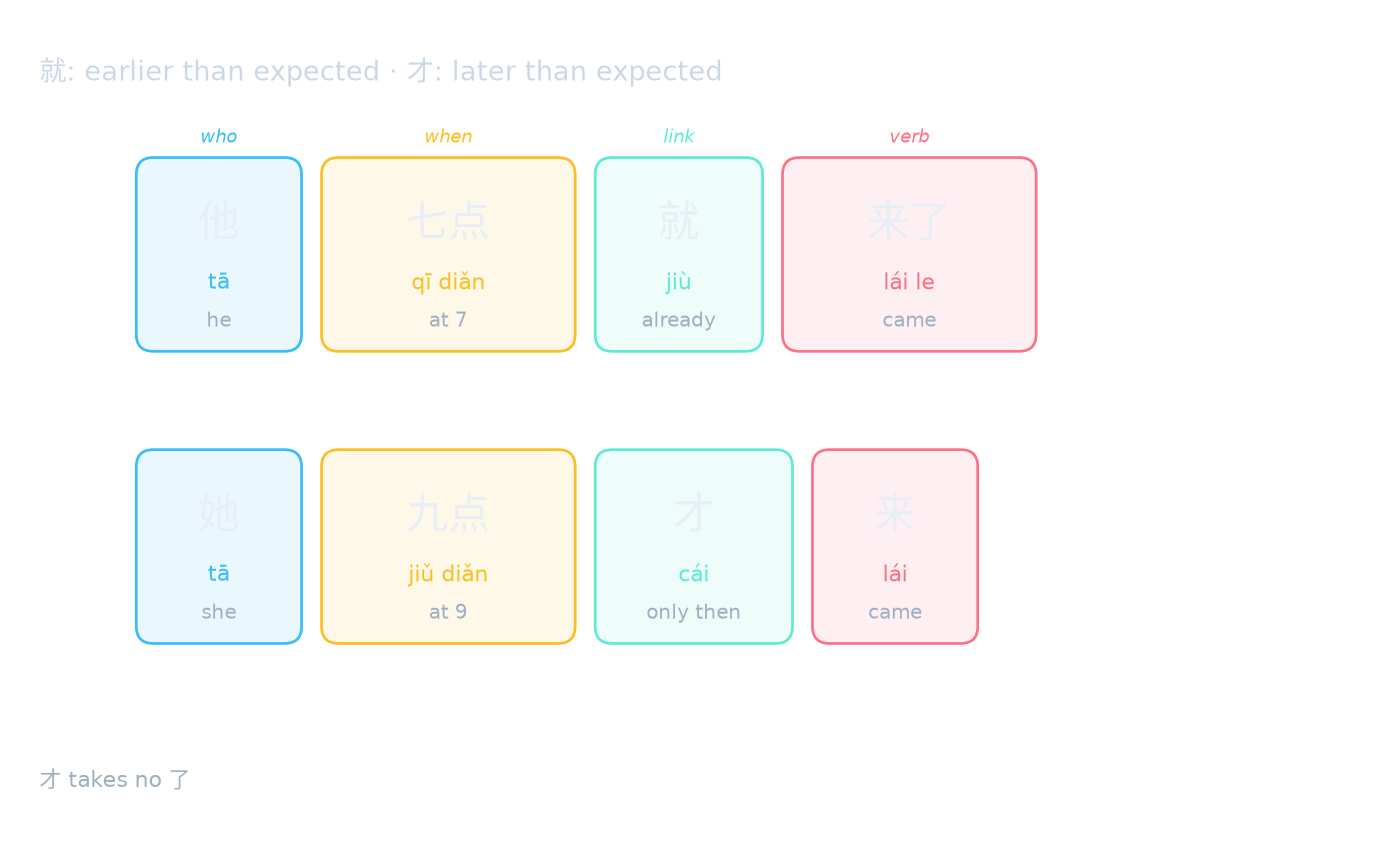
  • 2. then / just就jiù and only then / not until才cái – earlier or later than expected: he / him他tā七点qī diǎnthen / just就jiùto come来lái(completed / change)了le。
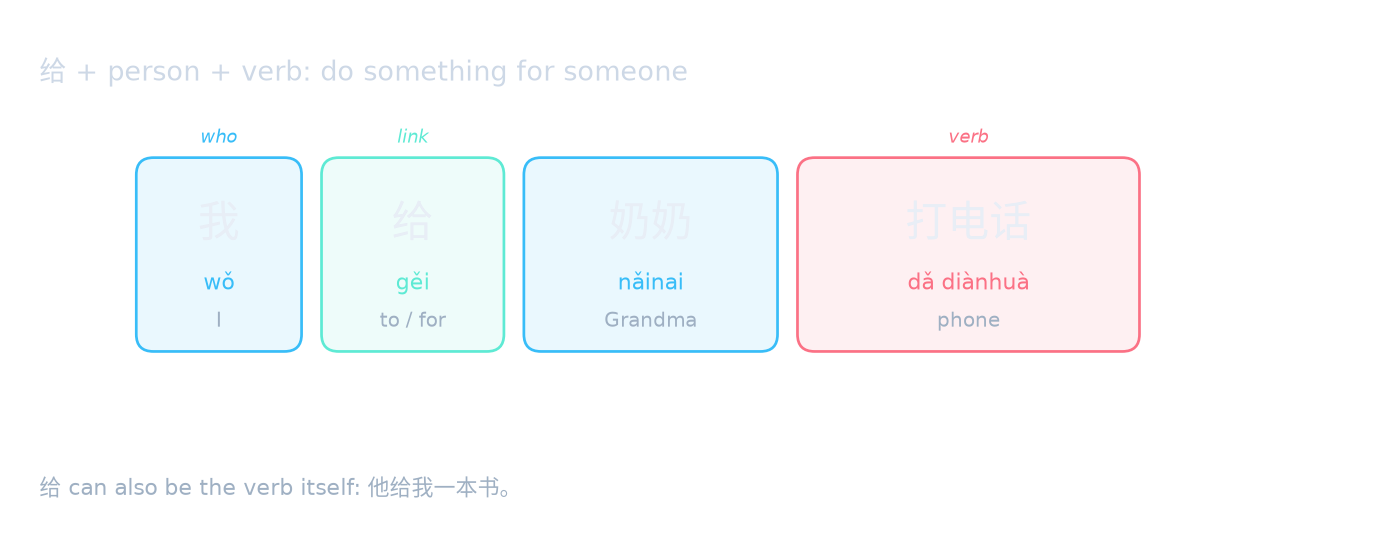
  • 3. to / for / give给gěi – to, for, and give: I / me我wǒto / for / give给gěigrandma奶奶nǎi nǎito make a telephone call打电话dǎ diàn huà,also也yěto / for / give给gěishe / her她tāto buy买mǎi(completed / change)了le一个yí gègift礼物lǐ wù。
5.2

1. 描述一个家庭并解释一种习俗

English

Give basic family information and describe a festival activity.

Key sentences

  • I / me我wǒto have / there is有yǒu一个yí gèolder sister姐姐jiě jiě。 Wǒ yǒu yí ge jiějie. – I have an older sister.
  • Spring Festival (Chinese…春节chūn jié,older sister姐姐jiě jiěto return home回家huí jiā(completed / change)了le。 Chūnjié, jiějie huí jiā le. – At the Spring Festival, my sister came home.
  • because因为yīn wèifamily member家人jiā rénat / in在zàitogether一起yì qǐ,so / therefore所以suǒ yǐeveryone大家dà jiādegree / adjective linker很hěnhappy; glad高兴gāo xìng。 Yīnwèi jiārén zài yìqǐ, suǒyǐ dàjiā hěn gāoxìng. – Because the family is together, everyone is happy.
  • Spring Festival (Chinese…春节chūn jiéyou (plural)你们nǐ menhome / family / (measure: shops)家jiāto do; to make做zuòwhat什么shén me? – What does your family do at the Spring Festival?

How it works

Family. to have / there is有yǒu + number + (measure word)个gè + family word: I / me我wǒto have / there is有yǒu两个liǎng gèyounger brother弟弟dì di. older sister姐姐jiě jiě is an older sister, younger sister妹妹mèi mèi a younger one; older brother哥哥gē gē and younger brother弟弟dì di are older and younger brothers.

because因为yīn wèi……so / therefore所以suǒ yǐ…… links a reason and a result. Chinese often uses both words where English uses only "because" or "so". You may also use just one of them.

Talking about customs. Describe what your family does, then ask: you (plural)你们nǐ menhome / family / (measure: shops)家jiā(and …? / softener)呢ne? Families celebrate in different ways.

Talk about family and a festival

Watch out

  • because因为yīn wèi introduces the reason; so / therefore所以suǒ yǐ introduces the result. Do not swap them.

Words in context

  • older sister姐姐jiě jiě jiějie – older sister. I / me我wǒto have / there is有yǒu一个yí gèolder sister姐姐jiě jiě。
  • family member家人jiā rén jiārén – family members. I / me我wǒand / with和héfamily member家人jiā rénto have a meal吃饭chī fàn。
  • Spring Festival (Chinese…春节chūn jié Chūnjié – Spring Festival. Spring Festival (Chinese…春节chūn jiéwe / us我们wǒ mento be at home在家zài jiā。
  • because因为yīn wèi yīnwèi – because. because因为yīn wèiolder sister姐姐jiě jiěto return home回家huí jiā(completed / change)了le。
  • so / therefore所以suǒ yǐ suǒyǐ – so / therefore. so / therefore所以suǒ yǐwe / us我们wǒ mentogether一起yì qǐto have a meal吃饭chī fàn。

Reading

Spring Festival (Chinese…春节chūn jié,林安lín ān(modifier / structural particle)的deolder sister姐姐jiě jiěto return home回家huí jiā(completed / change)了le。because因为yīn wèifamily member家人jiā rénat / in在zàitogether一起yì qǐ,so / therefore所以suǒ yǐeveryone大家dà jiādegree / adjective linker很hěnhappy; glad高兴gāo xìng。evening晚上wǎn shàngthey他们tā men吃饺子chī jiǎo zi。

Speaking

Describe one fictional family activity during a festival. Ask what another family does, without assuming the same custom.

词汇 训练
汉字 拼音 English
姐姐 jiě jie older sister
因为 yīn wèi because
一起 yī qǐ together
所以 suǒ yǐ therefore
大家 dà jiā everyone
弟弟 dì di younger brother
妹妹 mèi mei younger sister
哥哥 gē ge older brother
晚上 wǎn shang evening
5.3

2. 就和才——比预期早或晚

English

Form: time + then / just就jiù + verb + (completed / change)了le · time + only then / not until才cái + verb

  • he / him他tā七点qī diǎnthen / just就jiùto come来lái(completed / change)了le。 Tā qī diǎn jiù lái le. – He came as early as seven.
  • she / her她tā九点jiǔ diǎnonly then / not until才cáito come来lái。 Tā jiǔ diǎn cái lái. – She didn't come until nine.
  • 我学wǒ xué(completed / change)了le一个月yí gè yuèthen / just就jiùcan / will会huìto speak说shuō(completed / change)了le。 – After only a month I could speak.
  • 我学wǒ xué(completed / change)了le一年yī niánonly then / not until才cáican / will会huìto speak说shuō。 – It took me a whole year before I could speak.

How it works. Both words go after the time and before the verb, and both show the speaker's view of the time.

then / just就jiù jiù only then / not until才cái cái
earlier or faster than expected later or slower than expected
usually ends with (completed / change)了le no (completed / change)了le
七点qī diǎnthen / just就jiùto come来lái(completed / change)了le 九点jiǔ diǎnonly then / not until才cáito come来lái

Watch out

  • wrong: she / her她tā九点jiǔ diǎnonly then / not until才cáito come来lái(completed / change)了le → she / her她tā九点jiǔ diǎnonly then / not until才cáito come来lái.
  • wrong: then / just就jiù七点qī diǎnto come来lái(completed / change)了le → 七点qī diǎnthen / just就jiùto come来lái(completed / change)了le: the time comes first.
就: earlier than expected · 才: later than expected
词汇 训练
汉字 拼音 English
就 jiù then
5.4

3. 给——表示对象、受益者和给予

English

Form: to / for / give给gěi + person + verb · A + to / for / give给gěi + person + thing

  • I / me我wǒto / for / give给gěigrandma奶奶nǎi nǎito make a telephone call打电话dǎ diàn huà。 Wǒ gěi nǎinai dǎ diànhuà. – I phone Grandma.
  • mum; mother妈妈mā māto / for / give给gěiI / me我wǒto prepare a meal做饭zuò fàn。 Māma gěi wǒ zuò fàn. – Mum cooks for me.
  • he / him他tāto / for / give给gěiI / me我wǒone / a一yī本书běn shū。 Tā gěi wǒ yì běn shū. – He gives me a book.
  • you你nǐto / for / give给gěiwho谁shéito buy买mǎi(modifier / structural particle)的de? Nǐ gěi shéi mǎi de? – Who did you buy it for?

How it works. to / for / give给gěi gěi has two jobs.

  • As a verb it means "give": to / for / give给gěi + person + thing (he / him他tāto / for / give给gěiI / me我wǒone / a一yī本书běn shū).
  • Before another verb, to / for / give给gěi + person shows who receives the action or benefits from it: to / for / give给gěigrandma奶奶nǎi nǎito make a telephone call打电话dǎ diàn huà (phone Grandma), to / for / give给gěiI / me我wǒto write a letter写信xiě xìn (write to me), to / for / give给gěiI / me我wǒto prepare a meal做饭zuò fàn (cook for me). The to / for / give给gěi phrase comes before the main verb, unlike English "to Grandma".

Negatives and wishes. not不bù, not / haven't没méi, want / think / miss想xiǎng and want / will / need要yào go before to / for / give给gěi: I / me我wǒnot / haven't没méito / for / give给gěihe / him他tāto write a letter写信xiě xìn, I / me我wǒwant / think / miss想xiǎngto / for / give给gěishe / her她tā买花mǎi huā.

Watch out

  • wrong: to make a telephone call打电话dǎ diàn huàgrandma奶奶nǎi nǎi → to / for / give给gěigrandma奶奶nǎi nǎito make a telephone call打电话dǎ diàn huà.
  • wrong: I / me我wǒto / for / give给gěihe / him他tānot / haven't没méito write a letter写信xiě xìn → I / me我wǒnot / haven't没méito / for / give给gěihe / him他tāto write a letter写信xiě xìn.
给 + person + verb: do something for someone
词汇 训练
汉字 拼音 English
给 gěi to give
要 yào to want; will; need
5.5

练习

English

Cover the teaching pages before you answer. The answers are at the end.

1. Describe a family and explain a custom

1. Listening. A partner reads the script for this question from the answers aloud. Why does the family call the sister?

  • A. She is not at home
  • B. She cooked dumplings
  • C. She is a teacher

2. Reading. What causes the family’s happiness in the reading?

  • A. They buy a phone
  • B. They are together
  • C. The school opens

3. Complete the result marker: because因为yīn wèifamily member家人jiā rénat / in在zàitogether一起yì qǐ,…………everyone大家dà jiādegree / adjective linker很hěnhappy; glad高兴gāo xìng。

4. Match each word with its meaning in this unit.

  • (1) older sister姐姐jiě jiě

  • (2) family member家人jiā rén

  • (3) Spring Festival (Chinese…春节chūn jié

  • (4) because因为yīn wèi

  • (5) so / therefore所以suǒ yǐ

  • A. family members

  • B. Spring Festival

  • C. so / therefore

  • D. older sister

  • E. because

5. Write a family activity and one reason-result sentence. Write your answer in Chinese, then say it aloud.

6. I / me我wǒto have / there is有yǒu一个yí gèolder sister姐姐jiě jiě。一个yí gè means one and older sister姐姐jiě jiě means older sister. Which information is supplied?

  • A. Every family has an older sister.
  • B. The sister will return tomorrow.
  • C. The speaker has one older sister.

7. because因为yīn wèiolder brother哥哥gē gētomorrow明天míng tiānwant / will / need要yàoto go to work上班shàng bān,so / therefore所以suǒ yǐtoday今天jīn tiānto return home回家huí jiā。older brother哥哥gē gē means older brother, tomorrow明天míng tiānwant / will / need要yàoto go to work上班shàng bān must go to work tomorrow, and today今天jīn tiānto return home回家huí jiā goes home today. First locate because因为yīn wèi, the reason marker. Why does he go home today?

  • A. Because everyone always returns home on this date
  • B. Because the account says he dislikes the family
  • C. Because he must work tomorrow

8. Read: 林安有lín ān yǒu两个liǎng gèyounger brother弟弟dì di。今年春节jīn nián chūn jié,一个yí gèyounger brother弟弟dì dito return home回家huí jiā,other另lìng一个yí gèat / in在zàischool学校xué xiào。evening晚上wǎn shàngfamily member家人jiā réntogether一起yì qǐto eat吃chīcooked rice米饭mǐ fàn。younger brother弟弟dì di means younger brother and other另lìng一个yí gè the other. Which account fits this family?

  • A. One brother returns, the other is at school; the family eats rice.
  • B. Both brothers return home; the family eats rice together that evening.
  • C. One brother returns, the other is at school; the family eats dumplings.

9. Invent a fictional family gathering. Give a relationship and quantity, describe one activity, and explain one choice with because因为yīn wèi…so / therefore所以suǒ yǐ…. Ask a partner a question about that family. State why the account does not establish a custom for everyone. Write your answer in Chinese, then say it aloud.

2. then / just就jiù and only then / not until才cái – earlier or later than expected

10. Class starts at 8. “She didn’t come until nine.” she / her她tā九点jiǔ diǎn…………to come来lái。

11. Class starts at 8 and he arrives at 7. Which fits?

  • A. he / him他tāthen / just就jiù七点qī diǎnto come来lái(completed / change)了le。
  • B. he / him他tā七点qī diǎnonly then / not until才cáito come来lái(completed / change)了le。
  • C. he / him他tā七点qī diǎnthen / just就jiùto come来lái(completed / change)了le。

12. True or false? 我学wǒ xué(completed / change)了le一年yī niánonly then / not until才cáican / will会huìto speak说shuō suggests that learning to speak took a long time. If false, correct it.

13. Build: “After only a month of study I could speak.”

Put in order: then / just就jiùcan / will会huìto speak说shuō / 学了xué le一个月yí gè yuè / I / me我wǒ / (completed / change)了le。

14. Tell a friend about this morning. Say one thing that happened earlier than usual and one thing that happened later than you expected. Use then / just就jiù and only then / not until才cái. Write your answer in Chinese, then say it aloud.

3. to / for / give给gěi – to, for, and give

15. Complete: “I phone Grandma.” I / me我wǒ…………grandma奶奶nǎi nǎito make a telephone call打电话dǎ diàn huà。

16. Which says “I didn’t write to him”?

  • A. I / me我wǒto / for / give给gěihe / him他tānot / haven't没méito write a letter写信xiě xìn。
  • B. I / me我wǒto / for / give给gěinot / haven't没méihe / him他tāto write a letter写信xiě xìn。
  • C. I / me我wǒnot / haven't没méito / for / give给gěihe / him他tāto write a letter写信xiě xìn。

17. True or false? he / him他tāto / for / give给gěiI / me我wǒone / a一yī本书běn shū can mean “He gives me a book.” If false, correct it.

18. Build: “Who did you buy it for?”

Put in order: to / for / give给gěiwho谁shéi / to buy买mǎi / (modifier / structural particle)的de? / you你nǐ

19. Tell a friend what you did for your family last weekend and one thing you want to do for a friend. Use to / for / give给gěi. Write your answer in Chinese, then say it aloud.

5.6

混合练习

English

These questions mix the patterns and use new situations.

20. Choose then / just就jiù or only then / not until才cái: The lesson starts at eight. he / him他tā七点qī diǎn…………to come来lái(completed / change)了le。 / he / him他tā九点jiǔ diǎn…………to come来lái。

21. Say "I phoned Grandma" with to / for / give给gěi.

22. Link reason and result: it is the Spring Festival / my sister came home.

23. Find and fix the problem. A classmate reads because因为yīn wèiSpring Festival (Chinese…春节chūn jié,family member家人jiā rénto return回来huí lái(completed / change)了le as proof that every family in China does exactly the same thing. What is the sentence really about?

24. Use it yourself. Describe what a family does at the Spring Festival, then ask a partner about their family.

5.7

答案与解析

English

Mark your work, then correct each mistake in your own words.

1. Describe a family and explain a custom

1. Script: Spring Festival (Chinese…春节chūn jiéI / me我wǒand / with和héfamily member家人jiā rénto eat吃chīcooked rice米饭mǐ fàn。older sister姐姐jiě jiěnot不bùto be at home在家zài jiā,so / therefore所以suǒ yǐwe / us我们wǒ mento / for / give给gěishe / her她tāto make a telephone call打电话dǎ diàn huà。

A. She is not at home

not不bùto be at home在家zài jiā is given as the reason for calling.

2. B. They are together

because因为yīn wèifamily member家人jiā rénat / in在zàitogether一起yì qǐ states the cause.

3. so / therefore所以suǒ yǐ

so / therefore所以suǒ yǐ introduces the consequence.

4. (1) D: older sister姐姐jiě jiě = older sister; (2) A: family member家人jiā rén = family members; (3) B: Spring Festival (Chinese…春节chūn jié = Spring Festival; (4) E: because因为yīn wèi = because; (5) C: so / therefore所以suǒ yǐ = so / therefore

Use the example sentences to check each word’s meaning in context.

5. Model answer: older sister姐姐jiě jiěto return home回家huí jiā(completed / change)了le。because因为yīn wèifamily member家人jiā rénat / in在zàitogether一起yì qǐ,so / therefore所以suǒ yǐwe / us我们wǒ mendegree / adjective linker很hěnhappy; glad高兴gāo xìng。

Check your answer:

  • Name the people or relationship.
  • Give a specific activity.
  • Keep the reason and result in the intended direction.

6. C. The speaker has one older sister.

The sentence gives one relationship and quantity for this speaker. It supplies neither a rule for other families nor a return plan.

7. C. Because he must work tomorrow

tomorrow明天míng tiānwant / will / need要yàoto go to work上班shàng bān is the reason after because因为yīn wèi. No universal custom or dislike is stated. Today and tomorrow belong to different parts of the explanation.

8. A. One brother returns, the other is at school; the family eats rice.

The text separates one brother returning home from the other being at school, and names cooked rice米饭mǐ fàn, rice, for the meal. The first choice moves both brothers home; the second changes the food. No rule about other families is established.

9. Model answer: Possible account: I / me我wǒto have / there is有yǒu一个yí gèolder sister姐姐jiě jiě。because因为yīn wèiolder sister姐姐jiě jiětomorrow明天míng tiānwant / will / need要yàoto go to work上班shàng bān,so / therefore所以suǒ yǐwe / us我们wǒ mentoday今天jīn tiāntogether一起yì qǐto have a meal吃饭chī fàn。Question: you (plural)你们nǐ menwhy?为什么wèi shén metoday今天jīn tiāntogether一起yì qǐto have a meal吃饭chī fàn?Reply: because因为yīn wèiolder sister姐姐jiě jiětomorrow明天míng tiānwant / will / need要yàoto go to work上班shàng bān。This family chooses today because of the work schedule; other families may choose differently.

How to revise: If the reason merely repeats the choice, supply the circumstance that explains it. If you wrote everyone does this, narrow the account to the people whose practice you actually described.

Check your answer:

  • Keep the named family relationship and quantity consistent.
  • Give a specific activity for this fictional family.
  • Make the reason explain the stated choice.
  • Avoid turning one household’s practice into a universal cultural rule.

If the reason merely repeats the choice, supply the circumstance that explains it. If you wrote everyone does this, narrow the account to the people whose practice you actually described.

2. then / just就jiù and only then / not until才cái – earlier or later than expected

10. only then / not until才cái

only then / not until才cái marks a later-than-expected time and takes no (completed / change)了le.

11. C. he / him他tā七点qī diǎnthen / just就jiùto come来lái(completed / change)了le。

Earlier than expected uses then / just就jiù after the time, with (completed / change)了le at the end.

12. True.

True. only then / not until才cái marks that it took longer than expected.

13. 我学wǒ xué(completed / change)了le一个月yí gè yuèthen / just就jiùcan / will会huìto speak说shuō(completed / change)了le。

Time + then / just就jiù + verb + (completed / change)了le shows it happened quickly.

14. Model answer: I / me我wǒtoday今天jīn tiān六点liù diǎnthen / just就jiùto get up起床qǐ chuáng(completed / change)了le。bus公共汽车gōng gòng qì chē八点bā diǎnonly then / not until才cáito come来lái。

Check your answer:

  • My early event uses time + then / just就jiù + verb + (completed / change)了le.
  • My late event uses time + only then / not until才cái + verb, without (completed / change)了le.
  • then / just就jiù and only then / not until才cái come after the time and before the verb.
  • I tried another version with a length of time (学了xué le一年yī niánonly then / not until才cáican / will会huì).

3. to / for / give给gěi – to, for, and give

15. to / for / give给gěi

to / for / give给gěi + person comes before the verb to show who receives the call.

16. C. I / me我wǒnot / haven't没méito / for / give给gěihe / him他tāto write a letter写信xiě xìn。

The negative not / haven't没méi goes before to / for / give给gěi, not before the main verb.

17. True.

True. On its own, to / for / give给gěi is the verb “give”, followed by the person and then the thing.

18. you你nǐto / for / give给gěiwho谁shéito buy买mǎi(modifier / structural particle)的de?

to / for / give给gěi + who谁shéi comes before the verb to ask who benefits.

19. Model answer: up / on / last; to get on, attend上shàng(measure word)个gèweekend周末zhōu mòI / me我wǒto / for / give给gěimum; mother妈妈mā māto prepare a meal做饭zuò fàn(completed / change)了le,also也yěto / for / give给gěifather爸爸bà bàto make a telephone call打电话dǎ diàn huà(completed / change)了le。I / me我wǒwant / think / miss想xiǎngto / for / give给gěifriend朋友péng yǒuto buy买mǎione / a一yī本书běn shū。

Check your answer:

  • to / for / give给gěi + person comes before each main verb (to / for / give给gěimum; mother妈妈mā māto prepare a meal做饭zuò fàn).
  • want / think / miss想xiǎng, want / will / need要yào, not不bù or not / haven't没méi come before to / for / give给gěi.
  • I used to / for / give给gěi for the person who receives or benefits.
  • I tried another version using to / for / give给gěi as the verb “give”.

Scripts and models for section 1

Listening script. Spring Festival (Chinese…春节chūn jiéI / me我wǒand / with和héfamily member家人jiā rénto eat吃chīcooked rice米饭mǐ fàn。older sister姐姐jiě jiěnot不bùto be at home在家zài jiā,so / therefore所以suǒ yǐwe / us我们wǒ mento / for / give给gěishe / her她tāto make a telephone call打电话dǎ diàn huà。 – At Spring Festival I eat rice with my family. My sister is not at home, so we call her.

Reading in English. At Spring Festival, Lin An’s older sister comes home. Everyone is happy because the family is together. In the evening they eat dumplings.

Speaking model. A: Spring Festival (Chinese…春节chūn jiéyou (plural)你们nǐ mento do; to make做zuòwhat什么shén me? B: we / us我们wǒ mentogether一起yì qǐto have a meal吃饭chī fàn。you (plural)你们nǐ men(and …? / softener)呢ne?

Mixed practice

20. he / him他tā七点qī diǎnthen / just就jiùto come来lái(completed / change)了le (early)。he / him他tā九点jiǔ diǎnonly then / not until才cáito come来lái (late). then / just就jiù shows earlier than expected; only then / not until才cái shows later.

21. I / me我wǒto / for / give给gěigrandma奶奶nǎi nǎito make a telephone call打电话dǎ diàn huà。to / for / give给gěi + person comes before the verb when you do something to or for them.

22. because因为yīn wèito be / is是shìSpring Festival (Chinese…春节chūn jié,so / therefore所以suǒ yǐolder sister姐姐jiě jiěto return home回家huí jiā(completed / change)了le。

23. It gives the reason why this family came home: it is the Spring Festival. It says nothing about every family.

24. Model answer. we / us我们wǒ menhome / family / (measure: shops)家jiāto celebrate the Chinese…过年guò nián(modifier / structural particle)的detime; when时候shí hòutogether一起yì qǐto have a meal吃饭chī fàn。you (plural)你们nǐ menhome / family / (measure: shops)家jiā(and …? / softener)呢ne?(and …? / softener)呢ne asks the same question back.

Review later. Tomorrow, describe one family custom and ask a partner about theirs.

该知识点的互动课程

逐步完成,配合即时检查练习。

更多 HSK 2 知识点

登录或创建账户

IGCSE, A-Level & AP