跳到主要内容

任务七、十、十一 · Meals, leisure, experience and advice

HSK 2 · 知识点 4

本主题的视频课程 打开视频页面
3:19

HSK 2 · 饮食、休闲、经历与建议

经历、结果与方式。“过”表曾经;结果补语表成功完成;“得”表程度良好。三个动词对应三种不同语义。一项活动及其…

英文讲解与普通话例句 · 字幕与原声同步

点击任意汉字可查看拼音和释义。
English

Talk about experiences and actions. (experienced)过guo says you have done something before; in the middle of正在zhèng zài says you are doing it now; want / will / need要yào……(completed / change)了le says it is about to happen. measure word for times次cì counts how many times, (degree marker)得de comments on how well something is done, and one side一边yī biān……one side一边yī biān…… describes two actions at the same time.

4.1

一目了然

English
  • 1. verb + (experienced)过guo / in the middle of正在zhèng zài + verb – have done before / doing now: Wang Li (a name)王力wáng lìlast year去年qù nián去过qù guòShanghai municipality…上海shàng hǎi。
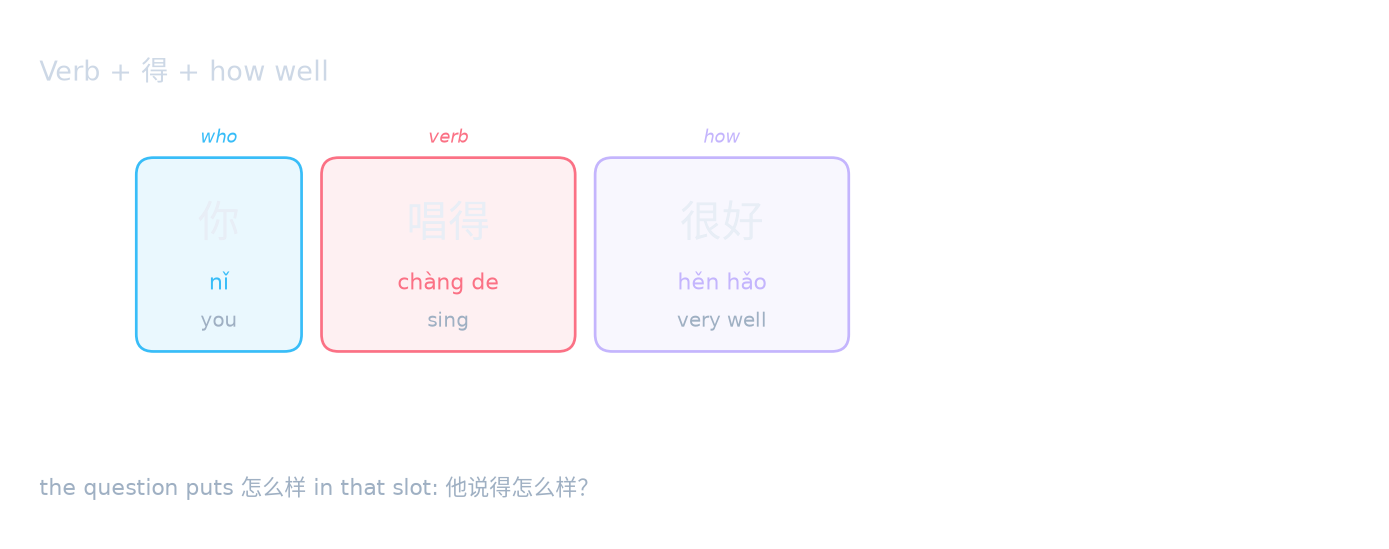
  • 2. (degree marker)得de – saying how well something is done: you你nǐto sing唱chàng(degree marker)得dedegree / adjective linker很hěngood好hǎo!
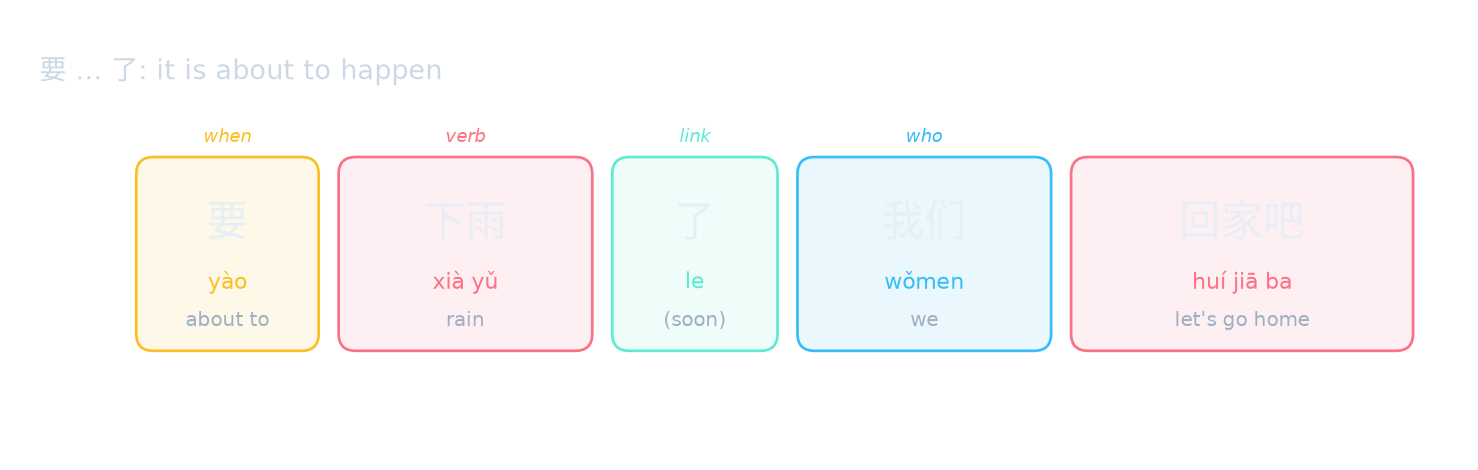
  • 3. want / will / need要yào……(completed / change)了le – about to happen: want / will / need要yàoto rain下雨xià yǔ(completed / change)了le,we / us我们wǒ men回家吧huí jiā ba。
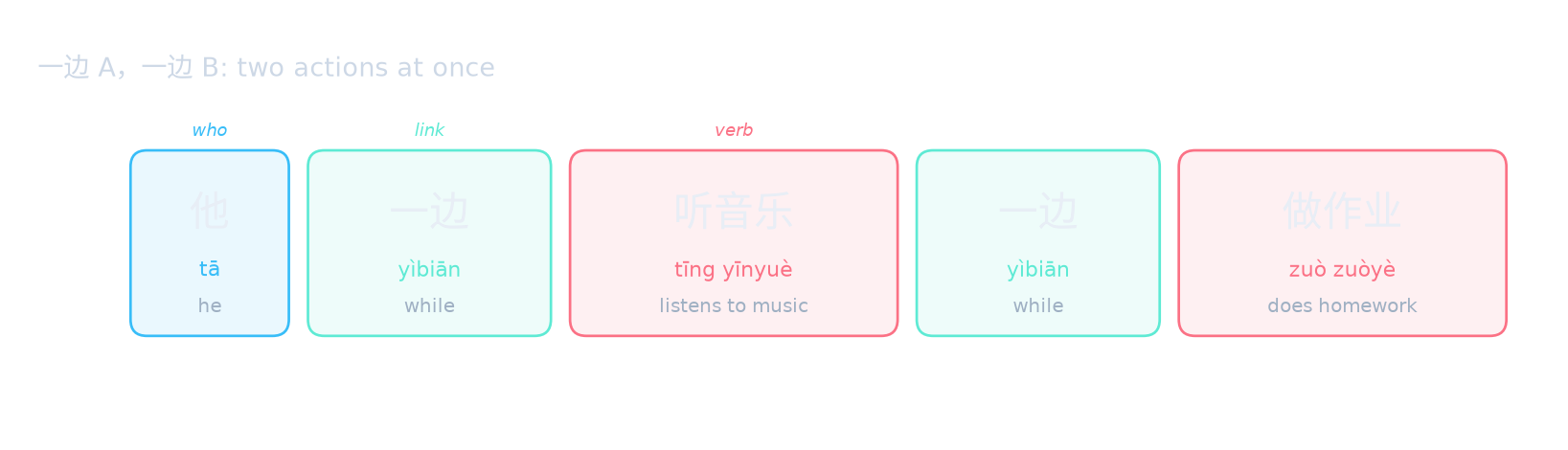
  • 4. one side一边yī biān……one side一边yī biān…… – doing two things at once: he / him他tāone side一边yī biānto listen to听tīngmusic音乐yīn yuè,one side一边yī biān做作业zuò zuò yè。
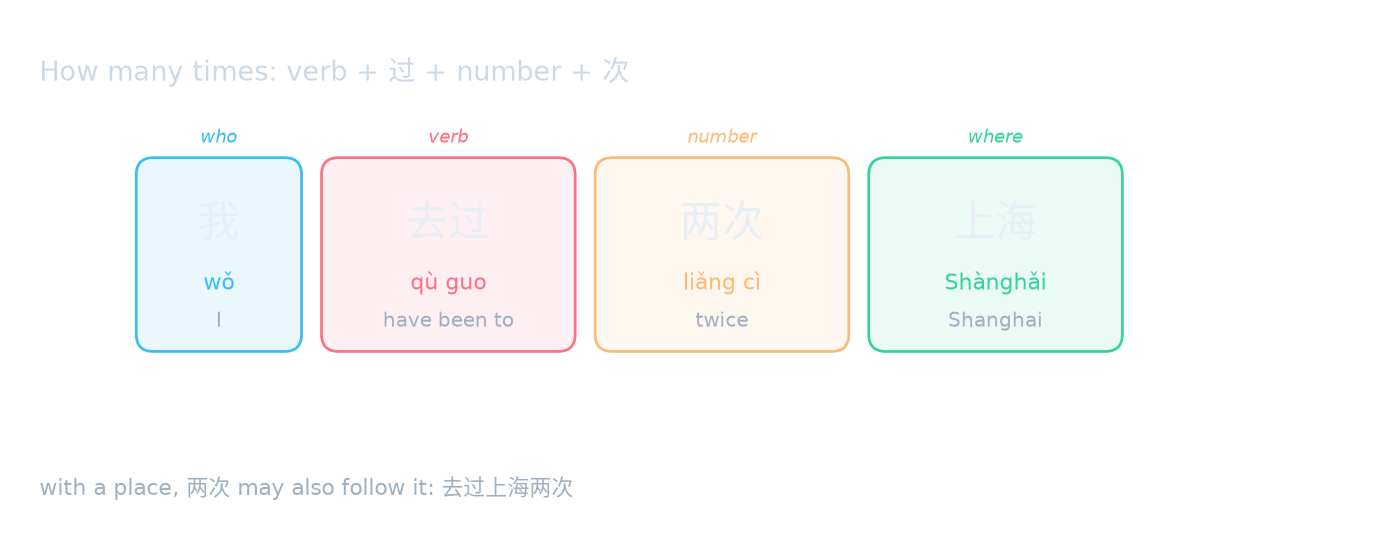
  • 5. measure word for times次cì – counting how many times: I / me我wǒ去过qù guòtwice两次liǎng cìShanghai municipality…上海shàng hǎi。
4.2

1. 谈论一次经历和正在进行的动作

English

Distinguish having done something before from doing it now.

Key sentences

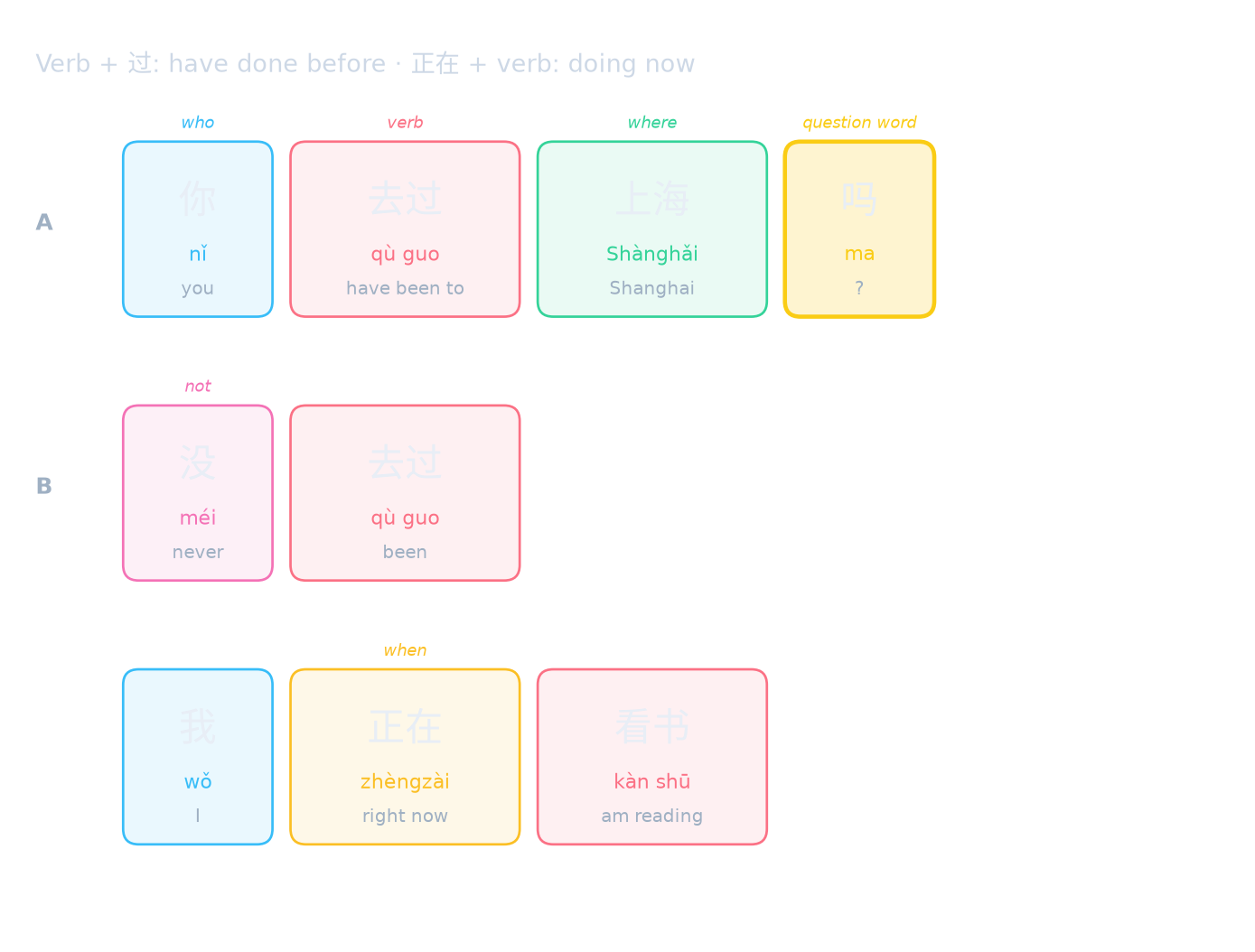
  • you你nǐ去过qù guòShanghai municipality…上海shàng hǎi(yes/no ?)吗ma? Nǐ qù guo Shànghǎi ma? – Have you ever been to Shanghai?
  • I / me我wǒlast year去年qù nián去过qù guò。 Wǒ qùnián qù guo. – I went there last year.
  • I / me我wǒnot / haven't没méi去过qù guòShanghai municipality…上海shàng hǎi。 Wǒ méi qù guo Shànghǎi. – I've never been to Shanghai.
  • you你nǐat / in在zàito do; to make做zuòwhat什么shén me?——I / me我wǒin the middle of正在zhèng zàito read看书kàn shū。 Wǒ zhèngzài kàn shū. – What are you doing? – I'm reading.

How it works

Verb + (experienced)过guo tells about an experience: something you have done at least once. The negative is not / haven't没méi + verb + (experienced)过guo: not / haven't没méi去过qù guò (have never been).

in the middle of正在zhèng zài + verb describes an action in progress right now: I / me我wǒin the middle of正在zhèng zàito study; to learn学习xué xí.

I / me我wǒ去过qù guòShanghai municipality…上海shàng hǎi I / me我wǒin the middle of正在zhèng zàito go去qùShanghai municipality…上海shàng hǎi
experience: I have been there in progress: I'm on my way now
Verb + 过: have done before · 正在 + verb: doing now

Watch out

  • wrong: I / me我wǒnot不bù去过qù guò → I / me我wǒnot / haven't没méi去过qù guò.
  • (experienced)过guo is about experience, so it often goes with before以前yǐ qián or last year去年qù nián, not with now现在xiàn zài.

Words in context

  • (experienced)过guo guo – experience marker. I / me我wǒ去过qù guòShanghai municipality…上海shàng hǎi。
  • in the middle of正在zhèng zài zhèngzài – in the process of. I / me我wǒin the middle of正在zhèng zàito study; to learn学习xué xí。
  • last year去年qù nián qùnián – last year. I / me我wǒlast year去年qù nián去过qù guòShanghai municipality…上海shàng hǎi。
  • to study; to learn学习xué xí xuéxí – study. I / me我wǒin the middle of正在zhèng zàito study; to learn学习xué xíChinese language中文zhōng wén。
  • before以前yǐ qián yǐqián – before. I / me我wǒbefore以前yǐ qián去过qù guò。

Reading

Wang Li (a name)王力wáng lìlast year去年qù nián去过qù guòShanghai municipality…上海shàng hǎi。林安lín ānnot / haven't没méi去过qù guòShanghai municipality…上海shàng hǎi。today今天jīn tiānWang Li (a name)王力wáng lìin the middle of正在zhèng zàito study; to learn学习xué xíChinese language中文zhōng wén,林安lín ānin the middle of正在zhèng zàito read看书kàn shū。

Speaking

Ask whether a partner has been to a city, then ask what they are doing now.

词汇 训练
汉字 拼音 English
去年 qù nián last year
正在 zhèng zài in the process of
4.3

2. 得——描述事情做得怎么样

English

Form: verb + (degree marker)得de + comment · (verb +) object + verb + (degree marker)得de + comment

  • you你nǐto sing唱chàng(degree marker)得dedegree / adjective linker很hěngood好hǎo! Nǐ chàng de hěn hǎo! – You sang really well!
  • he / him他tāto run跑pǎo(degree marker)得de很快hěn kuài。 Tā pǎo de hěn kuài. – He runs fast.
  • she / her她tāto speak说shuōChinese language汉语hàn yǔto speak说shuō(degree marker)得dedegree / adjective linker很hěngood好hǎo。 / she / her她tāChinese language汉语hàn yǔto speak说shuō(degree marker)得dedegree / adjective linker很hěngood好hǎo。 – She speaks Chinese very well.
  • I / me我wǒto write写xiě(degree marker)得deno good不好bù hǎo。 Wǒ xiě de bù hǎo. – I don't write well.

How it works. (degree marker)得de de links an action to a comment on how it is done. The comment is usually degree / adjective linker很hěn + adjective. Ask with how about怎么样zěn me yàng: he / him他tāto speak说shuō(degree marker)得dehow about怎么样zěn me yàng? – he / him他tāto speak说shuō(degree marker)得dedegree / adjective linker很hěngood好hǎo。

With an object. The object cannot go between the verb and (degree marker)得de. Either say the verb twice (to speak说shuōChinese language汉语hàn yǔto speak说shuō(degree marker)得dedegree / adjective linker很hěngood好hǎo) or put the object first (Chinese language汉语hàn yǔto speak说shuō(degree marker)得dedegree / adjective linker很hěngood好hǎo).

The negative. not不bù goes after (degree marker)得de, before the adjective: 写得xiě déno good不好bù hǎo.

Watch out

  • wrong: she / her她tāto speak说shuō(degree marker)得deChinese language汉语hàn yǔdegree / adjective linker很hěngood好hǎo → she / her她tāChinese language汉语hàn yǔto speak说shuō(degree marker)得dedegree / adjective linker很hěngood好hǎo.
  • wrong: he / him他tā很快hěn kuàito run跑pǎo → he / him他tāto run跑pǎo(degree marker)得de很快hěn kuài: the comment comes after (degree marker)得de.
  • wrong: I / me我wǒnot不bùto write写xiě(degree marker)得degood好hǎo → I / me我wǒto write写xiě(degree marker)得deno good不好bù hǎo.
Verb + 得 + how well
词汇 训练
汉字 拼音 English
得 de degree complement particle
4.4

3. 要……了——即将发生

English

Form: (fast; soon快kuài / then / just就jiù)want / will / need要yào + verb + (completed / change)了le

  • want / will / need要yàoto rain下雨xià yǔ(completed / change)了le,we / us我们wǒ men回家吧huí jiā ba。 Yào xià yǔ le, wǒmen huí jiā ba. – It's about to rain; let's go home.
  • train火车huǒ chē要开yào kāi(completed / change)了le。 Huǒchē yào kāi le. – The train is about to leave.
  • 快到kuài dào(completed / change)了le。 Kuài dào le. – We're nearly there.
  • we / us我们wǒ mentomorrow明天míng tiānwill就要jiù yàoexam; to take an exam考试kǎo shì(completed / change)了le。 – We have the exam tomorrow.

How it works. want / will / need要yào……(completed / change)了le says something will happen very soon. The final (completed / change)了le is part of the pattern. nearly at the point of…快要kuài yào……(completed / change)了le and fast; soon快kuài……(completed / change)了le stress that it is very close; will就要jiù yào……(completed / change)了le can take a time word.

Pattern Time word possible? Example
want / will / need要yào……(completed / change)了le no want / will / need要yàoto rain下雨xià yǔ(completed / change)了le
fast; soon快kuài(want / will / need要yào)……(completed / change)了le no 快到kuài dào(completed / change)了le
will就要jiù yào……(completed / change)了le yes tomorrow明天míng tiānwill就要jiù yàoexam; to take an exam考试kǎo shì(completed / change)了le

Answering. film; movie电影diàn yǐngwant / will / need要yàoto start开始kāi shǐ(completed / change)了le(yes/no ?)吗ma? – want / will / need要yàoto start开始kāi shǐ(completed / change)了le。/ still / also / even还háinot / haven't没méi(and …? / softener)呢ne。

Watch out

  • Keep the (completed / change)了le: without it, 我要wǒ yàoexam; to take an exam考试kǎo shì sounds like "I'm going to take an exam" (a plan).
  • wrong: tomorrow明天míng tiānnearly at the point of…快要kuài yàoexam; to take an exam考试kǎo shì(completed / change)了le → tomorrow明天míng tiānwill就要jiù yàoexam; to take an exam考试kǎo shì(completed / change)了le.
要 … 了: it is about to happen
词汇 训练
汉字 拼音 English
要 yào to want; will; need
快 kuài fast; soon
就 jiù then
考试 kǎo shì exam; to take an exam
开始 kāi shǐ to begin
还 hái still; also
4.5

4. 一边……一边……——同时做两件事

English

Form: subject + one side一边yī biān + verb₁,one side一边yī biān + verb₂

  • he / him他tāone side一边yī biānto listen to听tīngmusic音乐yīn yuè,one side一边yī biān做作业zuò zuò yè。 Tā yìbiān tīng yīnyuè, yìbiān zuò zuòyè. – He does his homework while listening to music.
  • mum; mother妈妈mā māone side一边yī biānto prepare a meal做饭zuò fàn,one side一边yī biānto sing唱歌chàng gē。 – Mum sings while she cooks.
  • we / us我们wǒ mensuffix of a noun of locality边biānto walk / to leave走zǒusuffix of a noun of locality边biānto speak说shuō(suggestion)吧ba。 – Let's talk as we walk.

How it works. one side一边yī biān……one side一边yī biān…… describes two actions done at the same time by the same person. The subject comes once, at the start, and each one side一边yī biān goes straight before its own verb. In quick speech, suffix of a noun of locality边biān……suffix of a noun of locality边biān…… is also common.

Watch out

  • Only actions, not states or feelings: wrong: one side一边yī biāndegree / adjective linker很hěnhappy; glad高兴gāo xìng,one side一边yī biān很累hěn lèi.
  • wrong: one side一边yī biānto have a meal吃饭chī fàn看电视kàn diàn shìone side一边yī biān → one side一边yī biānto have a meal吃饭chī fàn,one side一边yī biān看电视kàn diàn shì.
一边 A,一边 B: two actions at once
词汇 训练
汉字 拼音 English
唱歌 chàng gē to sing
走 zǒu to walk
吧 ba suggestion particle
4.6

5. 次——计算次数

English

Form: verb (+ (experienced)过guo / (completed / change)了le) + number + measure word for times次cì (+ object)

  • I / me我wǒ去过qù guòtwice两次liǎng cìShanghai municipality…上海shàng hǎi。 / I / me我wǒ去过qù guòShanghai municipality…上海shàng hǎitwice两次liǎng cì。 – I've been to Shanghai twice.
  • I / me我wǒto look at; to watch; to read看kàn(completed / change)了lethree times三次sān cì。 Wǒ kàn le sān cì. – I watched it three times.
  • I / me我wǒto look for; to give change找zhǎo(experienced)过guohe / him他tātwice两次liǎng cì。 Wǒ zhǎo guo tā liǎng cì. – I've looked for him twice.
  • you你nǐ去过qù guòseveral times几次jǐ cìBeijing北京běi jīng? – How many times have you been to Beijing?

How it works. measure word for times次cì cì counts how many times an action happens. It comes after the verb (and after (experienced)过guo or (completed / change)了le). "Two times" is twice两次liǎng cì.

Where does the object go?

Object Position Example
a place before or after measure word for times次cì 去过qù guòtwice两次liǎng cìShanghai municipality…上海shàng hǎi / 去过qù guòShanghai municipality…上海shàng hǎitwice两次liǎng cì
a pronoun before measure word for times次cì 找过zhǎo guòhe / him他tātwice两次liǎng cì

the first time第一次dì yī cì means "the first time": this这zhèto be / is是shìI / me我wǒthe first time第一次dì yī cì吃饺子chī jiǎo zi.

Watch out

  • wrong: I / me我wǒtwice两次liǎng cì去过qù guò → I / me我wǒ去过qù guòtwice两次liǎng cì.
  • wrong: 找过zhǎo guòtwice两次liǎng cìhe / him他tā → 找过zhǎo guòhe / him他tātwice两次liǎng cì.
How many times: verb + 过 + number + 次
词汇 训练
汉字 拼音 English
次 cì measure word for times
找 zhǎo to look for; to give change
4.7

练习

English

Cover the teaching pages before you answer. The answers are at the end.

1. Talk about an experience and a current action

1. Listening. A partner reads the script for this question from the answers aloud. What is happening now?

  • A. Swimming
  • B. Reading
  • C. Travelling to Shanghai

2. Reading. Who has not been to Shanghai?

  • A. Wang Li (a name)王力wáng lì
  • B. Both
  • C. 林安lín ān

3. Complete “I have been to Shanghai”: I / me我wǒto go去qù…………Shanghai municipality…上海shàng hǎi。

4. Match each word with its meaning in this unit.

  • (1) (experienced)过guo

  • (2) in the middle of正在zhèng zài

  • (3) last year去年qù nián

  • (4) to study; to learn学习xué xí

  • (5) before以前yǐ qián

  • A. study

  • B. before

  • C. last year

  • D. in the process of

  • E. experience marker

5. Write one experience sentence and one current-action sentence. Write your answer in Chinese, then say it aloud.

6. I / me我wǒnot / haven't没méi去过qù guòShanghai municipality…上海shàng hǎi。not / haven't没méi去过qù guò means have not been to. Which claim is supported?

  • A. The speaker has not had the experience of going to Shanghai.
  • B. The speaker has never heard the name Shanghai.
  • C. The speaker is travelling there now.

7. 林安lín ānlast year去年qù nián学过xué guòto swim游泳yóu yǒng,now现在xiàn zàiin the middle of正在zhèng zàito read看书kàn shū。last year去年qù nián means last year, 学过xué guòto swim游泳yóu yǒng has studied swimming and in the middle of正在zhèng zàito read看书kàn shū is reading now. First identify the current-action marker. What is she doing now?

  • A. The sentence says she cannot read
  • B. Taking a swimming lesson
  • C. Reading

8. Read: Wang Li (a name)王力wáng lìnot / haven't没méi去过qù guòBeijing北京běi jīng。today今天jīn tiānhe / him他tāin the middle of正在zhèng zàischool学校xué xiàoto study; to learn学习xué xíChinese language中文zhōng wén。Which account preserves the experience and current activity?

  • A. He has visited Beijing before and is studying at school now.
  • B. He has not visited Beijing and is studying in Beijing now.
  • C. He has not visited Beijing and is studying Chinese at school now.

9. Invent a fictional person with one earlier travel or learning experience and a different current activity. Write the account, then ask a partner one question about the experience and one about now. Say which facts about skill or future plans remain unknown. Write your answer in Chinese, then say it aloud.

2. (degree marker)得de – saying how well something is done

10. Complete: “He runs very fast.” he / him他tāto run跑pǎo…………很快hěn kuài。

11. Which sentence says “She speaks Chinese very well”?

  • A. she / her她tāto speak说shuō(degree marker)得deChinese language汉语hàn yǔdegree / adjective linker很hěngood好hǎo。
  • B. she / her她tāto speak说shuōChinese language汉语hàn yǔto speak说shuō(degree marker)得dedegree / adjective linker很hěngood好hǎo。
  • C. she / her她tādegree / adjective linker很hěngood好hǎoto speak说shuōChinese language汉语hàn yǔ(degree marker)得de。

12. True or false? In I / me我wǒto write写xiě(degree marker)得deno good不好bù hǎo, the not不bù goes after (degree marker)得de and before the adjective. If false, correct it.

13. Build: “How well did he sing?”

Put in order: he / him他tā / how about怎么样zěn me yàng? / to sing唱chàng / (degree marker)得de

14. A classmate has just given a short talk in Chinese. Say one sentence praising how they spoke and one about something you do not do well, then write both in Chinese. Use (degree marker)得de. Write your answer in Chinese, then say it aloud.

3. want / will / need要yào……(completed / change)了le – about to happen

15. Complete: “It’s about to rain.” want / will / need要yàoto rain下雨xià yǔ…………。

16. Which says “We have the exam tomorrow”?

  • A. we / us我们wǒ mentomorrow明天míng tiānnearly at the point of…快要kuài yàoexam; to take an exam考试kǎo shì(completed / change)了le。
  • B. we / us我们wǒ menwant / will / need要yàotomorrow明天míng tiānexam; to take an exam考试kǎo shì(completed / change)了le(yes/no ?)吗ma。
  • C. we / us我们wǒ mentomorrow明天míng tiānwill就要jiù yàoexam; to take an exam考试kǎo shì(completed / change)了le。

17. True or false? train火车huǒ chē要开yào kāi(completed / change)了le means the train left some time ago. If false, correct it.

18. Build: “We are nearly there.”

Put in order: fast; soon快kuài / we / us我们wǒ men / (completed / change)了le。 / to / arrive / (result: get)到dào

19. You are on a train with a friend. Say the train is about to arrive, that it is about to rain, and that you have a class tomorrow. Use want / will / need要yào……(completed / change)了le. Write your answer in Chinese, then say it aloud.

4. one side一边yī biān……one side一边yī biān…… – doing two things at once

20. Complete: “eat while watching TV” one side一边yī biānto have a meal吃饭chī fàn,…………看电视kàn diàn shì

21. Which sentence says “Mum sings while she cooks”?

  • A. one side一边yī biānmum; mother妈妈mā māto prepare a meal做饭zuò fàn,one side一边yī biānto sing唱歌chàng gē。
  • B. mum; mother妈妈mā māone side一边yī biānto prepare a meal做饭zuò fàn,one side一边yī biānto sing唱歌chàng gē。
  • C. mum; mother妈妈mā māone side一边yī biānto prepare a meal做饭zuò fànto sing唱歌chàng gēone side一边yī biān。

22. True or false? he / him他tāone side一边yī biāndegree / adjective linker很hěnhappy; glad高兴gāo xìng,one side一边yī biān很累hěn lèi is a natural sentence. If false, correct it.

23. Build: “He does his homework while listening to music.”

Put in order: he / him他tā / one side一边yī biān / 做作业zuò zuò yè。 / one side一边yī biānto listen to听tīngmusic音乐yīn yuè

24. Describe two habits from your evening routine where you do two things at once. Use one side一边yī biān……one side一边yī biān……. Write your answer in Chinese, then say it aloud.

5. measure word for times次cì – counting how many times

25. Complete: “I watched it three times.” I / me我wǒto look at; to watch; to read看kàn(completed / change)了lethree三sān…………。

26. Which says “I have looked for him twice”?

  • A. I / me我wǒto look for; to give change找zhǎo(experienced)过guohe / him他tātwice两次liǎng cì。
  • B. I / me我wǒto look for; to give change找zhǎo(experienced)过guotwice两次liǎng cìhe / him他tā。
  • C. I / me我wǒtwice两次liǎng cì找过zhǎo guòhe / him他tā。

27. True or false? 去过qù guòtwice两次liǎng cìShanghai municipality…上海shàng hǎi and 去过qù guòShanghai municipality…上海shàng hǎitwice两次liǎng cì are both acceptable. If false, correct it.

28. Build: “How many times have you been to Beijing?”

Put in order: 去过qù guò / several times几次jǐ cì / Beijing北京běi jīng? / you你nǐ

29. Tell a friend about places or films you have been to or seen more than once, and something you are doing for the first time. Use measure word for times次cì. Write your answer in Chinese, then say it aloud.

4.8

混合练习

English

These questions mix the patterns and use new situations.

30. Choose (experienced)过guo, in the middle of正在zhèng zài or want / will / need要yào……(completed / change)了le: I / me我wǒto go去qù…………Beijing北京běi jīng。 / I / me我wǒ…………to read看书kàn shū。 / train火车huǒ chē…………to open; to drive开kāi…………。

31. Where does twice两次liǎng cì go? I / me我wǒ去过qù guò / Shanghai municipality…上海shàng hǎi / twice两次liǎng cì

32. Which sentence comments on how well someone sings?

  • A. you你nǐto sing唱chàngdegree / adjective linker很hěngood好hǎo。
  • B. you你nǐto sing唱chàng(degree marker)得dedegree / adjective linker很hěngood好hǎo。
  • C. you你nǐdegree / adjective linker很hěngood好hǎoto sing唱chàng。

33. Find and fix the problem. I / me我wǒ去过qù guòBeijing北京běi jīng is translated as "I am going to Beijing now". Correct the translation.

34. Use it yourself. Say you have been to Beijing before, but now you are reading at home.

4.9

答案与解析

English

Mark your work, then correct each mistake in your own words.

1. Talk about an experience and a current action

1. Script: I / me我wǒbefore以前yǐ qián去过qù guòShanghai municipality…上海shàng hǎi。now现在xiàn zàiI / me我wǒin the middle of正在zhèng zàito read看书kàn shū。

B. Reading

now现在xiàn zài and in the middle of正在zhèng zàito read看书kàn shū identify the current action.

2. C. 林安lín ān

林安lín ānnot / haven't没méi去过qù guòShanghai municipality…上海shàng hǎi denies her experience.

3. (experienced)过guo

(experienced)过guo after to go去qù marks the experience in this pattern.

4. (1) E: (experienced)过guo = experience marker; (2) D: in the middle of正在zhèng zài = in the process of; (3) C: last year去年qù nián = last year; (4) A: to study; to learn学习xué xí = study; (5) B: before以前yǐ qián = before

Use the example sentences to check each word’s meaning in context.

5. Model answer: I / me我wǒ去过qù guòShanghai municipality…上海shàng hǎi。now现在xiàn zàiI / me我wǒin the middle of正在zhèng zàito study; to learn学习xué xíChinese language中文zhōng wén。

Check your answer:

  • Use (experienced)过guo for the experience.
  • Use in the middle of正在zhèng zài for the ongoing action.
  • Do not imply an experience is happening now.

6. A. The speaker has not had the experience of going to Shanghai.

not / haven't没méi去过qù guò denies that travel experience. It does not deny knowing the place’s name or establish a current journey. Keep the stated experience separate from general knowledge.

7. C. Reading

now现在xiàn zàiin the middle of正在zhèng zàito read看书kàn shū identifies current reading. The swimming study belongs to the earlier experience. Studying swimming earlier does not by itself establish her current proficiency.

8. C. He has not visited Beijing and is studying Chinese at school now.

not / haven't没méi去过qù guòBeijing北京běi jīng denies the travel experience. in the middle of正在zhèng zàischool学校xué xiàoto study; to learn学习xué xíChinese language中文zhōng wén gives the current activity and school setting. The first choice drops the experience negation; the second replaces the current school location with Beijing.

9. Model answer: Possible account: I / me我wǒlast year去年qù nián去过qù guòShanghai municipality…上海shàng hǎi。now现在xiàn zàiI / me我wǒin the middle of正在zhèng zàito read看书kàn shū。Questions: you你nǐ去过qù guòShanghai municipality…上海shàng hǎi(yes/no ?)吗ma?you你nǐnow现在xiàn zàiat / in在zàito do; to make做zuòwhat什么shén me?Replies: 去过qù guò。in the middle of正在zhèng zàito read看书kàn shū。This does not state a future trip or reading ability level. Other coherent experiences and current activities are valid.

How to revise: If your reply places the person in the earlier travel city now, return to the current-action clause. If a negative experience statement became a permanent inability, revise that unsupported inference.

Check your answer:

  • Use an experience frame for the earlier event.
  • Use a current-action frame with a clearly different activity.
  • Answer each question from the relevant clause.
  • Avoid inferring proficiency or a future plan from experience alone.

If your reply places the person in the earlier travel city now, return to the current-action clause. If a negative experience statement became a permanent inability, revise that unsupported inference.

2. (degree marker)得de – saying how well something is done

10. (degree marker)得de

(degree marker)得de links the action to run跑pǎo to the description 很快hěn kuài.

11. B. she / her她tāto speak说shuōChinese language汉语hàn yǔto speak说shuō(degree marker)得dedegree / adjective linker很hěngood好hǎo。

With an object, repeat the verb – to speak说shuōChinese language汉语hàn yǔ + to speak说shuō(degree marker)得dedegree / adjective linker很hěngood好hǎo. The object cannot sit between (degree marker)得de and degree / adjective linker很hěngood好hǎo, and the description must follow (degree marker)得de.

12. True.

True. The negative comments on the result, so not不bù comes after (degree marker)得de – 写得xiě déno good不好bù hǎo means “write badly”.

13. he / him他tāto sing唱chàng(degree marker)得dehow about怎么样zěn me yàng?

Subject + verb + (degree marker)得de + how about怎么样zěn me yàng asks how well the action was done.

14. Model answer: you你nǐto speak说shuōChinese language汉语hàn yǔto speak说shuō(degree marker)得dedegree / adjective linker很hěngood好hǎo。I / me我wǒto write写xiěChinese character汉字hàn zì写得xiě déno good不好bù hǎo。

Check your answer:

  • My first sentence uses verb + (degree marker)得de + description to praise how the classmate spoke.
  • If I named an object (Chinese language汉语hàn yǔ, Chinese character汉字hàn zì), I repeated the verb or put the object before the verb.
  • I tried a second version with a different action, such as to run跑pǎo, to sing唱chàng or to do; to make做zuò.

3. want / will / need要yào……(completed / change)了le – about to happen

15. (completed / change)了le

The final (completed / change)了le is required in want / will / need要yào……(completed / change)了le.

16. C. we / us我们wǒ mentomorrow明天míng tiānwill就要jiù yàoexam; to take an exam考试kǎo shì(completed / change)了le。

With a time word such as tomorrow明天míng tiān, use will就要jiù yào……(completed / change)了le. nearly at the point of…快要kuài yào does not take a time word.

17. False.

False. want / will / need要yào……(completed / change)了le means the train is about to leave.

18. we / us我们wǒ men快到kuài dào(completed / change)了le。

fast; soon快kuài + verb + (completed / change)了le says something is very close to happening.

19. Model answer: train火车huǒ chēnearly at the point of…快要kuài yàoto / arrive / (result: get)到dào(completed / change)了le。want / will / need要yàoto rain下雨xià yǔ(completed / change)了le。we / us我们wǒ mentomorrow明天míng tiānwill就要jiù yàoto go to class上课shàng kè(completed / change)了le。

Check your answer:

  • Each sentence ends with (completed / change)了le.
  • My sentence with a time word uses will就要jiù yào……(completed / change)了le.
  • I talked only about things that have not happened yet.
  • I tried another version with a different event.

4. one side一边yī biān……one side一边yī biān…… – doing two things at once

20. one side一边yī biān

Each action takes its own one side一边yī biān.

21. B. mum; mother妈妈mā māone side一边yī biānto prepare a meal做饭zuò fàn,one side一边yī biānto sing唱歌chàng gē。

The subject comes once at the start, and each one side一边yī biān sits directly before its verb.

22. False.

False. one side一边yī biān……one side一边yī biān joins actions, not states or feelings such as happy; glad高兴gāo xìng and tired累lèi.

23. he / him他tāone side一边yī biānto listen to听tīngmusic音乐yīn yuèone side一边yī biān做作业zuò zuò yè。

Subject + one side一边yī biān + verb1, one side一边yī biān + verb2.

24. Model answer: I / me我wǒone side一边yī biānto have a meal吃饭chī fàn,one side一边yī biānto look at; to watch; to read看kànmobile phone手机shǒu jī。I / me我wǒyounger sister妹妹mèi mèione side一边yī biān做作业zuò zuò yè,one side一边yī biānto listen to听tīngmusic音乐yīn yuè。

Check your answer:

  • Each sentence has one subject and two actions joined by one side一边yī biān……one side一边yī biān.
  • Each one side一边yī biān comes directly before its verb.
  • I joined actions, not feelings or states.
  • I tried another version with a different person.

5. measure word for times次cì – counting how many times

25. measure word for times次cì

measure word for times次cì after the number counts the times an action happened.

26. A. I / me我wǒto look for; to give change找zhǎo(experienced)过guohe / him他tātwice两次liǎng cì。

A pronoun object comes before measure word for times次cì, and the count follows the verb.

27. True.

True. With a place name, the count can come before or after the place.

28. you你nǐ去过qù guòseveral times几次jǐ cìBeijing北京běi jīng?

Verb + (experienced)过guo + several times几次jǐ cì + place asks how many times.

29. Model answer: I / me我wǒ去过qù guòthree times三次sān cìBeijing北京běi jīng。this这个zhè gefilm; movie电影diàn yǐngI / me我wǒto look at; to watch; to read看kàn(completed / change)了letwice两次liǎng cì。this这zhèto be / is是shìI / me我wǒthe first time第一次dì yī cìto learn学xuéChinese character汉字hàn zì。

Check your answer:

  • Each count puts the number + measure word for times次cì after the verb.
  • I used twice两次liǎng cì, not second (i.e. number two)二次èr cì.
  • I used the first time第一次dì yī cì for “the first time”.
  • I tried another version with a pronoun object (找过zhǎo guòhe / him他tātwice两次liǎng cì).

Scripts and models for section 1

Listening script. I / me我wǒbefore以前yǐ qián去过qù guòShanghai municipality…上海shàng hǎi。now现在xiàn zàiI / me我wǒin the middle of正在zhèng zàito read看书kàn shū。 – I have been to Shanghai before. Now I am reading.

Reading in English. Wang Li has been to Shanghai, last year. Lin An has not. Today Wang Li is studying Chinese and Lin An is reading.

Speaking model. A: you你nǐ去过qù guòShanghai municipality…上海shàng hǎi(yes/no ?)吗ma? B: not / haven't没méi去过qù guò。 A: you你nǐnow现在xiàn zàiat / in在zàito do; to make做zuòwhat什么shén me? B: I / me我wǒin the middle of正在zhèng zàito read看书kàn shū。

Mixed practice

30. I / me我wǒ去过qù guòBeijing北京běi jīng (experience)。I / me我wǒin the middle of正在zhèng zàito read看书kàn shū (happening now)。train火车huǒ chē要开yào kāi(completed / change)了le (about to happen).

31. I / me我wǒ去过qù guòtwice两次liǎng cìShanghai municipality…上海shàng hǎi。The number of times usually follows (experienced)过guo and comes before a place.

32. B. Verb + (degree marker)得de + comment says how well the action is done.

33. (experienced)过guo marks an experience: "I have been to Beijing (before)". For an action happening now, use in the middle of正在zhèng zài: I / me我wǒin the middle of正在zhèng zàito go去qùBeijing北京běi jīng(modifier / structural particle)的deon the road路上lù shàng.

34. Model answer. I / me我wǒ去过qù guòBeijing北京běi jīng,now现在xiàn zàiin the middle of正在zhèng zàihome / family / (measure: shops)家jiāto read看书kàn shū。(experienced)过guo for the experience, in the middle of正在zhèng zài for what is happening now.

Review later. Tomorrow, say one thing you have done ((experienced)过guo) and one thing you are doing now (in the middle of正在zhèng zài).

该知识点的互动课程

逐步完成,配合即时检查练习。

更多 HSK 2 知识点

登录或创建账户

IGCSE, A-Level & AP