跳到主要内容

Q.A-number · Arithmetic: divisibility, remainders and multiplicative change

GRE 普通考试 · 知识点 11

本主题的视频课程 打开视频页面
7:16

算术:整除、余数及乘性变化

本单元利用质因数分解处理整除性、最大公约数和最小公倍数问题,结合原始除数解释余数,以及…

英文讲解 · 可切换中英文字幕

11.1

算术:整除、余数与倍数变化

English

In 1801 the 24-year-old Carl Friedrich Gauss published Disquisitiones Arithmeticae ("Arithmetical Investigations"). On its first pages he introduced the sign $\equiv$ for numbers that leave the same remainder: $17 \equiv 2 \pmod 5$, because both leave remainder 2 when divided by 5. With that notation, questions about remainders became algebra. GRE arithmetic questions use the same ideas in simple form: factors, multiples, remainders, and percentages that multiply.

These questions ask you to:

  • Use prime factorisation 质因数分解 to find the greatest common factor 最大公因数 and the least common multiple 最小公倍数.
  • Reason about the remainder 余数 when integers are divided.
  • Work with ratios and with successive percentage changes.
词汇 训练
English 中文 拼音
prime factorisation/praɪm ˌfæktəraɪˈzeɪʃn/ 质因数分解 zhì yīn shù fēn jiě
greatest common factor/ˈɡreɪtɪst ˈkɒmən ˈfæktə/ 最大公因数 zuì dà gōng yīn shù
least common multiple/liːst ˈkɒmən ˈmʌltɪpl/ 最小公倍数 zuì xiǎo gōng bèi shù
remainder/rɪˈmeɪndə/ 余数 yú shù
11.2

因数与倍数

English
  • Write each number as a product of primes: $18 = 2 \cdot 3^2$, $24 = 2^3 \cdot 3$.
  • GCF: take each shared prime to its smaller power: $2 \cdot 3 = 6$.
  • LCM: take every prime to its larger power: $2^3 \cdot 3^2 = 72$.
  • For two numbers, GCF $\times$ LCM $=$ their product: $6 \times 72 = 432 = 18 \times 24$.
12 = 2 squared times 3 and 18 = 2 times 3 squared; the GCF takes the smaller powers, 6, and the LCM the larger powers, 36; their product 216 equals 12 times 18
Smaller powers for the GCF, larger powers for the LCM.
11.3

余数

English
  • "$n$ leaves remainder 2 when divided by 5" means $n = 5k + 2$ for some integer $k$.
  • Work with the form: $2n = 10k + 4 = 5(2k) + 4$, remainder 4; $3n = 15k + 6 = 5(3k + 1) + 1$, remainder 1.
  • A remainder is always at least 0 and less than the divisor.
  • Even and odd: even $\pm$ even and odd $\pm$ odd are even; an odd times an odd is odd.
11.4

比

English
  • In a ratio $a : b$, the total has $a + b$ parts.
  • Dividing 250 in the ratio $2 : 3$: each of 5 parts is 50, so the shares are 100 and 150.
11.5

乘法变化

English
$$P_{\text{final}} = P_{\text{initial}}(1 + r_1)(1 + r_2)$$
  • Successive percentage changes multiply; they do not add.
  • A 20% fall followed by a 20% rise gives $0.8 \times 1.2 = 0.96$: a 4% fall overall.
  • Each percentage is taken of a different base.
Bars 100, 80 and 96: down 20 percent multiplies by 0.8, up 20 percent multiplies by 1.2, and 0.8 times 1.2 is 0.96
Successive percentages multiply.
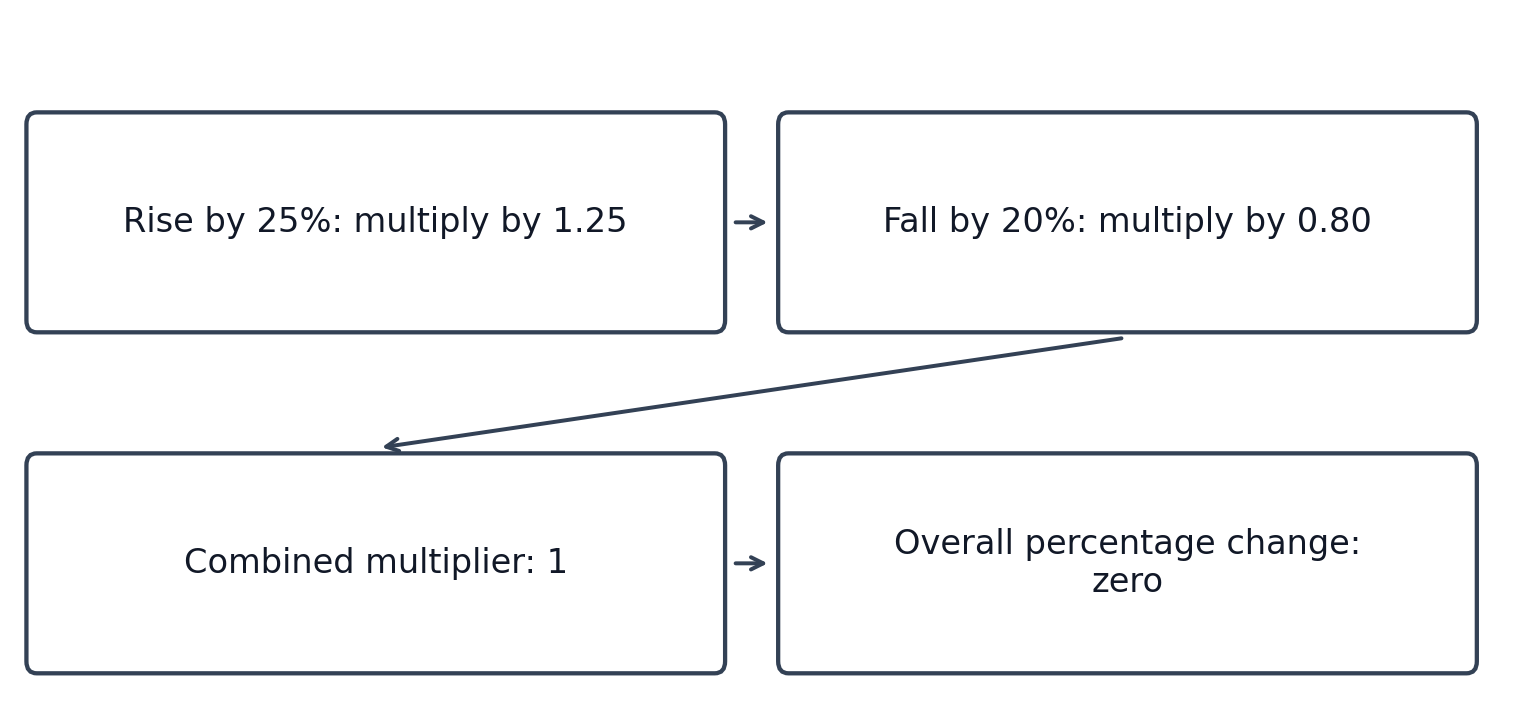
Four linked steps: Rise by 25%: multiply by 1.25; Fall by 20%: multiply by 0.80; Combined multiplier: 1; Overall percentage change: zero
×1.25 then ×0.80 gives ×1, so the overall change is zero
11.6

例题:因式与余数

English
  • $18 = 2 \cdot 3^2$ and $24 = 2^3 \cdot 3$: GCF 6, LCM 72.
  • If $n = 5k + 2$, then $2n$ leaves remainder 4 and $n + 4 = 5k + 6 = 5(k + 1) + 1$ leaves remainder 1.
  • Test with $n = 7$: $2n = 14 = 2 \times 5 + 4$, and $n + 4 = 11 = 2 \times 5 + 1$.
11.7

例题:原创应用

English

Find the greatest common factor and least common multiple of 36 and 60. A price rises 25% then falls 20%. Find its overall percentage change.

Model and reasoning

$36=2^2\cdot3^2$, $60=2^2\cdot3\cdot5$. Shared smaller powers give GCF=12; larger required powers give LCM=180. Their product $12\cdot180=36\cdot60$ checks the result. The price multiplier is $1.25\cdot0.80=1$, so the overall change is zero percent. The two changes use different reference prices; adding +25 and -20 would give a wrong five-percent increase.

11.8

独立迁移

English

An integer n has remainder 5 on division by 8. Find the remainder of $3n+7$ on division by 8, including for negative n. A value rises 10% in one year and 20% the next. What single percentage reduction restores its original value?

Check after attempting

Write $n=8k+5$ for integer k. Then $3n+7=24k+22=8(3k+2)+6$, so the remainder is six for all integer k. The final value is 1.32 times the original. Restoring it multiplies by $1/1.32=25/33$, a reduction of $1-25/33=8/33$, or about 24.24%. A 30% reduction does not reverse compounded growth. The remainder convention uses $0\le r<8$ even when n is negative.

11.9

常见错误

English
  • Taking the larger powers for the GCF.
  • Giving a remainder equal to or greater than the divisor.
  • Adding successive percentages.
  • Assuming a fall and an equal rise cancel out.
  • Treating a part of a ratio as a fraction of the other part.
11.10

关键术语

English

prime factorisation: Writing a number as a product of primes.

greatest common factor: The largest integer that divides each of the numbers.

least common multiple: The smallest positive integer that is a multiple of each of the numbers.

remainder: What is left over after division by a whole number of times.

11.11

自我检测

English
  • Find the GCF of 28 and 42.
  • $n$ leaves remainder 3 when divided by 7. What remainder does $n + 5$ leave?
  • A price rises 10% and then rises 10% again. What is the overall percentage increase?

Answers: 14. $n + 5 = 7k + 8 = 7(k + 1) + 1$: remainder 1. $1.1^2 = 1.21$: 21%.

该知识点的互动课程

逐步完成,配合即时检查练习。

更多 GRE 普通考试 知识点

登录或创建账户

IGCSE, A-Level & AP